Debt Collection Lawsuit 2026: How to Win, File an Answer, and Stop a Default Judgment
Quick Answer
- What this is: A civil lawsuit filed by a creditor or debt buyer trying to collect an unpaid debt through court.
- How much: The amount sued for varies; responding forces the collector to prove the debt is valid and the amount is accurate.
- Deadline: You must file a written answer by the date on your summons, often 20 to 30 days depending on your state.
You got served with court papers for a debt you may not even recognize. The company suing you might be a debt buyer that purchased your old account for pennies on the dollar and now wants a judgment against you. The worst thing you can do is ignore it. A default judgment gives them the power to garnish your wages, freeze your bank account, and put a lien on your property.
This guide covers how to answer a debt collection lawsuit, the defenses that actually work, and why filing a written response is the single most powerful move you can make. One fact that changes everything: debt buyers file thousands of these lawsuits expecting you not to show up. When you do, their case often falls apart.
The Facts
| Case | Individual debt collection lawsuit (no class action) |
|---|---|
| Court | State civil court or small claims court where you live |
| Status | Active lawsuits filed daily; no global settlement |
| Fund Size | Not applicable; plaintiff seeks the alleged debt amount |
| Est. Per Person | Varies; you may owe nothing if the collector cannot prove the debt |
| Claim Deadline | Answer deadline on your summons, typically 20 to 30 days |
| Administrator | Not applicable |
| Proof Needed | Collector must prove you owe the debt, the amount is correct, and they own it |
Key Takeaway: A debt collection lawsuit is not a settlement you can join. It is a case you must defend, and the collector has the burden of proving their claims.
Is a Debt Collection Lawsuit Legit or a Scam?
A debt collection lawsuit is legitimate if you were properly served with court papers, but scam lawsuits and fake debt collectors exist. You should verify that the case is real by checking with your local court clerk. If no case exists, the “lawsuit” is a scam.
Real debt lawsuits come with a summons and complaint filed in a court. The papers tell you which court, the case number, and how long you have to respond. Scammers sometimes call and threaten lawsuits that were never filed, hoping you will pay out of fear.
Under the Fair Debt Collection Practices Act (FDCPA), a debt collector cannot threaten to sue you if they do not intend to file a lawsuit . They also cannot sue you for a debt that is past the statute of limitations . If a collector violates these rules, you may have a claim against them.
How Much Does It Cost to Defend a Debt Collection Lawsuit?
Defending a debt collection lawsuit costs nothing to file an answer on your own, but hiring an attorney costs money depending on the case and your location. Filing fees vary by court, and some courts waive fees for low-income defendants.
The real cost of ignoring a lawsuit is much higher. A default judgment can add interest, court costs, and attorney fees to what you allegedly owe . The collector can then garnish up to 25% of your disposable wages in many states, though federal benefits like Social Security are protected from most garnishment .
Some consumer attorneys take FDCPA cases on contingency. If a collector violated the law, you might recover statutory damages of up to $1,000 plus actual damages and attorney fees. One forum report described a consumer who recovered $4,000 after a collector threatened his credit over a $75 debt .
What Evidence Does a Debt Collector Need to Prove Their Case?
A debt collector must prove you owe the debt, the amount is accurate, and they have the legal right to collect it . If they cannot prove even one of these elements, the case can be dismissed.
For debt buyers, the proof requirements are higher. They must show a chain of title proving the debt was transferred from the original creditor to them . Many debt buyers purchase accounts in bulk with only basic data: your name, a balance, and a generic contract template .
Common evidence problems that weaken their case include:
- Incomplete chain of title: They cannot prove how the debt was transferred to them
- Wrong account information: Names, amounts, or dates don’t match your records
- Generic contracts: They present a sample agreement not tied to your account
- No transaction history: They cannot show how the balance was calculated
Key Takeaway: The collector has the burden of proof. If they cannot document their ownership and the accuracy of the debt, the lawsuit may be dismissed.
Reality Check: What Debt Collectors Hope You Do
Reality Check: Debt collectors file lawsuits expecting you not to respond. When you do not answer, the court enters a default judgment without requiring the collector to prove anything. You lose automatically. Filing a written answer forces them to produce evidence, and a CFPB examination found that one debt buyer dismissed 70% of its cases when consumers filed answers . The system works against you only if you stay silent.
How Do You Win a Debt Collection Lawsuit?
You win a debt collection lawsuit by forcing the collector to prove their case and raising valid defenses in a written answer. Many cases settle or get dismissed before trial because the collector lacks evidence.
The strongest defenses include the statute of limitations, lack of standing, and failure to state a claim. Raising these defenses in your answer preserves them for later.
Here is what a winning approach looks like:
- File a written answer denying the claims and raising defenses
- Demand proof of the debt, ownership, and amount through discovery
- Challenge the chain of title if the plaintiff is a debt buyer
- Raise the statute of limitations if the debt is old
- Consider counterclaims if the collector violated the FDCPA
- Negotiate a settlement if the debt is valid and you want to resolve it
The CFPB reports that debt buyers often dismiss cases when consumers file answers because they cannot locate documentation to support their claims .
How Do You File an Answer to a Debt Lawsuit?
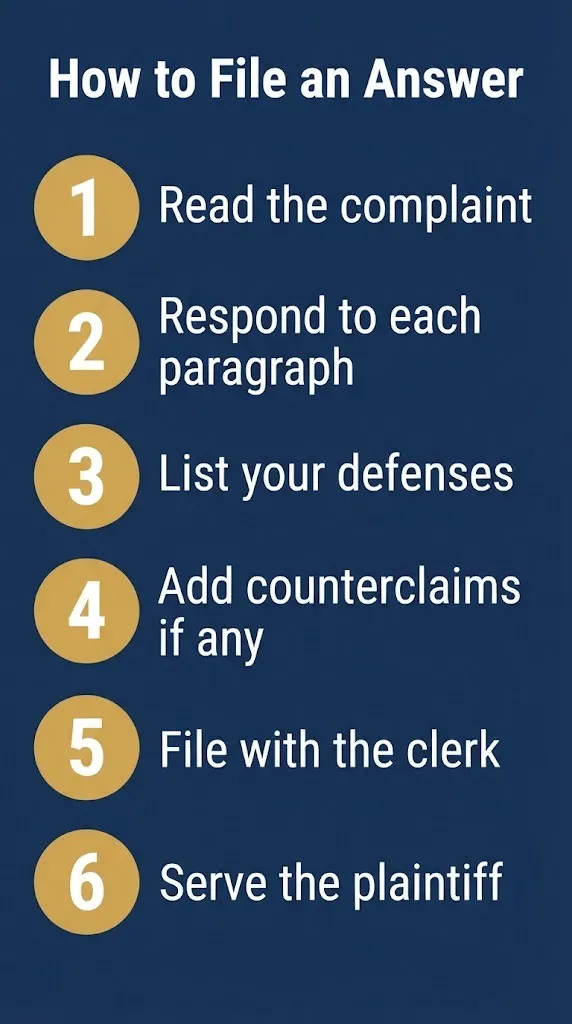
Filing an answer means responding to each numbered paragraph in the complaint and filing it with the court clerk by your deadline. You do not need an attorney to do this, though one can help if the case is complex.
The answer is your opportunity to admit, deny, or state that you lack knowledge about each claim. You can deny claims you dispute, admit claims that are true, and state that you lack sufficient information for the rest .
Here are the steps to file your answer:
- Read the complaint and note each numbered paragraph
- Respond to each paragraph with admit, deny, or lack of knowledge
- List your affirmative defenses (statute of limitations, lack of standing, etc.)
- Include any counterclaims if the collector violated the law
- Sign and file the answer with the court clerk before the deadline
- Serve a copy on the plaintiff’s attorney by mail or as required
- Keep proof of filing and service for your records
What Defenses Can You Raise in a Debt Collection Lawsuit?
Common defenses include statute of limitations, lack of standing, identity theft, and FDCPA violations. Raising these defenses in your answer can lead to dismissal or a favorable settlement.
Statute of limitations is the deadline for filing a lawsuit. If the collector sued you after that deadline, the debt is time-barred and the case should be dismissed. These deadlines range from 3 to 10 years depending on the state and debt type .
Lack of standing means the plaintiff cannot prove they own the debt. Debt buyers must show a valid chain of title from the original creditor to themselves .
FDCPA violations can be both a defense and a counterclaim. If the collector harassed you, made false statements, or sued on a time-barred debt, they may owe you money .
What Happens If You Ignore a Debt Collection Lawsuit?
If you ignore the lawsuit, the court will likely enter a default judgment against you for the amount claimed plus fees and costs. That judgment gives the collector powerful tools to collect.
A default judgment can lead to wage garnishment, bank account levies, and property liens depending on your state’s laws . Federal benefits like Social Security and veterans benefits are generally protected from garnishment for consumer debt .
You have a much better chance of fighting the case before a judgment is entered. Once a judgment exists, it can last for years and be renewed.
What Happens Next: Timeline for a Debt Collection Lawsuit
Days 1 to 30: File your written answer with the court before the deadline on your summons.
Weeks 2 to 8: The plaintiff may respond to your defenses or send discovery requests asking you to admit or deny facts.
Months 2 to 6: Discovery proceeds; either side may file motions for summary judgment.
Months 4 to 12: If no settlement, the case proceeds to trial or arbitration.
If you ignore it: Default judgment entered, collection powers activate, garnishment and liens become possible.
Frequently Asked Questions
Can a debt collector sue me for an old debt?
They can file the lawsuit, but you can raise the statute of limitations as a defense if the deadline passed. If you do not raise it, the court may still award a judgment.
What happens if I don’t answer a debt collection lawsuit?
The court will likely enter a default judgment against you. That judgment allows the collector to garnish wages, freeze bank accounts, and place liens on property.
Do I need a lawyer to answer a debt lawsuit?
No, you can file an answer on your own. Court self-help centers and online resources can guide you through the process.
How do I prove a debt is past the statute of limitations?
The statute of limitations starts from your last payment or account activity. Bank records and credit reports can show the date.
Can I settle a debt after being sued?
Yes, you can negotiate a settlement at any point. Get any agreement in writing before making a payment.
What is a debt buyer and why does it matter?
A debt buyer purchases old debts from original creditors for less than the amount owed. They must prove they own your specific debt to win in court.
Can a debt collector threaten to arrest me?
No, threatening arrest for an unpaid debt is a violation of the FDCPA. Arrest can only happen if you violate a court order.
How do I know if a debt lawsuit is real?
Check with your local court clerk to confirm the case exists and verify the case number. If no case is filed, it may be a scam.