Business Debt Settlement in 2026: What Actually Works, What Costs You More, and What the FTC Is Shutting Down
Quick Answer
- Business debt settlement is a negotiation to pay less than you owe, but no company can guarantee a specific reduction.
- Most debt settlement firms charge 15% to 25% of enrolled debt, and fewer than 10% of consumers complete these programs successfully.
- The FTC filed multiple enforcement actions in 2026 against operations charging illegal upfront fees, including one that took in $100 million.
If you own a small business and the bills are piling up, you have probably seen ads promising to cut your debt by half. Business debt settlement does exist, but the gap between what companies advertise and what actually happens is wide.
A U.S. Senate bill passed in August 2026 would restore higher debt limits for small business bankruptcy, giving struggling owners another option beyond expensive settlement programs .
The FTC has already shut down one major operation this year. In February 2026, the agency obtained a temporary restraining order against a company that took in an estimated $100 million while promising to reduce debts by up to 85% . The FTC says consumers were left deeper in debt.
This article covers what business debt settlement actually is, what it costs, who may qualify, and the enforcement actions reshaping the industry in 2026.
The Facts
| Item | Details |
|---|---|
| What It Is | Negotiating with creditors to accept less than the full balance |
| Typical Fees | 15% to 25% of enrolled debt |
| Success Rate | Fewer than 10% of consumers complete programs successfully |
| Time to First Settlement | Average of 14+ months after enrollment |
| FTC Enforcement | Multiple 2026 actions against illegal advance fees |
| Best For | Businesses already delinquent with no path to full repayment |
| Proof Needed | Documented financial hardship and inability to pay |
Is Business Debt Settlement Legitimate or a Scam?
Business debt settlement is legitimate when a company negotiates directly with your creditors to accept a reduced payoff, but the industry has widespread problems with deceptive practices and illegal fees.
The National Consumer Law Center testified in March 2026 that roughly 3 out of 4 consumers who try debt resolution end up owing more than before they enrolled . That statistic alone should make you pause before signing anything.
Legitimate settlement companies do the following:
- Disclose all fees in writing before you enroll
- Explain that creditors are not obligated to accept any settlement offer
- Tell you that forgiven debt may be taxable income
- Warn you that your credit score will drop
- Never collect fees before a debt is actually settled
The FTC’s Telemarketing Sales Rule prohibits charging advance fees for debt relief services . If a company asks for money before settling any account, that is a red flag.
The National Black Caucus of State Legislators passed a resolution in 2026 urging states to require licensing and audits for debt settlement firms, mandate clear disclosures about tax consequences, and prohibit companies from issuing loans or accepting payment for loan referrals .
Key Takeaway: Debt settlement can work, but the industry has a documented pattern of leaving consumers worse off, and the FTC is actively enforcing against illegal practices.
How Much Does Business Debt Settlement Cost?
Debt settlement companies typically charge 15% to 25% of the total debt you enroll in their program . If you enroll $50,000 in business debt, you could pay $7,500 to $12,500 in fees.
That fee comes on top of whatever you actually pay your creditors to settle. The math often works out like this:
- You owe $50,000
- Settlement company negotiates a 50% reduction, so you pay $25,000 to creditors
- You pay $10,000 in fees to the settlement company
- Your total out-of-pocket is $35,000, not $25,000
You saved $15,000, but the company took 40% of your savings.
The fees compound the problem because they are usually taken from the same dedicated account you are funding with monthly payments. The National Consumer Law Center notes that consumers must often save for 6 months or longer before the first settlement is even attempted .
Cost Comparison
| Debt Amount | Low Fee (15%) | High Fee (25%) |
|---|---|---|
| $20,000 | $3,000 | $5,000 |
| $50,000 | $7,500 | $12,500 |
| $100,000 | $15,000 | $25,000 |
The Federal Trade Commission’s 2010 Debt Relief Services rule addressed advance fees but did not eliminate the structural problems with for-profit debt settlement .
What Happens to Your Credit and Taxes After Settlement?
Your credit score will drop when you enroll in debt settlement, and forgiven debt is generally treated as taxable income by the IRS.
When you stop paying creditors as part of a settlement program, late payments and defaults appear on your credit report. The National Consumer Law Center testified that consumers must endure months of collection calls and sometimes lawsuits before any settlement is attempted .
The tax consequence is often overlooked. If a creditor forgives $20,000 of debt, the IRS may treat that $20,000 as income. You could owe thousands in taxes on money you never actually received.
There is an exception for insolvency. If your liabilities exceeded your assets at the time the debt was forgiven, you may be able to exclude some or all of the forgiven amount from taxable income. But you have to document that.
Some settlement companies negotiate how the debt is reported to credit bureaus as part of the agreement. It does not remove the damage, but it may reduce how long the negative mark stays on your report.
Reality Check: No legitimate debt relief company can promise a specific reduction amount, tell you to stop paying creditors without explaining the consequences, or charge large fees before any work happens . If someone guarantees you a 50% reduction before reviewing your financials, that is not a negotiation, that is a sales pitch.
Who May Qualify for Business Debt Settlement?
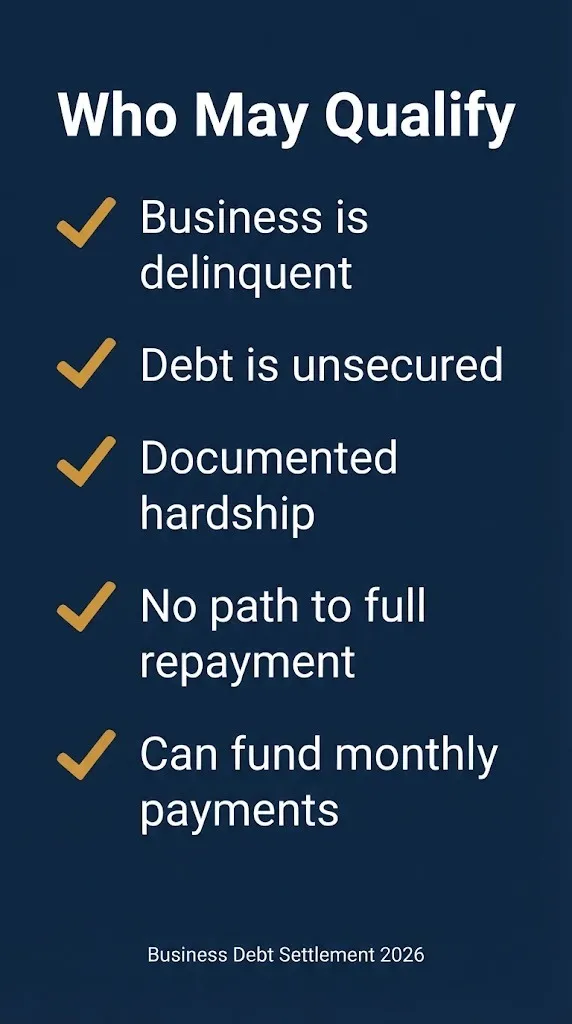
You may qualify for business debt settlement if your business is already delinquent or clearly heading toward default, and you can document that you cannot repay the full balance on any realistic schedule.
Creditors rarely agree to settle accounts that are being paid on time. There is no incentive for them to accept less when they are getting paid .
The profile that fits settlement best:
- The debt is unsecured, such as credit cards or unsecured lines of credit
- You have stopped paying or are about to stop
- You can document your financial hardship
- You can fund a dedicated account with monthly payments
- You understand that settlement will damage your credit and may trigger taxes
Who May Qualify
- Business is delinquent or clearly heading there
- Debt is unsecured (credit cards, unsecured credit lines)
- Documented financial hardship
- No realistic path to full repayment
- Can fund monthly payments into a dedicated account
Secured debts like equipment loans or mortgages are different. The creditor holds collateral and has less reason to negotiate. Merchant cash advances are their own category because daily debits compound the problem quickly .
If your business cannot cover payroll or creditors are already suing, debt settlement may be too slow. Bankruptcy or a formal workout may be the better path.
How Does Business Debt Settlement Compare to Other Options?
Business debt settlement is one of five main routes for reducing what your company owes, and it is usually not the first option you should try .
The severity ladder looks like this:
- Restructuring keeps the full balance but changes the payment schedule. Best if the business is profitable but the payments are crushing you.
- Consolidation replaces multiple debts with one new obligation, ideally at lower cost. Best for healthy businesses with stacked but current debts.
- Settlement negotiates a reduced payoff. Best when the balance itself is unpayable on any schedule.
- Workouts for MCA stacks combine negotiation across multiple funders with a realistic budget. Best when daily debits from merchant cash advances are the core problem.
- Bankruptcy or formal insolvency forces a plan onto creditors who will not agree voluntarily. Best when creditors are suing or the business cannot cover payroll.
A recent New York decision reclassified merchant cash advances as loans, and regulators are scrutinizing MCA structures more closely . If MCAs are your main problem, the legal landscape is shifting in borrowers’ favor.
Key Takeaway: Try restructuring or consolidation first. Settlement is for situations where the balance itself is the problem, not just the schedule.
What Are the Alternatives to For-Profit Debt Settlement?
You can often negotiate directly with your creditors and get the same reduction a settlement company would get, without paying the 15% to 25% fee.
The National Consumer Law Center testified that when a debt adjuster “negotiates,” it often just sends a standardized letter offering the same percentage the creditor would accept from you directly . The adjuster takes a fee for sending a letter you could have sent yourself.
Here is what direct negotiation looks like:
- Gather your financial documents showing hardship
- Contact each creditor’s hardship department
- Explain your situation and what you can realistically pay
- Ask what they can offer to resolve the account
- Get any agreement in writing before paying
You can also contact a nonprofit credit counseling agency. They provide debt management plans at much lower cost than for-profit settlement companies.
The Grassley-Durbin Bankruptcy Threshold Adjustment Act passed the Senate unanimously in August 2026. It would restore the Subchapter V debt limit to $7.5 million, making streamlined small business bankruptcy available to more companies . That is a faster and cheaper path for many owners than a two-year settlement program.
For vendor and supplier debt specifically, you can separate disputed invoices from undisputed ones and negotiate a payment schedule that keeps essential supplies flowing while you resolve the old balance .
What Happens If You Get Sued While in Debt Settlement?
You can still settle after a lawsuit is filed, but you must respond to the lawsuit while negotiating, or you risk a default judgment .
Creditors are motivated to avoid trial costs, so many are willing to settle even after filing. But ignoring the lawsuit while talking to a settlement company is a mistake that can cost you.
The steps to protect yourself:
- Respond to the lawsuit on time. File an answer with the court by the deadline stated in the papers.
- Deny the debt if you do not know it is yours. The creditor must prove you owe it.
- Raise affirmative defenses if you have them. Debt buyer defenses are common when the plaintiff is not the original creditor.
- Negotiate while the case is pending. Settlement discussions and litigation can happen at the same time.
- Get any settlement in writing before you pay, and make sure it includes dismissal of the lawsuit.
If the creditor is a debt buyer like Portfolio Recovery Associates or Midland Funding, they must attach a copy of the contract to the complaint . If they cannot prove they own the debt, that is a defense.
A default judgment gives the creditor power to levy bank accounts and garnish wages. Do not let that happen because you were waiting on a settlement company to handle it.
What Happens Next for Business Debt Settlement in 2026?
August 2026: Senate passed the Bankruptcy Threshold Adjustment Act unanimously, restoring higher debt limits for small business bankruptcy .
Expected late 2026: The House may take up the bankruptcy bill. If passed, Subchapter V becomes available to more small businesses.
Ongoing 2026: The FTC continues enforcement against illegal advance fees and government impersonation in debt relief.
Expected 2027: State legislatures may take up debt settlement reform bills modeled on the National Black Caucus resolution .
Watch for: CFPB enforcement remains limited due to funding cuts, leaving the FTC as the primary federal regulator in this space .
Frequently Asked Questions
Is business debt settlement a scam?
It is legitimate when done honestly, but the industry has widespread problems. The FTC has shut down multiple operations in 2026 for illegal advance fees and deceptive claims.
How much does business debt settlement cost?
Most companies charge 15% to 25% of the debt you enroll. On $50,000 of debt, that is $7,500 to $12,500 in fees, on top of whatever you pay creditors.
Can I settle business debt myself?
Yes. Many businesses negotiate directly with creditors and get the same reductions a settlement company would get, without paying the fee.
Does debt settlement hurt my credit?
Yes. Your score will drop when you stop paying creditors as part of the program, and the damage can last for years.
Will I owe taxes on forgiven business debt?
Possibly. The IRS generally treats forgiven debt as taxable income unless you can prove insolvency at the time the debt was forgiven.
What happens if I get sued while in a settlement program?
You must respond to the lawsuit yourself or through an attorney. Ignoring it can result in a default judgment even if you are negotiating a settlement.
What is the success rate for debt settlement programs?
Fewer than 10% of consumers who enroll successfully complete the programs according to GAO data cited in the NBCSL resolution .
Are there grants to pay off business debt?
No. A 665-program grant catalog found no dedicated grant for paying off existing business debt, and 48 programs explicitly forbid it .
Before you sign with any debt settlement company, do the math on the total cost. Ask for the fee structure in writing. And check whether direct negotiation or bankruptcy gives you a faster, cheaper path. The FTC’s enforcement actions in 2026 show that the gap between what companies promise and what they deliver is still wide.