Oldest Settlement in America in 2026: Separating Verified History From Marketing Spin
Quick Answer
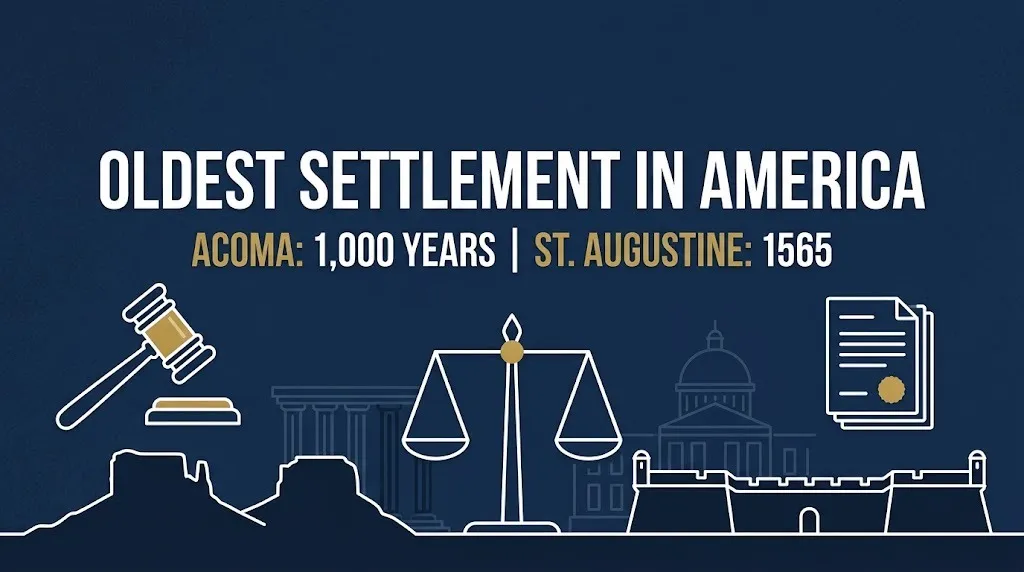
- Oldest Native Settlement: Acoma Sky City, New Mexico, has been continuously inhabited for at least 1,000 years, and tribal records place the community there even longer.
- Oldest European Settlement: St. Augustine, Florida, founded in 1565 by Don Pedro Menéndez de Avilés, is the oldest continuously occupied European-established city in the continental U.S.
- No Legal Deadline: There is no settlement claim, no payout, and no filing deadline. This is a historical fact question, not a lawsuit.
If you’re searching for the “oldest settlement in America,” you’ve likely encountered conflicting claims. Tourism websites promote St. Augustine. History books mention Jamestown and Plymouth. Native American tribal records point to places most Americans have never heard of.
The confusion comes from two different definitions of “settlement.” One refers to Native American communities established centuries before Europeans arrived. The other refers to European colonial towns founded after 1565. Both are legitimate. They just answer different questions.
The historical record is clear on both counts. What’s not clear is why so many sources still get it wrong, often for tourism marketing reasons.
This article separates verified history from promotional spin. It covers the oldest Native settlements, the oldest European towns, the legal battles over ancient remains, and why the question matters beyond trivia.
The Facts
| Category | Verified Answer |
|---|---|
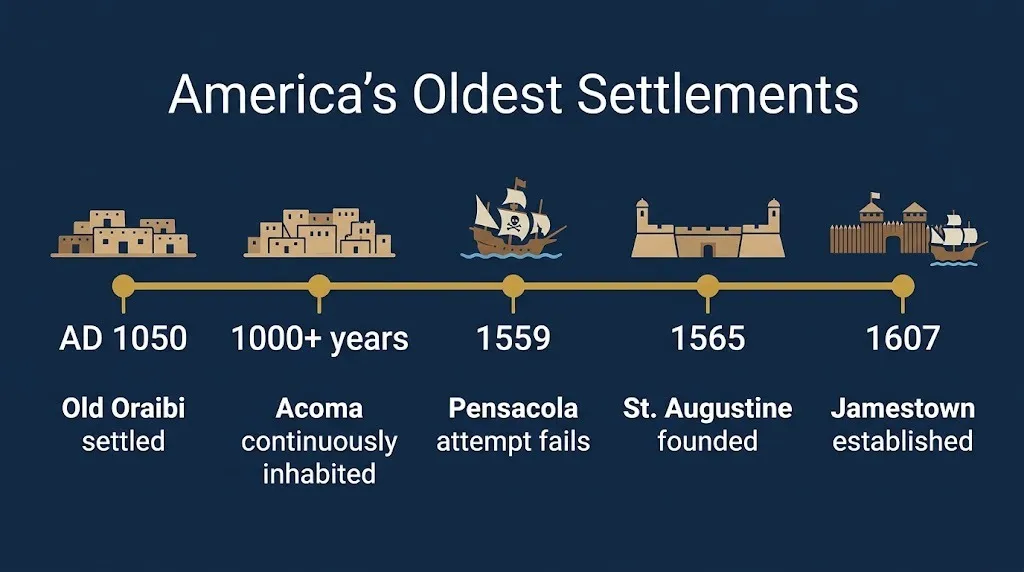
| Oldest Continuously Inhabited Native Settlement | Acoma Sky City, New Mexico (occupied at least 1,000 years) |
| Oldest European Settlement (Established) | St. Augustine, Florida (founded September 8, 1565) |
| Oldest European Settlement Attempt | Pensacola, Florida (1559, abandoned by 1561) |
| Oldest Continuously Inhabited Hopi Village | Oraibi, Arizona (settled around AD 1050) |
| Legal Status | No settlement, no payout, no deadline. Historical fact question only. |
What Is the Oldest Continuously Inhabited Settlement in America?
The oldest continuously inhabited settlement in the United States is Acoma Sky City in New Mexico, where the Acoma people have lived on their mesa-top home for at least 1,000 years.
The Acoma Pueblo sits on a sheer rock mesa about 360 feet above the surrounding basin, roughly 75 miles southwest of Albuquerque . Archaeological evidence, including potsherds found deep beneath the present surface, supports continuous occupation for a millennium or longer.
Governor Fred S. Vallo Sr. of the Pueblo of Acoma testified before Congress that his people “have lived at Acoma Sky City, our mesa-top home, for at least 1000 years, making it the oldest continuously inhabited community in the United States” . He added that traditional Acoma homes “are likely the oldest continuously inhabited homes in the United States.”
The mesa’s natural defenses made it an ideal settlement site. Water collects in natural rock basins. Farmlands lie below. The location provided protection that lowland villages lacked .
Spanish explorers first recorded Acoma in 1540, when Hernando de Alvarado’s expedition encountered the pueblo. By then, it had already been thriving for centuries .
Key Takeaway: Acoma Sky City is the oldest continuously inhabited settlement in the U.S., with at least 1,000 years of verified occupation and tribal records supporting an even longer history.
What Is the Oldest European Settlement in America?
The oldest continuously occupied European settlement in the United States is St. Augustine, Florida, founded on September 8, 1565, by Spanish admiral Don Pedro Menéndez de Avilés.
St. Augustine has been continuously occupied since its founding, making it the oldest European-established city in the continental United States . By the time Jamestown was established in 1607 and the Pilgrims landed at Plymouth in 1620, the founding families of St. Augustine were already having grandchildren .
Menéndez arrived with approximately 800 settlers and made landfall at a Timucuan village near the modern-day Fountain of Youth Archaeological Park. The Timucuan had lived in the area for over 500 years before the Spanish arrived. Their leader, Chief Seloy, met Menéndez, and the Spanish made their first settlement within Seloy’s town, using the existing council house as the first Spanish fort .
Father Francisco López de Mendoza Grajales, St. Augustine’s first pastor, celebrated the landing with the first Mass, followed by what many scholars consider America’s true first Thanksgiving, a shared meal between the Spanish colonists and the Timucuan people .
The city’s 450th anniversary was celebrated in 2015, confirming the 1565 founding date across multiple historical sources .
What Is the Oldest Hopi Village in America?
The oldest continuously inhabited Hopi village in the United States is Old Oraibi, Arizona, settled around AD 1050, making it one of the oldest continuously inhabited communities in North America.
A 1930 National Geographic Society expedition, led by Neil M. Judd and Dr. A.E. Douglas, determined that Oraibi was in existence by 1370. They reached this conclusion after analyzing about 5,000 timbers from ruins, using tree-ring dating to establish chronology . More recent sources place the settlement date around AD 1050 .
Oraibi sits on the Hopi Reservation in northeastern Arizona. It is often mentioned alongside Acoma as one of the oldest continuously inhabited places in the United States. The distinction between “village” and “settlement” is largely semantic. Both communities have maintained continuous occupation for roughly a millennium.
The Hopi people have lived in the region for thousands of years. Oraibi represents the longest continuously occupied site within their traditional homeland.
Key Takeaway: Old Oraibi in Arizona is the oldest continuously inhabited Hopi village, settled around AD 1050, making it one of America’s oldest communities alongside Acoma Sky City.
What Was the First European Settlement Attempt in America?
The first European settlement attempt in what is now the United States was Pensacola, Florida, established in August 1559 by Spanish explorer Tristán de Luna, but the colony failed within two years and was abandoned.
Pensacola’s story is often overshadowed by St. Augustine’s success. Luna arrived with 11 vessels and approximately 1,500 settlers, including African slaves and Mexican Indians. The expedition was charged with establishing a settlement on Pensacola Bay .
Weeks after landing, a powerful hurricane destroyed all but three of Luna’s ships. The settlers struggled for over a year, their numbers and supplies dwindling. By spring 1561, only a military outpost remained. By August, the last soldiers abandoned the site and returned to Mexico .
Spain did not establish another permanent garrison in Pensacola until 1698. The city that exists today dates from that later settlement, not Luna’s failed attempt .
This distinction matters for the “oldest city” debate. St. Augustine is often called the oldest city in the United States because it is the oldest continuously occupied European settlement. Pensacola was attempted earlier, but the settlement failed. Continuity, not priority, is the standard.
Why Do Sources Disagree About the Oldest Settlement?
Sources disagree about the oldest settlement because they use different definitions: Native vs. European, continuously occupied vs. attempted, and city vs. village vs. pueblo.
The confusion is usually deliberate or careless. Tourism boards promote their local history. Textbooks simplify complex timelines. Headlines claim the “oldest city in America” without specifying what that means.
Here are the distinctions that matter:
| Term | What It Means | Example |
|---|---|---|
| Oldest Native settlement | Continuous occupation by Indigenous people | Acoma Sky City, New Mexico |
| Oldest European settlement | Continuous European occupation | St. Augustine, Florida |
| Oldest European attempt | First attempted European colony, even if failed | Pensacola, Florida (1559) |
| Oldest city | Urban settlement with continuous governance | St. Augustine, Florida |
| Oldest village | Small community, often Indigenous | Oraibi, Arizona |
Acoma and St. Augustine are not competing claims. They answer different questions. Acoma predates European contact by centuries. St. Augustine is the oldest European town that survived.
Reality Check: No one is owed money because of the oldest settlement in America. There is no class action, no settlement administrator, and no claim form. If you see an ad offering “settlement compensation” for historical claims, it’s a scam. Historical facts don’t generate payouts.
What Legal Battles Have Involved Ancient American Settlements?
The most significant legal battle over ancient American settlements was the Kennewick Man case, a 9,200-year-old skeleton found in Washington state that triggered a decade-long court fight over Native American remains.
Kennewick Man, called “The Ancient One” by Native tribes, was discovered in 1996 along the Columbia River. Carbon dating placed the remains between 8,340 and 9,200 years old. Eight scientists sued the federal government to block reburial by tribes who claimed him as an ancestor under the Native American Graves Protection and Repatriation Act .
The legal battle lasted over seven years. A federal appeals court ultimately granted scientists the right to study the bones, ruling that the tribes had not clearly shown a relationship to Kennewick Man .
The case crystallized a national debate about who owns ancient human remains. It also highlighted a difficult reality: the archaeological site where Kennewick Man was found had been destroyed. The U.S. Army Corps of Engineers dumped concrete blocks onto the site in 1998, supposedly to protect it from erosion, likely obliterating any remaining archaeological evidence .
Other legal disputes have involved ancient sites in Florida, New Mexico, and Arizona. These cases typically pit tribal sovereignty and cultural rights against scientific research interests.
What Happens Next in the Study of America’s Oldest Settlements?
Expected next steps include continued archaeological research at Acoma, Oraibi, and other ancient sites, plus ongoing legal debates about tribal sovereignty and the protection of sacred places.
Here’s what’s happening in 2026:
- Ongoing: Archaeological research at Acoma and other Pueblo sites continues, with tribal oversight and collaboration.
- Ongoing: The debate over Monte Verde, Chile, once considered the oldest site in the Americas, continues after a 2026 study questioned its dating .
- Expected 2026-2027: New dating techniques may refine timelines for ancient settlements across North America.
- Expected 2027+: Legal frameworks around tribal sovereignty and cultural resource protection will continue to evolve.
For most Americans, the “oldest settlement” question is trivia. For the Acoma and Hopi people, it is identity. The distinction matters.
Frequently Asked Questions
What is the oldest settlement in America?
The oldest continuously inhabited settlement in the United States is Acoma Sky City in New Mexico.
The Acoma people have lived there for at least 1,000 years.
St. Augustine, Florida, is the oldest continuously occupied European settlement.
Is St. Augustine or Jamestown older?
St. Augustine is older. It was founded in 1565.
Jamestown was established in 1607, 42 years later.
St. Augustine is the oldest continuously occupied European city in the continental U.S.
What is the oldest city in the United States?
St. Augustine, Florida, is the oldest European-established city in the United States.
It was founded on September 8, 1565.
Acoma Sky City is the oldest continuously inhabited Native settlement.
Is Acoma Sky City older than St. Augustine?
Yes. Acoma Sky City has been continuously inhabited for at least 1,000 years.
St. Augustine was founded in 1565, about 460 years ago.
Acoma predates European contact by centuries.
What was the first European settlement in America?
The first European settlement attempt was Pensacola, Florida, in 1559.
The colony failed and was abandoned by 1561.
St. Augustine, founded in 1565, was the first to survive.
What is the oldest Hopi village?
Old Oraibi, Arizona, is the oldest continuously inhabited Hopi village.
It was settled around AD 1050.
It is one of the oldest communities in North America.
Is there a settlement payout for the oldest settlement in America?
No. There is no settlement payout, claim form, or deadline.
This is a historical fact question, not a legal claim.
Any ad offering money for “historical settlement claims” is a scam.
Why is St. Augustine called the oldest city?
St. Augustine is called the oldest city because it is the oldest continuously occupied European-established city in the continental U.S.
It was founded in 1565 and has been occupied ever since.
Acoma is older but is classified as a pueblo, not a European city.
The “oldest settlement in America” question has two correct answers, depending on what you mean. Acoma Sky City is the oldest continuously inhabited Native settlement. St. Augustine is the oldest continuously occupied European city.
The most important fact to remember: there is no legal claim, no payout, and no deadline. This is history, not litigation. If you see an ad claiming otherwise, close the tab.