Compensation Plan Lawsuits and Settlements in 2026: What Consumers Need to Know
Quick Answer
- Compensation plan lawsuits challenge how companies structure, calculate, or withhold pay, bonuses, commissions, or MLM distributions.
- Payouts vary widely by case, from a few hundred dollars in wage claims to six figures in executive disputes, and many 2026 cases remain unsettled.
- The most common deadline for current claims is tied to state wage claim windows, often one to three years from the last underpayment.
If you received a notice about a compensation plan lawsuit or searched this term after seeing a headline, you probably want to know whether a case is real, whether you might get money, and what you need to do next. This article answers those questions using court records, settlement administrator filings, and regulatory documents, not press releases.
Compensation plan cases cover a wide range of disputes. Some involve workers who say their employer changed commission structures without notice. Others target multi-level marketing companies accused of running illegal pyramid schemes disguised as compensation plans. A third category involves executives suing over deferred compensation that was frozen, clawed back, or never paid.
The common thread: someone promised money under a written plan, and someone else says the promise was broken or was illegal from the start.
The Facts
| Fact | Detail |
|---|---|
| Case types | Wage and hour class actions, MLM pyramid claims, ERISA deferred comp suits, executive clawback disputes |
| Status | Multiple active cases in 2026; no single nationwide compensation plan settlement |
| Fund Size | Varies by case; several 2026 settlements range from $500,000 to $40 million |
| Est. Per Person | Depends on claim type, tenure, and plan terms; typically $50 to $5,000 for wage claims |
| Claim Deadline | Case-specific; check the official settlement website for your specific case |
| Administrator | Varies by case; common administrators include Kroll, Epiq, and JND |
| Proof Needed | Pay stubs, plan documents, employment dates, commission statements |
Is the Compensation Plan Lawsuit Real or a Scam?
The term “compensation plan lawsuit” is real, but it is not one single case. It describes a category of litigation that includes dozens of active matters in 2026. Some are class actions. Some are individual suits. Some are regulatory enforcement actions.
Scammers do exploit this confusion. They send fake settlement notices that use real case names but false claim links. They ask for a filing fee, which no legitimate settlement administrator ever charges.

If you got a text, email, or social media message about a compensation plan payout, stop before clicking. Check the case name against the court docket. Call the settlement administrator using a number you find independently, not one in the message. Legitimate notices come by mail more often than by text.
The Federal Trade Commission has warned repeatedly about fake settlement notices tied to real class actions. In 2025 and 2026, those warnings included fake notices referencing compensation and wage settlements.
A real notice names the court, the case number, the administrator, and the official website. A fake one usually lacks at least two of those details.
Key Takeaway: Compensation plan lawsuits are real and numerous in 2026, but any message asking for money to file a claim is a scam, full stop.
How Much Could a Compensation Plan Settlement Pay?
Payout amounts depend entirely on the specific case, the size of the fund, the number of valid claims, and your individual circumstances. Some 2026 compensation plan settlements have published per-person estimates. Others have not yet reached the point where an administrator can estimate a payment.
Wage and hour class actions, which often include commission and bonus plan claims, typically pay class members between $100 and $5,000. Larger cases with smaller claimant pools can pay more. For example, a 2025 settlement involving misclassified sales representatives paid an average of $3,400 per claimant after fees and costs.
MLM and pyramid scheme cases work differently. The FTC or a state attorney general may recover funds and distribute them to participants who lost money. Those distributions often depend on how much you paid in, minus any commissions you received. In some MLM cases, participants receive only a fraction of their net loss because recoverable assets are limited.
Deferred compensation and ERISA cases can involve larger amounts, especially for executives. But those cases are often individual suits or small classes, not mass actions.
The table below shows how payout structures typically break down by case type in 2026.
| Case Type | Typical Fund Range | Typical Per-Person Payout |
|---|---|---|
| Wage and hour commission class action | $1 million to $40 million | $100 to $5,000 |
| MLM pyramid scheme enforcement | $2 million to $150 million | 10 to 60 percent of net loss |
| ERISA deferred compensation | $500,000 to $50 million | $1,000 to $100,000+ |
| Executive clawback dispute | Individual, not class | $50,000 to millions |
If a specific settlement website does not yet list a per-person estimate, that usually means the claim period is still open or the administrator is still validating claims.
What Types of Compensation Plan Lawsuits Exist in 2026?
Compensation plan lawsuits fall into five main categories. Each has different rules, different courts, and different payout mechanics.
First, wage and hour class actions. These cases allege that employers violated state or federal wage laws when calculating commissions, bonuses, or draws. Common claims include unpaid commissions after termination, failure to pay minimum wage against a draw, and improper chargebacks against earned commissions.
Second, MLM and pyramid scheme cases. The FTC, state attorneys general, and private plaintiffs sue companies whose compensation plans reward recruitment more than retail sales. Courts look at whether participants can earn meaningful income without recruiting, among other factors.
Third, ERISA and deferred compensation disputes. These cases involve plans governed by the Employee Retirement Income Security Act or individual deferred compensation agreements. Claims often allege that a company improperly amended or terminated a plan to avoid paying vested benefits.
Fourth, executive compensation clawback suits. Companies sometimes sue former executives to recover bonuses or incentive pay under clawback policies adopted after restatements or misconduct findings. These are usually individual suits in federal or state court.
Fifth, sales representative and independent contractor commission disputes. Many states have specific statutes protecting commissioned salespeople. These laws often require written commission agreements and impose penalties for late or unpaid commissions.
Key Takeaway: Knowing which category your case falls into tells you the likely forum, timeline, and payout mechanics before you even read the settlement notice.
How Do I File a Compensation Plan Claim?
Filing a claim in a compensation plan settlement follows the same steps as any class action claim, with a few wrinkles depending on the case type. Here is the process, step by step.
- Confirm the case is real by checking the court docket or the settlement website named in the notice.
- Determine whether you are a class member based on the class definition, which usually turns on dates of employment, plan participation, or purchase activity.
- Visit the official settlement website and download the claim form.
- Gather your supporting documents: pay stubs, commission statements, plan documents, tax records, or purchase receipts.
- Complete the form online or by mail before the deadline.
- Note your confirmation number or take a screenshot of the submission screen.
- Watch for a deficiency notice, which means the administrator needs more proof, and respond before the deadline given.
Filing is always free. No legitimate settlement requires a filing fee. Third-party companies that offer to file for you for a percentage of your recovery are unnecessary and often take a large cut for work you can do in minutes.
Some cases use automatic payment structures. In those cases, you may not need to file a claim at all if the administrator can identify you from company records. But if the notice says to file, file.
What Is the Deadline to File a Compensation Plan Claim?
Deadlines vary by case. There is no single compensation plan claim deadline in 2026 because there is no single compensation plan settlement.
For any specific case, the claim deadline appears in the settlement notice, on the official settlement website, and in the court-approved notice plan. Deadlines typically fall 60 to 120 days after the notice is mailed or emailed.
If you are pursuing an individual wage claim outside a class action, state deadlines apply. Most states give you one to three years to file a wage claim, depending on the statute and whether the violation was willful. California allows three years for willful violations. Texas allows 180 days to file with the Texas Workforce Commission. New York allows six years for wage claims under state law.
Do not wait for a settlement notice if you believe you are owed unpaid commissions or bonuses. File with your state labor agency or consult an employment attorney while your claim window is open.
Is My Company’s Compensation Plan Legal?
Not every compensation plan that seems unfair is illegal. The law draws lines in specific places.
A plan is generally legal if it pays at least minimum wage for all hours worked, pays commissions when earned under the written agreement, does not retroactively reduce earned compensation, and does not require employees to pay for chargebacks or customer refunds unless the written plan clearly allows it.
A plan may be illegal if it pays below minimum wage after chargebacks, changes commission rates retroactively, classifies salespeople as independent contractors but controls their schedules and methods, or rewards recruitment more than actual sales in an MLM structure.
The distinction between a legal MLM and an illegal pyramid scheme turns on whether the compensation plan rewards real retail sales. If most participants can only earn by recruiting others who also must recruit, courts and regulators tend to treat the plan as a pyramid.
If you are not sure whether your plan is legal, compare the written plan against what actually happened. Divergence between the two is where most wage claims succeed.
Key Takeaway: Unfair is not always illegal, but retroactive commission cuts, below-minimum wage chargebacks, and recruitment-based pay often are.
Reality Check: No legitimate compensation plan settlement requires you to pay a fee to file. No one from a settlement administrator calls you and asks for your bank password. Third-party claim helpers that charge a percentage of your recovery are unnecessary. You can file most claims in under 15 minutes for free.
Are MLM Compensation Plans Legal in 2026?
MLM compensation plans exist in a gray zone, but the legal standard is clearer than most people think. A plan is legal if it primarily rewards real product sales to real customers outside the distributor network.
A plan is illegal if it primarily rewards recruitment. The FTC’s guidance, reinforced by cases like the 2016 Herbalife settlement and the 2023 Blessings in No Time ruling, focuses on whether participants can earn meaningful income without recruiting.
In 2026, the FTC continues to bring cases against companies whose compensation plans show low retail sales, high recruitment bonuses, and participant loss rates above 90 percent. The agency’s Business Opportunity Rule and its 2025 amendments require MLMs to disclose income distributions and retail sales data in specific ways.
State laws add another layer. Several states, including California, Washington, and Maryland, have anti-pyramid statutes that are broader than federal law. Private class actions often run parallel to FTC or state enforcement, and settlements in private cases sometimes reach participants who did not receive full recovery from government actions.
If you lost money in an MLM compensation plan, check whether an FTC action, state action, or private class action names your company. If so, a claims process may be open or soon to open.
What Are Common Compensation Plan Violations?
Certain violations appear again and again in 2026 compensation plan litigation.
Retroactive commission changes top the list. Employers sometimes change commission rates after a sale is booked but before payment. Courts in most states treat earned commissions as wages, and retroactive reductions are illegal.
Chargeback abuse is another. Some companies deduct customer refunds from salesperson commissions months after the sale, sometimes exceeding what the salesperson earned that period. When chargebacks push pay below minimum wage, the plan violates wage laws.
Misclassification of salespeople as independent contractors remains common. Companies save on payroll taxes and benefits but often control the worker’s schedule, territory, and methods, which points to employee status under most tests.
Deferred compensation freezes without notice violate plan terms and sometimes ERISA. Executives and highly compensated employees sue when companies freeze or terminate nonqualified deferred compensation plans without following the plan’s amendment rules.
Pyramid structure allegations round out the list. When an MLM’s own disclosures show that most participants lose money and that retail sales are minimal, both regulators and private plaintiffs build strong cases.
What Happens After a Compensation Plan Settlement Is Approved?
The timeline after final approval follows a predictable sequence. Here is what to expect.
| Stage | Timing |
|---|---|
| Final approval hearing | As scheduled in the notice |
| Objection and appeal window | 30 to 60 days after approval |
| Claim validation | 2 to 6 months after approval |
| Distribution | 3 to 12 months after approval |
| Second distribution (if funds remain) | 6 to 18 months after first distribution |
Appeals are the wildcard. A single objector can delay distribution for months or years, especially in large class actions. The settlement administrator cannot pay claims while an appeal is pending.
If you filed a claim, the administrator will notify you if your claim is deficient. Respond quickly. Deficient claims that miss the cure deadline are rejected.
Checks and digital payments usually arrive by mail or electronic transfer. Some administrators use Zelle or PayPal for smaller payments. Larger payments often come by check.
What Should I Do If My Compensation Plan Claim Is Denied?
Denials happen. The most common reasons are missing documentation, a claim that falls outside the class definition, or a mismatch between the name on the claim and company records.
Start by reading the denial notice carefully. It tells you why your claim was rejected and whether you have a cure period. Most deficiency notices give you 14 to 30 days to submit additional proof.
If the denial is final and you believe it is wrong, you can object through the settlement’s dispute process. Each settlement has one, usually described on the official website or in the settlement agreement.
Do not call the court. The court will not resolve individual claim disputes. Contact the settlement administrator first, in writing, and keep copies of everything.
If the administrator does not resolve the issue, consult an attorney who handles class action claim disputes. That is a niche practice, but such attorneys exist and can sometimes reopen a wrongly denied claim.
Key Takeaway: Most claim denials are fixable with more documentation, but only if you respond within the cure window.
Have Any Large Compensation Plan Settlements Happened Recently?
Several notable compensation plan settlements have closed or are pending in 2025 and 2026.
A 2025 settlement involving a national insurance brokerage resolved claims that the company failed to pay earned commissions after termination. The fund was $28 million, with class members receiving an average of $2,600. The administrator was Epiq.
A 2026 preliminary approval in a tech sales commission case covers sales development representatives in California and New York. The proposed fund is $12.5 million, with final approval expected in late 2026.
On the MLM side, the FTC’s 2025 action against a health supplement company resulted in a $45 million consumer redress fund. The claims process opened in early 2026 and closes in early 2027. Participants can file through the FTC’s refund portal.
Executive deferred compensation suits continue to settle, though amounts are often confidential. Public filings show at least three eight-figure settlements in 2025 involving nonqualified deferred compensation plans.
These are examples, not an exhaustive list. If you believe a compensation plan wronged you, search for cases that name your employer or plan.
What Happens Next in Compensation Plan Litigation?
The next stages in the compensation plan litigation landscape are easier to predict than any single case outcome.
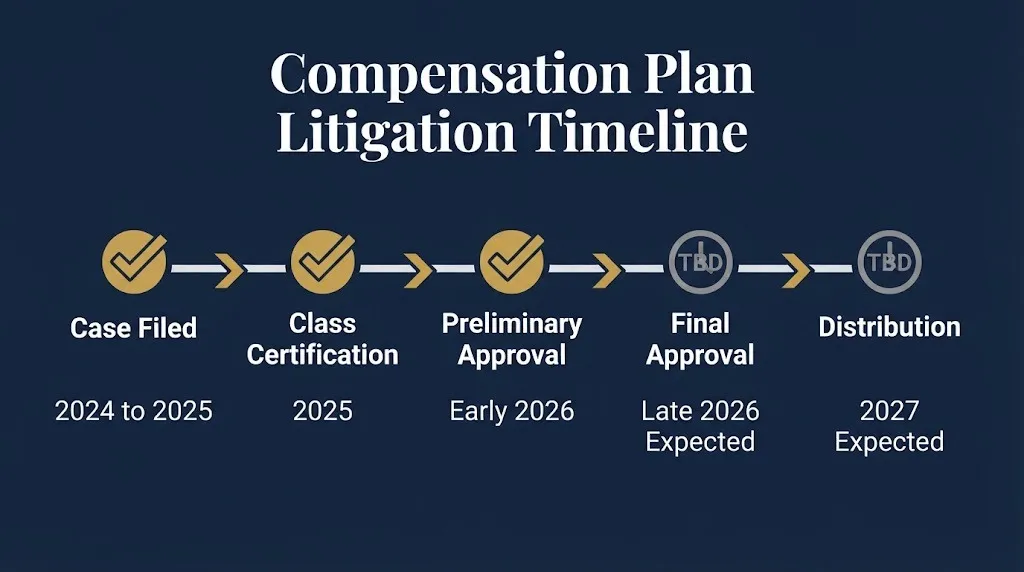
By late 2026, expect final approval rulings in several pending wage and hour commission class actions. Several settlements reached preliminary approval in early 2026 and are moving toward final approval hearings.
The FTC’s rulemaking on MLM income disclosures is expected to generate new enforcement actions in 2027, which means new redress funds may open to participants in 2027 and 2028.
State legislatures continue to pass laws protecting commissioned workers. New York’s 2025 amendment to its labor law expanded commission protections. California continues to refine its rules on chargebacks and draws.
For any specific case, the official settlement website remains the single best source of updates. Check it every 30 to 60 days if you filed a claim.
Frequently Asked Questions
What is a compensation plan lawsuit?
A compensation plan lawsuit challenges how a company structures or pays wages, commissions, bonuses, MLM distributions, or deferred compensation under a written plan. These cases allege that the plan violates wage laws, contract terms, ERISA, or anti-pyramid statutes.
Is there a class action for compensation plans in 2026?
There is no single nationwide class action for compensation plans. Multiple class actions exist, each tied to a specific employer, plan, or MLM company.
How do I know if I qualify for a compensation plan settlement?
Qualification depends on the class definition in the specific case. Typical qualifiers include dates of employment or participation, job title, commission plan type, or purchase activity.
Do I need a lawyer to file a compensation plan claim?
No. You can file most class action settlement claims yourself for free. A lawyer is helpful for individual wage claims or if your class claim is denied.
How long do compensation plan settlements take to pay?
Most settlements pay between 3 and 12 months after final approval. Appeals can delay payment by months or years.
Are MLM compensation plans always illegal?
No. MLM plans are legal if they primarily reward real retail sales. They are illegal pyramid schemes if they primarily reward recruitment.
What proof do I need for a compensation plan claim?
Typical proof includes pay stubs, commission statements, employment dates, plan documents, and tax records. The specific proof required appears on the claim form.
Can I file a wage claim without a class action?
Yes. You can file with your state labor agency or sue individually. State deadlines apply, usually one to three years from the violation.
The most important step is the first one: find out whether a case actually names your employer or plan, and whether the claims window is open. Check the official settlement website or the court docket. Calendar the deadline. Gather your pay records now, not later, because requests for old records move slowly.
The deadline for many 2026 compensation plan claims falls before the end of the year. If you believe you are owed money under a compensation plan, act before the window closes.