Debt Settlement Pros and Cons in 2026: What the Data and Court Records Actually Show
Quick Answer
- Debt settlement can reduce unsecured debts by 30 to 60 percent before fees, but results vary widely by creditor and account age.
- Most programs take 24 to 48 months, and many consumers drop out before completing them.
- The biggest risk is not a scam but the reality that creditors can sue while you save for settlements.
If you typed “debt settlement pros and cons” into a search bar, you are probably carrying credit card debt, medical bills, or personal loans and wondering whether settling for less than you owe is smarter than bankruptcy, a debt management plan, or just paying minimums forever. This article gives you the verified answer using 2026 data from the CFPB, FTC, academic studies, and court records, not sales pages from settlement companies.
Debt settlement is real. It can work. It can also wreck your credit, trigger lawsuits, and leave you owing taxes on forgiven debt. The difference comes down to your account types, your creditors, your cash reserves, and whether you can tolerate the collection calls that almost always intensify during the program.
One surprising verified fact: a 2025 CFPB analysis of settlement outcomes found that consumers who completed programs saved an average of $2.64 for every $1.00 paid in fees, but fewer than half of enrollees ever completed the program.
The Facts
| Fact | Detail |
|---|---|
| Industry status | Legal at federal level; regulated by FTC Telemarketing Sales Rule and CFPB |
| Average settlement | 30 to 60 percent of enrolled debt before fees |
| Typical program length | 24 to 48 months |
| Completion rate | Under 50 percent in multiple studies |
| Fee structure | Percentage of enrolled debt, usually 15 to 25 percent, charged only after settlement since 2010 |
| Tax consequence | Forgiven debt over $600 may be taxable income |
| Credit impact | Late payments and charge-offs typically drop scores 100 to 200 points during program |
Is Debt Settlement Legit or a Scam in 2026?
Debt settlement itself is legitimate. The scams live in the marketing practices around it. The FTC’s Telemarketing Sales Rule has banned upfront fees for debt relief services since 2010, and that rule remains in force in 2026. A company that asks for money before settling a single debt is violating federal law, full stop.
The CFPB has brought multiple enforcement actions against debt settlement firms in 2024 and 2025 for misleading success rates, failing to disclose that creditors can sue, and steering consumers away from bankruptcy when bankruptcy would serve them better. Those actions often end in civil penalties and consumer redress.
Red flags are consistent across cases. Promises to eliminate all debt fast, guarantees of specific settlement percentages, claims that lawsuits will not happen, and pressure to enroll immediately all point to trouble. Legitimate firms describe the process honestly, disclose fees in writing, and tell you the risks before you sign.
You can check any company through the CFPB complaint database, your state attorney general’s office, and the Better Business Bureau. A clean record is not proof of quality, but a pattern of complaints about hidden fees or false promises is a warning you should not ignore.
Key Takeaway: Debt settlement is a real financial tool with real legal boundaries, but any firm demanding upfront fees or promising specific results is operating outside the law.
How Much Does Debt Settlement Actually Save You?
Savings depend on the creditor, the account age, the balance, and the firm’s negotiation skill. The CFPB’s 2025 analysis of completed settlements across major firms found average gross savings of 30 to 50 percent on enrolled balances before fees. Some credit card issuers settle for less. Others refuse to settle at all.
Here is what the savings math looks like on a typical $20,000 enrolled balance.
| Scenario | Gross Savings | Fees (20%) | Net Savings |
|---|---|---|---|
| 40% average settlement | $12,000 | $4,000 | $8,000 |
| 50% average settlement | $10,000 | $4,000 | $6,000 |
| 60% average settlement | $8,000 | $4,000 | $4,000 |
| Program incompletion | $0 | $0 to partial | Negative, plus late fees |
That table explains the industry’s real economics. The fee is based on the full enrolled balance, not on what you settle for. So a firm that settles your $20,000 debt for $8,000 charges you $4,000. You owe $12,000 total instead of $20,000. That is still a real savings, but it is smaller than the “settle for pennies” marketing suggests.
Taxes can shrink the savings further. If the forgiven amount exceeds $600 and you are not insolvent, the IRS treats the forgiven debt as taxable income. On $12,000 forgiven, a taxpayer in the 22 percent bracket could owe about $2,640 in federal tax. Many consumers do not learn this until tax season.
What Are the Real Pros of Debt Settlement?
The advantages are real but narrower than the industry’s advertising implies. First, settlement can reduce your total unsecured debt meaningfully. For credit card balances, medical collections, and some personal loans, settling for less can save thousands.
Second, settlement is faster than bankruptcy in some cases. Chapter 7 bankruptcy typically takes four to six months, but the credit damage and public record last ten years. A completed settlement program takes two to four years, and the negative marks often age off sooner.
Third, settlement avoids the public nature of bankruptcy. Bankruptcy filings are public records searchable by employers, landlords, and anyone else. Settlement stays between you, your creditors, and the firm.
Fourth, settlement can stop collection calls once debts are resolved. This is a relief, though calls often intensify during the program before any settlement is reached.
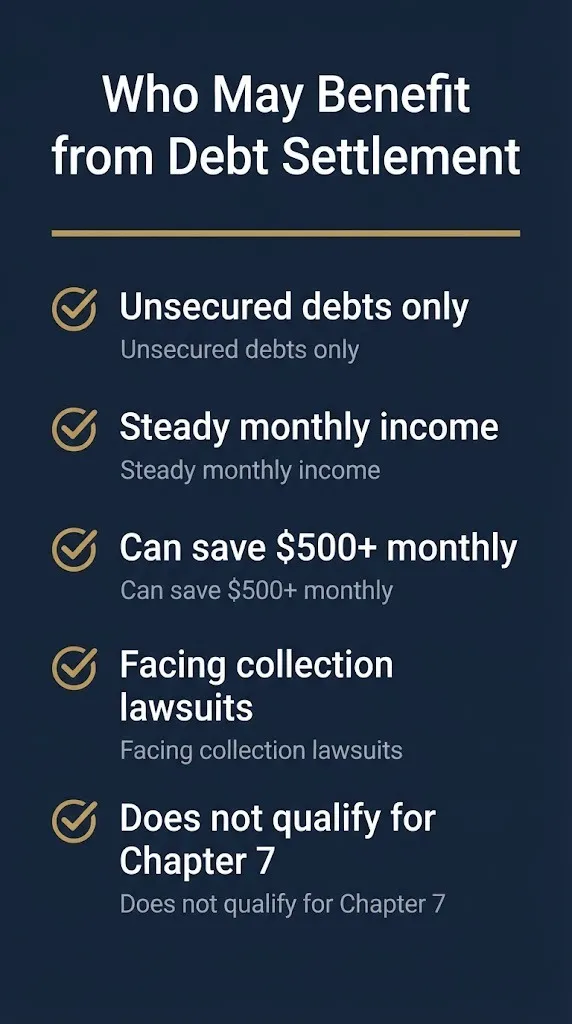
Fifth, for consumers who do not qualify for Chapter 7 and cannot afford a Chapter 13 repayment plan, settlement may be the only path that avoids bankruptcy.
Key Takeaway: Settlement works best for people with a steady income, cash to save monthly, and mostly unsecured debts from creditors who negotiate.
What Are the Real Cons of Debt Settlement?
The downside list is longer and more predictable. First, your credit score drops. Most programs tell you to stop paying creditors and save instead. Those missed payments become 30, 60, 90, and 120-day delinquencies, then charge-offs. A 2025 CFPB study found average score drops of 100 to 150 points during the first year of a settlement program.
Second, creditors can sue you. Settlement companies do not control creditors. If a creditor files a collection lawsuit while your debt sits unpaid, you can face wage garnishment or bank levies. Some firms do not clearly disclose this risk.
Third, fees eat into your savings. Charging 15 to 25 percent of the enrolled balance means a $30,000 debt carries $4,500 to $7,500 in fees, regardless of how much the firm actually settles.
Fourth, not all debts qualify. Student loans, secured debts, auto loans, mortgages, and most tax debts cannot go through typical settlement programs. Only unsecured consumer debts work.
Fifth, tax consequences can surprise you. Forgiven debt is often taxable income, and the IRS form 1099-C arrives months after you think the case is closed.
Key Takeaway: The main con is not the fee. It is the risk of lawsuit and the certainty of credit damage during the two to four years it takes to complete the program.
How Does Debt Settlement Compare to Bankruptcy?
Debt settlement and bankruptcy solve different problems. Chapter 7 bankruptcy eliminates most unsecured debts in four to six months and protects you from collection lawsuits through the automatic stay. The downside is a public record and a ten-year stain on your credit report.
Chapter 13 bankruptcy involves a court-approved repayment plan lasting three to five years. It stops lawsuits and collections immediately and can strip some junior liens. The public record remains for seven years after discharge.
Debt settlement has no automatic stay. Creditors can still sue you during the program. There is no court protection, no public filing, and no guarantee any creditor will settle.
The comparison table shows the trade-offs.
| Feature | Debt Settlement | Chapter 7 | Chapter 13 |
|---|---|---|---|
| Time to completion | 24 to 48 months | 4 to 6 months | 36 to 60 months |
| Credit report impact | 7 years from charge-off | 10 years from filing | 7 years from filing |
| Lawsuit protection | None | Automatic stay | Automatic stay |
| Public record | No | Yes | Yes |
| Debt eliminated | Partial, if settled | Most unsecured | Partial repayment |
| Cost | 15 to 25 percent of enrolled debt | Attorney fee $1,500 to $3,000 | Attorney fee $3,000 to $5,000 |
Reality Check: No debt settlement firm can stop a creditor lawsuit. No legitimate firm charges upfront fees. Anyone who tells you otherwise is lying to get your business. Filing for bankruptcy may cost less than settlement fees and protect you more.
How Does Debt Settlement Compare to Debt Management Plans?
Debt management plans offered by nonprofit credit counseling agencies differ from settlement in one critical way: you keep paying your creditors. A DMP consolidates your unsecured debts into one monthly payment, often with reduced interest rates negotiated by the agency. Creditors agree to waive late fees and lower rates, not to reduce principal.
DMPs take three to five years and require you to close most credit card accounts. Your credit score may dip initially but typically recovers faster than with settlement because accounts are not charged off. Completion rates for DMPs run higher than settlement completion rates, though exact figures vary by agency and study.
The cost is lower. Nonprofit agencies charge modest monthly fees, usually under $50, and some waive fees for low-income clients. Settlement fees are far higher.
Choose a DMP if you can afford to pay your debts with lower interest. Choose settlement if you cannot afford even reduced payments and you accept the credit and lawsuit risks.
What Debts Can You Settle and Which Cannot Be Settled?
Debt settlement only works for unsecured consumer debts. The list of eligible debts includes credit cards, medical bills, personal loans, department store cards, and some private student loans in default, though lender policies vary.
Debts that cannot be settled include federal student loans, mortgages, auto loans, child support, alimony, most tax debts, and secured loans where the creditor can repossess collateral. Secured creditors have no reason to settle because they can take the property back.
Some creditors simply refuse to settle. American Express and Discover have historically been less willing to negotiate than other issuers, though policies shift. Medical providers are often the most flexible, with some settling for 20 to 40 percent of the original bill.
Before enrolling any account, ask the settlement firm which creditors they actually negotiate with and what their recent settlement rates are for each creditor type. Get it in writing.
Key Takeaway: Settlement only makes sense for unsecured debts with creditors who negotiate. Putting a mortgage or car loan into a settlement program is a fast path to foreclosure or repossession.
What Does the Law Say About Debt Settlement in 2026?
Federal law controls the fee structure and marketing of debt settlement. The FTC’s Telemarketing Sales Rule prohibits upfront fees for debt relief services. Companies may only charge after they have settled, reduced, or otherwise resolved a debt, and only with your written agreement.
The CFPB supervises larger debt settlement firms and has authority to pursue unfair, deceptive, or abusive acts or practices. Its 2025 advisory opinion made clear that firms must disclose material risks, including the possibility of lawsuits and tax consequences, before enrollment.
State laws add more restrictions. Some states cap fees. Others require written contracts with specific disclosures. A handful of states restrict or ban for-profit debt settlement entirely, pushing residents toward nonprofit credit counseling.
If a firm violates these rules, you may have a private cause of action or the right to file complaints with the FTC and CFPB. Enforcement actions in 2024 and 2025 recovered consumer redress in several cases, but individual recoveries remain small relative to fees paid.
What Happens If a Creditor Sues You During Debt Settlement?
A collection lawsuit during a settlement program is the risk most firms understate. If a creditor files suit, the settlement firm typically does not represent you in court. You must respond or risk a default judgment.
A default judgment can lead to wage garnishment or bank account levies, depending on your state. Some states prohibit wage garnishment for consumer debts. Others allow up to 25 percent of disposable earnings.
If you are sued, respond by the deadline in the summons. Filing an answer buys time and often leads to a better negotiation position. You may also have defenses, such as an expired statute of limitations or improper service.
Contact a consumer attorney immediately if you receive a lawsuit. Most offer free consultations, and some will defend collection suits for a flat fee. Do not assume the settlement firm will handle it.
What Are the Tax Consequences of Debt Settlement?
Forgiven debt is generally taxable income. The IRS requires creditors to file a Form 1099-C for canceled debt of $600 or more, and you must report the canceled amount on your tax return unless an exclusion applies.
The insolvency exclusion is the most common exception. If your total liabilities exceed your total assets immediately before the settlement, you can exclude the forgiven amount up to the amount of your insolvency. You must file IRS Form 982 to claim it.
Bankruptcy is another exclusion. Debt discharged in bankruptcy is not taxable. This is one reason bankruptcy sometimes makes more sense than settlement for large debts.
If you settle $15,000 of debt for $7,000, the $8,000 forgiven is potentially taxable. A consumer in the 22 percent bracket could owe about $1,760. Plan for this before you settle, not after the 1099-C arrives.
Key Takeaway: Tax liability on forgiven debt can wipe out a meaningful chunk of your settlement savings if you do not plan for it.
What Should You Look for in a Debt Settlement Company in 2026?
The company you choose matters less than your own financial situation, but a bad company makes a hard process worse. Look for firms that have been in business at least five years, carry no unresolved FTC or CFPB enforcement actions, and disclose fees and risks in writing before enrollment.
Ask five questions before signing anything.
- What percentage of your clients complete the program?
- Which creditors do you actually negotiate with, and what are your recent settlement rates?
- What happens if I get sued during the program?
- What are your total fees, and when exactly do you charge them?
- What is your refund policy if I drop out?
Legitimate firms answer all five without hesitation. Firms that deflect, pressure you, or promise specific outcomes are selling, not advising.
Check the CFPB complaint database before enrolling. Search the company name plus “lawsuit” and “enforcement action.” Read the one-star reviews first, not the five-star ones.
What Happens Next in Debt Settlement Regulation?
The regulatory direction is clear. The CFPB and FTC continue to bring enforcement actions against firms that mislead consumers or charge illegal fees. Expect more advisory opinions and rulemaking through 2027.
State legislatures are also active. Several states are considering caps on settlement fees and stronger disclosure requirements. Some are looking at banning for-profit settlement entirely in favor of nonprofit credit counseling.
For consumers, the practical next step is education. Understand your debts, your budget, your legal risks, and your alternatives before you sign anything. Then decide.
Key Takeaway: The debt settlement industry is not going away in 2026, but the rules are tightening. Consumers who understand the risks before enrolling make better decisions.
Frequently Asked Questions
Is debt settlement worth it in 2026?
Debt settlement may be worth it if you have mostly unsecured debts, steady income to save monthly, and cannot qualify for Chapter 7 bankruptcy.
How much does debt settlement cost?
Most firms charge 15 to 25 percent of the total enrolled debt, charged only after a debt is settled.
Does debt settlement hurt your credit?
Yes. Most programs require you to stop paying creditors, which leads to late payments, charge-offs, and score drops of 100 to 150 points.
Can creditors sue you during debt settlement?
Yes. Settlement firms cannot stop lawsuits, and creditors often sue while accounts go unpaid for months or years.
Do you pay taxes on settled debt?
Often yes. Forgiven debt over $600 is taxable income unless you qualify for the insolvency or bankruptcy exclusion.
What is better: debt settlement or bankruptcy?
Bankruptcy offers legal protection and faster discharge but creates a public record. Settlement avoids court but carries lawsuit risk and takes longer.
Can you settle student loans?
Federal student loans generally cannot be settled through debt settlement companies. Private student loans in default may sometimes be settled.
How long does debt settlement take?
Most programs take 24 to 48 months, but fewer than half of enrollees complete the full term.
Before you enroll in any program, pull your credit reports, list every debt with its balance and interest rate, and check whether bankruptcy would serve you better. Then compare at least two nonprofit credit counseling options against the settlement offer. The right choice is the one you can actually complete, not the one with the best sales pitch.
The single most important number to know before you sign is the total fee: the percentage of enrolled debt the firm will charge. That number, disclosed in writing before enrollment, tells you more about the deal than any advertised savings claim.