Vanguard Settlement Fund in 2026: Interest Rates, Claims, and What Investors Need to Know
Quick Answer
- The Vanguard settlement fund is not a lawsuit payout but the money market fund that holds cash in brokerage accounts.
- Its 2026 yield is approximately 4.75 to 5.00 percent, driven by Federal Reserve policy.
- Several Vanguard class actions exist separately, and each has its own claim process and deadline.
If you searched “Vanguard settlement fund” because you saw a notice, an email, or a headline, you need one clarification before anything else. The term means two different things, and mixing them up leads to bad decisions.
First, Vanguard’s settlement fund is the default money market fund where uninvested cash sits in your brokerage or retirement account. It earns interest monthly. That interest rate is what most people are actually asking about when they type this phrase into a search bar.
Second, Vanguard has faced actual lawsuits that produced settlement funds: pools of money distributed to harmed investors. Those cases are separate, with their own administrators, deadlines, and payout rules.
This article covers both meanings, because the search engines and AI answers often blur them together in ways that confuse investors.
The Facts
| Fact | Detail |
|---|---|
| Settlement fund type | Vanguard Federal Money Market Fund, the default cash sweep vehicle |
| 2026 yield | Approximately 4.75 to 5.00 percent, variable |
| Yield driver | Federal Reserve federal funds rate |
| Expense ratio | 0.11 percent |
| Separate lawsuit settlements | Multiple, with distinct administrators and deadlines |
| Tax treatment | Monthly dividends taxed as ordinary income |
| Risk level | Not FDIC insured, but invests in government securities |
Is the Vanguard Settlement Fund a Lawsuit Payout or a Money Market Fund?
The Vanguard settlement fund is a money market fund, not a lawsuit payout. It is the place Vanguard parks your uninvested cash. Every Vanguard brokerage account has one by default.
The official name is the Vanguard Federal Money Market Fund. Vanguard also uses the term “settlement fund” in account statements and trade confirmations because the fund settles your buy and sell transactions. When you sell a stock or ETF, the proceeds land in the settlement fund before you move them elsewhere.
This naming overlap causes real confusion. A class action lawsuit against Vanguard that results in a settlement also creates a “settlement fund.” But that is a different legal construct: money held by a court-appointed administrator for distribution to class members.
If you got a notice about a Vanguard settlement, check whether it names a specific lawsuit. If it talks about your account’s cash balance or monthly interest, that is the money market fund. The two are unrelated.
Key Takeaway: The term “Vanguard settlement fund” usually means the money market fund holding your cash, but lawsuit settlement funds also exist separately.
What Is the Vanguard Settlement Fund Interest Rate in 2026?
The Vanguard Federal Money Market Fund yield in 2026 sits near 4.75 to 5.00 percent. That rate moves with the Federal Reserve’s federal funds rate, which has remained elevated after the 2022 to 2023 hiking cycle and has not been cut as aggressively as some investors expected.
Vanguard does not set this rate by choice. The fund invests in short-term U.S. government securities, repurchase agreements, and other high-quality money market instruments. When the Fed raises or lowers rates, the yield on those instruments follows within days or weeks.
Your actual yield depends on the fund’s trailing seven-day yield, which Vanguard publishes daily. As of early September 2026, that figure sits in the high 4 percent range. The exact number changes weekly.
The expense ratio is 0.11 percent. That fee is deducted before you see your yield. A 5.00 percent gross yield minus 0.11 percent in expenses leaves roughly 4.89 percent net to you.
Key Takeaway: The settlement fund yield is a market rate, not a fixed promise. It tracks the Fed and can fall if the Fed cuts rates.
How Does the Vanguard Settlement Fund Interest Rate Compare to Other Brokerages?
Vanguard’s settlement fund yield is competitive with, but not always the highest among, major brokerages. Fidelity, Schwab, and Vanguard all offer money market sweep options with yields that cluster near the federal funds rate.
The table below shows typical 2026 yields for default cash sweep vehicles at major brokers.
| Brokerage | Default Sweep Vehicle | Approximate 2026 Yield |
|---|---|---|
| Vanguard | Vanguard Federal Money Market Fund | 4.75 to 5.00 percent |
| Fidelity | Fidelity Government Money Market Fund | 4.70 to 5.00 percent |
| Charles Schwab | Schwab Cash Solutions | 0.30 to 0.50 percent (default) |
| E*TRADE | Morgan Stanley Cash Sweep | 0.25 to 0.50 percent (default) |
Schwab and E*TRADE default sweep vehicles pay far less because those brokers treat cash sweep balances as a profit center. You can manually move cash into higher-yielding purchased money market funds at those brokers, but the default settlement account pays little.
Vanguard’s structural difference is that the settlement fund itself is the higher-yielding money market fund. There is no low-yield default that you must manually escape. That is a meaningful advantage for Vanguard account holders.
Reality Check: No one at Vanguard will call you to “fix” your settlement fund rate. No third party can boost your yield for a fee. If someone offers a special settlement fund investment, it is a scam, not a Vanguard product.
How Often Does the Vanguard Settlement Fund Pay Interest?
The Vanguard Federal Money Market Fund pays dividends monthly. The dividend accrues daily based on your account balance and is credited to your account on the last business day of each month.
The amount you receive depends on your average balance during the month. Cash sitting in the settlement fund for only a few days earns only a few days of interest. Cash held all month earns the full monthly dividend.
Dividends are reinvested by default in most account types. In taxable brokerage accounts, you can choose to have dividends paid to your settlement fund or reinvested in the same money market fund. Either way, the amount is taxable as ordinary income, not as qualified dividends.
Retirement accounts like IRAs defer taxes on the dividend. Taxable accounts owe federal and possibly state income tax on every dollar the settlement fund pays.
Is the Vanguard Settlement Fund FDIC Insured?
The Vanguard settlement fund is not FDIC insured. It is a money market fund, which is an investment product, not a bank deposit. Money market funds can lose value, though government money market funds like Vanguard’s have a strong record of maintaining a $1.00 net asset value.
The FDIC insures bank deposits up to $250,000 per depositor, per insured bank. Vanguard is not a bank, and its settlement fund holds securities, not deposits.
The fund’s holdings are overwhelmingly U.S. government obligations and repurchase agreements collateralized by government securities. That reduces credit risk but does not eliminate it. The fund’s prospectus states that it seeks to maintain a stable $1.00 share price, but it cannot guarantee it.
For most investors, the practical difference is small. Government money market funds have historically been safe. But if you require federal insurance, a high-yield savings account or bank money market account is the alternative.
Key Takeaway: The settlement fund earns more than most bank accounts but carries investment risk, not FDIC protection.
What Vanguard Lawsuits Have Created Actual Settlement Funds in 2026?
Several Vanguard class actions have produced or are producing actual settlement funds. These are legal distributions, not the money market settlement fund.
The most notable recent case involves Vanguard’s target-date funds and an alleged tax surprise for investors in taxable accounts. That case, filed in the Eastern District of Pennsylvania, settled for $40 million in 2025. Claims closed in early 2026, and payments are expected in late 2026 or early 2027.
Another active case involves Vanguard’s cash sweep program, with plaintiffs alleging that Vanguard failed to disclose the lower yields available in certain sweep arrangements. That case is still in litigation, and no settlement fund has been approved as of September 2026.
A third case involving Vanguard’s Personal Advisor Services and fee disclosures was dismissed in 2025 and is on appeal. No settlement fund exists there.
If you hold Vanguard accounts and believe you may be a class member in any of these cases, check the official settlement website for each case. Do not rely on news headlines alone.
How Do I Check If I Qualify for a Vanguard Lawsuit Settlement?
Qualification for a Vanguard lawsuit settlement depends on the specific class definition in each case. Some settlements cover all investors who held certain funds during specific date ranges. Others cover only taxable account holders or only advisory clients.
To check your status, start with the official settlement website named in the notice. Enter your account information or claim number if the administrator provides an online look-up tool. Many Vanguard settlements use administrators like Kroll, Epiq, or JND.
If you did not receive a notice but believe you may qualify, visit the administrator’s website for the specific case and search for your eligibility. You will typically need your Vanguard account number, dates of ownership, and transaction records.
Do not pay anyone to check your eligibility or file your claim. Filing is free. Third-party claim filers charge fees for work you can do yourself in minutes.
What Is the Deadline for Vanguard Settlement Claims in 2026?
The deadline varies by case, and there is no single Vanguard settlement deadline in 2026. Each class action has its own schedule set by the court.
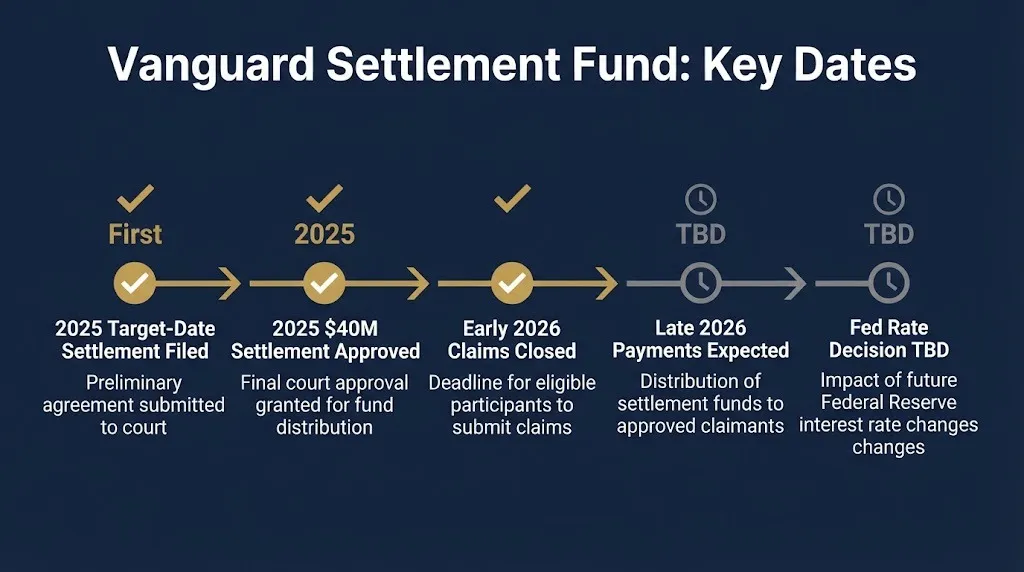
For the target-date fund tax case, the claim deadline has already passed. Payments are in process. For the cash sweep litigation, no settlement has been approved, so no deadline exists yet.
If you receive a notice, the deadline appears in bold on the first page and on the settlement website. Mark it on your calendar. Deadlines are not extended except in rare circumstances.
For the settlement fund itself, there is no deadline. It earns interest continuously as long as cash sits in your account.
Key Takeaway: Legal settlement deadlines are strict and case-specific. The money market settlement fund has no deadline at all.
How Much Could a Vanguard Lawsuit Settlement Pay?
Payout amounts depend on the size of the settlement fund, the number of valid claims, and your specific losses. For the target-date fund tax case, the $40 million fund was divided among class members based on the taxes they allegedly overpaid. Individual recoveries were expected to range from under $100 to several thousand dollars.
The table below shows how typical financial class action payouts work.
| Settlement Fund Size | Number of Claimants | Typical Per-Person Payout |
|---|---|---|
| $10 million | 50,000 | $150 to $300 after fees |
| $40 million | 100,000 | $250 to $500 after fees |
| $100 million | 200,000 | $350 to $750 after fees |
| $500 million | 500,000 | $700 to $1,500 after fees |
These are rough illustrations, not predictions for any specific Vanguard case. Attorney fees, administrative costs, and claim rates all reduce the final per-person amount.
For the money market settlement fund, the payout is your monthly dividend. On a $50,000 cash balance earning 4.90 percent net, that is roughly $2,450 per year, or about $204 per month.
What Is the Difference Between the Settlement Fund and a Settlement Fund Lawsuit?
The difference is fundamental. The settlement fund in your Vanguard account is a cash holding vehicle. You control it. You can add money, withdraw money, or invest it. It earns a market interest rate that changes with the Fed.
A settlement fund lawsuit is a legal process. A court approves a class action settlement, and a claims administrator distributes the money to eligible class members. You do not control it. You only receive money if you qualify and file a claim.
The two share a name but not a function. One is a routine part of every brokerage account. The other is a one-time legal event.
Confusing them is like confusing a checking account with a tax refund. They both hold money, but the rules, timing, and control are different.
Why Is the Vanguard Settlement Fund Interest Rate Higher Than My Bank Account?
The settlement fund invests in short-term government securities that pay near the federal funds rate. Your bank account pays whatever the bank decides, and most banks keep a wide margin between what they earn on deposits and what they pay you.
A high-yield savings account at an online bank often pays close to the settlement fund yield. A traditional brick-and-mortar bank checking or savings account often pays 0.01 to 0.50 percent, even when the Fed rate is near 5 percent.
Vanguard passes through more of the yield because the settlement fund is a money market fund with an expense ratio of 0.11 percent. There is no bank profit margin layered on top.
If your cash is sitting in a low-yield bank account, moving it to a Vanguard settlement fund or a comparable money market fund can earn dramatically more interest with minimal additional risk.
Key Takeaway: The settlement fund pays more because it is a low-cost money market fund, not a bank deposit with a wide profit margin built in.
Will the Vanguard Settlement Fund Interest Rate Drop in 2026?
The rate will drop if and when the Federal Reserve cuts the federal funds rate. As of September 2026, the Fed has held rates steady through most of the year, but market expectations point to possible cuts in late 2026 or 2027.
Money market fund yields lag Fed moves by only a few days or weeks. If the Fed cuts by 0.25 percent, the settlement fund yield falls by roughly the same amount within a month.
If the Fed cuts aggressively, the settlement fund yield could fall to 3 percent or lower over time. If the Fed stays put, the yield stays near current levels.
This is not a Vanguard decision. It is a macroeconomic one. Vanguard passes through what the market pays, minus 0.11 percent.
What Are the Risks of Keeping Money in the Vanguard Settlement Fund?
The risks are small but real. The fund is not FDIC insured. It can theoretically lose value, though a government money market fund has never broken the dollar in Vanguard’s history.
Inflation risk is more practical. If the settlement fund yields 4.90 percent and inflation runs 3 percent, your real return is under 2 percent. Cash in a money market fund preserves nominal dollars but may lose purchasing power over time.
Opportunity cost is the biggest risk for long-term money. Cash that sits in a settlement fund earning 5 percent has historically underperformed a diversified stock portfolio over ten-year periods. The settlement fund is for cash you may need soon, not for retirement savings.
What Happens Next for Vanguard Settlement Fund Rates and Lawsuits?
The next stages are predictable in broad terms, even if exact dates are not.
By late 2026, the target-date fund tax settlement is expected to begin distributing payments. The administrator will mail checks or process electronic payments to verified class members.
The cash sweep litigation may see a ruling on class certification or a settlement motion, but no date is confirmed.
The Federal Reserve’s next rate decision will drive the settlement fund yield. Watch the Fed’s scheduled meetings for the most direct signal.
For your account, the action item is simple. Check your cash balance. If it sits in the settlement fund, confirm the current yield and consider whether that cash belongs in a higher-returning investment.
Key Takeaway: Watch the Fed for yield changes. Watch the court dockets for lawsuit deadlines. They are separate timelines.
Frequently Asked Questions
What is the Vanguard settlement fund?
The Vanguard settlement fund is the money market fund that holds uninvested cash in your Vanguard brokerage account.
What is the Vanguard settlement fund interest rate in 2026?
The rate is approximately 4.75 to 5.00 percent, tracking the Federal Reserve’s benchmark rate.
Is the Vanguard settlement fund FDIC insured?
No. It is a money market fund, not a bank deposit, and carries investment risk rather than FDIC protection.
How often does the Vanguard settlement fund pay interest?
It pays dividends monthly, credited on the last business day of each month.
Are there Vanguard lawsuit settlements I can claim?
Several class actions exist, but each has its own eligibility rules and deadlines. Check the specific settlement website.
Will the Vanguard settlement fund rate go down?
It will drop if the Federal Reserve cuts the federal funds rate, which could happen in late 2026 or 2027.
How do I check my Vanguard settlement fund balance?
Log into your Vanguard account. The settlement fund balance appears on your account summary and holdings pages.
Can I move money out of the Vanguard settlement fund?
Yes. You can withdraw to a bank account or invest in any Vanguard fund, ETF, or stock.
The single most important distinction is the one between the money market settlement fund and a lawsuit settlement fund. One is a cash account you control. The other is a legal payout you may or may not qualify for. Check which one applies to you before taking any action.
Watch the Federal Reserve’s next meeting for yield direction. Watch the official settlement websites for any Vanguard class action deadlines. Both move on their own timelines, and missing either one costs you money.