Buyer of Structured Settlement Annuity in 2026: How the Process Works and What It Costs You
Quick Answer
- Is it legit? Yes. Buying and selling structured settlement payment rights is legal with court approval in all 50 states.
- How much do you get? Typically 35% to 70% of your payments’ face value, depending on the discount rate and timeline.
- Key requirement? A judge must approve every transfer and find it is in your best interest.
A buyer of structured settlement annuity is a company that purchases your future payment stream for a lump sum today. The transaction is legal, regulated, and supervised by state courts. It is also expensive. You are essentially borrowing against your own money at interest rates that can rival credit cards .
If you’re searching this term, you’re likely one of two people. Either you own a structured settlement and need cash now. Or you’re an investor looking at structured settlements as an asset class. This article covers both angles, but the primary focus is on the seller’s side, because that’s where the money and the risk are.
The process is not quick. It is not simple. And the discount rate you accept determines whether you’re making a smart financial move or a costly mistake. Here’s what you need to know before you sign anything.
The Facts
| Transaction Type | Court-supervised transfer of structured settlement payment rights |
|---|---|
| Legal Framework | Structured Settlement Protection Act (SSPA) in all 50 states + D.C. |
| Federal Statute | IRC § 5891 (excise tax without court-approved transfer) |
| Typical Discount Rate | 11% to 20% annually |
| Typical Payout | 35% to 70% of future payment face value |
| Court Approval | Required in every transaction |
| Timeline | 30 to 60 days from start to funding |
Is Buying a Structured Settlement Annuity Legal?
Buying a structured settlement annuity is legal, but only with court approval. Every state has a Structured Settlement Protection Act (SSPA) that governs these transactions .
The federal government added another layer in 2002 with IRC § 5891. That statute imposes an excise tax on any structured settlement transfer that isn’t approved by a qualified court order . The message is clear: transfers without judicial oversight are penalized.
The SSPA framework exists for one reason: to protect you. Structured settlements are designed to provide long-term financial security, often for people recovering from serious injuries. The law recognizes that selling future payments can jeopardize that security .
Courts are cautious. Judges review every transfer request and can deny it if the sale isn’t in your best interest. They look at your financial situation, your medical needs, your dependents, and whether alternatives exist .
The transaction isn’t like withdrawing from a bank account. It’s more like a home refinance. You’re accessing money that’s technically yours, but you need approval, paperwork, and a judge’s signature to make it happen.
How Much Money Do You Get From Selling Structured Settlement Payments?
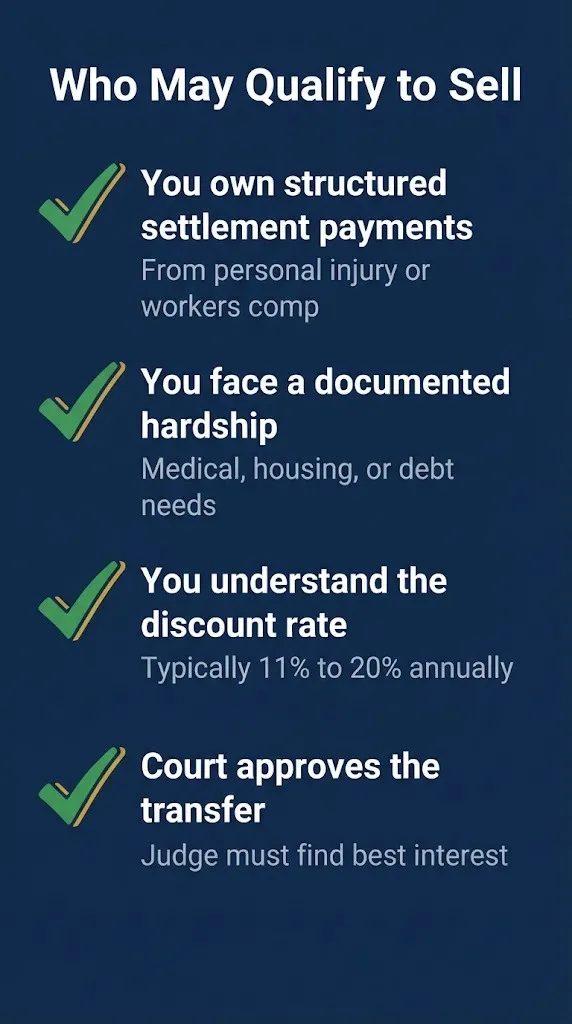
You typically receive 35% to 70% of your payments’ face value when you sell structured settlement payments. The exact amount depends on the discount rate, the timing of payments, and how far into the future those payments stretch.
Here’s how the math works. If you sell $100,000 in future payments scheduled over 10 years, a buyer might offer $50,000 to $70,000 today. The gap between those numbers is the discount, which is effectively the interest rate you’re paying to access your money early .
The discount rate is the single most important number in the transaction. Most deals fall between 11% and 20% annually . Some courts have approved rates as high as 19.99% .
Here’s a comparison table showing how discount rates affect your payout:
| Face Value | Discount Rate | Years | Approximate Lump Sum |
|---|---|---|---|
| $100,000 | 11% | 10 | ~$65,000 |
| $100,000 | 15% | 10 | ~$55,000 |
| $100,000 | 20% | 10 | ~$45,000 |
| $100,000 | 15% | 20 | ~$35,000 |
The longer the payment stream, the steeper the discount. A 20-year stream at 15% might only net you 35% of face value .
Reality Check: No one will call you and offer a lump sum for your structured settlement out of generosity. Every offer is calculated to profit the buyer. The question isn’t whether they make money. It’s whether the price they’re offering is reasonable compared to other buyers and your alternatives.
What Is a Structured Settlement Protection Act?
A Structured Settlement Protection Act is a state law that requires court approval before you can sell your structured settlement payments. All 50 states and the District of Columbia have one .
The SSPA framework was developed by the National Conference of Insurance Legislators (NCOIL). Most state laws follow the NCOIL model closely . The laws share common requirements:
- Full disclosure: Buyers must give you a clear written statement of all transaction terms.
- Cooling off period: You have time to back out after signing.
- Court approval: A judge must find the transfer is in your best interest.
- Independent advice: You can seek your own attorney or financial advisor.
- Hardship consideration: Courts weigh whether you’re facing genuine financial difficulty.
The “best interest” standard is the heart of the SSPA. It’s not enough that you want to sell. The judge must be convinced that selling serves your long-term welfare, not just your short-term needs .
Courts consider factors like your age, income, medical needs, dependents, and whether you’ve attempted similar transactions before. If a judge thinks you’re being taken advantage of, the deal gets denied .
How Do You Choose the Best Structured Settlement Buyer?
You choose the best structured settlement buyer by getting at least three quotes, asking for discount rates in writing, and checking complaint histories. The “best” buyer is the one that offers the highest net payout with transparent terms.
Price is the primary factor, but it’s not the only one. Here’s what separates good buyers from bad ones:
| Factor | What to Look For |
|---|---|
| Discount rate | Request it in writing. Compare rates across all quotes. |
| Net payout | The amount quoted should be the amount you receive. Ask about fees. |
| Partial sale options | Can you sell only what you need and keep the rest? |
| Court process | Who handles filing and legal costs? |
| Timeline | What’s the realistic funding timeline? |
| Reviews | Check BBB and Consumer Financial Protection Bureau complaints. |
Strategic Capital is known for its consultative approach and focus on partial sales. Roughly 85% of their transactions are partial sales, preserving long-term income . JG Wentworth is the largest and most recognizable buyer, with the biggest advertising presence . Stone Street Capital, Peachtree Financial, and CBC Settlement Funding are other major players .
The Wallet on Fire comparison noted that JG Wentworth, Peachtree, and Stone Street share the same corporate umbrella, which limits direct competition between them . That’s a reason to look beyond the biggest names.
What Are the Fees and Costs of Selling a Structured Settlement?
The fees and costs of selling a structured settlement typically include court filing fees (around $400), attorney fees ($4,000 to $5,000), and administrative costs. These come out of your settlement value .
Some buyers advertise “no upfront costs” and handle these fees themselves. That doesn’t mean the costs disappear. They’re baked into the discount rate or deducted from your payout.
Here’s what the typical fee structure looks like:
- Court filing fee: ~$400 per transaction
- Attorney fees: $4,000 to $5,000
- Background check: Varies
- Administrative: Varies
If you complete multiple transactions over time, you pay these fees each time. That’s a reason to sell exactly what you need in one transaction rather than coming back for more later.
Key Takeaway: Fees are real and they reduce your payout. Ask every buyer for a complete written breakdown of costs before you commit. The amount quoted should be the amount you receive.
Can You Sell Only Part of Your Structured Settlement?
Yes, you can sell only part of your structured settlement and keep the rest. Partial sales are common and often recommended because they preserve your long-term income while giving you the cash you need now .
There are five common partial sale structures:
- Sell a block of years: Sell all payments for a set period (e.g., the next five years) and keep everything after.
- Sell a portion of each payment: Sell $800 of a $2,000 monthly check and keep $1,200.
- Sell future lump sums: Sell one or more scheduled lump-sum payments and keep the monthly checks.
- Sell part of a lump sum: Sell $30,000 of a $50,000 scheduled payment.
- Blended approach: Combine structures for larger needs .
Judges generally receive partial transfers well. They show you’re not liquidating everything, just accessing what you need . A partial sale also minimizes the impact of the discount rate. You’re only applying that rate to a fraction of your assets.
Strategic Capital structures most of its deals as partial sales for exactly this reason. Their data shows 85% of transactions are partial .
What Is the Difference Between Factoring and a Loan?
Factoring is the sale of your future structured settlement payments for a lump sum. It is not a loan. You cannot borrow against a structured settlement because the annuity has no withdrawal or loan features .
This distinction matters for taxes and legal treatment. A loan has repayment terms. A factoring transaction is a sale. You transfer ownership of the payment rights to the buyer. You don’t pay it back .
Some companies market structured settlement transactions as “loans.” That’s misleading. There’s no loan product here. The only way to access your money early is to sell the rights to some or all of your future payments.
The tax treatment differs too. Structured settlement payments for physical injury are tax-free under IRC § 104(a)(2) . When you sell those payments, the lump sum may become taxable ordinary income under IRC § 5891 if the transfer qualifies . That’s a reason to consult a tax professional before selling.
What Happens Next in the Structured Settlement Sale Process?
The structured settlement sale process follows a predictable timeline from quote to funding, typically taking 30 to 60 days. Court approval is the longest step .
Expected timeline:
- Day 1-7: Get quotes from multiple buyers. Compare discount rates and net payouts.
- Day 7-14: Accept an offer. Sign the purchase agreement and disclosure statement.
- Day 14-30: Buyer prepares and files the court petition. You may need to provide documents.
- Day 30-45: Court hearing. A judge reviews the transaction and issues an approval order.
- Day 45-60: Funding. Once the signed order is received, money is wired to your account.
Some companies advertise 72-hour approvals, but that’s misleading. The court process takes time regardless of how fast the buyer moves. A 30-day timeline is fast. 60 days is normal .
Frequently Asked Questions
Is selling a structured settlement a good idea?
It depends on your situation. If you’re facing foreclosure, medical bills, or other urgent needs, a partial sale can help. If you’re selling for discretionary spending, the steep discount may not be worth it.
What is the average discount rate for structured settlement buyers?
Most discount rates range from 11% to 20% annually. Courts have approved rates as high as 19.99% in some cases.
Do I need a lawyer to sell my structured settlement?
You are not required to have your own lawyer, but the court will consider whether you received independent professional advice. Many judges view independent counsel favorably.
How long does it take to get money from a structured settlement sale?
The process typically takes 30 to 60 days from start to funding. Court approval is the longest step.
Can I sell my structured settlement without going to court?
No. Every state requires court approval under its Structured Settlement Protection Act. Transfers without court approval trigger a federal excise tax.
What happens if the judge denies my structured settlement sale?
If the judge denies the transfer, the sale does not happen. You keep your payments. You may be able to refile if circumstances change.
Can I sell my structured settlement payments more than once?
Yes. Each sale requires its own court approval. Many people complete multiple transactions over time as their needs change.
Are structured settlement payments taxable after I sell them?
The lump sum you receive may be treated as taxable ordinary income if the transfer qualifies under IRC § 5891. Consult a tax professional before selling.
What You Should Do Now
If you’re considering selling your structured settlement, get at least three quotes before you commit. Ask every buyer for their discount rate in writing. Compare the net payout, not just the gross offer. A difference of a few percentage points in the discount rate can mean thousands of dollars.
The single most important number is the discount rate. A 15% rate on a 10-year payment stream means you’re giving up about 45% of your money. Make sure the reason you’re selling is worth that cost.