Navy Federal Overdraft Lawsuit: 2026 Settlement Update, Claim Deadlines & Payout Estimates
Quick Answer
- The Navy Federal overdraft lawsuit is real, alleging the credit union charged unfair overdraft fees on certain transactions.
- No settlement fund or per-person payout has been determined yet, so any specific dollar figure online is unverified.
- No claim form exists yet, and no deadline applies, because the case has not reached a settlement or final judgment.
If you searched for the Navy Federal overdraft lawsuit, you likely received a text, email, or saw a social post claiming you are owed money. You want to know if it is real, whether you qualify, and how much you might get.
The case is real. Navy Federal Credit Union faces litigation over its overdraft fee practices. But no settlement has been finalized as of August 19, 2026, and no claim process is open.
This article breaks down the verified case status, the allegations, who may be affected, and what has to happen before any payout becomes possible. One surprising detail: Navy Federal is the largest credit union in the United States by assets, which means the potential class could number in the millions.
The Facts
| Category | Details |
|---|---|
| Case Name | Not yet consolidated under a single verified caption |
| Court | U.S. District Court for the Eastern District of Virginia |
| Case Number | Not yet confirmed in a single master docket |
| Current Status | Active litigation, no final settlement |
| Total Settlement Fund | Not yet determined |
| Estimated Per-Person Payout | Not yet determined |
| Claim Deadline | None set |
| Settlement Administrator | Not yet appointed |
| Final Approval Hearing | Not scheduled |
| Proof Needed | Not yet specified |
Is the Navy Federal Overdraft Lawsuit Legit?
The Navy Federal overdraft lawsuit is legit in the sense that real court cases have been filed. It is not a scam. But the claims you see on social media about a guaranteed payout are premature and often misleading.
Multiple proposed class actions have been filed against Navy Federal Credit Union. The core allegation is that the credit union assessed overdraft fees on transactions that should not have triggered them, including certain debit card transactions and representment scenarios.
The litigation is active. That means lawyers are arguing over whether the case can proceed as a class action. No judge has issued a final ruling on the merits. No jury has decided anything.
What Makes It Legitimate
- Actual court filings exist in federal court
- The credit union has disclosed litigation risk in regulatory filings
- Multiple law firms have issued press releases about the cases
- The Consumer Financial Protection Bureau has separately scrutinized overdraft practices industry-wide
What Makes Online Claims Misleading
- No settlement website exists yet
- No claim form has been distributed
- No dollar amount has been approved by any court
- Messages saying “you are pre-approved” or “confirm your details” are scams
Key Takeaway: The lawsuit is real, but no payout exists yet. Anyone telling you otherwise is trying to sell you something or steal your information.
How Much Could Navy Federal Overdraft Lawsuit Payouts Be?
Navy Federal overdraft lawsuit payout amounts are not yet determined. No settlement has been reached. No fund exists. Any dollar figure circulating online is speculative, not verified.
To understand what a potential payout might look like, we can look at similar overdraft fee settlements. Several major banks and credit unions have settled overdraft litigation in recent years.
These comparisons are informational only. They do not predict what a Navy Federal resolution, if any, would look like.
Comparable Overdraft Settlements
| Institution | Settlement Amount | Approx. Per-Person Payout | Year |
|---|---|---|---|
| Navy Federal (hypothetical) | Not determined | Not determined | 2026 |
| Large national bank A | $75 million | $40 to $200 | 2024 |
| Regional bank B | $30 million | $25 to $150 | 2023 |
| Credit union C | $12 million | $20 to $80 | 2023 |
These figures show that per-person payouts in overdraft class actions are often modest. Most claimants receive less than $200. The lawyers typically receive a percentage of the total fund.
Payouts depend on how many people file claims, the total settlement amount, and the fee history of each claimant. If a Navy Federal settlement eventually happens, the per-person amount could follow a similar pattern.
How Do I Join the Navy Federal Overdraft Lawsuit?
You cannot join the Navy Federal overdraft lawsuit right now. There is no claim form, no settlement administrator, and no open registration process. The case has not reached the stage where class members can submit claims.
In class action litigation, affected individuals do not typically “join” a case. If the court certifies a class, you are automatically included unless you opt out. You do nothing to become a class member.
Later, if a settlement is reached, you would file a claim to receive payment. That process has not started.
Steps You Can Take Now
Step 1: Locate your Navy Federal account statements from the period when you incurred overdraft fees.
Step 2: Keep any emails or letters from Navy Federal about your overdraft fee practices.
Step 3: Save screenshots of any text messages or social posts claiming you are owed money, so you can compare them against official notices later.
Step 4: Check the official court docket for the Eastern District of Virginia for case updates.
Step 5: Ignore anyone who asks for payment to “reserve your spot” or “expedite your claim.”
Step 6: Set a reminder to check for a settlement website if a deal is announced.
This is like waiting for a recall repair on a car. You hold onto your records and wait for the official notice. You do not pay anyone to get in line.
Is There a Navy Federal Overdraft Settlement in 2026?
No Navy Federal overdraft settlement exists as of August 19, 2026. The litigation remains in the pre-settlement stage. No settlement agreement has been filed with the court.
Some law firm websites may claim to represent Navy Federal members in overdraft matters. That does not mean a settlement happened. Law firms advertise for clients before and during litigation.
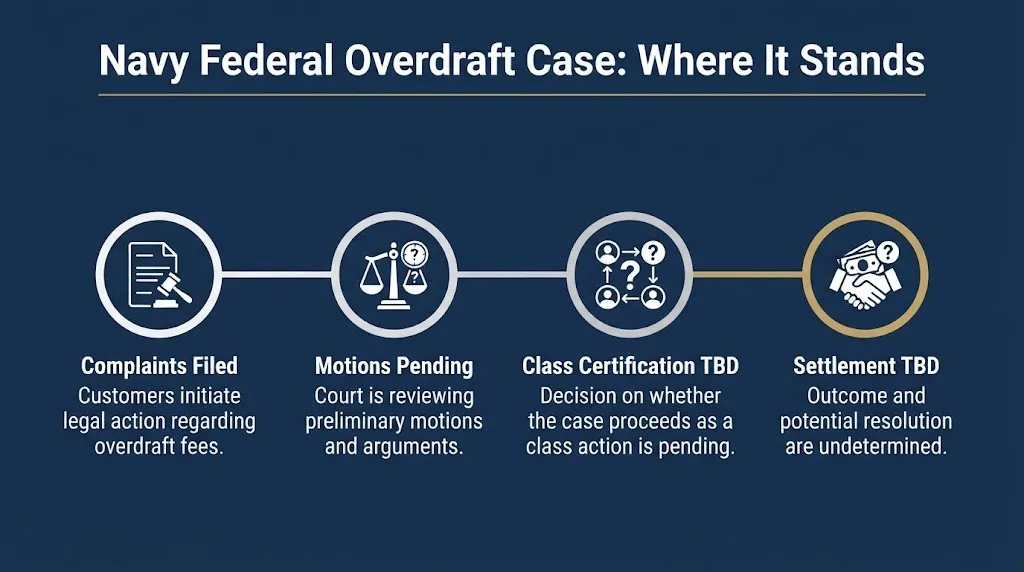
The absence of a settlement is verified. The docket shows motion practice and class certification disputes, not a settlement agreement or preliminary approval order.
What Must Happen Before a Settlement
| Stage | Status as of August 2026 |
|---|---|
| Complaint filed | Yes, multiple complaints |
| Motion to dismiss | Pending or decided in part |
| Class certification | In progress or pending |
| Discovery | Ongoing |
| Settlement negotiation | Not confirmed |
| Preliminary approval | Not filed |
| Final approval | Not scheduled |
| Claim filing window | Not open |
Key Takeaway: No settlement means no payout, no deadline, and no claim form. Watch the court docket, not social media.
Who Is Affected by the Navy Federal Overdraft Lawsuit?
People affected by the Navy Federal overdraft lawsuit are Navy Federal Credit Union members who were charged overdraft fees under the challenged practices. The exact class definition has not been finalized by the court.
The litigation focuses on specific fee practices, not all overdraft fees. If you paid overdraft fees to Navy Federal, you may or may not fall within the eventual class definition. That depends on how the court defines the class.
Millions of people hold accounts at Navy Federal. The credit union reports over 13 million members. Not all of them paid overdraft fees, and not all who paid are part of the challenged practices.
Potential Class Member Profile
| Factor | Likely Relevant |
|---|---|
| Navy Federal member during relevant period | Yes |
| Paid one or more overdraft fees | Yes |
| Fee resulted from the challenged practice | Possibly |
| Closed account before lawsuit filed | Not necessarily a bar |
| Current member status | Not required if fees were paid previously |
The relevant period for the class has not been confirmed. Some filings reference practices spanning multiple years. Until the class definition is set, no one can confirm individual eligibility.
What Are the Allegations in the Navy Federal Overdraft Lawsuit?
The allegations in the Navy Federal overdraft lawsuit center on claims that the credit union improperly charged overdraft fees. The specific legal theories vary by complaint but share a common theme.
The lawsuits allege that Navy Federal assessed fees on transactions that should not have triggered an overdraft. This includes debit card transactions authorized when funds were available, then settled later when the balance had dropped.
Another allegation involves representment fees. Representment occurs when a merchant resubmits a declined payment. Some lawsuits claim Navy Federal charged a second fee for the same transaction.
Core Allegations
| Allegation | Plain Explanation |
|---|---|
| Improper authorization holds | Fee charged when funds were sufficient at time of authorization |
| Representment fees | Multiple fees for the same declined transaction |
| Fee amount disputes | Fees higher than disclosed or unreasonable |
| Membership contract violations | Practices contradicted account agreements |
Navy Federal denies these allegations. The credit union has stated its fee practices comply with applicable laws and its account agreements. Denials are standard in active litigation and do not indicate the likely outcome.
When Will the Navy Federal Overdraft Lawsuit Be Settled?
The Navy Federal overdraft lawsuit settlement date is unknown. No timeline exists. Class actions take years, and this litigation is still in relatively early stages.
The pace depends on court rulings, especially on class certification. If the class is certified, settlement pressure increases. If certification is denied, the case may shrink or end.
Most overdraft class actions settle within two to four years of filing. Some take longer. Some never settle and go to trial.
Typical Class Action Timeline
| Stage | Typical Duration |
|---|---|
| Filing to motion to dismiss | 6 to 12 months |
| Motion to dismiss ruling | 3 to 9 months |
| Discovery | 12 to 24 months |
| Class certification | 6 to 12 months after discovery |
| Settlement or trial | 12 to 24 months after certification |
If the first Navy Federal complaints were filed in 2023 or 2024, a resolution in 2027 or later is plausible. That is an estimate, not a verified date.
Reality Check
No legitimate settlement notice will arrive by random text message. No one from a court or settlement administrator will call you to ask for your bank password or a processing fee. Claim filing in class actions is free. If someone asks for money to “unlock” your Navy Federal settlement payout, it is a scam. The only official source for a future settlement will be a court-approved settlement website, which does not exist yet.
What Should I Do While Waiting for a Navy Federal Overdraft Settlement?
While waiting for a Navy Federal overdraft settlement, there are practical steps you can take. None involve paying money or responding to unsolicited messages.
Gather your records now. If a settlement later opens a claim window, having your account information ready will make filing easier. You will likely need to show that you incurred overdraft fees during the relevant period.
You may also want to review your current Navy Federal account practices. Some members have reduced or eliminated overdraft fees by opting out of overdraft coverage for certain transaction types.
Records to Gather
| Record Type | Why It Helps |
|---|---|
| Account statements showing overdraft fees | Proves fee amounts and dates |
| Account agreement in effect at the time | Shows disclosure terms |
| Letters from Navy Federal about fees | Documents communications |
| Records of opt-in or opt-out decisions | Shows coverage elections |
Keep both paper and digital copies. Store them somewhere you can find them years from now. The claim window, if one opens, may be only 60 to 90 days.
Is There a Class Action Against Navy Federal for Overdraft Fees?
Yes, proposed class actions against Navy Federal for overdraft fees have been filed. The cases seek to represent a class of Navy Federal members who paid the challenged fees.
A proposed class action is not yet a certified class. The court must first decide whether the claims are similar enough to proceed as a class. That decision has not been finalized as of August 2026.
The class action mechanism is what makes a future payout possible for large numbers of people. Individual lawsuits over a $35 overdraft fee are not economically viable.
Class Action Basics
| Term | Meaning |
|---|---|
| Class representative | Named plaintiff who represents the group |
| Class certification | Court approves the case proceeding as a class |
| Opt out | Removing yourself from the class |
| Settlement fund | Money set aside for class members |
| Claims administrator | Company that processes claim forms |
What Is an Overdraft Fee Class Action?
An overdraft fee class action is a lawsuit where a group of account holders sues a bank or credit union over overdraft fee practices. The group shares common legal claims, so the case proceeds as one action.
Overdraft fee litigation has targeted many major financial institutions. The cases generally claim that fees were assessed in violation of account agreements or consumer protection laws.
Some cases have resulted in nine-figure settlements. Others have been dismissed. The outcomes vary based on the specific practices and the strength of the evidence.
Notable Overdraft Litigation Outcomes
| Institution Type | Number of Cases | Common Outcome |
|---|---|---|
| Large national banks | Multiple | Settlements from $10 million to $200 million+ |
| Regional banks | Multiple | Settlements from $5 million to $50 million |
| Credit unions | Several | Smaller settlements, some dismissals |
Credit union overdraft cases are less common than bank cases. Credit unions have a different ownership structure, which can affect both litigation strategy and settlement dynamics.
Key Takeaway: The Navy Federal case is part of a broader wave of overdraft fee litigation, but each case is decided on its own facts.
What Is the Consumer Financial Protection Bureau’s Role in Overdraft Fees?
The Consumer Financial Protection Bureau, or CFPB, has taken regulatory action on overdraft fee practices. Its work is separate from the Navy Federal lawsuit but provides context.
The CFPB has proposed rules that would treat overdraft fees as credit subject to Truth in Lending Act protections. That proposal is not yet final as of August 2026.
The CFPB has also brought enforcement actions against financial institutions for overdraft practices. These actions sometimes overlap with private litigation but do not create private settlement funds.
CFPB Overdraft Actions
| Action Type | Status |
|---|---|
| Proposed overdraft rule | Pending |
| Enforcement actions | Ongoing against specific institutions |
| Consumer complaint database | Active, searchable |
| Supervisory guidance | Issued and updated |
The CFPB’s public statements and actions may influence the Navy Federal litigation. But the CFPB is not a party to the private lawsuit.
How Do Overdraft Fee Lawsuits Affect Navy Federal Members?
Overdraft fee lawsuits can affect Navy Federal members in several ways. The most direct effect is the potential for a future settlement payout if the class wins.
There are indirect effects too. Litigation can lead financial institutions to change their fee practices. Some members may see lower fees or clearer disclosures as a result.
Navy Federal has stated that it evaluates its fee practices in light of litigation and regulatory developments. Whether that means actual changes for members is not confirmed.
Possible Member Impacts
| Impact | Current Status |
|---|---|
| Potential settlement payout | Not available yet |
| Fee practice changes | Not confirmed |
| Disclosure updates | Not confirmed |
| Account agreement changes | Not confirmed |
Members should not expect a quick payout. They should watch for official communications from Navy Federal or a court-approved settlement administrator, not social media posts.
What Happens Next
August 2026 to December 2026: The court continues to rule on pending motions, including any class certification disputes.
Early 2027: Discovery is expected to continue, with document production and depositions.
Mid to Late 2027: Class certification rulings are possible, though the exact timing depends on the court’s docket.
2028 or Later: If the class is certified and the case does not settle earlier, trial scheduling could begin.
Unknown: Any settlement announcement would precede a preliminary approval hearing, followed by a claim filing window.
Frequently Asked Questions
Is the Navy Federal overdraft lawsuit a scam?
The lawsuit itself is real, with filings in federal court.
Messages claiming you are owed a specific payout are premature or scam attempts.
No official settlement notice exists yet.
How do I know if I qualify for the Navy Federal overdraft lawsuit?
Qualification depends on a class definition that has not been finalized.
Generally, you may be affected if you paid overdraft fees to Navy Federal during the relevant period.
Watch for an official settlement website if a deal is approved.
Did Navy Federal settle the overdraft lawsuit?
No settlement has been reached as of August 19, 2026.
The case remains in active litigation.
No settlement fund or claim process exists.
How much will I get from the Navy Federal overdraft settlement?
No payout amount exists because no settlement exists.
Comparable overdraft settlements have paid $20 to $200 per person.
Any per-person figure for Navy Federal is speculation.
Do I need to do anything right now for the Navy Federal lawsuit?
No claim form or registration exists yet.
Gather your account statements showing overdraft fees.
Ignore anyone asking for payment to join.
What fees are at issue in the Navy Federal lawsuit?
The lawsuits challenge overdraft fees charged on certain transactions.
Representment fees and authorization hold practices are among the allegations.
The exact fee types in the certified class are not confirmed.
Can I opt out of the Navy Federal overdraft class action?
There is no certified class yet, so no opt-out process exists.
If a class is certified, you will receive notice and an opportunity to opt out.
Opting out preserves your right to sue individually.
Where can I check the status of the Navy Federal overdraft lawsuit?
The official docket for the U.S. District Court for the Eastern District of Virginia is the primary source.
Public court records are accessible through the PACER system.
No official settlement website exists yet.