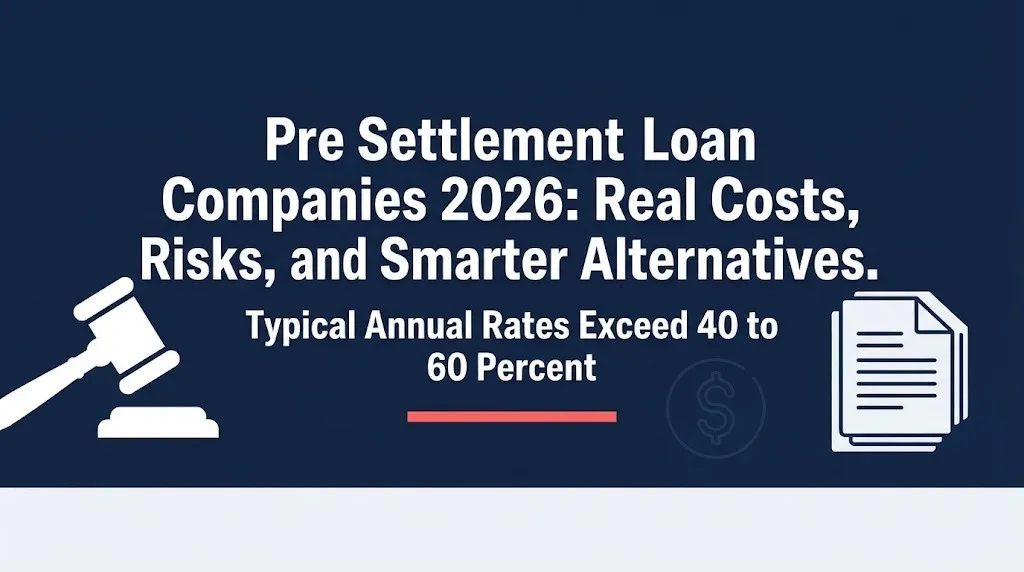
Pre Settlement Loan Companies 2026: Real Costs, Risks, and Smarter Alternatives
Quick Answer:
- Pre settlement loans are real cash advances against potential lawsuit winnings, not scams, but they carry extreme costs.
- Typical advances range from $500 to $100,000 depending on your case’s estimated value and expected settlement timeline.
- No federal agency regulates these loans directly, leaving rate caps and disclosure rules to individual states.
A pre settlement loan in 2026 is a cash advance against money you might win from a lawsuit. The company gives you cash now, and you repay it from your settlement or verdict later. If you lose your case, you usually owe nothing back, which is the one feature that separates these products from traditional loans.
If you’re searching this term, you probably have a pending lawsuit, money is tight, and someone told you a lawsuit cash advance could bridge the gap. The reality is more complicated than the ads suggest.
This article covers what these companies actually charge, how the contracts work, which states regulate them, and the alternatives that might cost you far less.
The Facts
| Item | Verified Details |
|---|---|
| Product Type | Non-recourse cash advance on lawsuit proceeds |
| Typical Advance Size | $500 to $100,000 |
| Typical Repayment | 2x to 4x the advance after 2 to 3 years |
| Effective APR | 40% to 60%+ common, sometimes over 100% |
| Federal Regulation | None specific to pre settlement funding |
| State Regulation | Varies widely, some states cap rates |
| Risk to Borrower | None if case loses, but high cost if case wins |
Are pre settlement loan companies legitimate?
Yes, pre settlement loan companies are legitimate businesses operating in most states. They provide cash advances to plaintiffs with pending lawsuits, using the potential settlement as collateral.
The industry has existed for decades and includes both large national funders and smaller regional firms. Some are publicly traded or backed by institutional investors. Others are small operations with minimal track records.
That said, legitimacy does not mean the product is a good deal. The Consumer Financial Protection Bureau has repeatedly warned consumers about the high cost of lawsuit cash advances. No federal law caps their rates, and state protections vary dramatically.
How do pre settlement loans work?
A pre settlement loan works by giving you cash now in exchange for a share of your future settlement or verdict. The funding company reviews your case with your attorney’s cooperation, estimates its value, and offers an advance based on that estimate.
The contract is technically a non-recourse purchase of a portion of your lawsuit proceeds. That means if you lose the case, you keep the money and owe nothing. If you win, you repay the advance plus fees and interest from the settlement before you receive your share.
Here’s how a typical transaction breaks down:
| Stage | What Happens |
|---|---|
| Application | You and your attorney submit case details |
| Underwriting | Funder reviews case strength and expected value |
| Offer | Funder proposes an advance amount and repayment terms |
| Contract | You sign, attorney acknowledges |
| Funding | Cash arrives within 24 to 48 hours |
| Repayment | From settlement proceeds if you win |
Key Takeaway: The non-recourse feature is real and valuable, but it comes at a price that compounds quickly the longer your case takes.
How much can I borrow from a pre settlement loan company?
Pre settlement loan companies typically advance between $500 and $100,000, depending on your case’s estimated value and the funder’s underwriting standards. Most advances fall between $1,000 and $25,000.
The funder reviews your medical records, police reports, liability evidence, and insurance policy limits. Strong cases with clear liability and high policy limits get larger offers. Weak cases with disputed fault get smaller offers or none at all.
The general rule is that funders advance no more than 10 to 20 percent of the expected case value. If your case is worth an estimated $50,000, expect an offer between $5,000 and $10,000, not $50,000.
What do pre settlement loans actually cost?
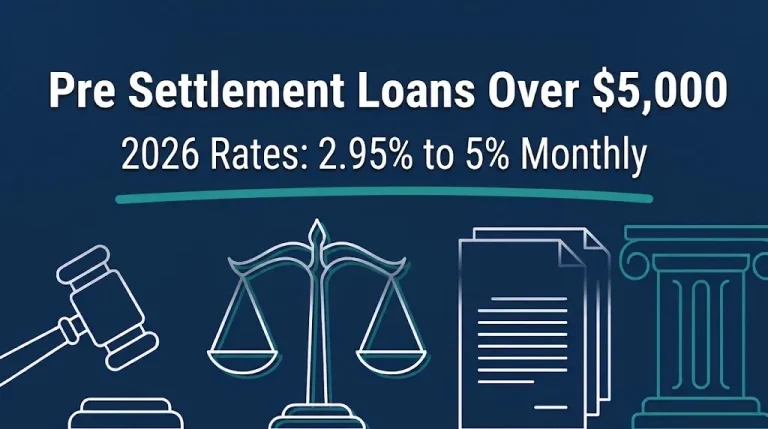
Pre settlement loans are expensive. The effective annual percentage rate commonly exceeds 40 to 60 percent, and some contracts reach triple digits over the life of a case.
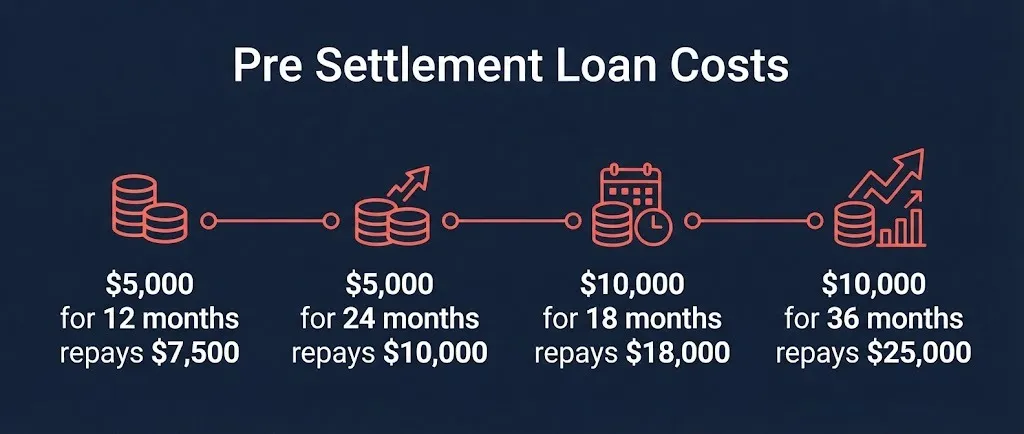
Here’s how the math works in practice:
| Advance | Time to Settlement | Repayment | Effective APR |
|---|---|---|---|
| $5,000 | 12 months | $7,500 | 50% |
| $5,000 | 24 months | $10,000 | 50% |
| $10,000 | 18 months | $18,000 | 53% |
| $10,000 | 36 months | $25,000 | 50% |
Companies often use fees and compounding structures rather than a simple interest rate. A “fee” of 3 to 5 percent per month is common. That sounds small until you realize it compounds monthly and adds up fast.
Reality Check: No pre settlement loan company is required to quote you an APR like a credit card or mortgage lender. The industry has fought against APR disclosure, arguing the product is not a loan. That opacity is exactly why consumers underestimate the cost.
Is lawsuit funding near me a good idea?
Lawsuit funding near you might be convenient, but convenience does not make it a good deal. Local funders often charge the same or higher rates than national companies, with less regulatory oversight.
The better question is whether any lawsuit funding is a good idea for your specific situation. If you have no other way to pay rent, keep your car, or cover medical care while your case settles, a cash advance might prevent worse outcomes. If you’re using it for optional spending, it’s almost certainly a bad idea.
Compare the cost to alternatives first. A personal loan, credit card advance, family loan, or even negotiating a payment plan with creditors usually costs less than lawsuit funding.
Key Takeaway: The convenience of local lawsuit funding rarely justifies the cost; exhaust cheaper options before signing a pre settlement contract.
What states regulate pre settlement loan companies?
State regulation of pre settlement loan companies varies widely. Some states cap rates and require disclosures. Others treat the industry as unregulated commerce.
States with stronger consumer protections include Illinois, Indiana, Vermont, and Maine. These states require APR disclosures, cap fees, or license funders. States with minimal regulation include many in the South and Midwest, where funders operate with few constraints.
No federal law specifically addresses lawsuit funding. The Consumer Financial Protection Bureau has authority over certain unfair practices but has not issued binding rules for the industry. That leaves consumers depending on state law, which is patchwork at best.
How do I find reputable accident lawsuit funding companies?
Finding a reputable accident lawsuit funding company requires checking several factors before you sign anything. Your own attorney is usually the best starting point.
Here are the steps:
- Ask your attorney for funder recommendations.
- Check the funder’s state licensing status, if your state requires licenses.
- Ask for a complete fee schedule and total repayment amount for your specific case.
- Compare offers from at least two or three funders.
- Read the contract’s repayment terms, not just the advance amount.
- Avoid funders that pressure you to decide quickly.
- Ask what happens if your case settles for less than expected.
Your attorney must cooperate with the funder for the advance to happen. If your attorney won’t work with a particular company, that’s a red flag worth heeding.
What are the alternatives to pre settlement loans?
Several alternatives to pre settlement loans cost far less and carry fewer risks. Most people explore these before turning to lawsuit funding.
| Alternative | Typical Cost | Best For |
|---|---|---|
| Personal loan from bank or credit union | 8% to 18% APR | Good credit borrowers |
| Credit card with 0% intro period | 0% for 12 to 18 months | Short-term needs |
| Family or friend loan | 0% to low interest | Flexible repayment |
| Creditor payment plans | Varies, often 0% | Medical and utility bills |
| Attorney lien reduction | Negotiated | Reducing total legal cost |
| State disability or workers comp | No repayment | Income replacement |
A personal loan requires repayment regardless of your lawsuit outcome. That’s the tradeoff. But at 10 percent instead of 50 percent, the savings often outweigh the risk for people with decent credit.
Key Takeaway: Cheaper alternatives exist for most borrowers; the non-recourse feature of lawsuit funding mainly benefits people with bad credit and no other options.
What should I watch for in pre settlement loan contracts?
Pre settlement loan contracts contain several traps that cost borrowers thousands of dollars. The most important is the fee structure.
Watch for these specific terms:
- Monthly compounding fees instead of simple interest
- Origination or processing fees added upfront
- Minimum repayment periods that lock in fees even if you settle fast
- Attorney acknowledgment clauses that give the funder leverage
- Arbitration clauses that limit your ability to sue the funder
- Renewal or refinance pressure when your case drags on
The repayment amount, not the advance amount, is the number that matters. A $10,000 advance that repays $25,000 after three years is a $25,000 decision, not a $10,000 one.
How long does pre settlement funding take?
Pre settlement funding typically takes 24 to 72 hours from application to cash in your account once your attorney provides the necessary case documents. The speed is one of the product’s main selling points.
The application itself is short. You fill out basic information about your case and sign an authorization for the funder to contact your attorney. The attorney then sends medical records, police reports, and insurance information.
If your attorney is responsive and your case is straightforward, funding can happen in one business day. Complex cases with multiple defendants or disputed liability take longer, sometimes weeks.
What happens if I lose my case after taking a pre settlement loan?
If you lose your case after taking a pre settlement loan, you owe nothing. The non-recourse nature of the transaction means the funder loses its investment.
This is the single most attractive feature of pre settlement funding. Unlike a bank loan, which you must repay regardless of outcome, a lawsuit cash advance disappears if your case fails. The funder absorbs the loss.
But this protection comes at a steep price. The high fees and compounding structures exist precisely because funders write off advances to losing cases. You pay extra on a win to cover the risk of a loss.
What happens next with pre settlement loan regulation?
Here’s what to watch in the coming months:
2026 to 2027: More states are expected to introduce rate cap and disclosure legislation for lawsuit funding.
Ongoing: The Consumer Financial Protection Bureau continues monitoring the industry for unfair practices.
Case by case: Individual lawsuits against funders over undisclosed fees remain active in several states.
No federal legislation is pending as of September 2026.
Frequently Asked Questions
Are pre settlement loans a scam?
No, pre settlement loans are legal financial products, but some companies use deceptive marketing and hidden fees.
How much does a $10,000 lawsuit loan cost?
A $10,000 advance can cost $20,000 to $30,000 in repayment after two to three years.
Can I get a pre settlement loan without a lawyer?
No, funders require an attorney to cooperate with the underwriting process.
What is the average interest rate on lawsuit loans?
Effective rates typically run 40 to 60 percent annually, with some exceeding 100 percent.
Do I have to pay back a lawsuit loan if I lose?
No, pre settlement advances are non-recourse, meaning you owe nothing if you lose.
Is lawsuit funding regulated?
State regulation varies widely, and no federal law specifically governs the industry.
Can I get more than one pre settlement loan?
Some funders allow multiple advances, but the compounding costs escalate quickly.
How do lawsuit loan companies get paid?
They receive payment directly from your settlement proceeds through your attorney.
Closing
The most important number in any pre settlement loan offer is the total repayment amount, not the advance amount. Ask for that figure in writing before you sign anything.
If you have any other option that costs less, take it. If lawsuit funding is your only choice, compare at least three offers and have your attorney review the contract first. The high cost buys you time, not freedom.