Chime Settlement 2026: What’s Verified, What’s Still Rumor, and How to Apply If a Deal Happens
Quick Answer
- No Chime settlement exists as of August 2026. The data breach case is still in early litigation, not settled.
- Estimated per-person payouts are not yet determined. Any dollar figure you see online right now is a guess, not a confirmed number.
- No claim deadline exists yet. The case management conference happened July 7, 2026, with no trial date or settlement announced since.
If you’ve searched “Chime settlement 2026” hoping to file a claim, here’s the direct answer. There isn’t one to file yet. Chime is being sued in federal court over an April 2026 data breach, but that lawsuit hasn’t turned into a settlement.
This matters if you’re a Chime customer who lost access to your money that week, or if you got a text or email hinting at a payout. The one date that matters right now isn’t a claim deadline. It’s April 3, 2026, when the first lawsuit was filed.
This article breaks down the real court record behind the headlines: the case number, who’s suing, what a payout could eventually look like, and how to spot a scam claim site. One detail most articles skip: Chime has publicly disputed that customer data was actually exposed.
The Facts
| Case | Castaneda, et al. v. Chime Financial, Inc. |
| Status | Early litigation, no class certification, no settlement |
| Fund Size | Not yet confirmed, no settlement has been reached |
| Est. Per Person | Not yet determined |
| Claim Deadline | Not yet confirmed, no claims process exists |
| Administrator | Not yet appointed |
| Proof Needed | Not yet confirmed, save records now in case a claim opens |
Is There a Chime Settlement in 2026?
No confirmed Chime settlement exists as of this writing. What’s active is a group of federal lawsuits over an April 2026 data breach and service outage.
The lead case is Castaneda, et al. v. Chime Financial, Inc., filed April 3, 2026, in the U.S. District Court for the Northern District of California. Court records list the case number as 3:26-cv-02924. Plaintiffs Cindy Castaneda and Lauren Goodloe brought the suit two days after the outage hit.
Two more related complaints followed within weeks, from plaintiffs identified in filings as Michael Walsh and Melissa Porter. All are pending in the same California federal court. None have reached a settlement, class certification, or trial date.
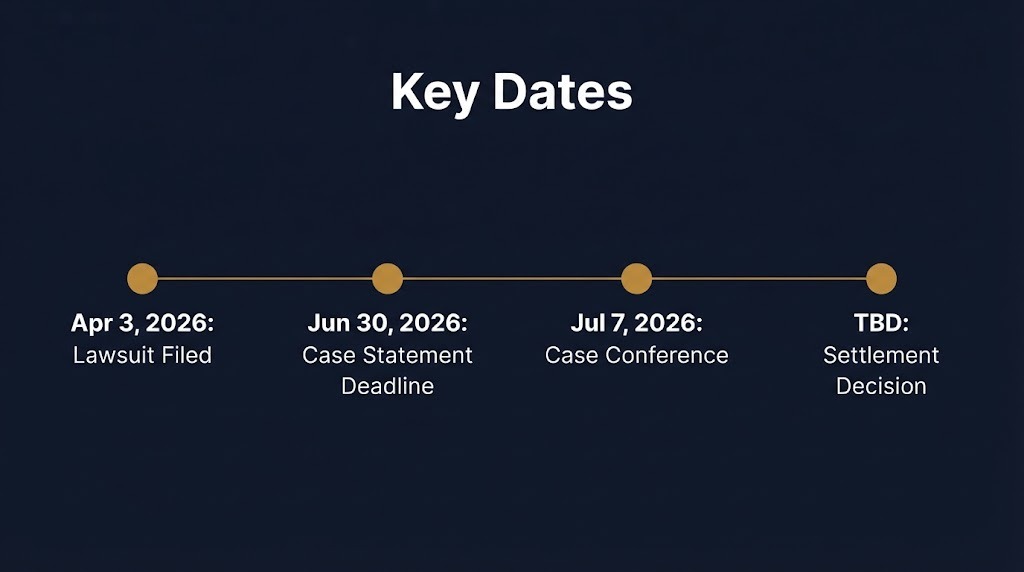
Key detail: a case management conference took place July 7, 2026, following a case management statement deadline of June 30, 2026. That’s a routine early-stage scheduling step, not a settlement milestone.
Is the Chime Settlement Legit, or Could It Be a Scam?
Right now, any website claiming to process a Chime settlement claim is not legitimate. There’s no claims process to join because no settlement exists.
This distinction matters because scam sites often launch the moment a company makes headlines. They copy real case details to look credible, then collect your personal information under the guise of a claim form.
A genuine settlement notice will only come after a court grants preliminary approval and appoints a claims administrator. Until then:
- No legitimate site will ask for your Social Security number to “check eligibility.”
- No court-approved claim form exists for the April 2026 breach case.
- Legitimate updates come from the official court docket, not unsolicited texts.
If you get a message claiming otherwise, treat it as a red flag rather than good news.
How Much Money Could the Chime Settlement Pay Per Person?
No confirmed payout figure exists, because no settlement has been reached. Any number you see quoted online is an estimate, not a court-verified amount.
Some legal-news sites have floated a range of roughly $50 for basic disruption claims up to $500 or more for documented financial harm. That range is based on comparable fintech data breach settlements elsewhere, not on any figure tied to this specific case.
Real payout amounts in class actions like this typically depend on three things: the size of the eventual settlement fund, how many people file valid claims, and whether you can document actual financial loss. A locked-out account with no direct cost usually pays less than a documented late fee or missed bill payment.
Key Takeaway: No Chime settlement fund exists yet, so treat every payout number circulating online as a rough estimate, not a promise.
What Are the Estimated Chime Settlement Payout Tiers?
There are no confirmed payout tiers because no settlement structure has been finalized. This section will only apply once a court approves a deal.
In comparable fintech and data breach cases, settlements often use a two-tier structure. A flat payment goes to anyone in the class, and a higher, document-based payment goes to people who can prove specific losses.
| Tier (illustrative only, not confirmed) | Who it might cover |
|---|---|
| Base payment | Anyone confirmed in the affected class |
| Documented loss payment | Customers who show bank fees, missed payments, or other direct costs tied to the April 1 outage |
Treat this table as a pattern from other cases, not a Chime number. Nothing here is confirmed for this lawsuit.
Who May Qualify for a Future Chime Settlement?
You may qualify if you were a Chime account holder affected by the April 1, 2026, outage or data exposure. That’s the class described in the current complaint, though it hasn’t been certified by a court yet.
The lawsuit’s proposed class covers U.S. residents whose personally identifiable information was compromised in the breach. It also names people who lost access to funds during the outage itself, even without confirmed data exposure.
You may have a stronger potential claim if you can show:
- You held an active Chime account on April 1, 2026.
- You experienced a login failure, black screen, or outdated balance that day.
- You missed a bill, incurred a fee, or lost access to a paycheck deposit because of it.
- You received any notice from Chime referencing the outage or a security issue.
- You still have screenshots, bank records, or app error messages from that period.
None of this guarantees eligibility for payment. It only describes who the lawsuit currently aims to represent.
Reality Check: No legitimate settlement fund will ever text you first asking for banking details to “verify” a payment. Filing a real class action claim is always free, and paying any third party to “process” your Chime claim right now is unnecessary since no claim form exists.
Chime Settlement Application: How to File When the Time Comes
There’s no Chime settlement application available right now, because no settlement has been approved. This section covers what filing will likely look like if the case resolves.
Once a court grants preliminary approval, a claims administrator gets appointed and an official settlement website goes live. That’s the moment an actual application opens, not before.
Based on how similar fintech settlements have unfolded, expect this general sequence:
- Court grants preliminary settlement approval.
- A settlement administrator sets up an official claims website.
- Class members get notice by email, mail, or both.
- You submit a claim form online or by mail before the deadline.
- You may need to select a payment tier, basic or documented loss.
- The court holds a final approval hearing.
- Approved payments go out by check or direct deposit afterward.
Key Takeaway: There’s no live Chime settlement application yet, so anything asking you to “apply now” for this case should be treated as false.
What Documents Should You Save Now for a Chime Claim?
You should start collecting documentation now, even though no claim form exists yet. Doing this early can strengthen a future claim if a settlement is reached.
Useful records include account statements from around April 1, 2026, screenshots of login errors or outdated balances, and any Chime app notifications from that period. Bank fee notices or bounced payment records tied to the outage matter too.
A helpful comparison: this is like keeping a receipt for a store return you might need to make later. You don’t know yet if you’ll need it, but it costs nothing to hold onto and can’t be recreated after the fact.
- Screenshots of app errors or outdated balances
- Emails or texts from Chime referencing the outage
- Bank or billing records showing a fee, late charge, or missed deposit
- Any correspondence with Chime customer service about the incident
When Is the Chime Settlement Deadline?
There is no Chime settlement deadline right now, because no settlement or claims process exists. Any specific date circulating online for this case should not be trusted.
Once a settlement is approved, claim windows in comparable class actions typically stay open for 90 to 120 days. That’s a general pattern from similar cases, not a confirmed date for this one.
The safest move is to check the official court docket or the eventual official settlement website directly, rather than relying on secondhand claims about deadlines. Class action deadlines are strict once set, and courts rarely grant extensions to individual latecomers.
What Is the Latest Chime Lawsuit Update?
The most recent confirmed update, as of mid-July 2026, is that the case remains in early litigation with no settlement or trial date. A case management conference occurred July 7, 2026.
Separately, Chime faces an unrelated lawsuit filed June 2, 2026, in the U.S. District Court for the Southern District of New York. That case, brought by J.D. Power, involves a trademark and advertising dispute over Chime’s “America’s #1 choice for banking” marketing claim. It is not a consumer class action and does not create a consumer claims process.
Chime has also publicly disputed the breach allegations, stating the April 1 incident only affected its marketing website with no impact to member account information. That directly contradicts what the plaintiffs allege in their complaint, so the two sides remain far apart on basic facts of the case.
Key Takeaway: As of the latest confirmed court activity, no settlement talks, class certification, or trial date have been publicly reported in the Chime data breach case.
What Is the Status of the Chime Data Breach Case in Court?
The case sits in early-stage federal litigation, past the initial filing but before class certification or settlement. That’s the confirmed status as of the most recent public court records.
Multiple related complaints over the same April 2026 incident are consolidated in front of the same Northern District of California court. Plaintiffs are represented by attorney Carly M. Roman of Strauss Borrelli PLLC, according to the original complaint filed April 3, 2026.
The lawsuit alleges negligence, breach of contract, and violations of the California Consumer Privacy Act and California’s Unfair Competition Law. Plaintiffs are seeking class certification, damages, injunctive relief requiring stronger cybersecurity, and attorneys’ fees.
Did Chime Already Pay a Settlement to Customers? The CFPB Order Explained
Yes, but it’s a separate and already-resolved matter, not the 2026 data breach case. In May 2024, the Consumer Financial Protection Bureau ordered Chime to pay consumer redress over delayed account-closure refunds.
That consent order required Chime to pay at least $1.3 million in redress to harmed consumers, plus a $3.25 million civil penalty to the CFPB’s victims relief fund. Chime distributed those payments directly using its own account records, without a separate public claims process.
This is worth knowing because forum threads sometimes conflate the CFPB action with a current “Chime settlement.” They’re not the same case. If you’re owed money under the 2024 CFPB order and never received a check, contact Chime or file a complaint through the CFPB directly.
California regulators have also acted against Chime separately. In 2021, the state’s Department of Financial Protection and Innovation required Chime to stop using certain banking terminology. A February 2024 DFPI consent order addressed complaint-handling practices with a $2.5 million penalty.
What Happened in the April 2026 Chime Data Breach?
On April 1, 2026, a cybercriminal group tracked as Team 313 allegedly attacked Chime’s servers, triggering a widespread service outage. Thousands of customers reported being locked out of their accounts that day.
At peak disruption, outage-tracking platforms logged more than 16,000 user reports, with the lawsuit estimating roughly 20,000 or more affected users overall. Because Chime operates entirely through its app with no physical branches, many customers had no alternative way to reach their money.
Users described black screens, outdated balances from prior days, and stalled ACH transfers. Some couldn’t pay rent or cover bills that were due that day. It’s a bit like a store losing your gift card balance at checkout, except this was someone’s entire paycheck.
Key Takeaway: The core harm alleged isn’t just data exposure. It’s the outage itself, which cut off tens of thousands of people from money they needed that day.
Why Is Chime Being Sued?
Chime is being sued because plaintiffs allege the company failed to protect customer data and failed to keep its systems running during the attack. Those are two distinct legal theories in the same case.
The complaint alleges negligence, arguing Chime didn’t maintain adequate cybersecurity safeguards despite its own privacy notice promising protection. It also alleges breach of contract and violations of California’s Consumer Privacy Act and Unfair Competition Law.
Plaintiffs argue Chime knew, or should have known, how sensitive the personal data it stores really is. The case notes Chime’s privacy notice explicitly commits to safeguarding customer information, a claim the plaintiffs say the company didn’t back up in practice.
Who Is Team 313?
Team 313 is a cybercriminal group that claimed responsibility for the April 1, 2026, attack on Chime’s systems. Different cybersecurity firms track the same group under different names.
Check Point refers to the group as Void Manticore, Microsoft calls it Storm-0842, and CrowdStrike labels it BANISHED KITTEN. Reporting has linked the group to Iran, while some case summaries describe it as Iraq-based, so the exact origin isn’t fully settled across sources.
The group posted claims of responsibility on its own leak site and on social media following the outage. Chime, for its part, has disputed the scope of what the attackers actually accessed.
What Other Lawsuits Is Chime Facing in 2026?
Beyond the data breach case, Chime faces at least two other notable legal matters in 2026. Neither one creates a consumer claims process right now.
The first is a trademark and false-advertising lawsuit filed by J.D. Power on June 2, 2026, in the Southern District of New York. It alleges Chime misused J.D. Power’s name and survey data in marketing claiming it was “America’s #1 choice for banking.”
The second is a separate dispute under Washington State’s Consumer Electronic Mail Act, alleging Chime sent unsolicited text messages to consumers. That matter is distinct from both the data breach case and the J.D. Power suit.
Key Takeaway: Chime is fighting legal battles on three separate fronts in 2026, but only the data breach case currently affects everyday customers directly.
What Happens Next
April 3, 2026: Lead complaint filed in the Northern District of California.
June 30, 2026: Case management statement deadline in the lead case.
July 7, 2026: Initial case management conference held.
Expected, no confirmed date: Class certification motion and briefing.
Expected, no confirmed date: Settlement talks, if any, followed by preliminary court approval and a public claims process.
Frequently Asked Questions
Is the Chime settlement real or a scam?
No confirmed Chime settlement exists yet, so any site claiming to process a claim right now is not legitimate.
Wait for an announcement tied to the official court docket or a court-appointed administrator.
How much money will I get from the Chime settlement?
No amount is confirmed, since no settlement has been reached.
Numbers like $50 to $500 circulating online are estimates based on other fintech cases, not verified figures for this one.
When will Chime settlement checks be mailed?
No payment date exists because no settlement has been approved.
Checks typically go out only after a final approval hearing, which hasn’t been scheduled.
Do I need a lawyer to file a Chime claim?
You generally don’t need one to file a standard class action claim once a form is available.
An attorney may help if you suffered significant, well-documented financial harm.
What is Chime being sued for?
Chime is being sued over an alleged April 2026 data breach and the account outage that came with it.
Claims include negligence, breach of contract, and California privacy law violations.
Is my Chime data breach claim the same as the CFPB payment?
No, they’re separate matters.
The CFPB case from 2024 involved delayed account-closure refunds and was already resolved with direct payments from Chime.
What if I never got a notice about the Chime lawsuit?
That’s expected right now, since no class has been certified and no notices have gone out.
If a settlement is approved later, notice usually goes to the email or address on file with Chime.
Where can I check the official Chime settlement status?
Check the federal court docket for case number 3:26-cv-02924 in the Northern District of California.
Once a settlement exists, an official settlement website will be the reliable source, not third-party claim sites.
There’s no Chime settlement to file for today, only an active lawsuit working its way through federal court. Save your April 2026 account records now, and check the official court docket rather than trusting unsolicited claim links.
Watch for the next real milestone: any move toward class certification or settlement talks in the Northern District of California case, 3:26-cv-02924.