Total Compensation 2026: What It Actually Includes and Why Your Paycheck Is Not the Whole Story
Quick Answer
- Total compensation includes salary, bonuses, benefits, retirement contributions, equity, and employer-paid taxes.
- Your paycheck is only the cash portion. The rest is paid on your behalf, not to you.
- Knowing your total compensation matters for salary negotiations, job offers, and understanding what you actually earn.
You look at your paycheck and see a number. Then you look at your job offer and see a different number. Then your employer says you cost much more than you think. All three are true. The difference is total compensation.
Most workers think about salary. Employers think about total cost. The gap between those two numbers is where retirement contributions, health insurance premiums, payroll taxes, and bonuses live. You do not see most of it in your bank account. That does not mean it is not real money.
This article explains what total compensation includes, how to calculate yours, and why it matters when you negotiate, compare offers, or file a claim where your earnings are at issue. No fluff. Just the verified breakdown.
The Facts
| Fact | Verified Value |
|---|---|
| Concept | Total compensation |
| Core Components | Salary, bonuses, benefits, retirement, equity, taxes |
| Employer-Paid Taxes | Social Security 6.2%, Medicare 1.45%, unemployment taxes |
| Typical Benefits Share | 30% to 40% of total compensation on average |
| Legal Context | Used in wage claims, workers compensation, discrimination damages |
| Calculation Basis | Annualized value of all direct and indirect pay |
What is total compensation?
Total compensation is the complete value of everything an employer pays for your work. It is not just your salary. It is your salary plus every benefit, bonus, retirement contribution, equity grant, and employer-paid tax.
The term matters because it changes the conversation. When an employer says the job pays $70,000, the total compensation may be $95,000. The extra $25,000 is health insurance, retirement match, paid time off, and payroll taxes. You never see that money in your checking account, but it is part of what the job costs.
Total compensation is also a legal concept. Courts use it to calculate damages in wage claims, discrimination cases, and workers compensation matters. If your earnings are at issue, the number that matters is not your paycheck. It is the full value of what the employer provided.
Key Takeaway: Your salary is the visible part of your pay. Total compensation is the full picture.
What does total compensation include?
The components of total compensation fall into two buckets. Direct compensation is money paid to you or on your behalf. Indirect compensation is the value of benefits and perks.
Direct compensation includes:
- Base salary or hourly wages.
- Bonuses and commissions.
- Overtime pay.
- Equity compensation like stock options or restricted stock units.
- Profit sharing.
Indirect compensation includes:
- Health, dental, and vision insurance.
- Retirement contributions, including employer match.
- Paid time off, sick leave, and holidays.
- Life and disability insurance.
- Tuition reimbursement.
- Employee assistance programs.
Employer-paid taxes are a separate category. Your employer pays 6.2 percent of your wages for Social Security and 1.45 percent for Medicare. Unemployment taxes vary by state.
How is total compensation different from salary?
Salary is the fixed amount you are paid each pay period. Total compensation is salary plus everything else. The difference can be substantial.
A $60,000 salary can easily become $80,000 in total compensation once you add health insurance, retirement match, paid time off, and employer taxes. The salary is what you see. The total is what the employer budgets.
This is like a car’s sticker price versus the total cost of ownership. The sticker price is the salary. Insurance, maintenance, fuel, and registration are the benefits and taxes. The total is what you actually pay to drive the car.
How do I calculate my total compensation?
You can calculate your total compensation by adding every component. Start with your base salary. Then add the value of each benefit and the employer’s tax payments.
Here is a sample calculation for a $60,000 salary:
| Component | Annual Value |
|---|---|
| Base salary | $60,000 |
| Health insurance (employer share) | $7,200 |
| Retirement match (4 percent) | $2,400 |
| Paid time off (10 days) | $2,307 |
| Bonuses (estimated) | $3,000 |
| Employer Social Security (6.2 percent) | $3,720 |
| Employer Medicare (1.45 percent) | $870 |
| Total Compensation | $79,497 |
The salary is $60,000. The total compensation is nearly $80,000. The difference is real money that you benefit from, even though you never see most of it in cash.
Why does total compensation matter in a lawsuit?
Total compensation matters in many legal contexts. Courts and agencies use it to calculate damages, lost wages, and benefit entitlements.
In a wage and hour case, the question may be whether your employer properly calculated your overtime rate. The regular rate includes bonuses and some benefits, not just base pay. Underpaying the regular rate means underpaying overtime.
In a discrimination case, lost compensation includes salary, bonuses, retirement contributions, and the value of benefits you lost. A court will not limit your damages to your paycheck. It will look at the full compensation package.
In a workers compensation claim, your average weekly wage may include bonuses, commissions, and some benefits. The higher your total compensation, the higher your weekly benefit. Getting the calculation wrong costs you money.
Key Takeaway: The number on your W-2 is not always the number that matters in a legal case.
What is the employer’s share of payroll taxes?
Your employer pays taxes on your wages. These are called the employer’s share of payroll taxes. They are part of your total compensation even though they never appear on your pay stub.
The federal taxes are:
- Social Security: 6.2 percent of wages up to the annual wage base.
- Medicare: 1.45 percent of all wages, with an additional 0.9 percent on wages above a threshold.
- Federal unemployment tax: 6.0 percent on the first $7,000 of wages, with credits that usually reduce the effective rate.
State unemployment taxes vary. Some states also impose disability insurance taxes. The total employer tax burden is typically 8 to 10 percent of wages.
What is the difference between total compensation and total rewards?
Total rewards is a broader term. It includes total compensation plus non-financial benefits like career development, flexible work arrangements, recognition programs, and company culture.
Total compensation is the financial value. Total rewards is the financial value plus the intangible benefits. Employers use total rewards to market the full employment experience. Employees should focus on total compensation first, then consider the intangibles.
A job with a lower total compensation may offer better total rewards if it includes remote work, flexible hours, or career growth. But those intangibles do not pay your rent. The financial value matters most for most people.
How do employers use total compensation in job offers?
Employers use total compensation to make job offers sound better. An offer letter may list a salary of $75,000 and a total compensation of $95,000. The difference is the value of benefits and bonuses.
The practice is not deceptive by itself. The benefits do have real value. But you should not confuse a total compensation number with cash. You cannot spend your health insurance premium. You can spend your salary.
When comparing offers, ask for a breakdown. What is the base salary? What is the bonus target? What is the value of each benefit? What is guaranteed versus discretionary? The details matter more than the headline number.
Key Takeaway: A big total compensation number is good. A clear breakdown is better.
What is equity compensation?
Equity compensation is an ownership interest in the company. It can be stock options, restricted stock units, or actual shares. It is a significant part of total compensation at many tech companies and startups.
The value of equity is uncertain. A stock option gives you the right to buy shares at a set price. If the company’s stock rises above that price, the option has value. If it does not, the option is worthless.
Restricted stock units are simpler. You receive shares when they vest. The value depends on the stock price on the vesting date.
When calculating your total compensation, count equity at its current value or expected value. But remember that equity is not cash. It can go up, go down, or become worthless.
What happens to my total compensation if I leave my job?
Most components end when you leave. Your salary stops. Your health insurance may continue for a limited time under COBRA, but you pay the full premium. Your retirement account balance is yours to keep or roll over.
Equity compensation depends on vesting. Unvested options or restricted stock units are usually forfeited when you leave. Vested shares are yours. Some companies accelerate vesting on departure, but that is the exception, not the rule.
Your final paycheck should include all earned wages and accrued but unused paid time off, if your state requires it. The employer’s share of payroll taxes ends when your employment ends.
How does total compensation affect a severance negotiation?
Severance is usually based on salary, not total compensation. A typical package offers a few weeks or months of salary continuation. It rarely includes the value of benefits or bonuses unless you negotiate for it.
You can negotiate for continued health insurance coverage. You can negotiate for a pro-rated bonus or accelerated equity vesting. Those items increase the value of your severance beyond the salary component.
Knowing your total compensation gives you leverage. It tells you what you are actually losing when you leave. That knowledge is power in any severance discussion.
What is the average benefits share of total compensation?
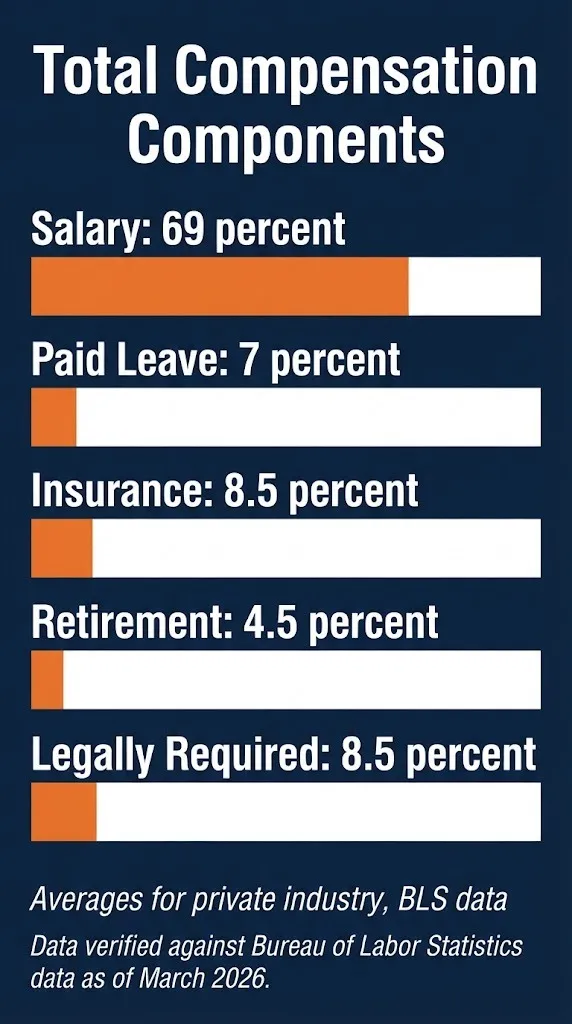
The U.S. Bureau of Labor Statistics reports that benefits make up about 30 to 31 percent of total employer compensation costs for private industry workers. The number varies by industry and job type.
Here is the verified breakdown for private industry workers:
| Component | Share of Total Compensation |
|---|---|
| Wages and salaries | 69.0% |
| Benefits | 31.0% |
| Paid leave | 7.0% |
| Insurance | 8.5% |
| Retirement | 4.5% |
| Legally required benefits | 8.5% |
These are averages. Your specific share depends on your employer, your industry, and your benefits package.
Key Takeaway: Benefits are not a perk. They are roughly a third of what your employer pays for your work.
Reality Check
No employer is going to volunteer a higher salary just because you understand total compensation. Understanding the number is not the same as negotiating it. The total compensation figure is most useful as a comparison tool and a negotiation baseline. It tells you what you are worth to the employer. Use that information in your next review, offer negotiation, or legal claim. But do not expect your employer to care that you understand the math.
What Happens Next
| Timeline | Expected Stage |
|---|---|
| Now | Pull your pay stub and benefits summary |
| This month | Calculate your total compensation |
| Before negotiation | Compare your total against market data |
| At review time | Present your value using the full number |
| If legal claim | Use total compensation as your damages basis |
These steps apply whether you are negotiating a salary, comparing offers, or calculating damages in a claim.
Frequently Asked Questions
What is total compensation?
It is the full value of everything an employer provides for your work, not just salary.
What does total compensation include?
Salary, bonuses, benefits, retirement contributions, equity, and employer-paid taxes.
How is total compensation different from salary?
Salary is the cash portion. Total compensation includes benefits and taxes.
How do I calculate my total compensation?
Add your salary, bonus, benefits value, retirement match, and employer taxes.
Why does total compensation matter in a lawsuit?
Courts use it to calculate lost wages, damages, and workers compensation benefits.
What is the employer’s share of payroll taxes?
Social Security and Medicare taxes, plus state and federal unemployment taxes.
What is equity compensation?
Stock options or restricted stock units that give you ownership in the company.
What percentage of total compensation is benefits?
About 30 to 31 percent for private industry workers on average.
The Number on Your Paycheck Is Not the Whole Story
You earn more than you think. The employer pays more than you see. The difference is total compensation, and it matters in every conversation about your pay, your benefits, and your legal rights.
Calculate yours. Know the number. Use it.