Workers Compensation Insurance Cost 2026: What Employers Pay, What Drives Rates, and How to Lower Your Premium
Quick Answer
- Workers compensation insurance costs roughly $1 per $100 of payroll on average nationally.
- Your rate depends on your state, your job classification code, your payroll, and your claims history.
- A single serious claim can raise your premium for years through the experience modifier.
You are a business owner. You got your workers compensation renewal. The premium went up. You do not understand why. You want to know what drives the cost and how to get it down.
This article explains the verified factors behind workers compensation pricing. It covers the classification system, the experience modifier, state differences, and the levers you can pull to reduce what you pay. No sales pitch. Just the numbers and how they work.
The cost matters because workers compensation is mandatory in most states. You cannot opt out. The question is not whether you pay. The question is how much, and whether you are paying more than you should.
The Facts
| Fact | Verified Value |
|---|---|
| National Average Cost | About $1 per $100 of payroll |
| Typical Range | $0.50 to $3.00 per $100 of payroll |
| Primary Cost Drivers | Classification code, payroll, claims history, state |
| Experience Modifier Impact | Up to 25 percent discount or surcharge |
| Payroll Audit | Annual, can adjust premium retroactively |
| Payment Options | Annual, semi-annual, quarterly, or pay-as-you-go |
What is the average cost of workers compensation insurance?
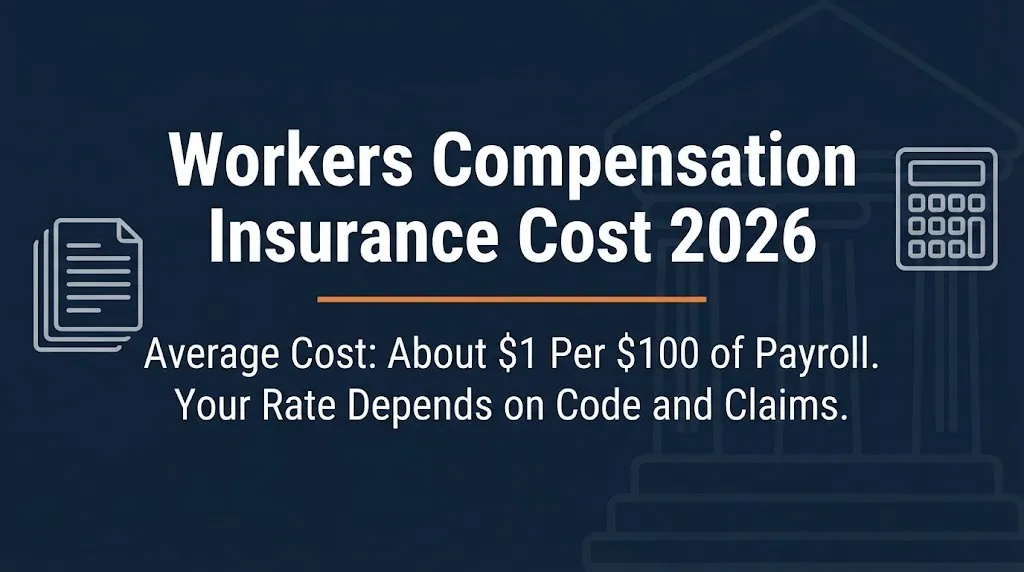
The national average is roughly $1 per $100 of payroll. That means a business with $100,000 in payroll pays about $1,000 per year, before experience modifications.
The average hides a wide range. A low-risk clerical business may pay $0.50 per $100. A high-risk roofing company may pay $3.00 per $100 or more. The classification code and state rate determine where you fall.
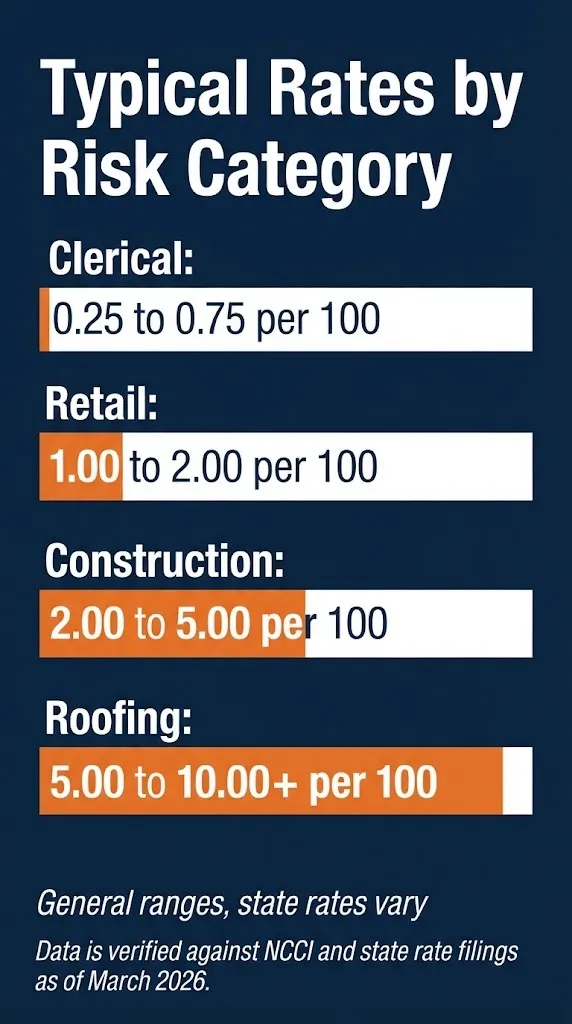
Here is a verified cost range by risk category:
| Risk Category | Typical Rate per $100 |
|---|---|
| Clerical and office | $0.25 to $0.75 |
| Retail and restaurant | $1.00 to $2.00 |
| Construction and trades | $2.00 to $5.00 |
| Roofing and high-risk | $5.00 to $10.00+ |
These are general ranges. Your actual rate depends on your state, your specific classification, and your claims history.
Key Takeaway: The average is not your number. Your number depends on what your employees actually do.
What factors determine workers compensation insurance cost?
Four factors drive your premium. The first is your classification code. Each code carries a base rate set by your state’s rating bureau. Riskier work means a higher rate.
The second is your payroll. The premium is calculated per $100 of payroll. More payroll means more premium. The calculation is simple multiplication.
The third is your experience modifier. This is a multiplier based on your claims history compared to other businesses in your industry. A clean history earns a discount. A bad history earns a surcharge.
The fourth is your state. Each state has its own rate structure, benefit levels, and regulatory environment. The same business pays different rates in different states.
Here is the formula in simple terms:
- Premium = (Payroll ÷ 100) × Classification Rate × Experience Modifier
- Then add state taxes and fees.
How does the experience modifier affect my premium?
The experience modifier, often called the e-mod or ex-mod, compares your claims to the average for your industry. A modifier of 1.00 is average. Below 1.00 is better. Above 1.00 is worse.
A modifier of 0.75 means you pay 25 percent less than the standard rate. A modifier of 1.25 means you pay 25 percent more. The modifier recalculates annually based on your rolling claims history.
A single serious injury can push your modifier up for three years. Workers compensation claims stay in your experience period for multiple years. The financial impact outlasts the injury itself.
Here is how a modifier changes a $10,000 base premium:
| Modifier | Premium |
|---|---|
| 0.75 | $7,500 |
| 1.00 | $10,000 |
| 1.25 | $12,500 |
| 1.50 | $15,000 |
Key Takeaway: Your claims history is the one factor you can control most directly. Fewer claims means a lower modifier.
How do classification codes affect workers compensation cost?
Classification codes group jobs by risk. Each code has a rate per $100 of payroll. The code is assigned based on what your employees actually do, not what your business is called.
A misclassification can cost you real money. If your workers are classified as a higher-risk code, you overpay. If they are classified lower and the audit catches it, you owe back premium.
Common codes and their relative risk:
| Code | Description | Risk Level |
|---|---|---|
| 8810 | Clerical office | Low |
| 8017 | Retail store | Moderate |
| 9082 | Restaurant | Moderate to high |
| 5645 | Carpentry | High |
| 5551 | Roofing | Very high |
Check your policy declarations page. Confirm the code matches the work. If it does not, contact your insurer for a review.
What is a payroll audit and how does it affect my cost?
Workers compensation policies are audited annually. The insurer reviews your actual payroll and operations. If your payroll was higher than estimated, you owe additional premium. If lower, you get a refund.
The audit also checks classification codes. If the auditor finds that your employees were misclassified, the insurer reclassifies you retroactively. That can create a surprise bill.
Here is how the audit works:
- The insurer sends an audit request after the policy year ends.
- You provide payroll records, tax filings, and job descriptions.
- The auditor calculates your actual payroll by classification.
- The premium is adjusted up or down based on actuals.
- You pay the difference or receive a credit.
Accurate records make the audit painless. Poor records invite disputes.
How can I lower my workers compensation insurance cost?
You can lower your premium through risk management, accurate classification, and claims control. The levers are practical, not mysterious.
Here are the verified strategies:
- Implement a formal safety program with documented training.
- Investigate every incident immediately and correct hazards.
- Report claims promptly and manage return-to-work programs.
- Review your classification codes for accuracy.
- Maintain accurate payroll records separated by classification.
- Shop your policy through multiple insurers at renewal.
- Ask about premium credits for safety programs or drug-free workplaces.
- Consider a pay-as-you-go plan to match premium to actual payroll.
These steps reduce both the frequency and severity of claims. Over time, they lower your experience modifier and your base rate.
Key Takeaway: The cheapest workers compensation policy is the one with no claims.
How does workers compensation cost vary by state?
State differences are significant. Each state sets its own benefit levels, fee schedules, and rate structures. Some states are monopolistic, meaning the state fund is the only option.
Here is a verified comparison of average rates for selected states:
| State | Rate per $100 of Payroll |
|---|---|
| California | $1.85 |
| New York | $1.55 |
| Texas | $0.75 |
| Florida | $1.10 |
| Illinois | $1.20 |
These are approximate averages across all classifications. Your specific rate depends on your code and claims history.
What is the difference between workers compensation insurance and other business insurance?
Workers compensation covers work-related injuries and illnesses. It pays medical bills, lost wages, and disability benefits. It is mandatory in most states.
General liability insurance covers third-party claims like customer injuries or property damage. It does not cover employee injuries. Commercial auto covers vehicles. Property insurance covers your building and equipment.
They are separate policies with separate premiums. Workers compensation is often the most expensive because the benefits are statutory and the risk is continuous.
Do sole proprietors need workers compensation insurance?
It depends on the state and the work. Some states exempt sole proprietors. Others require coverage if you have any employees. Even if coverage is optional for you, some clients may require it as a condition of a contract.
If you are a sole proprietor without employees, check your state’s rules. Some states allow you to opt out. Others require coverage regardless. The cost is based on your payroll, which may be minimal if you have no employees.
What happens if I do not carry workers compensation insurance?
The consequences are severe. In most states, failing to carry required coverage is a violation of law. Penalties include fines, stop-work orders, and personal liability for employee injuries.
If an employee is injured and you have no coverage, you pay the medical bills and lost wages out of pocket. You may also face criminal charges in some states. The risk is not worth the premium savings.
Key Takeaway: The cost of coverage is always cheaper than the cost of an uninsured injury.
How does a workers compensation claim affect my premium?
A claim affects your experience modifier for three years in most states. The more severe the claim, the bigger the impact. A small medical-only claim has less effect than a lost-time claim with surgery and disability.
The modifier compares your actual losses to expected losses for your classification. If your losses exceed expectations, your modifier rises. If they are lower, your modifier falls.
Here is the typical impact timeline:
| Year | Impact |
|---|---|
| Claim year | No immediate effect on current policy |
| Year 1 after claim | Modifier increases at renewal |
| Year 2 after claim | Modifier still elevated |
| Year 3 after claim | Modifier begins to return to normal |
What is a pay-as-you-go workers compensation plan?
A pay-as-you-go plan calculates premium based on actual payroll each pay period. Instead of an annual estimate, you pay as you go. The premium adjusts in real time.
This option helps cash flow. You do not tie up capital in an annual premium. You also avoid a surprise audit bill because the premium already matches actual payroll.
Most insurers offer pay-as-you-go through a payroll service integration. The cost is the same. The timing is different.
Reality Check
No one will call you to lower your workers compensation premium out of the blue. Legitimate insurers and brokers do not make unsolicited calls promising instant savings. If someone claims they can cut your premium without seeing your payroll and claims history, they are selling a lead, not a policy. Real premium reduction comes from safety, accuracy, and time. There is no shortcut.
What Happens Next
| Timeline | Expected Stage |
|---|---|
| Now | Review your policy declarations and classification codes |
| Before renewal | Implement safety and return-to-work programs |
| At renewal | Shop multiple insurers and compare quotes |
| After policy year | Complete the payroll audit accurately |
| Annually | Monitor your experience modifier and claims history |
These steps are standard practice. The payoff compounds over time.
Frequently Asked Questions
What is the average cost of workers compensation insurance?
About $1 per $100 of payroll nationally, with a wide range by industry.
What factors determine my workers compensation premium?
Your classification code, payroll, claims history, and state rates.
How does the experience modifier work?
It compares your claims to your industry average. Above 1.00 means a surcharge.
How can I lower my workers compensation cost?
Improve safety, manage claims, verify classification codes, and shop your policy.
What is a payroll audit?
An annual review of your actual payroll and operations that adjusts your premium.
Do I need workers compensation for myself as a sole proprietor?
It depends on your state. Some exempt sole proprietors, others require coverage.
What happens if I do not have workers compensation?
Fines, stop-work orders, and personal liability for employee injuries.
How long does a claim affect my premium?
Typically three years through the experience modifier.
The Cheapest Policy Is the One With No Claims
You cannot negotiate away the classification rate. You cannot hide payroll. The state sets the rules. What you control is your safety record, your claims management, and your accuracy.
A clean claims history is the best discount in workers compensation. It compounds year after year. Build it, protect it, and your premium will follow.