Structured Settlement Debt Collector Lawsuits: 2026 Consumer Rights, Company Practices, and What to Watch
Quick Answer
- Structured settlement debt collector lawsuits are real, with multiple companies facing active court cases and CFPB enforcement actions.
- Consumers may recover statutory damages up to $1,000 per violation under federal debt collection law, with state laws sometimes higher.
- No universal claim deadline exists, but each active case has its own filing window and proof requirements.
If you have structured settlement payments and a debt collector is contacting you about them, you need to understand one thing immediately. Structured settlement payments are protected differently than regular income.
Those monthly or annual payments come from a personal injury settlement or similar legal resolution. They are not ordinary wages. Debt collectors cannot simply seize them the way they might garnish a paycheck.
This article covers the active lawsuits against structured settlement companies in 2026, what consumers may recover, and how to respond if a collector contacts you about your settlement funds.
The Facts
| Case | Multiple active structured settlement company lawsuits and regulatory actions |
|---|---|
| Status | Active litigation, some enforcement actions resolved |
| Fund Size | Varies by case, no single confirmed national fund |
| Est. Per Person | Up to $1,000 statutory damages under FDCPA, more under state laws |
| Claim Deadline | Varies by case, no universal deadline |
| Administrator | Varies by case, not yet confirmed for most active matters |
| Proof Needed | Payment records, collection notices, communication logs |
Are Structured Settlement Debt Collector Lawsuits Legitimate?
Structured settlement debt collector lawsuits are legitimate legal actions against companies that improperly pursue, seize, or interfere with protected settlement payments. They are not a single class action but a category of consumer protection cases.
The Consumer Financial Protection Bureau has taken multiple enforcement actions against structured settlement companies. State attorneys general have done the same. These are public, documented cases with real consumers behind them.
What makes these cases confusing is that the companies involved rarely call themselves debt collectors. They use names like “purchasing companies” or “factoring companies.” Their business model involves buying future structured settlement payments at a discount.
The legality of that business model is not the issue. The issue is how some of these companies treat consumers, what they disclose, and how they pursue money when payments get redirected.
What Is a Structured Settlement Company and Why Are They Being Sued?
A structured settlement company buys, sells, or manages payment streams from legal settlements. They are being sued in 2026 for practices that consumers and regulators say violate federal and state consumer protection laws.
The structured settlement industry grew out of personal injury settlements. Instead of receiving one large check, an injured person receives payments over years. Congress created tax incentives for these arrangements decades ago.
Problems arise when a person needs cash sooner. They might sell some future payments to a factoring company. That transaction requires court approval in most states. Some companies skip that step or mislead consumers about the consequences.
Active lawsuits in 2026 focus on several themes:
- Companies contacting consumers who never sold their payments
- Debt collection tactics against people who owed nothing
- Failure to disclose that selling payments reduces future income
- Unauthorized contact with structured settlement payment issuers
- Harassment of consumers who already sold payments and now face collection
How Much Can You Get from a Structured Settlement Company Lawsuit?
Consumers who win claims against structured settlement companies may receive statutory damages, actual damages, or both. Federal law caps statutory damages at $1,000 per violation under the Fair Debt Collection Practices Act.
State laws often allow more. California’s Rosenthal Act, for example, incorporates FDCPA protections and adds state remedies. Some states allow punitive damages in cases of egregious conduct.
Here is how potential recovery breaks down:
| Claim Type | Potential Recovery | Legal Basis |
|---|---|---|
| FDCPA violation | Up to $1,000 statutory damages per case | Federal law |
| State debt collection law | Often mirrors FDCPA, sometimes higher | State statutes |
| Actual damages | Lost payments, emotional distress, attorney fees | Common law claims |
| Class action share | Varies widely by settlement size and claimant count | Court-approved settlements |
Actual damages matter more than statutory amounts in many cases. If a company improperly intercepted a $5,000 structured settlement payment, your actual loss is $5,000. Statutory damages are extra.
Attorney fees are often recoverable under these laws. That means lawyers take these cases on contingency without upfront charges to consumers.
Key Takeaway: Statutory damages provide a baseline, but actual losses often drive higher recovery in structured settlement cases.
What Does the Fair Debt Collection Practices Act Cover?
The Fair Debt Collection Practices Act, called the FDCPA, protects consumers from abusive debt collection tactics. It applies to third-party debt collectors, not the original creditor in most cases.
Structured settlement companies sometimes cross the line into “debt collector” territory under the law. When they try to collect money from consumers, whether legitimately owed or not, they must follow FDCPA rules.
The FDCPA prohibits:
- Calling before 8 a.m. or after 9 p.m. local time
- Contacting you at work if you told them not to
- Threatening arrest, lawsuit, or wage garnishment they cannot legally do
- Lying about the amount you owe
- Contacting third parties about your debt without permission
- Harassing you with repeated calls
- Using profane or abusive language
A structured settlement company trying to recover payments it claims you owe is a debt collector under this law. Violations create individual claims and class action potential.
Can a Debt Collector Take Your Structured Settlement Payments?
A debt collector generally cannot directly seize structured settlement payments without a court order, and even then, state and federal laws protect these payments from most garnishment attempts.
Structured settlement payments come from a settlement agreement. They are not the same as wages. The issuing insurance company sends payments to you or to an account you designate. A debt collector does not have the power to intercept those payments without legal action.
However, if a court enters a judgment against you, the collector may try to garnish bank accounts. If your structured settlement payments land in a bank account, and that account is garnished, the payments can be frozen. This is where consumers face real risk.
The key distinction is between the payment itself and the account where it sits. The payment is protected. The bank account is not automatically protected. Some states exempt certain income from garnishment, but the protection is not automatic. You may need to assert it.
What Should You Do if a Debt Collector Contacts You About Structured Settlement Payments?
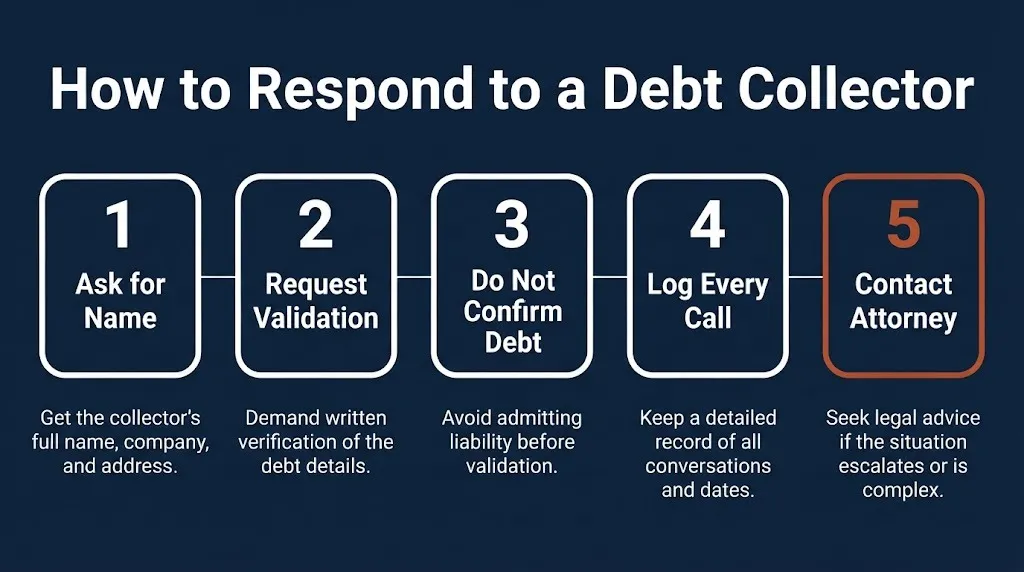
If a debt collector contacts you about structured settlement payments, take specific steps to protect your rights and build a case. Do not ignore the contact, but do not volunteer information either.
Follow these steps:
- Ask for the company’s name, address, and the purpose of the contact.
- Request a written validation notice, which the FDCPA requires within five days of first contact.
- Do not confirm or deny any debt over the phone.
- Do not provide your bank account information or structured settlement details.
- Send a written request that the company stop contacting you if you believe the debt is invalid.
- Keep a log of every call, including date, time, caller name, and what was said.
- Save all letters, emails, and text messages from the collector.
- Contact a consumer protection attorney to review your situation.
This is like a store return without a receipt. You need proof of what happened, when it happened, and who said what. Documentation wins these cases.
Key Takeaway: A validation notice is your first legal shield. If a collector refuses to provide one, that is itself a potential FDCPA violation.
Is There a Structured Settlement Company Class Action in 2026?
No single national structured settlement company class action settlement has been confirmed as of September 3, 2026. Multiple individual and putative class action cases are pending against various companies.
The structured settlement industry includes many companies operating under different names. They are not one entity. Lawsuits name specific defendants for specific practices.
Some active and recent matters involve companies that buy structured settlement payments. Others involve companies that finance the transactions. Still others involve collection agencies working on behalf of these companies.
The CFPB has brought enforcement actions naming specific companies for specific violations. Those actions sometimes result in consumer redress funds. When they do, the CFPB publishes the fund details and claim instructions.
If you received structured settlement payments and sold some or all of them, you may be a class member in a future or pending case. Check the official CFPB enforcement database and federal court records for current case names.
What Are the Signs a Structured Settlement Company Is Breaking the Law?
Structured settlement companies break the law in patterns that are easy to recognize once you know what to look for. The signs are not subtle.
Here are the red flags:
- Contacting you about payments you never agreed to sell
- Pressuring you to sell payments quickly with limited information
- Refusing to provide written disclosures about the transaction
- Failing to tell you that court approval is required
- Calling your insurance company or payment issuer without your knowledge
- Threatening consequences for not completing a sale
- Calling repeatedly or outside legal hours
- Contacting your family, employer, or references about your payments
- Claiming you owe money when you have no contract or judgment against you
Any of these actions may violate the FDCPA, state debt collection laws, or state structured settlement protection statutes. Many states require specific disclosures and a court hearing before any sale of structured settlement payments is valid.
Reality Check: No legitimate structured settlement company will demand money from you over the phone without sending written documentation first. Filing a complaint with the CFPB, the FTC, or your state attorney general costs nothing. Any “service” charging upfront fees to “stop debt collectors” or “protect your settlement” is unnecessary. Consumer protection lawyers take these cases on contingency.
What Are Structured Settlement Protection Acts?
Structured Settlement Protection Acts are state laws that require court approval before future settlement payments can be sold. They exist to protect injured people from being pressured into bad financial decisions.
Every state except a few has some version of this law. The laws vary in details but share a core requirement. A judge must determine that selling future payments is in the best interest of the seller.
The judge considers the seller’s financial situation, the reason for the sale, and whether the discount is reasonable. Companies often discount future payments by 10 to 40 percent. That means selling $10,000 in future payments might net you $6,000 to $9,000 today.
These laws matter for lawsuits because some structured settlement companies bypass the court process entirely. They structure transactions as loans or advances instead of sales. That allows them to avoid court review while achieving a similar economic result. Courts and regulators have increasingly rejected this workaround.
What Is the CFPB Doing About Structured Settlement Companies?
The Consumer Financial Protection Bureau has increased scrutiny of structured settlement companies in recent years. Enforcement actions target deceptive practices and illegal debt collection.
The CFPB has authority over consumer financial products and services. Structured settlement transactions often fall within that authority because they involve credit or debt collection. The bureau can bring enforcement actions, seek penalties, and order consumer redress.
Recent CFPB actions have focused on:
- Companies that misrepresented the nature of structured settlement transactions
- Failure to disclose fees and discount rates
- Illegal collection tactics against consumers
- Unauthorized withdrawals from consumer bank accounts
When the CFPB obtains a redress order, affected consumers receive notice. The notice comes through mail or email and directs them to a claim website. No upfront payment is ever required to participate.
What Happens Next in Structured Settlement Litigation?
The structured settlement litigation landscape continues evolving in 2026. Multiple cases are working through federal and state courts.
Late 2026: Several pending motions for class certification expected to be decided.
Early 2027: Potential CFPB enforcement actions against additional structured settlement companies.
2027: Any resulting settlements would trigger public notice programs and claim periods.
Ongoing: State legislatures may strengthen Structured Settlement Protection Acts in response to industry practices.
If you have a potential claim, do not wait for a class action. Individual FDCPA claims carry their own deadlines, typically one year from the violation. State law deadlines vary. An attorney can evaluate your specific situation now.
Frequently Asked Questions
Is my structured settlement protected from debt collectors?
Your structured settlement payments are protected from direct garnishment in most cases.
But money sitting in a bank account can be frozen if a collector has a judgment.
You may need to assert exemptions to protect those funds.
Can I sell my structured settlement payments?
You can sell structured settlement payments in most states, but you need court approval first.
The court must find that the sale is in your best interest.
Companies offering “loans” against payments may be trying to avoid this requirement.
What is the statute of limitations for suing a debt collector?
The FDCPA has a one-year statute of limitations from the date of the violation.
State debt collection laws may allow longer filing windows.
Contact an attorney promptly if you believe your rights were violated.
Do I need a lawyer to deal with a structured settlement company?
You are not legally required to have a lawyer, but these transactions and disputes are complex.
Consumer protection attorneys typically work on contingency for FDCPA claims.
Court approval for selling payments almost always requires legal representation in practice.
What damages can I recover for FDCPA violations?
You can recover up to $1,000 in statutory damages per FDCPA case.
Actual damages for financial losses or emotional distress are available.
Attorney fees and court costs can be recovered from the violating collector.
How do I report a structured settlement company?
You can file complaints with the CFPB, the FTC, and your state attorney general.
The CFPB complaint portal is free and takes minutes to use.
These complaints do not create a lawsuit but can trigger enforcement action.
Are structured settlement sales a scam?
Structured settlement sales are legal but heavily regulated.
The discount rate means you receive less than the future payments are worth.
Some companies use deceptive tactics to push transactions that are not in your interest.
What is a structured settlement factoring company?
A factoring company buys future payment rights at a discount.
The company pays you cash now and collects the future payments from the issuer.
These transactions require court approval under state Structured Settlement Protection Acts.
The Bottom Line
Structured settlement debt collector lawsuits are a real and growing area of consumer protection law in 2026. If a company is contacting you about payments you never agreed to sell, or using abusive tactics, you have legal options.
Your first move is documentation. Your second move is contacting a consumer protection attorney. Both cost nothing upfront.
The most important date is the date of the violation. FDCPA claims expire one year after the illegal conduct. Do not wait for a class action that may never come.