Paid in Full vs Settlement on Credit Report: What It Means in 2026
Quick Answer
- “Paid in full” means you repaid 100% of the debt; “settled” means the creditor accepted less than you owed.
- A settled account is reported as negative and stays on your credit report for about 7 years.
- If you can’t pay in full, settling is still better for your credit than leaving the debt unpaid.
If you’re staring at a debt you can’t fully repay, the choice between settling and paying in full feels impossible. You want to do the right thing for your credit, but your bank account says otherwise. The good news: there’s a clear answer, and it’s not as complicated as the credit bureaus make it seem.
The short version: paid in full is always better for your credit score. It tells lenders you honored your original agreement. Settled means you negotiated a reduced payoff, which is reported as a negative mark. But here’s what most people miss: settling is still vastly better than doing nothing at all.
This article breaks down exactly what each status means, how long they stay on your report, and the one thing you should never do when negotiating a settlement.
The Facts
| Status | Credit Report Notation |
|---|---|
| Paid in Full | “Paid in full” or “paid as agreed” |
| Settled | “Settled for less than the full amount” |
| Settled Impact | Negative mark, stays about 7 years |
| Paid in Full Impact | Positive or neutral |
| Settlement Clock | Starts from original delinquency date |
| Late Payments | Remain about 7 years regardless of payoff type |
Is Paid in Full Better Than Settlement for Your Credit?
Yes, paid in full is better for your credit than settlement. When you pay the entire balance you owe, the account is reported as “paid in full” or “paid as agreed,” which tells future lenders you met your obligation as originally promised .
A settled account, by contrast, is reported as “settled for less than the full amount” or “paid in full for less than the full balance” . This is considered negative information. It signals to lenders that you didn’t repay everything you agreed to.
The difference matters because your payment history is the single most important factor in your credit score. A “paid in full” status supports your score. A “settled” status drags it down.
That said, context matters. If your choice is between settling and not paying at all, settling wins every time. An unpaid debt can charge off, go to collections, and hurt your credit far worse than a settled account .
Does Debt Settlement Hurt Your Credit?
Yes, debt settlement hurts your credit, often significantly. The damage comes from two sources: the missed payments that typically precede settlement, and the “settled” notation itself .
Most creditors won’t negotiate a settlement unless you’re already behind on payments. That means you’ll have multiple late payments reported before you ever reach a settlement agreement. Each missed payment is a separate negative mark .
Then the settlement itself adds another negative notation. The combined effect can drop your credit score by 100 points or more, depending on where you started .
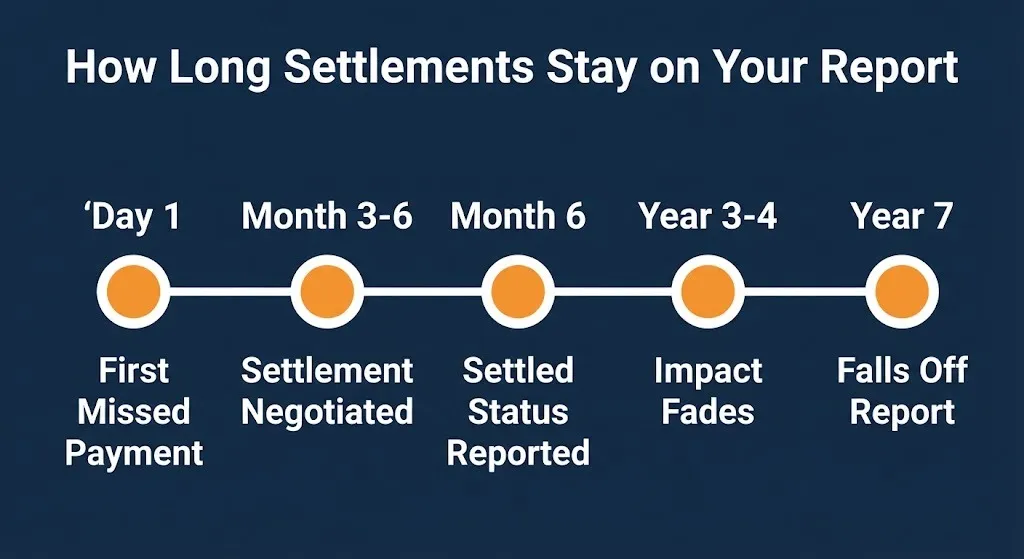
The good news is that the damage fades over time. As the negative marks age, their impact on your score diminishes. After about 7 years, they fall off your report entirely .
Key Takeaway: Settlement damages your credit through missed payments and the settled notation, but the damage is temporary and fades over time.
How Long Does a Settlement Stay on Your Credit Report?
A settled account stays on your credit report for about 7 years from the original delinquency date. That’s the date of the first missed payment that led to the settlement, not the date you actually settled .
This timing catches people off guard. If you were 18 months behind before settling, you don’t get a fresh 7 years. Roughly 5.5 years remain on the clock from the settlement date .
The clock works differently if the account was never late. If you settled an account that was still in good standing, the 7 years runs from the settlement date itself .
| Scenario | 7-Year Clock Starts |
|---|---|
| Account was delinquent before settlement | Original delinquency date |
| Account was current when settled | Settlement date |
| Late payments from before settlement | Original delinquency date for each |
Reality Check: No credit repair company can remove accurate negative information from your credit report. Anything they claim to do, you can do yourself for free. The FTC warns that companies promising to erase accurate settled accounts are running a scam . Disputing information you know is accurate is illegal and won’t work.
Paid in Full vs Settled in Full: What’s the Difference?
“Paid in full” and “settled in full” are not the same thing, despite the confusingly similar wording. “Paid in full” means you repaid 100% of the original balance. “Settled in full” means you paid the full amount of a negotiated settlement, which was less than what you originally owed .
This distinction trips up a lot of people. You might think “settled in full” sounds positive, like you completed something. But on your credit report, it’s still reported as a settlement, not a full repayment.
Only “paid in full” tells lenders you repaid everything. “Settled in full” still carries the negative connotation that you didn’t pay what you agreed to .
Should You Settle a Debt or Pay in Full?
You should pay in full if you can afford it and your credit score matters for upcoming financial goals. Settle only when full repayment isn’t realistic and the debt is already seriously delinquent .
Here’s how to decide:
- Pay in full if: You can afford it, your credit is still in decent shape, or you plan to apply for a mortgage or car loan soon.
- Settle if: You can’t afford the full balance, you’re already months behind, or the debt has been charged off or sent to collections.
The worst option is doing nothing. An unpaid debt will keep accruing interest, may lead to lawsuits, and will eventually drop off your credit report anyway, but only after years of damage .
How to Negotiate a Settlement on Your Own
You can negotiate a debt settlement yourself without hiring a third-party company. Creditors are often willing to negotiate directly with you because it saves them the cost of collection efforts .
Follow these steps:
- Confirm the debt is yours and the amount is accurate.
- Determine what you can afford to pay as a lump sum.
- Contact the creditor or collector directly.
- Explain your hardship honestly and briefly.
- Make an offer, typically 25% to 50% of the balance.
- Get the agreement in writing before paying anything.
- Never give bank account access or debit card numbers.
- Keep records of all communication and payments.
DIY settlement saves you the 15% to 25% fee that debt settlement companies charge . You also keep control of the process.
What Happens Next
When you settle: The account is reported as settled within 30 days. Negative marks remain for about 7 years.
As time passes: The impact of the settlement on your score diminishes gradually. New positive payment history helps offset the damage.
After 7 years: The settled account and associated late payments fall off your credit report entirely.
Going forward: Focus on on-time payments and low balances to rebuild your score.
Frequently Asked Questions
Is paid in full better than settled on your credit report?
Yes. Paid in full is reported as a positive or neutral status. Settled is reported as negative and tells lenders you repaid less than you owed .
How long does a settled account stay on your credit report?
A settled account stays on your credit report for about 7 years from the original delinquency date, not the settlement date .
Does debt settlement hurt your credit score?
Yes. Debt settlement hurts your score through missed payments and the settled notation. The impact can be significant but fades over time .
Can I negotiate a settlement myself?
Yes. You can contact creditors directly and negotiate a reduced payoff. This saves you the fees that debt settlement companies charge .
What’s the difference between paid in full and settled in full?
Paid in full means you repaid 100% of the original debt. Settled in full means you paid a negotiated amount that was less than what you owed .
Will settling a debt improve my credit score?
Settling won’t improve your score immediately, but it’s better than leaving the debt unpaid. Once negative marks age off, your score can recover .
Can I remove a settled account from my credit report?
Only if the information is inaccurate. Accurate settled accounts cannot be removed early. Credit repair companies claiming otherwise are misleading you .
What happens if I don’t pay a settled debt?
Once you settle a debt, you no longer owe the remaining balance. The creditor has agreed to accept less as full payment. However, the negative mark remains on your report.
Your Next Move
If you can pay in full, do it. The credit benefits are clear and long-lasting. If you can’t, settling is a legitimate option that beats doing nothing, but understand the trade-off.
The single most important thing: get any settlement agreement in writing before you pay a dime. No written agreement, no payment. Once it’s in writing and you’ve paid, the debt is resolved. Then focus on rebuilding. The negative mark will fall off in about 7 years from your first missed payment.