Shoulder Injury Settlement Without Surgery 2026: Average Payouts, Claim Values, and What You Can Expect
Quick Answer
- Is it legit? Yes. Non-surgical shoulder injuries still qualify for personal injury settlements if negligence caused the harm.
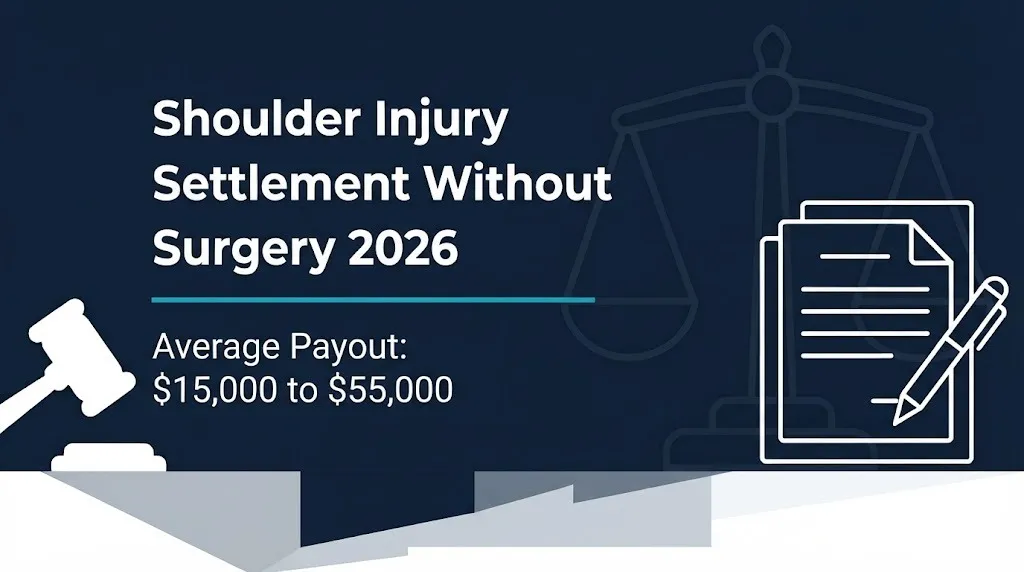
- How much? Most settle between $15,000 and $55,000, but rotator cuff tears can reach six figures.
- Key deadline? Most states give you 2 years to file a personal injury lawsuit. Check your state’s deadline.
A shoulder injury settlement without surgery is worth less than a surgical case, but that does not mean it is worth nothing. The average payout for non-surgical shoulder injuries sits between $15,000 and $55,000, with soft tissue strains resolving at the low end and partial rotator cuff tears reaching the upper range . Insurance adjusters often try to dismiss these claims as “soft tissue,” but the truth is more complicated. A partial tear, chronic inflammation, or labral injury can cause pain and limitation for years without ever requiring an operation.
If you are dealing with a non-surgical shoulder injury from a car accident or another negligence incident, you are probably wondering what your case is worth. The answer depends on your medical records, your pain levels, and how the injury affects your job. A construction worker with a dominant-arm partial tear will see a much higher settlement than an office worker with a mild strain.
This article breaks down verified settlement ranges for non-surgical shoulder injuries, the factors that drive value up or down, how to document your claim, and what happens when the insurance company tries to lowball you. One fact that surprises most people: insurers may undervalue up to 70% of non-surgical shoulder claims at first, sometimes offering just 20-30% of their true value .
The Facts
| Claim Type | Personal injury settlement for non-surgical shoulder injury |
|---|---|
| Status | Individual claims, no class action or settlement fund |
| Fund Size | Not applicable |
| Est. Per Person | $15,000 to $55,000 average; higher for partial tears |
| Claim Deadline | Typically 2 years from accident date (varies by state) |
| Administrator | Not applicable |
| Proof Needed | Medical records, MRI, treatment documentation, wage loss records |
Is a shoulder injury settlement without surgery real or a scam?
A shoulder injury settlement without surgery is real and common. You do not need to have an operation to recover compensation for a shoulder injury caused by someone else’s negligence. What matters is proving that the injury happened, that it caused you harm, and that the at-fault party is responsible.
This is not a class action or a settlement fund. It is an individual personal injury claim. You file it against the at-fault driver’s insurance company or another liable party. The process is free to start, and most personal injury attorneys work on contingency, meaning they get paid only if you win .
Be careful of scams. If someone contacts you demanding payment to “process your shoulder claim” or asks for your bank information upfront, that is fraud. Legitimate settlements come after a signed release, through official channels.
What is the average settlement for a shoulder injury without surgery?
The average settlement for a shoulder injury without surgery ranges from $15,000 to $55,000. The low end covers minor strains that resolve with a few months of physical therapy. The high end covers partial rotator cuff tears, labral injuries, or chronic conditions that require ongoing treatment.
Here is the breakdown:
| Injury Type | Treatment | Typical Settlement Range |
|---|---|---|
| Minor strain/sprain | Physical therapy | $0 to $15,000 |
| Partial rotator cuff tear | Injections, PT | $0 to $35,000 |
| Soft tissue damage (no surgery) | Therapy, pain management | $15,000 to $50,000 |
| Partial tear (workers’ comp) | No surgery | $28,000 to $55,000 |
One real-world example: a Hawaii case involving a non-surgical shoulder injury with over $30,000 in medical bills settled for $55,000 after attorneys demonstrated the significant emotional toll and functional limitations .
Key Takeaway: Non-surgical shoulder settlements typically range from $15,000 to $55,000, but partial tears and chronic conditions can push higher.
Why does surgery increase your settlement so much?
Surgery increases your settlement because it provides objective proof of injury severity that insurance companies cannot easily dismiss. A recommendation for surgery, or a completed operation, typically multiplies case value by 3x to 5x compared to a soft tissue claim treated only with physical therapy .
Here is what changes when surgery is involved:
- Medical bills climb: Arthroscopic shoulder surgery costs $15,000 to $40,000 or more .
- Recovery takes longer: Surgical cases require 6 to 12 months of rehabilitation, extending lost wages.
- Permanent restrictions emerge: Post-surgical patients often face permanent lifting limitations, supporting future damages claims.
- Pain and suffering increase: The surgery itself, plus the recovery process, adds substantial non-economic damages.
A non-surgical claim with $10,000 in medical bills might settle for $25,000. A surgical claim with $40,000 in bills could settle for $150,000 or more. That gap reflects real differences in harm, not arbitrary pricing.
What factors determine your non-surgical shoulder settlement amount?
Your non-surgical shoulder settlement amount depends on injury severity, treatment duration, impact on work, and the strength of your medical documentation.
Injury severity is the biggest factor. A mild strain that resolves in eight weeks is worth far less than a partial rotator cuff tear that causes ongoing pain for a year. MRI findings showing a structural tear carry more weight than subjective pain complaints alone .
Treatment duration and consistency matter enormously. A long gap in treatment tells the adjuster your injury was not serious. Consistent physical therapy records, progress notes, and follow-up visits build a credible case .
Impact on your ability to work drives value higher. If you cannot perform your job because of overhead lifting restrictions, you have a lost earning capacity claim. A 45-year-old electrician with permanent restrictions faces decades of reduced income, which translates into a larger settlement .
Dominant arm injuries command higher settlements, typically 15-25% more, because the functional impact on daily life is greater .
Pre-existing conditions can reduce value, but the aggravation doctrine protects you. If your shoulder worked fine before the accident and now it does not, the at-fault party is responsible for the worsening, even if some degeneration existed .
Reality Check: No one texts you settlement money from a shoulder injury claim. Filing is always free. Third-party “claim helpers” charging fees are unnecessary. If someone demands payment upfront, it is a scam.
How do you document a non-surgical shoulder injury claim?
You document a non-surgical shoulder injury claim by getting an MRI early, attending all medical appointments, and keeping detailed records of how the injury affects your daily life.
Here are the steps:
- Get an MRI as soon as possible. MRI captures acute findings like fluid and edema that distinguish a fresh injury from chronic degeneration .
- Report the shoulder at your first medical visit. Even if other injuries seem more urgent, make sure the shoulder is documented .
- Attend every physical therapy session. Progress notes document your pain levels and functional struggles .
- Keep a pain journal. Write down what you cannot do: reach overhead, sleep on that side, lift groceries .
- Take photos and videos showing your limitations, such as struggling to put on a jacket .
- Ask family and coworkers for written statements describing how the injury changed your capabilities .
- Save all medical bills and wage loss records. These form the baseline for your economic damages.
Documentation transforms vague pain complaints into concrete evidence. Adjusters respond to specificity.
How do you file a shoulder injury claim without surgery?
You file a shoulder injury claim by sending a demand package to the at-fault party’s insurance company after you reach maximum medical improvement (MMI).
Here are the steps:
- Complete your medical treatment. Do not settle until your doctor says you have improved as much as you will .
- Gather all records. Medical bills, treatment notes, MRI reports, wage loss documentation, and your pain journal.
- Prepare a demand package. This letter explains the accident, your injuries, and the compensation you seek.
- Send the demand to the insurance company. The adjuster will review it and respond with an offer or a denial.
- Negotiate. Most cases settle through back-and-forth negotiation.
- If negotiation fails, file a lawsuit. This extends the timeline but can pressure the insurer to make a fair offer.
Most personal injury attorneys offer free consultations and work on contingency. You pay nothing upfront .
What if the insurance company makes a lowball offer?
If the insurance company makes a lowball offer, do not accept it. First offers are almost always lower than your case is worth. Insurers may undervalue up to 70% of non-surgical shoulder claims at first, sometimes offering just 20-30% of their true value .
Common tactics include:
- The “no surgery, no serious injury” dismissal. The adjuster argues your injury is minor because you did not have surgery .
- The quick, lowball offer. They call within weeks with an offer that sounds good but is far less than your claim is worth .
- Blaming pre-existing conditions. They argue your pain existed before the accident, even if you had no symptoms .
How to respond:
- Do not accept the first offer.
- Thank the adjuster and say you need time to review it.
- Consult an attorney if the offer seems low.
- Counter with medical evidence and a clear explanation of your limitations.
Once you accept a settlement, you cannot ask for more money later. The release is permanent.
What happens next in your shoulder injury claim?
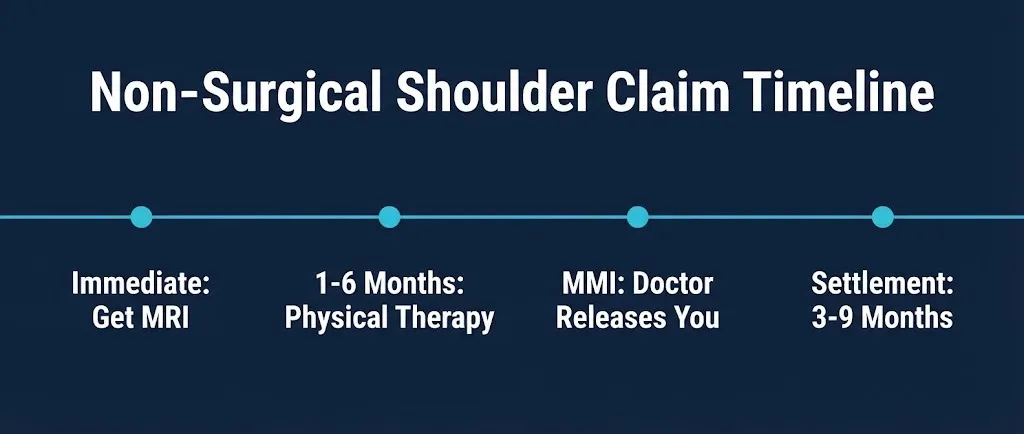
The next stage depends on where you are in treatment. If you are still healing, the next step is reaching MMI. If you have reached MMI, your attorney will prepare a demand package. If negotiations stall, a lawsuit may be filed.
Here is the typical sequence:
- Medical treatment phase: You attend appointments and heal. Duration varies by injury.
- Maximum medical improvement: Your doctor says you have improved as much as you will.
- Demand package preparation: Your attorney compiles records and sends a settlement demand.
- Negotiation phase: Back-and-forth with the insurer. Typically 1-3 months.
- Lawsuit filing (if needed): Extends timeline by 6-18 months or more.
- Settlement and payment: Check issued within 5-30 days after agreement.
Frequently Asked Questions
How much is a shoulder injury settlement without surgery?
Most non-surgical shoulder settlements range from $15,000 to $55,000. Partial rotator cuff tears and chronic conditions settle at the higher end .
Can I get a settlement for a shoulder injury without surgery?
Yes. You do not need surgery to recover compensation. What matters is proving the injury, its impact on your life, and the at-fault party’s responsibility.
How long does a shoulder injury settlement take without surgery?
Most non-surgical shoulder claims settle within 3 to 9 months, depending on treatment duration and whether liability is disputed.
What if the insurance company says my shoulder injury is pre-existing?
The aggravation doctrine protects you. If your shoulder worked fine before the accident and now it does not, the at-fault party is responsible for the worsening .
Do I need a lawyer for a shoulder injury settlement?
Not always, but non-surgical shoulder claims are often undervalued. An attorney can help you document the injury properly and negotiate a fair settlement .
How much does a shoulder injury lawyer cost?
Most work on contingency. You pay nothing upfront, and the fee comes from your settlement, typically 33% or less.
What is the average settlement for a partial rotator cuff tear without surgery?
Partial tears treated with injections and physical therapy typically settle between $28,000 and $55,000, depending on severity and work impact .
What should you do right now?
Get an MRI if you have not already. Imaging is the single most important piece of evidence in a shoulder injury claim. Without it, the adjuster will treat your injury as soft tissue and offer a low settlement.
Document everything: medical records, physical therapy notes, wage loss, and how the injury limits your daily activities. The stronger your documentation, the higher your settlement.
The single most important fact to remember: non-surgical shoulder settlements range from $15,000 to $55,000, but the insurance company’s first offer is almost always lower than your case is worth.