Cerebral Palsy Lawsuit 2026: Settlement Amounts, Birth Injury Claims, and How Lawsuits Work
Quick Answer
- Is it legit? Yes. Cerebral palsy lawsuits are individual medical malpractice claims against doctors or hospitals.
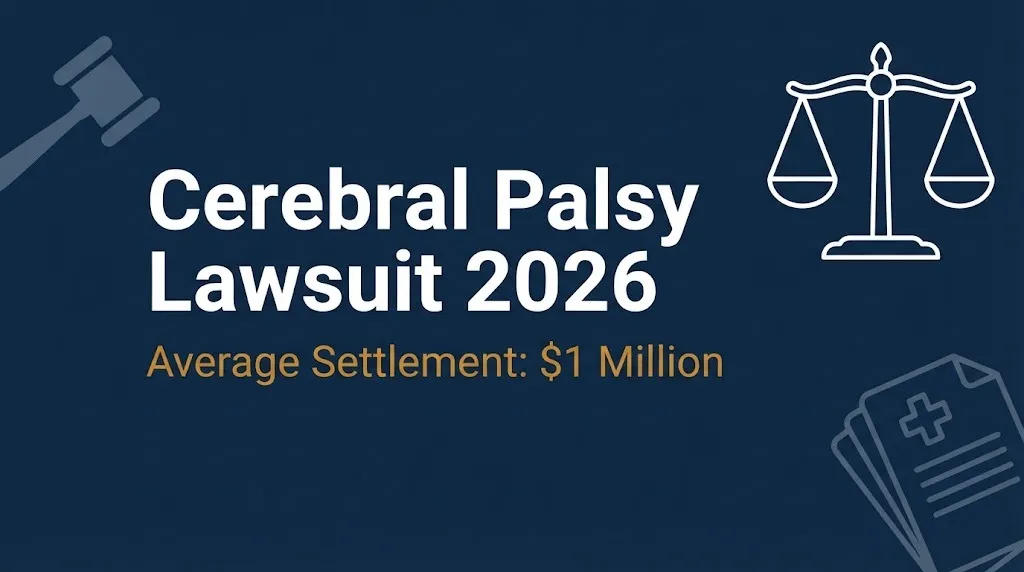
- How much? The average settlement is around $1 million. Severe cases can exceed $10 million.
- Key deadline? Varies by state. Many states require filing within 2 to 3 years, but some allow extensions for minors.
If your child was diagnosed with cerebral palsy and you believe medical negligence played a role, the path forward is not a class action settlement with a claim form. It is an individual medical malpractice lawsuit against the healthcare providers who managed the pregnancy, labor, or delivery.
Cerebral palsy is a permanent movement disorder caused by brain damage. In some cases, the cause is unknown. In others, the injury results from preventable errors: delayed C-sections, failure to respond to fetal distress, or improper use of delivery tools. When negligence can be proven, families can pursue compensation for a lifetime of care.
This article covers what the evidence shows as of September 2026: typical settlement ranges by severity, the types of medical errors that support a claim, how attorney fees work, the deadlines that apply in birth injury cases, and what families should gather before consulting a lawyer.
Is a cerebral palsy lawsuit a class action?
No. A cerebral palsy lawsuit is an individual medical malpractice case, not a class action. There is no national settlement fund, no claims administrator, and no deadline to file a claim form.
Each cerebral palsy lawsuit is filed on behalf of one child against the specific doctors, nurses, or hospitals involved in that child’s birth. The case rises or falls on the medical records from that pregnancy and delivery.
This distinction matters because families often search for “cerebral palsy settlement claim” expecting a process similar to a data breach or product liability class action. That process does not exist here.
The upside of individual litigation is that compensation can be tailored to the child’s actual needs. The downside is that each case must prove negligence and causation, which requires expert medical testimony and significant time.
How much is a cerebral palsy lawsuit settlement worth?
Cerebral palsy settlement amounts depend on the severity of the child’s condition, the cost of lifetime care, and the strength of the evidence. The average settlement is around $1 million, but severe cases routinely exceed $5 million .
Here is how settlements break down by severity level:
| Severity | Typical Costs Covered | Settlement Range |
|---|---|---|
| Mild CP | Physical therapy, outpatient treatments, adaptive equipment | $500,000 to $1 million+ |
| Moderate CP | Regular therapy, surgeries, special education, mobility aids | $1 million to $5 million+ |
| Severe CP | Lifelong nursing care, multiple surgeries, home modifications, 24/7 support | $5 million to $10 million+ |
Recent verdicts show the upper end of the range. A Missouri jury awarded $48.1 million in March 2025 after a doctor allowed the mother to push for roughly 12 hours instead of performing a C-section . A Minnesota family received $29 million in May 2025 when a nurse-midwife failed to contact the on-call OB/GYN promptly .
Sokolove Law reports securing settlements including $8.9 million in Pennsylvania, $8 million in New York, and $6.75 million in Florida .
Key Takeaway: The single biggest factor in a cerebral palsy settlement is the projected cost of the child’s lifetime care. That number is built from medical records and expert analysis, not from a predetermined schedule.
What medical errors support a cerebral palsy lawsuit?
A cerebral palsy lawsuit requires proof that a medical provider’s negligence caused or contributed to the brain injury. The errors that most often support these claims involve failures to respond to signs of fetal distress.
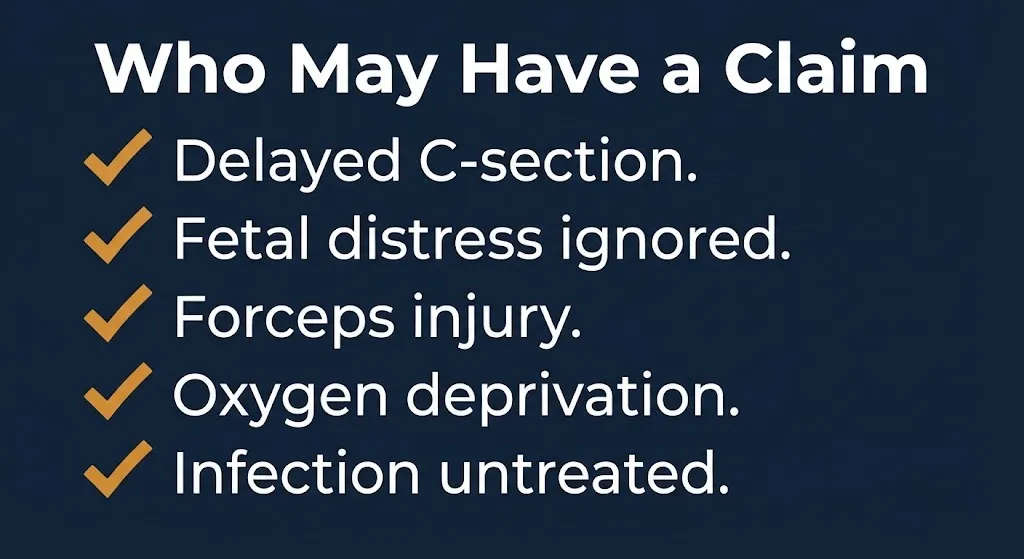
According to Weiss & Paarz, a birth injury law firm, the preventable errors that commonly lead to cerebral palsy claims include:
- Failure to timely respond to fetal distress during labor
- Failure to consider or recommend a Cesarean section when complications arise
- Failure to timely respond to signs of oxygen deprivation to the baby
- Improper use of forceps or vacuum extraction during delivery
- Failure to treat or prevent infections in the mother or baby during pregnancy or labor
The key legal question is causation. A cerebral palsy diagnosis alone does not prove malpractice. Families must show that a specific error by a specific provider led to the brain injury.
A common scenario involves a prolonged delay before delivery. In the UK case reported by Boyes Turner, a mother’s requests for a C-section were refused, and the baby suffered a cardiac arrest and hypoxic brain injury during delivery delays . The settlement reached £17.8 million, equivalent to roughly $22 million at current exchange rates.
How do you file a cerebral palsy lawsuit?
Filing a cerebral palsy lawsuit starts with a medical record review, not a court filing. An experienced birth injury attorney will examine the pregnancy, labor, and delivery records to determine whether negligence occurred.
Here is the typical process:
- Consult a birth injury attorney. Most offer free case reviews. Bring any medical records you have.
- Medical record collection. The attorney obtains full records from the hospital, prenatal care providers, and any specialists.
- Expert review. A medical expert reviews the records to identify whether the standard of care was violated.
- Notice of claim. Many states require pre-suit notice to the healthcare provider before filing a lawsuit.
- Lawsuit filing. If the case proceeds, the complaint is filed in civil court. The defendant has a set time to respond.
- Discovery. Both sides exchange evidence, including depositions and expert reports.
- Settlement negotiation or trial. Most cases settle before trial. If not, a jury determines the outcome.
The timeline from initial consultation to resolution typically ranges from 18 months to 3 years or more. Birth injury cases are complex and require extensive expert testimony.
What is the deadline to file a cerebral palsy lawsuit?
The deadline to file a cerebral palsy lawsuit depends on the state where the birth occurred. Most states have a statute of limitations of 2 to 3 years for medical malpractice claims, but many extend the deadline for minors.
In many states, the clock does not start running until the child turns 18. That means families may have until the child’s 20th or 21st birthday to file, depending on the state’s rules.
Some states have shorter deadlines. Others have caps on damages that limit how much a family can recover, even in severe cases.
Because the rules vary so widely, consulting an attorney promptly is important. A lawyer can determine the specific deadline that applies to your case.
How much does a cerebral palsy lawyer cost?
Most cerebral palsy lawyers work on a contingency fee basis. You pay nothing upfront, and the attorney receives a percentage of the settlement or verdict if you win. If the case is unsuccessful, you typically owe nothing.
Contingency fees in birth injury cases commonly range from 25% to 40% of the recovery. The exact percentage depends on the firm and whether the case goes to trial.
Case expenses, such as expert witness fees and medical record retrieval, are typically advanced by the law firm and repaid from the settlement proceeds.
Reality Check: No legitimate cerebral palsy attorney asks for money upfront to review your case. If someone demands a retainer or processing fee before looking at your medical records, that is a red flag. Legitimate firms offer free consultations and only get paid if you recover.
What evidence do you need for a cerebral palsy lawsuit?
The evidence needed for a cerebral palsy lawsuit centers on the medical records from the pregnancy, labor, delivery, and the child’s early medical care. Expert testimony connects the dots between provider errors and the brain injury.
Key evidence includes:
- Prenatal records showing the mother’s health, risk factors, and any complications
- Fetal monitoring strips showing the baby’s heart rate during labor
- Delivery notes documenting the timing of interventions and the baby’s condition at birth
- Apgar scores and resuscitation records
- Neonatal imaging such as MRI or CT scans showing brain injury
- Medical expert reports explaining how the standard of care was breached and how that breach caused the injury
The strength of the evidence often determines whether a case settles or goes to trial. Cases with clear documentation of fetal distress and delayed response tend to produce higher settlements.
What happens next in a cerebral palsy lawsuit?
The timeline for a cerebral palsy lawsuit depends on the complexity of the case and whether it settles or goes to trial. Most cases resolve within 18 months to 3 years.
Here is the expected sequence:
Month 1-3: Free consultation and medical record collection. The attorney reviews the records with a medical expert.
Month 3-6: Expert review completed. The attorney advises whether a viable claim exists.
Month 6-12: Notice of claim filed, if required. Lawsuit filed if the case proceeds.
Year 1-2: Discovery phase. Depositions, expert reports, and settlement negotiations.
Year 2-3: Settlement reached or trial date set. Most cases settle before trial.
After resolution: Structured settlement or lump sum payment established. Funds managed for the child’s lifetime care.
The $1 million average settlement for cerebral palsy cases reflects the middle of a wide range . Severe cases involving 24/7 care can reach $10 million or more.
Frequently Asked Questions
How much is a cerebral palsy lawsuit worth?
The average settlement is around $1 million, but amounts vary widely. Severe cases involving lifelong care have produced verdicts of $10 million to $48 million or more.
How long do you have to file a cerebral palsy lawsuit?
Deadlines vary by state, typically 2 to 3 years for medical malpractice. Many states extend the deadline for minors, allowing claims until the child turns 18 or later.
Can you sue for cerebral palsy if the cause is unknown?
A lawsuit requires proof that medical negligence caused the injury. If the cause is genuinely unknown, a claim cannot succeed. An attorney can review medical records to determine whether negligence played a role.
What evidence is needed for a cerebral palsy lawsuit?
Medical records from the pregnancy, labor, and delivery are essential. Fetal monitoring strips, delivery notes, and neonatal imaging help establish whether negligence caused the brain injury.
Do cerebral palsy lawyers charge upfront fees?
Most work on contingency. You pay nothing upfront, and the attorney receives a percentage of the settlement if you win. Case expenses are typically advanced by the firm.
What is the average payout for a cerebral palsy birth injury?
The average settlement is around $1 million. Payouts depend on injury severity, the cost of lifetime care, and the strength of the evidence proving negligence.
The Bottom Line for Families Considering a Cerebral Palsy Lawsuit
A cerebral palsy lawsuit is not a class action with a claim form and a deadline. It is an individual medical malpractice case that requires proof of negligence and a showing that the negligence caused the brain injury.
The average settlement is around $1 million, but severe cases involving lifelong care have produced verdicts exceeding $48 million. The key factors are the severity of the child’s condition, the projected cost of lifetime care, and the strength of the medical evidence.
If you believe your child’s cerebral palsy resulted from medical negligence, the first step is a free consultation with a birth injury attorney. The deadline varies by state, and many allow claims until the child reaches adulthood. Gather your medical records and seek a review promptly.