Post-Concussion Syndrome Settlement Value 2026: What Real Cases Actually Pay
Quick Answer
- Post-concussion syndrome settlements are real injury claims, not a class action or scam. Every case is valued individually.
- Reported 2026 ranges run from about $20,000 to $150,000 for mild PCS, and $250,000 to $1 million or more for severe or permanent cases.
- There’s no universal deadline. Filing windows depend on your state’s statute of limitations, typically one to three years from the injury.
If you’re searching “post-concussion syndrome settlement value,” here’s the honest answer. There’s no fixed payout number, and anyone promising you one hasn’t seen your case.
This matters if you’re weeks or months into lingering headaches, brain fog, or dizziness after a head injury, and you’re trying to figure out what your claim might realistically be worth. Published 2026 law firm data puts most mild cases in the tens of thousands, while severe or permanent cases can reach seven figures.
This guide breaks down real reported ranges by severity, what actually moves the number up or down, and how the process works. One detail worth knowing upfront: California data shows trial verdicts average roughly 3.5 times higher than confidential settlements in brain injury cases.
The Facts
| Case | General guide to post-concussion syndrome and TBI settlement value, not a single lawsuit or settlement fund |
| Status | Individual injury claims, filed and valued case by case |
| Fund Size | Not applicable, these are individual claims, not a class action settlement fund |
| Est. Per Person | Reported ranges: roughly $20,000 to $150,000+ for mild PCS, $250,000 to $1 million or more for severe or permanent TBI, per published 2026 law firm data |
| Claim Deadline | Varies by state statute of limitations, typically 1 to 3 years from the injury date |
| Administrator | Not applicable, claims go through insurers, defendants, and civil courts, not a claims administrator |
| Proof Needed | Medical records, neuropsychological testing, imaging, and documentation of lost income |
Is Post-Concussion Syndrome Settlement Value a Real Legal Claim?
Yes, post-concussion syndrome is a recognized medical diagnosis that supports real personal injury claims. It’s classified as a mild traumatic brain injury under the DSM-5 diagnostic manual.
PCS occurs when concussion symptoms persist beyond the typical two-week to three-month recovery window. Roughly 10 to 15 percent of concussion patients go on to develop it, according to figures cited by multiple personal injury firms and referencing Mayo Clinic research.
This isn’t a class action or a mass settlement fund you can join. It’s an individual injury claim, meaning your specific medical evidence, symptom duration, and impact on daily life determine what your case is worth. No two PCS settlements are identical, even with similar diagnoses.
What Is the Average Post-Concussion Syndrome Settlement Value?
Not a single number. Published 2026 data shows PCS settlements typically fall between $20,000 and $500,000, depending heavily on severity and documentation.
One firm’s own case data put their average PCS settlement at $32,795.62, reviewed as of March 2026. That figure reflects one firm’s specific caseload, not a national average, and shouldn’t be treated as a prediction for any individual claim.
Broader industry ranges reported across multiple firms in 2026 show:
| Severity | Reported Range |
|---|---|
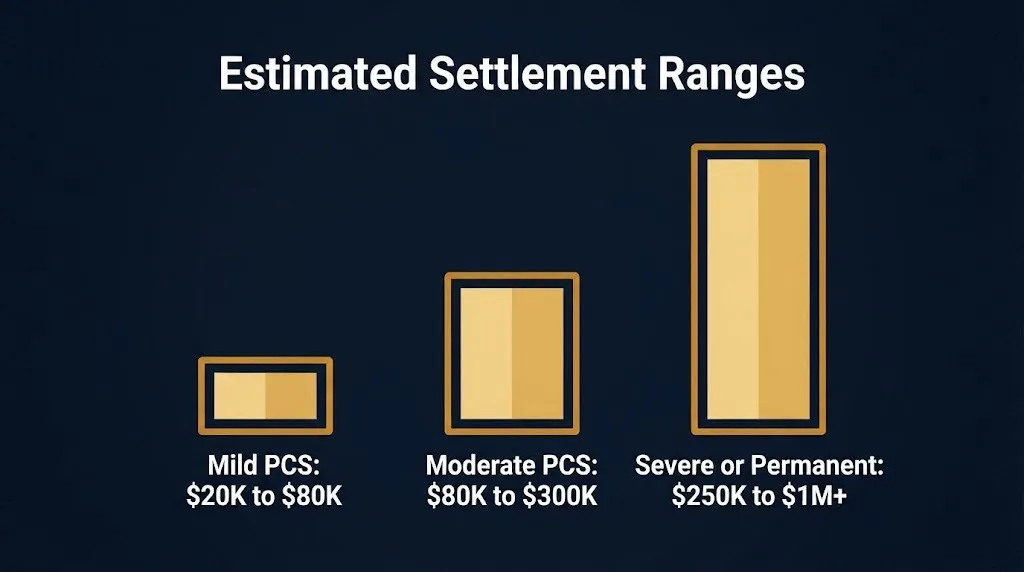
| Mild PCS, full recovery in weeks | $20,000 to $80,000 |
| Moderate PCS, symptoms 6 to 12 months, work disruption | $80,000 to $300,000 |
| Severe or permanent PCS with documented cognitive impairment | $250,000 to $1,000,000+ |
These are reported ranges from published legal industry data, not guarantees. Amounts depend on your state, your evidence, and the specifics of your case.
What Is the Average Settlement for Concussion?
A typical concussion settlement, without long-term PCS symptoms, generally runs from about $20,000 to $100,000, based on 2026 firm-reported data. Quick recovery cases tend to sit at the lower end of that range.
Simple concussions with full recovery in two to four weeks commonly settle between $20,000 and $40,000, according to a 2026 Illinois-focused legal guide. That range reflects minimal ongoing treatment and no lasting work impact.
One 2025 case example cited in industry data involved a $225,000 jury verdict in California, where a motorcyclist suffered a concussion after being struck by a vehicle at an intersection. Verdicts and settlements aren’t the same thing though, and verdicts tend to run higher.
Key Takeaway: A straightforward concussion with quick recovery is valued very differently than one that develops into post-concussion syndrome, often by a factor of three or more.
What Is Mild Concussion Settlement Value?
Mild concussion settlement values commonly range from about $1,000 to $100,000, with most falling between $20,000 and $40,000 for cases with quick, documented recovery. The wide spread reflects how much documentation and duration matter.
A 2026 Illinois legal guide reported that simple concussions resolving within two to four weeks typically settle in the $20,000 to $40,000 range. That same source noted mild concussions overall, including some borderline PCS cases, can reach $100,000 depending on treatment and documentation.
Some sources describe even lower starting points, around $1,000 to $5,000, for extremely minor, fast-resolving injuries with limited medical treatment. The gap between that figure and six-figure PCS settlements shows why an accurate diagnosis and thorough medical documentation matter so much to case value.
What Is a Fair Settlement for TBI?
There’s no universal “fair” number for a traumatic brain injury settlement, because severity varies enormously between cases. Published 2026 data shows overall TBI settlements ranging from about $5,000 for the mildest cases to more than $1 million for severe, permanent injuries.
One analysis of three law firms’ published TBI data, conducted in May 2026, calculated an overall average TBI settlement of $540,000 across all severity levels. That same analysis broke figures down by severity:
| TBI Severity | Reported Settlement Range |
|---|---|
| Mild | $5,000 to $150,000 |
| Moderate | $85,000 to $500,000 |
| Severe | $240,000 to $1,000,000+ |
Not yet determined for your specific case, since these figures represent industry-wide reported patterns, not individualized predictions. A fair settlement depends on your documented losses, not a fixed formula.
What Is the Average Settlement for Traumatic Brain Injury?
Reported 2026 averages for traumatic brain injury settlements generally cluster between $540,000 and $1.2 million, though the full range spans from a few thousand dollars to eight figures for catastrophic cases. The wide gap reflects just how differently mild and severe cases are valued.
One Pennsylvania firm reported an average TBI settlement of $700,000 to $1.2 million based on its own case data. A separate 2026 analysis averaging figures across three firms calculated an overall average of $540,000, which sits notably lower.
California-specific data adds more texture. A 2026 study of 100 California TBI cases found confidential settlements averaged $2,990,849, with a median of $1,450,974, while trial verdicts averaged $10,344,240 with a median of $8,115,000. That’s a striking gap, roughly 3.5 times higher for cases that went to trial versus those that settled quietly.
Key Takeaway: Reported TBI averages vary widely by firm and state, from around $540,000 to well over $1 million, and cases that go to trial tend to produce significantly higher outcomes than confidential settlements.
What Factors Increase Brain Injury Compensation?
The strongest driver of case value is documented, permanent impact across multiple dimensions of your injury. Insurers and courts weigh medical evidence far more heavily than the initial diagnosis label.
According to 2026 legal industry guidance, the strongest cases document impairment across three areas: cognitive function through neuropsychological testing, physical symptoms through vestibular and balance assessments, and emotional impact through psychiatric evaluation. Missing even one of these can weaken an otherwise strong claim.
Other factors that commonly raise settlement value include:
- Documented lost wages or reduced earning capacity
- Imaging evidence such as MRI or diffusion tensor imaging (DTI)
- Length of symptom duration, especially past three to six months
- Need for ongoing therapy, rehabilitation, or future medical care
- Clear liability on the part of the at-fault party
- Available insurance policy limits
Reality Check: No online calculator or “instant settlement estimate” tool can tell you your exact payout, because real case value depends on medical evidence a computer can’t see. Be skeptical of any site charging a fee to “unlock” your settlement number, since a real attorney consultation for a personal injury case is typically free.
How Do You File a Head Injury Lawsuit or Brain Injury Lawsuit?
Filing a brain injury lawsuit generally starts with medical treatment, moves through evidence gathering, and often ends in settlement negotiation rather than trial. Most personal injury cases resolve before reaching a courtroom.
Here’s the general process reported across 2026 personal injury guides:
- Get evaluated by a doctor immediately and follow all recommended treatment.
- Request complete copies of your medical records and imaging results.
- Document how symptoms affect your work and daily life.
- Consult a personal injury attorney, typically for a free case evaluation.
- Your attorney sends a demand letter to the at-fault party’s insurer.
- Negotiations begin, often over several rounds of offers.
- If no fair offer emerges, your attorney may file a formal lawsuit.
- Most cases still settle before trial, though some proceed to a verdict.
This process resembles a warranty claim that gets denied at first, where documentation and persistence matter more than the initial offer.
What Proof Do You Need for a Head Injury Claim?
You need medical documentation that connects your symptoms directly to the injury event, ideally across cognitive, physical, and emotional dimensions. Without that connection, insurers often dispute the claim’s severity or cause.
Commonly required proof includes:
- Emergency room and follow-up medical records
- Neurologist or neuropsychologist evaluation reports
- Imaging studies, including MRI or CT scans when available
- Pay stubs or employer statements showing lost income
- A symptom journal documenting daily impact over time
- Witness statements about the incident itself
Key Takeaway: The single biggest factor separating low settlements from six and seven-figure ones is documented, multi-dimensional medical evidence, not the initial injury description.
How Long Does a Brain Injury Lawsuit Take?
Most brain injury claims resolve through settlement within several months to about two years, though severe cases or ones that go to trial can take considerably longer. Timing depends heavily on how quickly medical treatment stabilizes.
Cases with mild, fully-documented recovery often settle faster because the full extent of damages becomes clear sooner. Cases involving permanent or uncertain long-term impairment typically take longer, since attorneys generally wait until your medical condition stabilizes (reaches “maximum medical improvement”) before finalizing a settlement demand.
Once a case does settle, payment timelines commonly range from a few weeks to a few months after resolution, based on 2026 legal industry reporting. Cases that proceed to trial add significant additional time for court scheduling and potential appeals.
What Is Post-Concussion Syndrome?
Post-concussion syndrome is a condition where concussion symptoms persist well beyond the typical recovery window, sometimes for months or years. It’s considered a mild traumatic brain injury under current diagnostic standards.
A concussion itself results from a blow or jolt to the head that disrupts normal brain function. Most people recover within two weeks to three months, but PCS develops when symptoms like headaches, dizziness, cognitive difficulty, or mood changes continue well past that point.
Common PCS symptoms include persistent headaches, chronic dizziness, ongoing cognitive difficulties, sleep disturbances, and emotional changes. These symptoms often require expert testimony from neurologists or neuropsychologists to fully document in a legal claim.
What’s the Difference Between a Concussion Settlement and a Full TBI Settlement?
A standard concussion settlement typically involves lower figures than a broader traumatic brain injury settlement, mainly because “TBI” as a category includes far more severe injuries. Post-concussion syndrome sits in between the two.
Concussions and mild PCS cases generally top out in the low hundreds of thousands, per 2026 reported ranges. Broader TBI settlements, which include moderate and severe brain injuries with permanent impairment, commonly reach into the high hundreds of thousands to multiple millions.
The terminology matters when you’re researching your own case. If your injury involves permanent cognitive deficits, loss of consciousness beyond a few minutes, or a need for long-term care, your case likely falls under the higher TBI ranges rather than typical concussion or mild PCS figures.
Who Typically Qualifies for Compensation After a Head Injury?
You may qualify for compensation if another party’s negligence caused your head injury and you have documented medical treatment connecting your symptoms to that event. Qualification depends on liability and evidence, not the injury alone.
Common scenarios that generate head injury claims include car accidents, slip and fall incidents, workplace accidents, and sports-related injuries where a third party bears some responsibility. Each state applies its own negligence and fault-sharing rules, which can affect how much you’re able to recover even with a strong medical case.
You’ll generally need to show:
- A specific incident caused your head injury.
- Another party’s negligence contributed to that incident.
- You sought medical treatment reasonably promptly.
- Your symptoms are documented by qualified medical professionals.
- You can show a financial or quality-of-life impact from the injury.
Amounts always depend on your specific facts, not a guaranteed formula.
What Do Real Case Examples Show About Brain Injury Settlement Value?
Real reported case outcomes vary enormously, even within similar injury categories, which is exactly why averages can be misleading. A single case example can’t predict your outcome, but it shows the realistic spread.
A 2026 study analyzing 100 California TBI cases found 63 confidential settlements averaging $2,990,849, alongside 14 trial verdicts averaging $10,344,240. That gap illustrates how much case strategy and willingness to go to trial can influence final numbers.
One Pennsylvania firm reported a $2.9 million settlement for a client struck by a truck while riding a motorcycle, an outcome on the higher end of the moderate to severe TBI range. Meanwhile, mild PCS cases with quick, well-documented recovery have settled for as little as $20,000 to $30,000 in reported firm data.
Key Takeaway: The distance between a $20,000 mild PCS settlement and a multi-million dollar severe TBI verdict comes down almost entirely to documented severity and permanence, not the type of incident that caused the injury.
What Happens Next
Ongoing: Continue documented medical treatment and specialist evaluations until your condition stabilizes.
Expected, case-dependent: Your attorney compiles medical records, imaging, and lost wage documentation to support a demand.
Expected, case-dependent: Settlement negotiation with the insurer or at-fault party begins, often over multiple rounds.
Expected, case-dependent: Case resolves through settlement, or proceeds toward litigation and possible trial if no fair offer is reached.
Frequently Asked Questions
What is the average post-concussion syndrome settlement value?
Reported 2026 data shows PCS settlements typically ranging from $20,000 for mild cases to $500,000 or more for severe, documented impairment.
One firm’s own average settlement figure was $32,795.62, though this reflects one firm’s caseload, not a national standard.
Is there a fixed settlement amount for concussions?
No, there’s no fixed amount, since every claim is evaluated individually based on medical evidence and impact.
Reported ranges for standard concussions run roughly $20,000 to $100,000.
What is a fair settlement for TBI?
A fair settlement depends entirely on injury severity, documentation, and state law, not a universal number.
Reported 2026 averages range from about $540,000 to $1.2 million across firms, with mild cases valued far lower and severe cases far higher.
How much does post-concussion syndrome compensation depend on lost wages?
Documented lost income significantly raises settlement value in most reported cases.
Cases with clear wage loss evidence commonly value higher than similar cases without it.
Do I need a lawyer to get fair compensation for a head injury?
You’re not legally required to hire one, but attorney-negotiated settlements in reported data tend to be substantially higher than self-negotiated claims.
Most personal injury attorneys offer free initial consultations.
How long do I have to file a head injury lawsuit?
Deadlines vary by state and are governed by each state’s statute of limitations, commonly one to three years from the injury date.
Check your specific state’s rules or consult an attorney promptly after your injury.
Can mild concussion cases still result in a lawsuit?
Yes, mild concussions can support valid claims, though reported settlement values are generally lower than for cases involving lasting symptoms.
Documentation of even short-term impact still matters for these claims.
What is the highest reported settlement for a brain injury?
Reported 2026 data shows severe TBI verdicts and settlements reaching into the millions, with one California case study averaging $10.3 million for trial verdicts.
These figures represent the most severe, catastrophic cases, not typical outcomes.
Post-concussion syndrome and TBI settlement values vary too widely for any single number to apply to your case. Start building your medical documentation now, and consult a personal injury attorney directly for a case-specific evaluation.
The one figure worth remembering: reported 2026 data shows the gap between mild and severe cases spans from roughly $20,000 to over $10 million, so your documentation is what determines where you land.