Aggravated Injury Settlement in 2026: How Pre-Existing Conditions Affect Your Payout
Quick Answer
- An aggravated injury settlement pays for how much worse an accident made a condition you already had, not for the original condition itself.
- Verified aggravation settlements in 2026 range from $100,000 to $750,000, with the difference driven by medical proof that the accident caused measurable worsening.
- You must file within your state’s statute of limitations, typically two to three years from the accident date, and the “discovery rule” may extend that in some states.
An aggravated injury settlement is the money you recover when a crash or fall worsens a condition you already had before the accident. The law calls this “aggravation of a pre-existing condition,” and it is a compensable injury in every state.
Insurers fight these claims hard because they want you to believe a prior diagnosis disqualifies you. It does not. The legal test is whether the accident made your condition measurably worse, and medical evidence is how you prove it.
This article explains how aggravated injury settlements are calculated, what real cases have paid, how to document the before-and-after difference, and the tactics insurers use to discount these claims. You will also see state-specific rules and the single piece of evidence that separates strong aggravation claims from weak ones.
Is an aggravated injury settlement legitimate, or is it a scam?
An aggravated injury settlement is a legitimate legal claim recognized in all 50 states, and it is not a scam. The legal principle is simple: a negligent driver takes you as they find you, and if the crash worsens a condition you already had, they owe for the worsening .
Insurers routinely argue that pre-existing conditions mean you cannot recover. That argument fails in court. Florida law, for example, explicitly allows recovery for the aggravation of a pre-existing condition . New York law focuses on the “aggravation” of symptoms rather than the existence of a prior injury .
The scam risk here comes from the other direction. Some attorneys or “claims advocates” promise that a prior injury makes your case more valuable without reviewing the medical records. That is a sales pitch. An aggravation claim is only as strong as the medical evidence showing measurable worsening.
If someone tells you a prior injury guarantees a high payout, walk away. The value depends on what changed after the accident, not on the diagnosis itself.
Key Takeaway: Aggravated injury settlements are legitimate claims in every state, but their value depends entirely on medical proof that the accident caused measurable worsening, not on the existence of a prior condition.
How much can you expect from an aggravated injury settlement?
Verified aggravated injury settlements range from policy-limit recoveries of $100,000 to $750,000 where insurers disputed causation, with the highest amounts going to cases with objective before-and-after medical evidence. The table below shows real 2026 outcomes.
| Case Type | Verified Settlement | Key Factor |
|---|---|---|
| Rear-end crash, lumbar fusion surgery | $750,000 | Radiology expert proved disc herniation grew after crash |
| T-bone crash, knee surgery, degenerative changes | $100,000 policy limits | Full policy limits recovered despite prior degeneration |
| Car accident, bilateral rotator cuff tears | $100,000 | Escalation of care traced from crash to surgery |
| MVA, pre-existing spinal conditions | $250,000 | Apportionment between pre-existing and accident-related |
| MVA, aggravated degenerative changes | $350,000 non-economic | Accident made knee surgery “long overdue” |
The $750,000 case is the most instructive. The insurer initially valued the claim at $120,000, arguing the client’s pre-existing back condition caused his pain. A radiology expert compared pre-accident and post-accident MRIs and showed the disc herniation had become significantly larger after the crash .
That evidence changed the case entirely. The insurer revealed an additional $1 million umbrella policy, and the case settled for $750,000 weeks before trial.
Key Takeaway: The highest aggravated injury settlements go to cases where a medical expert can point to objective evidence, like imaging comparisons, showing the accident made a documented condition measurably worse.
What is the Reality Check on aggravated injury settlement promises?
Reality Check: No attorney can tell you what your aggravated injury case is worth before reviewing your medical records and comparing them to post-accident imaging. If a lawyer guarantees a specific payout because you have a pre-existing condition, that is not a legal assessment. The strongest aggravation claims have objective before-and-after evidence, and even then, insurers will argue that natural degeneration, not the accident, caused your current symptoms. Your case value depends on defeating that argument with medical proof, not on the existence of a prior diagnosis.
How are aggravated injury settlements calculated?
Aggravated injury settlements are calculated by isolating the portion of your current symptoms, treatment, and limitations that the accident caused or worsened, then applying your state’s damages rules. The calculation is not the total value of your condition. It is the difference between your condition before the accident and your condition after.
The process works like this:
- Establish your baseline. Pre-accident medical records, imaging, and treatment history show what your condition was before the crash.
- Document the worsening. Post-accident imaging, new diagnoses, and treatment escalation show what changed.
- Get an expert opinion. A treating physician or retained expert explains how the accident aggravated the condition and to what degree.
- Apply apportionment. If some of your current symptoms come from natural degeneration, the settlement may be reduced by that portion.
- Calculate damages. Economic damages (medical bills, lost wages) plus non-economic damages (pain and suffering) for the aggravated portion.
Apportionment is the battleground. In one Australian case, an insurer’s expert argued two-thirds of the claimant’s symptoms came from pre-existing degeneration and only one-third from the accident . The tribunal rejected that opinion because the expert’s reasoning was inconsistent with the medical evidence. The claimant’s last severe flare-up was in 2014, and she managed reasonably well until the accident.
A $100,000 UIM settlement illustrates how damages add up. The client had bilateral rotator cuff tears with surgery inevitable. The insurer cited pre-existing conditions. The law firm proved “escalation of care” by tracing treatment from the crash to imaging to surgery, recovering the full $25,000 policy limit plus $75,000 in UIM coverage .
Key Takeaway: Aggravated injury settlements compensate only the worsening the accident caused, and the two biggest fights are proving the worsening with objective evidence and defeating the insurer’s apportionment arguments.
What evidence do you need to prove an aggravated injury claim?
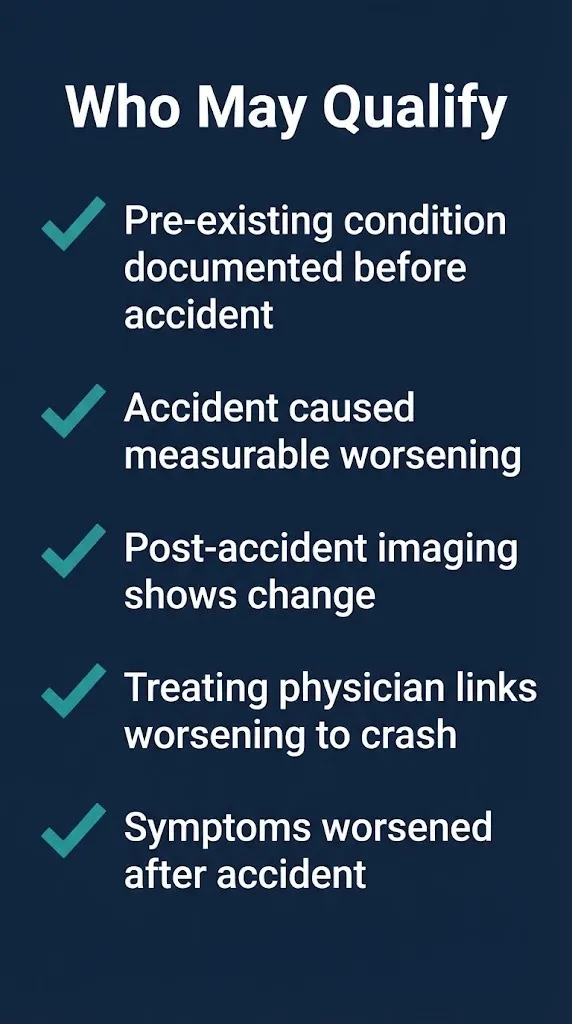
You need five categories of evidence to prove an aggravated injury claim: pre-accident baseline records, post-accident imaging showing change, treating physician documentation linking the worsening to the accident, a symptom journal showing functional decline, and expert testimony on causation. Without all five, the insurer will discount your claim heavily.
Pre-accident baseline records. Medical records, imaging, and treatment notes from before the crash. These show what your condition was and, critically, what it was not. If you were managing well, those records are gold.
Post-accident imaging. MRI, CT, or X-ray comparisons showing measurable change. A radiology expert who compares films side by side is the most powerful evidence in aggravation cases .
Treating physician documentation. Notes from your doctor explaining that the accident aggravated your condition and how. A treating physician’s opinion carries more weight than a hired expert’s.
Symptom journal. A daily record of pain, limitations, and functional changes after the crash. This fills the gap between imaging studies.
Expert testimony. A physician who can explain causation and rebut the insurer’s “natural degeneration” argument. This is often the difference between a low offer and a fair settlement.
The insurer will demand broad medical authorizations hoping to find unrelated records to use against you. You do not have to sign unlimited authorizations. Limit them to relevant body parts and timeframes .
Key Takeaway: The strongest aggravated injury claims have imaging comparisons showing measurable change, a treating physician who links the worsening to the accident, and a symptom journal documenting functional decline.
What tactics do insurers use against aggravated injury claims?
Insurers use five main tactics against aggravated injury claims: arguing the prior condition was already severe, demanding unlimited medical records, taking recorded statements that minimize your pain, blaming natural degeneration, and delaying offers hoping you settle out of frustration. Recognizing these tactics helps you counter them.
“Your condition was already bad.” The insurer digs through old records to find your worst days before the accident. The counter is evidence that you were functioning well, even if you had a diagnosis .
Unlimited medical authorizations. The adjuster asks you to sign a broad release, then reviews decades of records looking for anything to use against you. Limit authorizations to the body parts and timeframes relevant to the accident .
Recorded statements. A friendly adjuster asks how you are doing, you say “fine,” and that recording becomes evidence your injury is not serious. You are not required to give a recorded statement to the other driver’s insurer .
“Natural degeneration.” The insurer hires an expert to argue your symptoms come from normal aging or wear and tear, not the accident. The counter is a treating physician who can distinguish accident-related change from natural progression .
Delay and exhaustion. Some insurers make low offers and wait, hoping financial pressure forces you to accept. Filing suit often changes the calculation.
Key Takeaway: Insurers attack aggravated injury claims by reframing your prior condition as the cause of everything, and the best defense is a complete medical record showing you were functioning well before the accident.
How do you file an aggravated injury claim and get a settlement?
Filing an aggravated injury claim means notifying the at-fault driver’s insurer, submitting medical evidence showing the worsening, and negotiating a settlement that accounts for the aggravation. You do not need a lawyer to file, but aggravation cases are harder to prove alone. Follow these steps:
- Seek medical treatment immediately after the accident and tell every provider about your prior condition.
- Request your pre-accident medical records from all providers who treated the condition before the crash.
- Get post-accident imaging and ask your doctor to compare it to prior studies.
- Keep a symptom journal documenting daily pain, limitations, and functional changes.
- Notify the at-fault driver’s insurer that you are claiming aggravation of a pre-existing condition.
- Do not sign broad medical authorizations or give a recorded statement without advice.
- Gather lost wage documentation and remediation receipts.
- Consult an attorney if the insurer disputes causation or makes a low offer.
The “escalation of care” narrative matters. Show the insurer that you were managing before the accident, then needed new treatment after. One firm recovered policy limits by tracing the treatment trajectory from the crash to imaging to surgery .
Key Takeaway: Filing an aggravation claim requires you to build a before-and-after medical record, and the escalation of care from the accident to new treatment is the narrative that drives settlement value.
What deadlines apply to aggravated injury settlements?
The deadline for an aggravated injury claim is your state’s statute of limitations, typically two to three years from the accident date, though some states apply a discovery rule that starts the clock when you knew or should have known the accident worsened your condition. Missing the deadline bars your claim entirely.
Here are typical filing deadlines by state:
| State | Filing Deadline |
|---|---|
| California | 2 years |
| New York | 3 years |
| Texas | 2 years |
| Florida | 2 years |
| Ohio | 2 years |
The discovery rule matters in aggravation cases because the worsening may not be immediately apparent. If your pre-existing condition was stable and the crash triggered symptoms that developed over weeks, the clock may start later. But do not rely on that. Consult an attorney early.
If your claim involves a government entity, the notice deadline can be as short as 90 days .
Key Takeaway: Your state’s statute of limitations is the hard deadline for aggravated injury claims, and government defendants have much shorter notice requirements, so consult an attorney early.
How long does an aggravated injury settlement take?
Most aggravated injury settlements resolve within six to eighteen months, but cases with disputed causation or surgery can take two years or longer. The timeline depends on how long your treatment lasts and how hard the insurer fights.
Clear aggravation, minor injury: 3 to 6 months after treatment ends.
Moderate aggravation, contested causation: 9 to 18 months.
Surgery or permanent worsening: 18 to 36 months.
Cases that go to trial: add 12 months or more .
You should not settle until you reach maximum medical improvement, or MMI, because until then you do not know the full extent of the worsening. Settling early means leaving money on the table for future treatment.
Key Takeaway: Aggravated injury settlements take longer when causation is disputed, and you should not accept an offer until your doctors confirm you have reached maximum medical improvement.
What happens next in an aggravated injury claim?
The aggravated injury claim process moves through documentation, demand, negotiation, and either settlement or litigation. Here is the expected timeline:
Immediately after the accident: Seek medical care and tell providers about your prior condition.
Within weeks: Request pre-accident records and get post-accident imaging.
During treatment: Keep a symptom journal and document functional changes.
After MMI: Submit a demand package with before-and-after medical evidence.
Negotiation or mediation: The insurer evaluates the evidence and makes an offer.
If no settlement: File suit. Discovery and expert reports often change settlement value.
TBD: Trial if no agreement is reached.
Frequently Asked Questions
What is an aggravated injury settlement?
An aggravated injury settlement compensates you when an accident makes a pre-existing condition worse. You recover for the worsening, not for the original condition.
Can I get a settlement if I had a pre-existing condition?
Yes. Every state allows recovery for aggravation of a pre-existing condition. The insurer may argue your symptoms were already there, but medical evidence showing measurable worsening defeats that argument.
How much is an aggravated injury settlement worth?
Verified settlements range from $100,000 policy-limit recoveries to $750,000 in disputed causation cases. Value depends on medical proof of worsening, treatment escalation, and how hard the insurer fights.
What evidence proves an aggravated injury?
The strongest evidence is imaging comparisons showing measurable change, treating physician documentation linking the worsening to the accident, and a symptom journal showing functional decline.
Will the insurance company see my past medical records?
They will try. You do not have to sign unlimited medical authorizations. Limit releases to relevant body parts and timeframes, and consult an attorney before signing anything broad.
How long do I have to file an aggravated injury claim?
Your state’s statute of limitations applies, typically two to three years from the accident. Some states have a discovery rule that may extend the deadline. Government claims have shorter notice requirements.
What if the insurer says my pain is from natural degeneration?
That is a common defense. Your counter is a treating physician who can distinguish accident-related worsening from natural progression. Radiology comparisons and escalation of care evidence are key.
Do I need a lawyer for an aggravated injury claim?
You do not need one, but aggravation cases are harder to prove than typical injury claims. An attorney can gather the medical evidence and expert opinions that drive settlement value.
Your next step
Gather every medical record from before the accident that treated your pre-existing condition. That baseline is the foundation of your claim, and without it, the insurer will argue your symptoms were always there. Then get post-accident imaging and ask your doctor to document how the accident changed your condition. The date that matters most is your state’s statute of limitations, so confirm it and calendar it today.