Surgical Errors Lawsuit 2026: Case Status, Payout Realities, and the Deadlines That Actually Matter
Quick Answer
- Surgical errors lawsuits are individual malpractice claims, not class actions with a claim form or deadline you can miss.
- Verified 2026 settlements include $24 million for a paralyzed mother and $2.05 million for a surgical death.
- If you suspect a surgical error, the clock starts at discovery, and most states give you two to three years.
What Is a Surgical Errors Lawsuit?
A surgical errors lawsuit is a medical malpractice claim filed against a surgeon, hospital, or surgical team for a preventable mistake during a procedure. It is not a class action. There is no national settlement fund. No administrator is holding money for you.
That distinction matters because people search for “surgical errors lawsuit settlement” expecting a claim form. What they find instead is a patchwork of individual cases, each with its own facts, its own court, and its own timeline.
The legal standard is negligence, not bad outcome. Surgery carries risk. A complication alone does not prove malpractice. What you have to show is that the provider deviated from the accepted standard of care and that deviation caused your injury.
Wrong-site surgery sits in a different category. Courts and regulators call these “never events.” They should not happen. When they do, the liability picture changes dramatically.
How Much Can You Get From a Surgical Error Lawsuit?
There is no standard payout. Surgical error compensation depends on the severity of harm, your state’s damage caps, and whether the case settles or goes to trial.
Verified 2026 settlements show the range:
| Case | Injury | Amount | Source |
|---|---|---|---|
| Chicago-area hospital | Paralysis, brain injury in mother of three | $24 million | March 2026 |
| Virginia hospital | Death after robotic sleeve gastrectomy | $2.05 million | May 2026 |
| Ohio (pending) | Wrong-leg amputation, double amputee | Undetermined | Filed Sept. 2026 |
The $24 million case involved a 39-year-old woman who suffered a stroke during brain tumor surgery. The surgical team failed to perform adequate imaging, used an inappropriate approach, and drilled through an unexpected bony growth.
The Virginia case involved a 68-year-old man who died after a robotic-assisted sleeve gastrectomy. The surgeon caused injuries to the small bowel and major blood vessels, and the patient bled out despite emergency intervention.
Key Takeaway: Most surgical error claims do not produce public verdicts or settlements, and the amounts that do become public range from hundreds of thousands to tens of millions depending on how catastrophic the injury is.
What Types of Surgical Errors Lead to Lawsuits?
The most common surgical errors that trigger malpractice claims are wrong-site surgery, retained instruments, anesthesia mistakes, nerve or organ damage, and failure to manage post-operative complications.
Here is what each looks like in practice:
Wrong-site or wrong-patient surgery. Operating on the wrong leg, the wrong kidney, or the wrong person entirely. These are the cases that make headlines because they are so obviously preventable.
Retained surgical instruments. Sponges, clamps, or other items left inside the body. These can cause infection, pain, and organ damage, sometimes not discovered for months or years.
Anesthesia errors. Wrong dosage, failure to monitor vital signs, or missed allergic reactions. These can cause brain damage, cardiac arrest, or death.
Nerve or organ damage. Sometimes this is an unavoidable risk. Sometimes it is a sign of inattention or operating outside accepted technique.
Post-operative failures. Failing to recognize internal bleeding, infection, or blood clots after surgery can be just as dangerous as an error during the procedure itself.
A systematic review of surgical malpractice cases found that most lawsuits involve routine procedures, not rare complex ones. Cholecystectomy, hernia repair, and appendectomy generate the most claims simply because they are performed so often.
Do You Qualify to File a Surgical Error Lawsuit?
You may have grounds for a surgical error claim if a preventable mistake caused you harm, not just an unsatisfactory outcome. The bar is negligence, not disappointment.
The four elements you would need to establish:
- Duty: The surgeon and hospital owed you a standard of care.
- Breach: They failed to meet that standard.
- Causation: That failure directly caused your injury.
- Damages: You suffered measurable harm, physical, financial, or emotional.
Not every bad outcome meets this test. A review of orthopedic malpractice claims found that many cases involved no clear deviation from the standard of care. Adverse outcomes and communication breakdowns often drive litigation, not negligence alone.
For wrong-site surgery, the analysis shifts. These cases are considered res ipsa loquitur, “the thing speaks for itself.” You may not need an expert witness to prove negligence because the error itself proves it.
How Do You File a Surgical Errors Lawsuit?
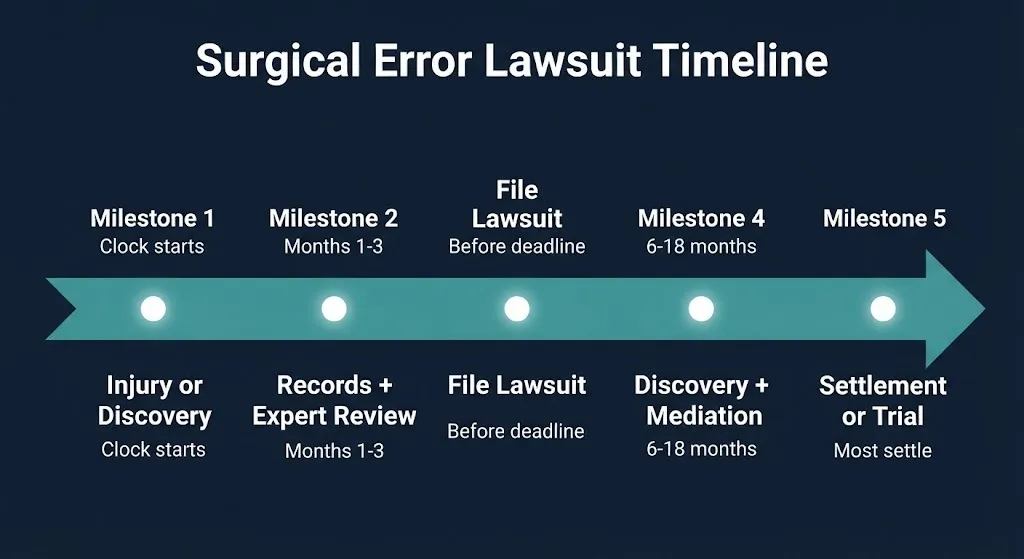
Filing a surgical error lawsuit is a multi-step process that typically takes months before a complaint is even filed in court. The steps are sequential and each one matters.
- Get your complete medical records. Request everything from the hospital and all providers involved. You are entitled to these records.
- Get an independent medical review. A different specialist in the same field reviews your records and determines whether the care fell below standard.
- Consult a malpractice attorney. Most offer free consultations and work on contingency, meaning you pay nothing unless you recover.
- File a certificate of merit if required. Many states require an expert affidavit within a set period after filing, sometimes 60 days.
- File the complaint in the correct court. This is usually the county where the hospital or surgeon is located.
- Complete discovery. Both sides exchange records, answer written questions, and sit for depositions.
- Attend mediation if ordered. Many courts require it before trial. Most cases settle here.
- Prepare for trial if no settlement. About 7 percent of malpractice claims go to a jury verdict.
Key Takeaway: You do not need to figure out the legal standard yourself. A malpractice attorney and an independent medical expert do that work, usually at no upfront cost to you.
What Is the Statute of Limitations for Surgical Error Lawsuits?
The statute of limitations for surgical error lawsuits is typically two to three years from the date of injury or discovery, but every state sets its own rule and some impose absolute deadlines.
| State | Time Limit | Discovery Rule | Notes |
|---|---|---|---|
| Ohio | 1 year | Yes | 4-year statute of repose |
| Pennsylvania | 2 years | Yes | 7-year statute of repose |
| Maryland | 3 years | Yes | 5-year statute of repose |
| Florida | 2 years | Yes | 4-year overall limit, minors until age 8 |
| Texas | 2 years | Yes | 10-year statute of repose |
| California | 1 year | Yes | 3-year overall limit from injury |
A statute of limitations is the deadline for filing. A statute of repose is an absolute bar that cuts off claims regardless of when you discovered the injury.
The Mississippi case illustrates why this matters. A patient filed a malpractice claim more than seven years after the surgery that injured her. The Fifth Circuit ruled in April 2026 that Mississippi’s seven-year provision is a statute of repose and barred her claim entirely, even though she may not have discovered the injury until later.
Do not wait. If you think you have a surgical error claim, the records, the witnesses, and the legal window all get harder with time.
How Long Does a Surgical Error Lawsuit Take?
Most surgical error lawsuits resolve within one to three years, but complex cases with permanent injuries or contested liability can run four years or longer.
The timeline depends on several factors:
Reaching maximum medical improvement. Your lawyer usually waits until your condition stabilizes before valuing the claim. Settling too early risks undervaluing future care needs.
Discovery disputes. Surgical records are dense. Both sides need expert review. Cooperation breakdowns stretch the calendar.
Court backlogs. A crowded docket can push a trial date out by a year, and that date drives settlement negotiations.
Mediation timing. Many cases settle at or after mediation. If mediation fails, the pressure to settle rises as trial approaches.
A study of medical litigation found the median time from filing to resolution was 2.37 years, with about 90 percent of cases resolved within four years.
Why No Class Action Settlement Exists for Surgical Errors
Surgical errors lawsuits are individual claims because every surgery, every error, and every injury is different. Class actions work when many people suffer the same harm from the same product or practice. Surgical errors do not fit that pattern.
This means there is no claim form to file, no deadline to miss, and no administrator holding a pool of money. If you see an advertisement promising “surgical error settlement money” with a deadline, that is not how this works.
The Repatha lawsuit comparison is useful here. That was a $407 million verdict between two pharmaceutical companies. No consumer could claim a dime from it. Surgical error cases are similarly specific. The money goes to the injured patient, not to a class.
Reality Check: No one will text you about surgical error settlement money. There is no national fund. Filing a malpractice claim costs you nothing upfront with a contingency-fee attorney, and third-party “claim helpers” charging fees are unnecessary. If someone asks for payment to “process” a surgical error claim, walk away.
What Happens Next in the Ohio Wrong-Leg Amputation Case?
The Ohio case filed September 15, 2026, is the most recent high-profile surgical error lawsuit. Sharon Jacks, 74, went to Selby General Hospital for a below-the-knee amputation on her right leg due to cancer. The surgical team amputated her left leg instead.
The lawsuit names Selby General Hospital, Marietta Memorial Hospital, Marietta Area Health Care, and several physicians. Jacks is seeking compensatory and punitive damages under Ohio law.
The hospital has acknowledged that “expected operating room procedures were not followed” and said the staff involved are no longer in their positions.
Expected timeline:
- Late 2026: Defendants file answers and initial motions.
- Early 2027: Discovery begins, including expert review and depositions.
- 2027: Mediation likely, given the clear liability.
- 2028 or later: Trial if no settlement.
Wrong-site surgery cases historically result in plaintiff verdicts when they go to trial. A review of arthroscopic malpractice cases found that wrong-site surgery verdicts went 100 percent to the plaintiffs.
What Compensation Can You Recover in a Surgical Error Case?
Compensation in a surgical error case can cover medical expenses, lost income, pain and suffering, and future care needs. The categories are economic damages and non-economic damages.
Economic damages are the financial losses: additional surgeries, rehabilitation, lost wages, reduced earning capacity, and ongoing care.
Non-economic damages are the human losses: pain, suffering, disfigurement, loss of enjoyment of life, and emotional distress.
Most states cap non-economic damages in medical malpractice cases. The caps vary widely:
| State | Non-Economic Damages Cap | Source |
|---|---|---|
| California | $350,000 (increasing annually) | |
| Maryland | $830,000 (increasing $15,000/year) | |
| Massachusetts | $500,000 | |
| South Carolina | $350,000 single provider, $1,050,000 multiple | |
| Texas | $250,000 per defendant |
Some states have no cap. Pennsylvania has no cap on non-economic damages in most cases but does limit punitive damages. Rhode Island has no caps at all.
The $24 million Chicago settlement was not a verdict. It was a negotiated resolution that both sides agreed to. Caps apply to verdicts, not settlements, which is one reason most cases settle.
Frequently Asked Questions
Is the surgical errors lawsuit real or a scam?
Surgical errors lawsuits are real individual malpractice claims, but there is no class action settlement, no claim form, and no administrator holding money. Anyone promising you a check from a “surgical error settlement fund” is misleading you.
How much can I get for a surgical error?
Amounts depend on your injury, your state, and whether the case settles. Verified 2026 settlements range from $2.05 million for a surgical death to $24 million for catastrophic paralysis. Most cases settle for confidential amounts.
How long do I have to file a surgical error lawsuit?
Most states give you two to three years from the date of injury or discovery. Some states, like Ohio, have shorter limits. Do not wait to get your records reviewed.
Do I need a lawyer to file a surgical error claim?
You can file a malpractice lawsuit yourself, but you will need a medical expert to testify about the standard of care. Most attorneys handle these cases on contingency, meaning you pay nothing unless you recover.
What is the most common surgical error that leads to a lawsuit?
Retained surgical instruments and wrong-site surgery are among the most common preventable errors that lead to claims. Failure to diagnose or manage complications also generates frequent lawsuits.
Can I sue for a surgical error if the surgery was necessary?
Yes. The question is not whether the surgery was necessary but whether the care fell below the accepted standard. A necessary surgery performed negligently is still malpractice.
What if I signed a consent form before surgery?
A consent form does not waive your right to sue for negligence. It documents that you understood the risks of the procedure. It does not protect a surgeon who deviated from the standard of care.
Will my surgical error case go to trial?
Most do not. Over 95 percent of medical malpractice claims settle or are dismissed before trial. Only about 7 percent reach a jury verdict.
What Happens Next After You Suspect a Surgical Error
Immediately: Request your complete medical records from the hospital and all providers. You are entitled to them.
Within weeks: Get an independent medical review from a specialist in the same field. This determines whether you have a viable claim.
Within months: Consult a malpractice attorney. Most offer free consultations and handle cases on contingency.
Before the deadline: File the lawsuit before your state’s statute of limitations expires. In some states, this is as short as one year.
After filing: Expect discovery to take six months to a year. Mediation usually follows. Most cases settle.
If no settlement: Trial preparation begins, and the pressure to settle intensifies as the trial date approaches.
The most important thing you can do right now is get your records and get them reviewed. The legal window closes whether you are ready or not.