Bus Accident Lawsuit 2026: Settlement Amounts, Deadlines, and How to File a Claim
Quick Answer
- Bus accident lawsuits are individual claims, not a class action settlement with a universal payout.
- Recent verified bus settlements range from $5,000 for strains to over $5 million for catastrophic injuries.
- If a public bus is involved, you may have as little as 90 days to file a Notice of Claim.
A bus accident lawsuit is a personal injury claim you file against the bus driver, the bus company, or a government transit agency after a crash. There is no single settlement fund, no universal deadline, and no guaranteed payout for everyone.
If you were hurt on or by a bus, the number that matters most is the notice deadline. For public buses, that can be as short as 90 days. Miss it, and your case may end before it starts.
This article explains what the court records and settlement data actually show. It covers real payout examples, the deadlines that kill cases, and the exact steps to protect your claim. One detail that surprises most people: an insurance adjuster may call you within hours of the crash with a low offer, before you even know how badly you are hurt.
The Facts
| Case | Individual bus accident lawsuits, no single consolidated case |
| Status | Ongoing, claims filed case by case |
| Fund Size | No global fund. Payouts depend on operator insurance and assets |
| Est. Per Person | $5,000 to over $5,000,000 based on verified settlements |
| Claim Deadline | 90 days for public buses (varies by state), 2 to 3 years for private |
| Administrator | No settlement administrator. Claims go through the operator or its insurer |
| Proof Needed | Medical records, accident report, proof of injury and causation |
Is a Bus Accident Lawsuit Legit or a Scam?
A bus accident lawsuit is a legitimate legal claim, not a scam. You sue the at-fault operator for negligence, and courts award damages based on medical bills, lost wages, and pain and suffering.
The scam risk comes from the other direction. Some companies contact accident victims and offer to handle claims for a fee. Legitimate personal injury attorneys work on contingency, meaning they only get paid if you recover money. No upfront payment is required.
Federal and state courts handle thousands of bus accident claims every year. The MTA alone processes over 20,000 injury claims annually, according to its own claims data . These are real cases with real payouts.
The warning sign is anyone who texts or calls you first promising settlement money. A real claim starts with you, your medical records, and a filing against the bus operator.
How Much Is a Bus Accident Lawsuit Settlement Worth?
Bus accident settlements range from about $5,000 for minor soft tissue injuries to more than $5 million for catastrophic or fatal crashes. The amount depends on injury severity, who operated the bus, and how much insurance coverage is available.
Verified settlement examples from court records and attorney case results show the range:
| Injury Level | Verified Example | Amount |
|---|---|---|
| Minor strains | Neck and back strains from rear-end bus collision | $5,000 |
| Moderate injuries | Thrown from seat, lower back and shoulder injury | $18,000 |
| Multiple injuries | Head, neck, back, and knee injuries | $50,000 |
| School bus passenger | Minor injured in school bus collision | $156,000 |
| Severe child injury | Bus overturned, multiple child passengers hurt | $400,500 |
| Catastrophic | Teen thrown from bus, brain bleed, coma | $2,500,000 |
| Greyhound collision | Four passengers injured, punitive damages included | $5,050,000 |
| NYC city bus | Passenger required spinal fusion and multiple surgeries | $6,000,000 |
A $6 million settlement for a passenger on a New York City bus shows what severe injuries can bring. That passenger suffered shoulder tears, knee ligament damage, and spinal injuries requiring a laminectomy, facetectomy, and L5-S1 fusion . The case settled after three weeks of trial.
The lesson from the data is simple. Soft tissue injuries settle low. Surgeries, permanent disability, and clear liability settle high.
Key Takeaway: Bus settlement amounts follow injury severity and insurance limits, not a fixed formula, with verified outcomes spanning from $5,000 to over $6 million.
Do You Have to File a Notice of Claim for a Bus Accident Lawsuit?
You must file a Notice of Claim before suing any public bus operator. It is a formal document that tells the transit agency you intend to pursue damages. It is not a phone call or an online form.
Deadlines vary by state and by the type of bus:
| Bus Type | Notice Deadline | Lawsuit Deadline |
|---|---|---|
| NYC MTA bus | 90 days | 1 year and 90 days |
| NYC school bus (public district) | 30 days | Varies |
| Texas government bus | 6 months (some cities 90 days) | 2 years |
| Colorado public entity bus | 182 days | 3 years |
| Private charter or tour bus | None | 2 to 3 years |
Missing the Notice of Claim deadline almost always forfeits the entire case. New York courts do not grant extensions except in rare cases involving minors or mental incapacity .
Think of it like a store return policy with a hard cutoff. If you wait too long, the store does not have to honor the return, no matter how valid your receipt is. The Notice of Claim is your receipt, and the 90-day clock is the return window.
Who Can File a Bus Accident Lawsuit?
Passengers, other drivers, pedestrians, cyclists, and surviving family members can all file bus accident claims. You do not have to be riding the bus to have a case.
- Passengers: The most common claimants. You may sue the bus driver and the bus company.
- Other motorists: If a bus struck your car, you can file against the bus operator.
- Pedestrians and cyclists: Buses are heavy and cause severe injuries to people outside the vehicle. The same notice rules apply if the bus is publicly owned.
- Family members: In fatal crashes, surviving spouses, children, or estate representatives can file wrongful death claims.
A single crash can create multiple claimants drawing from the same insurance pool. In Texas, government bus claims are capped by statute, meaning every injured passenger shares a limited recovery fund . Filing early matters when the pool is fixed.
What Evidence Do You Need to Win a Bus Accident Lawsuit?
You need medical records linking your injuries to the crash, the official accident report, and evidence of who was at fault. Bus cases generate more evidence than ordinary car crashes, and the operator controls most of it.
The key evidence categories include:
- Medical records and bills showing treatment from the date of the crash forward
- The police accident report identifying the parties and any citations issued
- Bus camera footage from onboard surveillance systems
- Black box data recording speed, braking, and steering in the seconds before impact
- Driver qualification and training files showing whether the operator was fit for duty
- Maintenance records revealing mechanical failures that contributed to the crash
- Witness statements from other passengers or bystanders
Government transit agencies often resist releasing this evidence. Attorneys use public records requests and subpoenas to force production . Federal carriers must keep certain records for limited retention periods, and once that window closes, the company can legally destroy them . A preservation letter sent early puts the operator on notice that evidence cannot be destroyed.
Key Takeaway: Bus crash evidence lives in the operator’s records, and preservation letters plus early filing are how you keep that evidence from disappearing.
Reality Check: No legitimate settlement administrator or attorney will text you first offering bus accident money. Filing a claim is always free unless you hire an attorney on contingency. Third-party “claim helpers” charging upfront fees are unnecessary. The real deadline pressure comes from the 90-day notice rule, not from anyone demanding payment.
How Do You File a Bus Accident Lawsuit?
Filing a bus accident lawsuit follows a sequence, and skipping steps can end your claim. Here is the process in order:
- Get medical attention immediately. Your health comes first, and treatment records become your core evidence.
- Report the crash to police. Ensure an official accident report is filed.
- Photograph everything. The bus, the scene, your injuries, and any visible hazards.
- Collect witness names and contacts. Other passengers may have seen what the driver did.
- Determine who operated the bus. Public or private changes your deadline and your strategy.
- File a Notice of Claim if a public entity is involved. This must be done within the statutory window.
- Preserve evidence with a written letter to the operator. Demand that camera footage and black box data be retained.
- Consult an attorney before talking to any insurance adjuster. A recorded statement can hurt your claim.
A Cincinnati case shows why step eight matters. Three hours after a school bus crash injured two 13-year-old boys, an insurance adjuster called their mothers, who did not speak English, and offered to settle . The attorney described it as a “lowball offer” designed to close the case before the families knew their rights . That is the pattern to avoid.
What Happens Next in a Bus Accident Lawsuit?
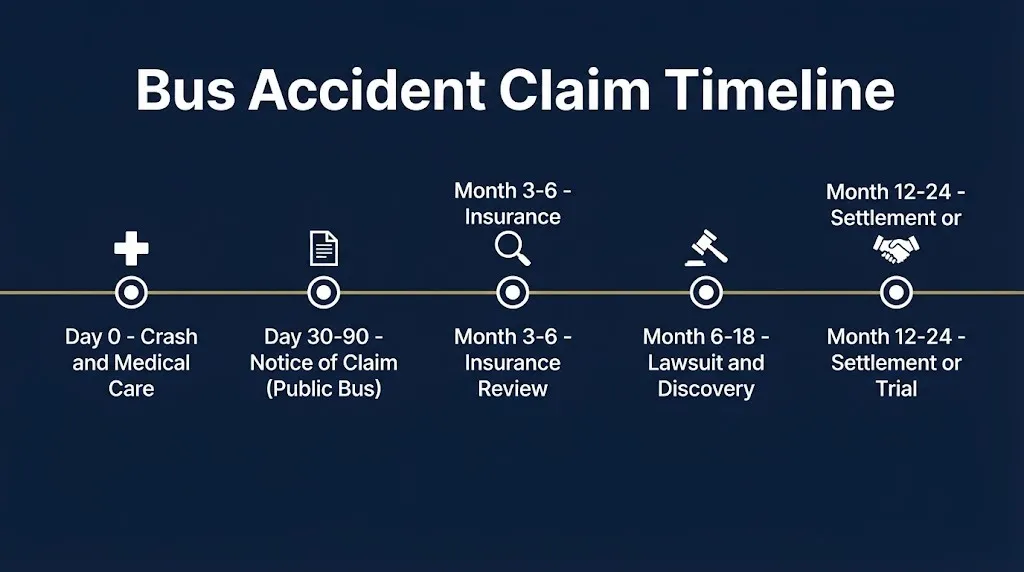
The timeline from crash to payment runs months to years depending on the operator and the complexity of the case.
Immediately after the crash: Medical treatment, accident report, evidence preservation. Public bus cases require a Notice of Claim within 30 to 90 days in many jurisdictions.
Expected 3 to 6 months: Insurance adjuster contact, initial settlement offers, and attorney evaluation. Reject low offers while treatment is ongoing.
Expected 6 to 18 months: Formal lawsuit filed, discovery phase begins, depositions taken, and expert witnesses retained. Government cases move on a statutory clock.
Expected 12 to 24 months: Mediation or settlement negotiations. Most cases resolve before trial.
If no settlement: Trial. A New York city bus case went to trial for three weeks before settling for $6 million on the eve of summations .
The single most important date for any public bus claim is the Notice of Claim deadline. Calendar it the day of the crash.
Frequently Asked Questions
How long do I have to file a bus accident lawsuit?
It depends on who operated the bus. Public bus claims require a Notice of Claim within 30 to 90 days, while private bus claims follow the state personal injury statute, usually two to three years .
How much can I get from a bus accident lawsuit?
There is no fixed amount. Verified settlements range from $5,000 for minor strains to over $6 million for catastrophic injuries requiring spinal surgery .
Can I sue if I was a passenger on a public bus?
Yes, but you must file a Notice of Claim first. Missing the 90-day deadline for an MTA bus, for example, almost always ends the case permanently .
Do I need a lawyer to file a bus accident claim?
You are not legally required to hire a lawyer, but bus cases involve complex notice rules and aggressive insurance adjusters. An attorney working on contingency costs you nothing upfront.
What if the bus driver fell asleep or was distracted?
Fatigue and distraction are common negligence claims in bus cases. A Virginia crash involved a driver who allegedly fell asleep before a collision that killed five people and injured over 40 .
Who pays if a government bus caused the crash?
The government entity pays, but recovery is often capped by statute. Texas caps damages against local government units, and multiple victims may share one limited fund .
Is there a class action settlement for bus accidents?
No. Bus accident lawsuits are individual claims, not class actions. Each injured person files separately, and outcomes vary by injury and jurisdiction.
What is the average bus accident settlement?
Average figures reported by law firms range from $250,000 to $950,000, but these averages come from settled cases with attorney representation and do not apply to every claim .
Key Takeaway: The two questions that control your bus accident claim are who operated the bus and how soon you filed, because those determine both your deadline and your recovery source.
Check the operator’s identity today. If a public transit agency owns the bus, find the Notice of Claim deadline for that specific agency and calendar it. Gather your medical records and accident report. The 90-day clock on public bus claims is the one deadline that ends cases permanently.