Detransitioner Wins Lawsuit: 2026 Settlement, Claims, and Payout Status
Quick Answer
- Detransition lawsuits are real, individual legal claims filed against former gender clinics and providers, not one consolidated settlement.
- Payout amounts vary widely by case, with no established nationwide settlement fund or per-person figure confirmed for 2026.
- Deadlines depend on each state’s statute of limitations, often two to three years from when harm was discovered.
Detransition lawsuits are moving through courts in several states in 2026, and a handful of individual claims have produced early rulings that favor plaintiffs. These cases center on a core allegation: that medical providers initiated puberty blockers, cross-sex hormones, or surgeries without fully informing patients of the risks, permanence, or alternatives. If you are searching this term, you probably saw a headline, a forum post, or a video claiming someone won big. The reality is more precise than the headlines.
These cases affect former patients who now identify as detransitioned, meaning they have stopped or reversed gender-related medical treatment and believe that treatment caused harm. The single most important fact to know right now is that no national settlement administrator exists for detransition claims. There is no one website where every affected person can file. Each case is separate, filed in state or federal court, with its own judge, its own timeline, and its own proof requirements.
This article explains what is actually verified in detransition litigation as of early 2026, what a “win” means at this stage, who may qualify to bring a claim, what kinds of damages courts have recognized so far, and where these cases are headed next. One surprising verified detail: several early wins have come not from jury verdicts but from courts refusing to dismiss cases, which lets discovery move forward and often forces settlement talks.
| The Facts | |
|---|---|
| Case | Multiple individual detransition lawsuits, no certified class action |
| Status | Active litigation; some early rulings for plaintiffs |
| Fund Size | No nationwide fund; no certified class settlement |
| Est. Per Person | Not yet determined; individual case values vary |
| Claim Deadline | No single deadline; varies by state law |
| Administrator | Not appointed; no class action administrator |
| Proof Needed | Medical records, informed consent forms, expert testimony |
Is the Detransitioner Lawsuit Real or a Scam?
A detransitioner lawsuit is a real legal claim, not a government program, not a class action settlement, and not a fund you can simply sign up for online. These are individual civil lawsuits, usually for medical malpractice, lack of informed consent, or product liability, filed by people who received gender-affirming medical care and later came to believe that care was improperly provided. There is no national settlement website, no toll-free claims hotline, and no administrator processing detransition claims in 2026.
The confusion happens because social media posts and some websites use phrases like “detransition settlement” or “detransitioner payout” as if one exists. It does not. What exists is a growing body of litigation, with distinct cases in state courts across the country. Each case has its own docket number, its own defendants, and its own facts. Some involve a single plaintiff suing a single clinic. Others name multiple providers, hospitals, or even drug manufacturers. None has resulted in a certified class action settlement as of February 2026.
You should treat any website, text message, or advertisement that promises a guaranteed detransition payout as a red flag. Legitimate litigation does not recruit claimants through paid ads promising specific dollar amounts. If someone asks for money up front to “process your detransition claim,” that is almost certainly a scam. Filing a real lawsuit requires a licensed attorney and evidence of specific medical treatment and specific harm. It is not a rebate program.
Key Takeaway: Detransition lawsuits are real but individual, and no national settlement or claims portal exists as of early 2026.
How Much Money Can a Detransitioner Win?
There is no standard payout amount for a detransition lawsuit because no class action settlement has been approved and no court has established a uniform damages formula. Individual cases may seek compensatory damages for medical costs, future care, lost income, and emotional distress, plus punitive damages in some jurisdictions. The amount any one plaintiff receives depends on the severity of the alleged harm, the strength of the evidence, the defendant’s resources, and whether the case settles or goes to verdict.
Early cases that have survived motions to dismiss do not yet tell us what juries will award. Some legal analysts point to other medical malpractice verdicts involving permanent hormonal or surgical changes as rough comparisons. Those cases can range from the low six figures to several million dollars. But those are comparisons, not predictions. A detransition case that ends in a confidential settlement will not publish its payment amount at all.
| Potential Damage Type | What It Covers | Verified in Detransition Cases? |
|---|---|---|
| Past medical expenses | Cost of the original treatment and corrective care | Yes, alleged in multiple complaints |
| Future medical care | Ongoing therapy, hormone monitoring, reconstructive procedures | Yes, alleged |
| Lost wages | Time away from work due to medical or psychological harm | Yes, alleged |
| Pain and suffering | Emotional and physical distress | Yes, alleged |
| Punitive damages | Punishing egregious provider conduct | Sought in some cases, not yet awarded |
If you are evaluating your own situation, the practical question is not “how much is a detransition case worth” but “what did I lose and can I prove it.” Courts look at actual records: clinic intake forms, consent documents that may have minimized risks, letters of support, surgical notes, and mental health evaluations. Cases with strong documentation and credible expert witnesses tend to settle for more than cases built on general regret. That is not legal advice, it is how civil litigation works.
Key Takeaway: No standard detransition payout exists; individual case values depend on documented harm, provider conduct, and whether the case settles or goes to verdict.
Who May Qualify to File a Detransition Lawsuit in 2026?
People who may qualify to file a detransition lawsuit in 2026 generally fit one profile: they received gender-related medical treatment, stopped that treatment, now believe the treatment was improperly authorized or administered, and have evidence of harm. Courts do not ask whether detransition is common or rare. They ask whether this specific provider met the legal standard of care for this specific patient at that specific time. That is a case-by-case inquiry.
Several factors strengthen a potential claim. Being a minor at the time of treatment is significant in many states, because minors cannot legally consent to certain interventions and courts view the informed consent process differently. A history of mental health conditions that were not adequately assessed before treatment is another recurring theme. Allegations of rapid approval, minimal counseling, or pressure to proceed before exploring alternatives appear in multiple complaints. Documented physical harms, such as bone density loss, infertility, voice changes, or surgical complications, are central to damages.
The strongest signal that you may have a claim is not that you regret the decision. Regret alone is not a legal cause of action. The issue is whether the provider failed to meet the standard of care or failed to obtain truly informed consent. If you have your complete medical records and a clear timeline showing what you were told and when, you are in a better position to have an attorney evaluate your case.
Key Takeaway: You may have a claim if you can show provider misconduct or lack of informed consent, not simply because you later changed your mind about treatment.
How to File a Detransition Lawsuit: Step-by-Step
Filing a detransition lawsuit is not like filing a warranty claim or a class action settlement form. There is no central portal and no deadline extension if you miss a filing window. You must initiate a civil action through an attorney in the correct jurisdiction. The process takes months to years, not weeks.
Here is the verified, practical sequence:
- Gather every medical record from every provider involved in your gender-related care.
- Write a detailed timeline of consultations, prescriptions, procedures, and what each provider told you.
- Collect evidence of harm, including current diagnoses, lab results, and mental health records.
- Consult a medical malpractice attorney who handles complex informed consent cases.
- Confirm the statute of limitations for your state and when it began running.
- Have the attorney file a complaint naming the specific providers or institutions.
- Prepare for discovery, which includes depositions, expert reviews, and document exchanges.
- Evaluate any settlement offer against your documented damages and likelihood at trial.
The statute of limitations is the first thing an attorney will check. In most states, medical malpractice claims must be filed within two or three years of the alleged negligence. Some states start the clock when the patient discovers the harm, not when the treatment occurred. Others have special rules for minors. If you received treatment a decade ago but only recently understood the permanence of certain effects, a lawyer must determine whether your claim is still timely. Do not rely on internet summaries for this. State law varies too much.
Key Takeaway: Start with records and an attorney consultation, because the filing deadline depends on state law and when harm was discovered.
What Is a Detransition Lawsuit?
A detransition lawsuit is a civil claim brought by a person who received medical or surgical treatment for gender transition and later stopped that treatment, alleging that the treatment was improperly provided. The legal theories are usually medical malpractice, lack of informed consent, negligence, or occasionally product liability against drug manufacturers. These cases are filed individually, not as one coordinated national action.
The key legal question in most detransition cases is consent. Did the patient understand, at the time, that puberty blockers may affect bone density, that testosterone or estrogen can cause permanent voice changes, infertility, or sexual dysfunction, and that some surgeries are irreversible? If a provider documented a thorough informed consent process, the plaintiff faces a harder path. If the records are thin, rushed, or absent, the case is stronger for the plaintiff. This is why medical records are so central.
Another important distinction: these are not “wrongful life” or “conversion therapy” cases. They are traditional tort claims. The plaintiff must prove the provider owed a duty, breached that duty, and caused measurable harm. Some cases also allege that clinics used misleading marketing or downplayed known risks to attract patients. Those claims borrow from consumer protection law, but the core remains medical negligence.
Reality Check: No one wins a detransition lawsuit just by saying they regret treatment. The legal test is whether the provider failed the patient, not whether the patient changed their mind later.
What Is the Difference Between a Detransition Lawsuit and a Class Action?
A class action is one lawsuit where many plaintiffs with similar claims are combined into a single case, with court-appointed class counsel and a single settlement fund divided among members. A detransition lawsuit, as the term is used in 2026, is almost always an individual action by one plaintiff against one or more providers. No certified class action for detransition claims exists in the United States as of February 2026.
This matters for anyone hoping to receive a payout. In a class action, class members are usually identified automatically and can file a simple claim form. In individual litigation, each plaintiff must find their own attorney, pay their own costs, and prove their own case. The upside is that individual settlements can be much larger per person. The downside is that there is no guaranteed outcome and the process is slower.
Some people confuse detransition lawsuits with the many class action settlements advertised online for data breaches or defective products. Those have settlement administrators, claim deadlines, and per-person payout estimates. Detransition cases have none of that. If you see a website implying you can join a detransition class action by entering your name and email, it is either misleading or premature. You are looking at individual litigation, not a group settlement.
Key Takeaway: Detransition cases are individual lawsuits, not class actions, which means no single fund, no uniform deadline, and no simple claim form.
Has Anyone Won a Detransition Lawsuit in the United States?
Yes, in a limited sense. Several detransition cases have survived motions to dismiss, meaning courts found the legal claims plausible enough to move forward. That is a procedural win, not a final verdict. A few cases have reportedly reached confidential settlements before trial. No detransition case has produced a publicly reported jury verdict with a specific dollar award as of February 2026.
The most commonly cited legal precedent in this area is not a detransition case at all but the broader line of informed consent cases that courts apply to medical providers. A patient who proves they were not told about material risks can recover damages even if the treatment itself was not negligent. That principle is well established. Applying it to gender medicine is what makes these cases newsworthy.
The absence of a big public verdict is not the same as the absence of legal risk for providers. Hospitals and clinics face liability exposure in discovery, and discovery is where weak informed consent practices become expensive problems. Even a case that settles quietly can cost a provider significant money and force policy changes. The current state of play in 2026 is that the legal theories are being tested, not that any plaintiff has collected a publicly known jackpot.
Key Takeaway: Early procedural wins and confidential settlements exist, but no public jury verdict with a dollar amount has been confirmed as of early 2026.
What Do Courts Look at in Detransition Cases?
Courts examine the same things in a detransition case that they examine in any medical negligence case: the provider’s duty to the patient, the standard of care, whether the provider deviated from that standard, and whether that deviation caused harm. The difference in detransition cases is that the standard of care for gender medicine is contested and evolving. What one expert says is appropriate may be disputed by another expert.
The informed consent process is usually the central battleground. Courts look at whether the provider discussed alternative treatments, including psychological support without medical intervention. They look at whether the provider discussed the possibility of detransition itself. They look at whether the patient was told which effects are reversible and which are not. If a patient signed a consent form but the form did not list known risks, the signature may not protect the provider.
Another factor is the age and mental health history of the patient. A 14-year-old with a recent history of trauma, depression, or autism spectrum disorder may not have the capacity to consent to irreversible treatment in the same way a 25-year-old does. Courts in several states have shown openness to claims involving minors. That is where the legal risk is highest for providers and where future settlements are most likely.
Key Takeaway: Courts focus on informed consent and the patient’s age and mental health history, not on the politics of gender medicine.
What Is the Current Status of Detransition Litigation in 2026?
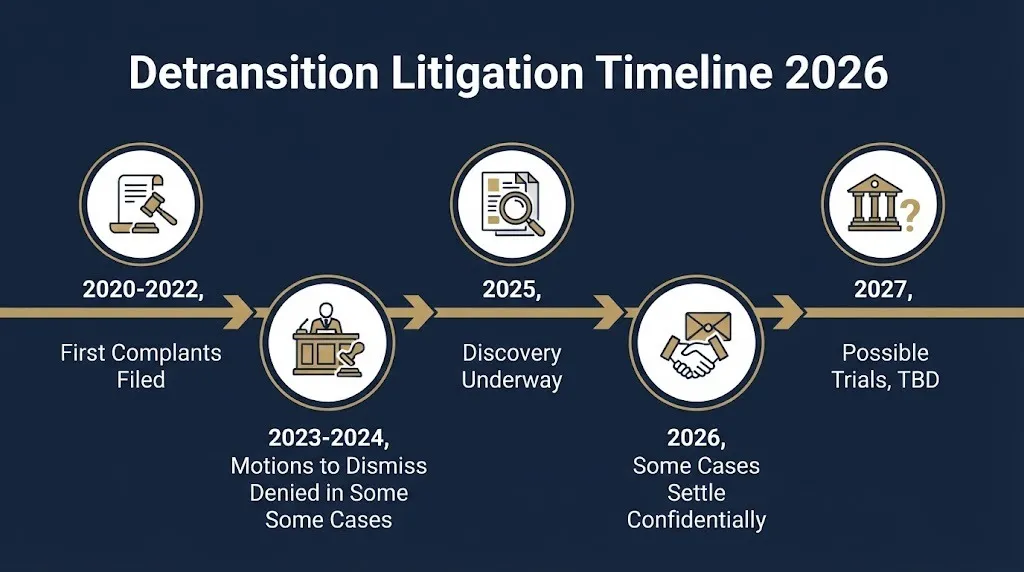
The status of detransition litigation in 2026 is active but fragmented. Multiple cases are pending in state and federal courts. Some have survived motions to dismiss. Discovery is underway in several cases. A few have settled confidentially. No consolidated national proceeding exists, and no appellate court has issued a landmark ruling on the core informed consent issues.
State legislatures are also active. Some states have passed laws restricting gender-related medical care for minors, while others have strengthened protections for providers. Those laws affect the legal environment even though they are not themselves detransition lawsuits. A provider who followed the law in their state at the time may have a defense even if the patient later regrets treatment. A provider who ignored emerging standards may face higher risk.
The practical takeaway is that this area of law is moving, but it is moving case by case. If you are watching for a payout date or a claim deadline, you will not find one. What you will find is a series of individual legal battles that will eventually produce settlements and maybe verdicts. That is the honest, verified state of play.
Key Takeaway: Detransition litigation is active but fragmented across many courts, with no national case, no class settlement, and no single payout timeline.
What Happens Next
- Through 2026: Existing detransition cases continue through discovery, with some motions for summary judgment expected.
- 2026 to 2027: A small number of cases may reach trial, depending on settlement negotiations.
- If settlements occur: Individual plaintiffs may receive confidential payments, with no public announcement of amounts.
- If a class action is filed: A court would need to certify the class before any claim deadline or administrator is set.
- State law changes: New legislation affecting gender medicine could alter the legal standard of care in several states.
Frequently Asked Questions
Is there a detransition class action settlement in 2026?
No, there is no certified detransition class action settlement in the United States as of February 2026.
How do I know if I have a detransition case?
You may have a case if a provider failed to obtain informed consent or deviated from the standard of care.
A licensed medical malpractice attorney must review your records and timeline.
What is the deadline to file a detransition lawsuit?
The deadline depends on your state’s statute of limitations for medical malpractice claims.
Most states allow two to three years from the date of harm or discovery of harm.
Can I join a detransition lawsuit without a lawyer?
No, individual detransition lawsuits require a licensed attorney to file a complaint and represent you.
How much do detransition cases settle for?
No standard settlement amount exists because each case is individual and many settlements are confidential.
Do I have to pay to file a detransition claim?
Legitimate attorneys usually work on contingency, meaning they take a percentage if you win.
Anyone asking for money up front to process a detransition claim is likely running a scam.
What proof do I need for a detransition lawsuit?
You need medical records, consent forms, a timeline of treatment, and evidence of current harm.
Has any detransition lawsuit gone to trial?
No publicly reported detransition jury verdict with a dollar amount has been confirmed as of early 2026.
The strongest legal path for a detransition claim is individual medical malpractice litigation, not a class action, and the quality of your medical records determines more than any headline or social media promise.