Slip and Fall Lawsuit: 2026 Guide to Filing, Settlement Amounts, and What to Expect
Quick Answer:
- Slip and fall lawsuits are real legal claims, not scams, filed when a property owner’s negligence causes injury.
- Settlement amounts depend on injury severity, medical costs, and lost wages, no fixed payout exists.
- Most states set a two-year statute of limitations from the date of injury, so check your deadline now.
If you slipped on a wet grocery store floor, tripped on a broken sidewalk, or fell down poorly lit stairs, you are likely searching for one thing: whether filing a lawsuit is worth it.
You have seen the ads. You have heard the stories. Someone got thousands of dollars after a fall. Someone else got nothing. The truth sits in the details most articles skip.
This guide covers every verified fact about slip and fall lawsuits in 2026: what they are worth, how long they take, what you must prove, and the traps that kill claims before they start. One surprising fact: roughly 95 percent of slip and fall cases settle before trial, according to data from the National Center for State Courts.
The Facts
| Detail | Value |
|---|---|
| Case Type | Personal injury premises liability claim |
| Legal Standard | Negligence of property owner or occupier |
| Average Settlement Range | $10,000 to $50,000 for moderate injuries |
| Statute of Limitations | Varies by state, typically 2 to 3 years |
| Proof Needed | Incident report, medical records, photos, witness statements |
| Settlement Timeline | 6 to 18 months for most resolved claims |
| Trial Rate | Under 5 percent of filed cases |
Is a Slip and Fall Lawsuit Legit or Just Hype?
A slip and fall lawsuit is a legitimate legal claim, not a frivolous stunt. It falls under premises liability law, which requires property owners to maintain reasonably safe conditions. When they fail to do that, and someone gets hurt as a direct result, the law provides a path to compensation.
The idea that these cases are easy money is wrong. Courts and insurance companies scrutinize them closely. You have to prove four things: the owner owed you a duty of care, the owner breached that duty, the breach caused your fall, and you suffered actual damages. Missing any one of those elements means the case fails.

Fraudulent claims do exist, and that is part of why insurers fight these cases aggressively. But legitimate claims arise every day. The National Floor Safety Institute reports that falls account for over 8 million emergency room visits annually. Those are real injuries with real medical bills. The legal system exists to sort the valid claims from the invalid ones, and it does so through a structured process of evidence, negotiation, and when necessary, litigation.
Red Flags That Signal a Weak Claim
Not every fall creates a viable lawsuit. Some red flags that insurance adjusters and courts look for include filing long after the incident with no explanation for the delay, having no medical treatment documented in the days following the fall, and falling in an area where warning signs were clearly posted.
Another common weakness is pre-existing injuries. If your medical records show a long history of back or knee problems before the fall, the defense will argue the fall did not cause your current condition. This does not mean your case is dead, but it means you need stronger medical evidence linking the fall to a measurable worsening of your condition.
Key Takeaway: A slip and fall claim is only as strong as the evidence you collect at the scene and in the days that follow. No evidence means no leverage.
How Much Is a Slip and Fall Lawsuit Worth in 2026?
There is no fixed payout for a slip and fall case. Settlement amounts vary wildly because each case turns on its own facts: the severity of the injury, the clarity of fault, the available insurance coverage, and the skill of your attorney. What one case settles for tells you almost nothing about what your case is worth.
That said, data from legal analytics firms and published insurer reports gives a rough framework. Cases involving soft tissue injuries like sprains and strains, where treatment is limited to a few doctor visits and physical therapy, typically resolve in the $3,000 to $15,000 range. Cases requiring surgery, such as a broken hip or herniated disc repair, often land between $50,000 and $150,000. Cases involving catastrophic injuries (spinal cord damage, traumatic brain injury, or wrongful death) can reach $250,000 to $1 million or more, usually capped by available insurance policy limits.
What Drives the Dollar Amount Higher
Insurance adjusters and juries evaluate damages using a formula, even if they do not call it one. Economic damages come first: all medical bills (past and future), lost wages, and any out-of-pocket costs tied to the injury. Then come non-economic damages: pain and suffering, loss of enjoyment of life, and permanent impairment.
The multiplier effect is real. In negotiations, the total economic damages are often multiplied by 1.5 to 5, depending on how severe and lasting the injury is. A $10,000 medical bill with a clean recovery might settle for $15,000 to $20,000 total. That same $10,000 bill with a permanent limp or chronic pain might settle for $40,000 to $50,000. This is not a guarantee, but it is the working math most plaintiff attorneys use when evaluating a case.
Think of it like a car insurance claim after an accident. The repair estimate is the base. But if the car was a rare model, or the accident left frame damage that cannot be fully fixed, the total payout rises. Your body is the same. Permanent damage multiplies the value.
Payout Ranges by Injury Type
| Injury Type | Typical Settlement Range | Factors That Increase Value |
|---|---|---|
| Minor soft tissue (sprains, bruises) | $3,000 to $15,000 | Clear liability, documented treatment |
| Fractures (wrist, ankle, arm) | $15,000 to $50,000 | Surgery required, lost work time |
| Hip fractures | $50,000 to $150,000 | Surgery, rehab, mobility loss |
| Herniated discs | $50,000 to $200,000 | Epidural injections, fusion surgery |
| Traumatic brain injury | $100,000 to $1M+ | Cognitive deficits, lifelong care needs |
| Spinal cord injury | $250,000 to $2M+ | Paralysis, permanent disability |
| Wrongful death | $250,000 to $1M+ | Lost income, funeral costs, family impact |
These ranges are not promises. They reflect settlements where liability was reasonably clear. If a store has surveillance footage showing a spill ignored for hours, the settlement climbs. If the fall happened on a small patch of ice during an active snowstorm, the settlement drops, because the law often gives property owners reasonable time to address weather conditions.
How Long Does a Slip and Fall Lawsuit Take?
Most slip and fall cases settle in 6 to 18 months from the date you hire an attorney. Cases that go to trial take longer, sometimes 2 to 3 years. The timeline depends on how quickly you finish medical treatment, how stubborn the insurance company is, and how backed up the local court docket is.
The process follows a predictable rhythm. You treat your injuries first. Your attorney sends a demand letter to the insurer, outlining your claim and asking for a specific dollar amount. Negotiations follow. If the insurer makes a fair offer, you settle. If not, your attorney files a lawsuit, and discovery begins. Discovery is where both sides exchange evidence, take depositions, and hire expert witnesses. Most cases settle during or right after discovery, because both sides then have a clear picture of what a trial will look like.
Trials are rare. As noted, fewer than 5 percent of slip and fall cases reach a verdict. Trials are expensive, slow, and unpredictable. Both sides usually prefer the certainty of a settlement. But if the insurer refuses to offer a reasonable amount, trial becomes the only way to get fair compensation.
Key Takeaway: Do not expect a fast check. Cases move at the speed of your recovery plus the insurer’s willingness to negotiate.
What Do You Need to Prove in a Slip and Fall Case?
You must prove four elements, and the burden is on you. The property owner does not have to prove they were careful. You have to prove they were not.
First, duty of care. You must show the property owner owed you a legal obligation to keep the premises safe. The duty varies by your reason for being there. A customer in a store gets the highest protection. A social guest on private property gets moderate protection. A trespasser gets almost none, except for protections against intentional harm.
Second, breach of duty. You must show the owner failed to meet that obligation. This usually means proving the owner knew about the hazard (a spill, a broken step, a torn carpet) and did nothing about it, or that the hazard existed long enough that the owner should have known and fixed it. This is where surveillance footage, maintenance logs, and witness testimony become critical.
Third, causation. You must link the owner’s breach directly to your fall. If you tripped over your own shoelaces, you lose. If you were distracted by your phone, the defense will use that against you under comparative negligence rules.
Fourth, damages. You must have actual losses: medical bills, lost wages, pain and suffering. A fall with no injury is not a lawsuit.
Common Defenses That Kill Claims
Insurance companies have a playbook. They will argue you were not paying attention. They will argue the hazard was open and obvious, meaning you should have seen it and avoided it. They will argue your injuries pre-existed the fall. They will argue you failed to mitigate damages by not following your doctor’s instructions. Every one of these defenses is designed to reduce or eliminate the payout. The strongest counter is documentation: photos of the scene, prompt medical care, and a consistent narrative from day one.
How to File a Slip and Fall Claim: Step by Step
Filing a claim is not just about calling a lawyer. What you do in the first 48 hours often determines whether you have a case at all. Here is the sequence.
- Report the fall immediately to the property owner, manager, or landlord. Get a copy of the incident report before leaving the scene if you are physically able. If they refuse to provide one, take notes on exactly who you spoke to and when.
- Take photos and videos of the exact spot where you fell. Capture the hazard from multiple angles. Include something for scale, like your shoe or a coin, next to the hazard. Do this immediately, because hazards get cleaned up fast.
- Get contact information from any witnesses. Names and phone numbers are enough. Witness memories fade within days.
- Seek medical attention the same day or the next morning at the latest. Tell the doctor exactly how and where you fell. A gap of several days between the fall and your first medical visit is the single biggest gift you can hand the insurance company.
- Save the clothing and shoes you were wearing. Do not wash them. They may contain trace evidence like the substance you slipped on.
- Do not give a recorded statement to any insurance adjuster before speaking with an attorney. Adjusters are trained to ask questions designed to minimize the claim. You have no obligation to speak to them.
- Consult a personal injury attorney who handles premises liability cases. Most offer free consultations and work on contingency, meaning they only get paid if you recover money.
- Follow every medical recommendation. Attend every appointment. Gaps in treatment are a red flag to insurers and juries alike.
What Not to Do After a Fall
Do not post about the fall on social media. Insurance investigators search for your profiles. A photo of you at a family barbecue while claiming a back injury can destroy your case. Do not sign any release or settlement offer from an insurer without legal review. Once you sign, your claim is over, even if complications arise later. Do not exaggerate your injuries to anyone, ever. Exaggeration discovered in a deposition or on surveillance video is fatal to a claim.
Key Takeaway: The first 48 hours after a fall build or break your case. Act like an investigator, not a victim.
Slip and Fall Settlements Without Surgery: What to Expect
Not every slip and fall case involves a broken bone or a scalpel. Many claims involve soft tissue injuries: sprained ankles, strained backs, bruised knees. These cases settle, but for less money, and insurers fight them harder because the injuries are harder to see on an X-ray.
A soft tissue case with $3,000 in medical bills, a few weeks of physical therapy, and no lost wages might settle for $5,000 to $10,000. That is not nothing, but it is also not a windfall. The challenge is convincing an adjuster that the pain is real and ongoing when the MRI is clean. Consistent treatment records and a doctor willing to write a narrative report linking the pain to the fall are essential.
Cases with chiropractic care only tend to settle lower than cases with orthopedic or neurological follow-up. This is not fair, but it is the reality of the insurance industry. Chiropractic treatment is sometimes viewed as less objective than an orthopedist’s findings. If your injury persists, get a referral to a specialist. It strengthens your case and, more importantly, gets you better care.
Slip and Fall Lawsuit Settlement Amounts With Surgery
Surgery transforms a case. Once a surgeon’s bill enters the file, the insurance adjuster knows the case just became more expensive to defend and more dangerous to take to trial. A herniated disc requiring a fusion, a broken hip needing a partial replacement, or a torn rotator cuff repaired arthroscopically all push settlement value into the mid-five figures and beyond.
The math is straightforward. A spinal fusion surgery costs $80,000 to $150,000 in billed charges. Add pre-surgery imaging, post-surgery rehab, and time off work, and the economic damages alone can exceed $200,000. A multiplier of 2 to 3 on top of that pushes the settlement demand into the $400,000 to $600,000 range. Whether the insurer pays that depends on policy limits. A grocery store chain might carry a $1 million commercial policy. A small landlord might carry only $100,000. Your recovery is capped by the available insurance, unless the defendant has significant personal assets, which is rare.
The Policy Limit Problem
You can have a million-dollar injury and a hundred-thousand-dollar policy limit. In that scenario, your attorney will demand the full policy limit. If the insurer pays it, the case settles. If the insurer unreasonably refuses, and a jury awards more than the limit, the insurer may face a bad faith claim. But getting money beyond the policy limit from the property owner personally is difficult. Most individuals do not have deep enough pockets to collect a large excess judgment. This is a hard truth that your attorney should explain early.
Reality Check: No legitimate settlement administrator or lawyer will cold-call you to offer a slip and fall payout. If someone contacts you claiming you are owed money from a fall you do not remember, it is a scam. Filing a claim always starts with you.
Average Slip and Fall Settlement Examples by Location
Where you fall matters. Different venues carry different insurance policies, different legal duties, and different jury sympathies. Here is how common settings break down.
Grocery Store and Retail Falls
These are the most common slip and fall cases. National chains like Walmart, Kroger, and Target carry large commercial policies. They also have surveillance cameras, which can prove or disprove your claim. A fall on a clear liquid in a grocery aisle, with footage showing an employee walked past the spill 20 minutes earlier and did nothing, is a strong case. Settlements in retail falls often range from $15,000 to $75,000 for moderate injuries, and higher for surgical cases. Walmart alone faces thousands of these claims annually, and most settle confidentially.
Restaurant and Bar Falls
Greasy kitchen floors, spilled drinks, and poor lighting make restaurants high-risk. The challenge is that many are small businesses with limited insurance. A mom-and-pop pizzeria might carry a $300,000 policy. A national chain like McDonald’s carries far more. If the fall involves a substance that should have been cleaned promptly, and there is a witness or camera, settlements track the retail range.
Apartment and Rental Property Falls
Landlords have a duty to maintain common areas: stairwells, hallways, parking lots, and sidewalks. Broken steps, missing handrails, and ice-covered walkways are frequent claims. The legal standard often requires the landlord to have actual or constructive notice of the hazard. If you reported the broken step three times and nothing was fixed, that is strong evidence of notice. If a storm dropped ice an hour before you fell, the landlord may argue they had no reasonable time to clear it. Residential falls often settle in the $10,000 to $50,000 range, depending on the injury and the landlord’s insurance.
Workplace Falls
If you fall at work, your primary remedy is workers compensation, not a personal injury lawsuit. Workers comp pays medical bills and a portion of lost wages regardless of fault, but it does not pay for pain and suffering. The exception is if a third party caused the fall (a contractor, a property owner who is not your employer). In that case, you may have both a workers comp claim and a third-party lawsuit. Those cases are complex and require an attorney who handles both systems.
Key Takeaway: The location of your fall determines which insurance policy pays and how much is available. A strong case against an underinsured defendant may still recover little.
How Comparative Negligence Affects Your Payout
Most states follow some form of comparative negligence. This means your own fault reduces your recovery. If you were texting while walking and missed a wet floor sign, a jury might find you 30 percent at fault. Your $100,000 verdict becomes $70,000.
Some states follow pure comparative negligence, where you can recover even if you are 99 percent at fault. Others follow modified comparative negligence, where you recover nothing if you are 50 or 51 percent or more at fault. A few states still follow contributory negligence, where any fault by you, even 1 percent, bars recovery entirely. Alabama, Maryland, North Carolina, Virginia, and the District of Columbia are contributory negligence jurisdictions as of 2026. If you fell in one of those states, the defense will fight to pin even a sliver of blame on you, because that sliver kills the whole case.
Your attorney should evaluate your comparative fault early. If you bear significant responsibility, the settlement value drops proportionally. This is not a surprise sprung at trial. It is baked into every serious settlement negotiation.
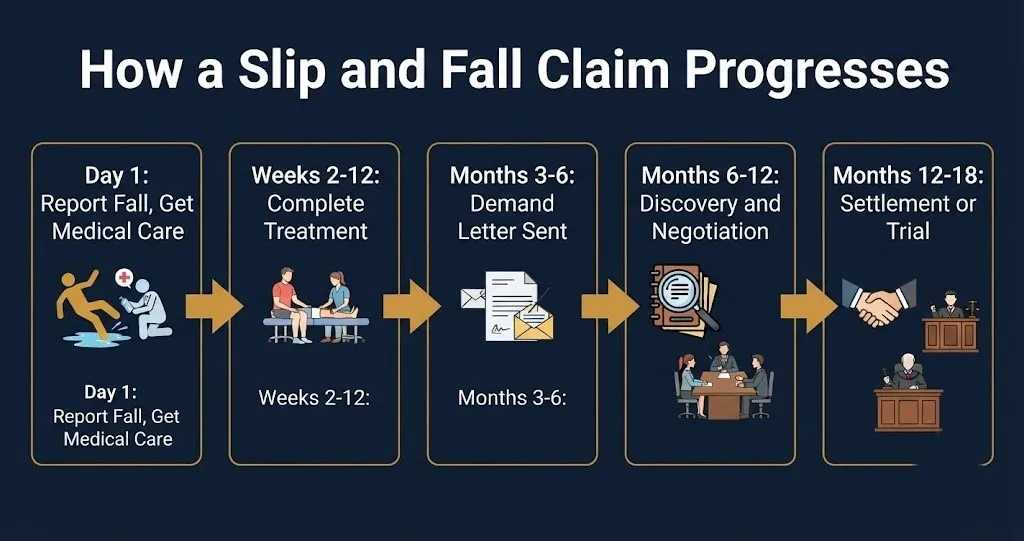
What Happens Next: The Timeline After You File
The path from fall to resolution has clear markers. Here is the expected sequence.
- Days 1 to 7: Medical treatment begins. Incident reported. Evidence collected. Attorney consulted.
- Weeks 2 to 12: Medical treatment continues. Attorney gathers records, investigates the property owner, identifies insurance coverage.
- Months 3 to 6: If treatment is complete, attorney sends a demand letter. Insurer responds, typically with a low initial offer. Negotiations begin.
- Months 6 to 12: If no settlement, lawsuit is filed. Discovery begins. Depositions are taken.
- Months 12 to 18: Mediation often occurs. Most cases settle at or after mediation.
- Months 18 to 36: If no settlement, trial is scheduled. Verdict reached. Appeals possible but uncommon in slip and fall cases.
This timeline assumes a reasonably cooperative insurer and a court without extreme backlogs. Some jurisdictions move faster. Some, particularly large urban courts, move slower. Your attorney should give you a realistic timeline for your specific venue.
Frequently Asked Questions
How long do I have to file a slip and fall lawsuit?
The statute of limitations varies by state.
Most states give you two years from the date of the fall.
Some states allow three years, and claims against government entities often require notice within 90 days.
Check your state’s deadline immediately.
Do I need a lawyer for a slip and fall claim?
You can file without one, but it is not recommended.
Insurance adjusters handle claims daily and know how to minimize payouts.
An experienced attorney understands valuation, negotiation, and the procedural rules that can trap pro se plaintiffs.
How much does a slip and fall lawyer cost?
Almost all personal injury attorneys work on contingency.
This means you pay nothing upfront.
The attorney takes a percentage of the recovery, typically 33 to 40 percent, with the percentage depending on whether the case settles or goes to trial.
What if the property owner says I was trespassing?
Your status on the property determines the duty you are owed.
Trespassers generally cannot recover for negligence, only for willful or wanton harm.
If you were on the property with permission, even implied permission, you are likely a licensee or invitee with greater protections.
Can I sue if I fell on a public sidewalk?
It depends on who owns and maintains the sidewalk.
Municipalities often have sovereign immunity protections and shorter notice deadlines.
If a private property owner is responsible for the sidewalk, standard premises liability rules apply.
Will my case go to trial?
Probably not.
Over 95 percent of slip and fall cases settle before trial.
Your attorney should prepare every case as if it will go to trial, because that preparation drives higher settlements.
How is pain and suffering calculated?
There is no fixed formula.
Insurers and juries consider the severity of the injury, the length of recovery, and the impact on daily life.
The multiplier method (economic damages multiplied by 1.5 to 5) is a common starting point in negotiations.
What if I can’t afford medical treatment after the fall?
Some attorneys work with medical providers who treat on a lien basis.
This means you receive treatment now, and the provider is paid from your settlement.
Not all providers offer this, and it is not available in every state.
Your slip and fall claim is only as strong as the evidence you preserve and the speed with which you act. If you fell recently, focus on medical care and documentation. If you are researching for a past fall, the statute of limitations is your most urgent question.
The single most important date in any slip and fall case is the filing deadline. Once it passes, the case is over, no matter how severe the injury or how clear the fault. Know your deadline, and act before it arrives.