Motor Accidents Compensation Act 2026: NSW Scheme Rules, Claim Deadlines, and What You Can Actually Recover
Quick Answer
- The Motor Accidents Compensation Act is a New South Wales law covering compensation for injuries from motor accidents, not a single settlement or class action.
- There is no universal payout figure. Damages depend on economic loss, treatment costs, and care needs.
- The critical deadline is six months from the accident to lodge a claim, with late claims requiring a full and satisfactory explanation.
You searched for the Motor Accidents Compensation Act because you were hurt in a car accident in New South Wales, or someone you know was, and you need to understand what compensation is available. The direct answer is that this Act sets the rules for claiming damages from a compulsory third party insurer, but it is not a fund you apply to for a preset amount.
What matters most is timing. Under the Act, a claim must generally be made within six months of the accident, and a late claim requires a full and satisfactory explanation to the court . That deadline is the one number that can end your claim permanently.
This article breaks down what the Act covers in 2026, how damages are calculated, what the courts have recently decided about public transport accidents and psychiatric injuries, and the steps to lodge a claim. One detail worth knowing up front: a 2026 decision confirmed that injuries on public buses are assessed under this older Act, not the newer scheme, which can make a real difference to whether you can recover damages at all .
The Facts
| Item | Verified Detail |
|---|---|
| Full Name | Motor Accidents Compensation Act 1999 (NSW) |
| Jurisdiction | New South Wales, Australia |
| Current Version | Consolidated 18 February 2026 |
| Claim Type | Common law damages for motor accident injuries |
| Settlement Fund | None. Claims are made against CTP insurers, not a government fund. |
| Estimated Payout | Not fixed. Depends on economic loss, treatment, and care. |
| Claim Deadline | Generally six months from the accident |
| Late Claim Test | Full and satisfactory explanation required |
| Administrator | Not applicable. Insurers and the Personal Injury Commission handle disputes. |
Is the Motor Accidents Compensation Act Still Active in 2026?
The Motor Accidents Compensation Act is still active in 2026, but its role has narrowed. The Act was consolidated with a current version effective 18 February 2026, and it continues to govern claims that fall outside the newer Motor Accident Injuries Act 2017 .

Most accidents occurring after December 2017 are covered by the 2017 scheme. However, the MAC Act still applies to older accidents, to certain transitional claims, and to specific categories such as public transport accidents. A February 2026 statute law amendment also updated a technical reference in section 62 of the Act, replacing a reference to the “President” with the “Commission” to reflect the current institutional structure .
If you were injured in an accident before the 2017 scheme commenced, or you were hurt on a public bus, the MAC Act is likely the relevant law. That distinction matters because the tests for damages are different.
How Much Compensation Can You Claim Under the MAC Act?
There is no fixed compensation amount under the Motor Accidents Compensation Act. Damages are calculated case by case, based on verified economic loss, treatment expenses, and care needs. A 2024 Personal Injury Commission assessment in a MAC Act matter illustrates how these figures add up in practice.
In that case, the Commission assessed damages totaling $523,770.49, broken down as follows :
| Damage Category | Assessed Amount |
|---|---|
| Past economic loss | $351,020.64 |
| Past paid economic loss | $22,065 |
| Past superannuation | $38,612.27 |
| Fox v Wood | $7,202 |
| Future economic loss | $95,000 |
| Past treatment expenses | $9,370.58 |
| Future treatment expenses | $500 |
| Total | $523,770.49 |
That total is not an average or a benchmark. It reflects one claimant’s specific circumstances, including a finding of total work incapacity from August 2020 to February 2024 and ongoing injuries . Your own claim may be worth far less or more, depending on your loss.
The Act also has specific rules for gratuitous care. Past care must meet a threshold of six hours per week for at least six months, with a maximum of 40 hours per week, paid at a set rate under section 128 . These thresholds are strict, and care claims that do not meet them may not be recoverable.
What Is the Claim Deadline Under the Motor Accidents Compensation Act?
The claim deadline under the Motor Accidents Compensation Act is generally six months from the date of the accident. If you miss that window, you can still make a late claim, but only if the court is satisfied you have a full and satisfactory explanation for the delay .
The test for a full and satisfactory explanation has two parts. First, you must give a full account of your conduct, knowledge, and belief from the accident date until you provide the explanation. Second, a reasonable person in your position must have been justified in experiencing the same delay . This is a high bar, and courts apply it strictly.
A June 2026 ruling in the NSW District Court shows how the test can be met even after a very long delay. In that case, a woman whose partner died in a December 2005 motorcycle accident was allowed to pursue the insurer more than 20 years later. The judge accepted she believed she could not proceed, feared costs, and was suffering depression, and found her explanations were full and satisfactory . That outcome does not mean long delays are routinely excused. It shows that the quality of the explanation matters more than the length of the delay.
Can You Claim for a Public Transport Accident Under the MAC Act?
You can claim for a public transport accident under the Motor Accidents Compensation Act, even for injuries that would be barred under the newer scheme. A January 2026 Personal Injury Commission decision, published in March 2026, confirmed this distinction.
In Russell v Allianz Australia Insurance Limited, the claimant was injured on a public bus in August 2019. The parties agreed the claimant had only sustained a “threshold injury” under the Motor Accident Injuries Act 2017, which would normally bar damages under that Act. However, the Commission found that section 121 of the Transport Administration Act 1988 meant the claim was governed by Chapter 5 of the MAC Act instead. Because the MAC Act does not contain the same threshold injury bar, the claim could proceed .
The practical lesson is that the law governing your claim depends on where and how the accident happened, not just when. If you were hurt on a public bus, the MAC Act may apply even for a recent accident, and you may have rights that would not exist under the 2017 scheme.
Key Takeaway: The Motor Accidents Compensation Act still governs specific claims in 2026, including public transport accidents, and the six-month claim deadline with its strict late-claim test is the single most important rule to understand.
Can You Claim for a Psychiatric Injury Under the MAC Act?
You can claim for a psychiatric injury under the Motor Accidents Compensation Act if the injury is measurably associated with a specific motor accident. Section 3A(2) of the Act excludes injuries that arise gradually from a series of incidents, but it does not exclude an aggravation or exacerbation of a pre-existing condition caused by one identifiable accident.
A July 2026 decision in the NSW District Court addressed this issue directly. A firefighter who attended a fatal bus collision in 2011 developed post-traumatic stress disorder, but the defendants argued his injury arose gradually from multiple traumatic events across his career. The court rejected that broad reading, holding that section 3A(2) applies only where the injury cannot be tied to a single accident at a fixed point in time. Because the claimant’s condition was measurably aggravated by the 2011 collision, his claim could proceed under the MAC Act .
This matters if you have prior trauma or a pre-existing psychological condition. The existence of earlier events does not automatically remove your claim from the scheme. What matters is whether the motor accident caused a measurable worsening that can be identified.
How Do You Lodge a Claim Under the Motor Accidents Compensation Act?
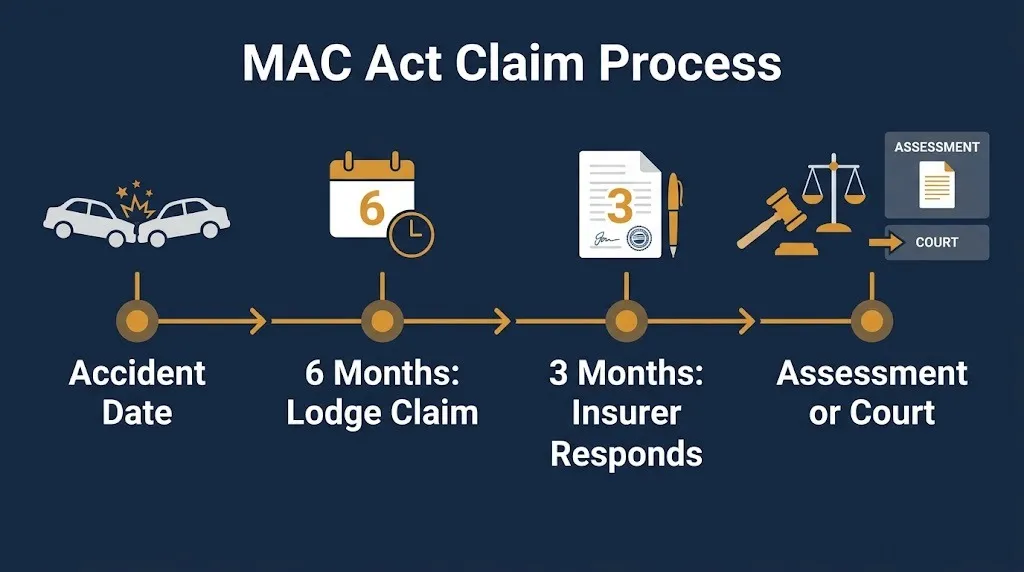
You lodge a claim under the Motor Accidents Compensation Act by notifying the relevant CTP insurer in the approved form, usually within six months of the accident. The steps below outline the general process.
- Report the accident to police if required under section 70 of the Act.
- Identify the at-fault vehicle and its compulsory third party insurer.
- Complete the notice of claim form required under section 74.
- Lodge the claim with the insurer within six months of the accident.
- Provide all relevant particulars of your claim as required under section 85A.
- Attend medical examinations arranged by the insurer if requested under section 86.
- Participate in a settlement conference if the insurer makes an offer under section 82.
- Refer the claim for assessment if it does not settle.
The insurer has a duty to respond to your claim within three months, and it must make a reasonable offer of settlement within a set period after receiving your particulars . If the claim is not resolved, it can be referred to the Personal Injury Commission for assessment.
Reality Check: No one texts you compensation money first. The MAC Act is a legal scheme, not a settlement fund, and there is no administrator handing out preset amounts. Claims are made against insurers, and the process requires documentation and, usually, legal help.
What Happens Next
- Within six months of the accident: Lodge your claim with the CTP insurer. This is the deadline that matters most.
- Within three months of your claim: The insurer must give written notice of whether it admits or denies liability .
- After you provide full particulars: The insurer must make a reasonable offer of settlement, unless it wholly denies liability .
- If the claim does not settle: A settlement conference is held, and the claim may be referred to the Personal Injury Commission for assessment.
- If you miss the six-month deadline: You must apply for leave to make a late claim and provide a full and satisfactory explanation to the court.
Frequently Asked Questions
Is the Motor Accidents Compensation Act still used in 2026?
Yes. It remains in force for older claims and specific categories, including public transport accidents, even though most new claims fall under the 2017 scheme .
How long do I have to make a claim under the MAC Act?
The general deadline is six months from the accident. Late claims require a full and satisfactory explanation that the court accepts .
Is there a settlement fund under the MAC Act?
No. There is no government fund or preset payout. Claims are made against the at-fault vehicle’s compulsory third party insurer.
Can I claim for a psychiatric injury under the MAC Act?
Yes, if the psychiatric injury is measurably caused or aggravated by a specific motor accident, even if you have prior trauma .
Does the MAC Act cover public bus accidents?
Yes. A 2026 decision confirmed that public transport accidents are governed by the MAC Act, which can allow damages even for threshold injuries .
What is the maximum I can claim for care under the MAC Act?
Past gratuitous care must meet a six-hour-per-week threshold for at least six months, and is capped at 40 hours per week at a set rate .
What happens if the insurer denies liability?
You can refer the dispute to the Personal Injury Commission for assessment, and the claim may proceed to court if it is not resolved.