Back Injury Settlement Without Surgery 2026: Realistic Payouts and What Affects Value
Quick Answer
- A back injury settlement without surgery is real and common. Most back injury claims settle without an operation.
- Typical settlements range from $10,000 for soft tissue injuries to $150,000 for herniated discs with ongoing treatment.
- The most important deadline is your state’s statute of limitations, usually 1 to 3 years for personal injury claims.
You hurt your back. You did not have surgery. You are wondering what your claim is worth and whether you can settle without going under the knife.
Here is the direct answer. Yes, you can settle a back injury claim without surgery. In fact, most back injury settlements happen without any operation. The value depends on your medical records, the cause of the injury, and who is paying.
This guide covers verified settlement ranges, the factors that move the number up or down, and what you need to prove to get paid. One surprising verified fact: insurance adjusters often place a lower value on non-surgical back claims, but strong documentation of ongoing pain and treatment limitations can still produce five-figure settlements.
The Facts
| Item | Detail |
|---|---|
| Claim Type | Personal injury or workers compensation |
| Surgery Requirement | Not required for settlement |
| Typical Settlement Range | $10,000 to $150,000 |
| Soft Tissue Injury Range | $2,500 to $25,000 |
| Herniated Disc Without Surgery | $30,000 to $150,000 |
| Statute of Limitations | 1 to 3 years, varies by state |
| Evidence Needed | Medical records, imaging, work restrictions |
| Average Resolution Time | 6 to 18 months |
Can You Get a Back Injury Settlement Without Surgery?
Yes, you can get a back injury settlement without surgery. Surgery is not a requirement for compensation. The majority of back injury claims settle without any operation.
Insurance companies settle non-surgical back claims every day. The key is proving that your injury is real, that it was caused by the accident or work incident, and that it has affected your life in measurable ways.
A herniated disc shown on an MRI can settle for a substantial amount even if you never have surgery. A muscle strain with only chiropractic notes may settle for much less. The difference is the objective evidence in your medical records.
Surgery can increase settlement value because it proves severity. But absence of surgery does not doom your claim. It simply means you need stronger documentation of ongoing symptoms and limitations.
How Much Is a Back Injury Settlement Without Surgery Worth?
A back injury settlement without surgery is typically worth between $10,000 and $150,000. The exact number depends on the type of injury, the strength of liability, and the available insurance coverage.
Soft tissue injuries like strains and sprains settle on the lower end. A simple muscle strain with a few weeks of physical therapy might settle for $2,500 to $10,000. A more persistent strain with months of treatment could reach $15,000 to $25,000.
Structural injuries like herniated discs or bulging discs settle higher, even without surgery. A herniated disc confirmed by MRI, with documented nerve pain and work restrictions, often settles between $30,000 and $100,000. Cases with multiple herniated levels or permanent restrictions can exceed $150,000.
Here is a general settlement range table based on injury type and treatment:
| Injury Type | No Surgery Settlement Range |
|---|---|
| Minor strain or sprain | $2,500 to $10,000 |
| Moderate strain with PT | $10,000 to $25,000 |
| Bulging disc with injections | $25,000 to $60,000 |
| Herniated disc with nerve pain | $40,000 to $100,000 |
| Multiple herniated discs | $75,000 to $150,000+ |
These ranges are based on typical personal injury settlements across the United States. Your case may fall outside them depending on your specific facts.
Key Takeaway: Non-surgical back settlements range from a few thousand dollars to over $150,000, with medical evidence driving the number.
What Factors Affect a Back Injury Settlement Without Surgery?
Several factors determine the value of a back injury settlement without surgery. The most important are medical documentation, liability, damages, and the available insurance policy limits.
Medical documentation is the backbone of your claim. An MRI showing a herniated disc is worth more than a doctor’s note saying you have back pain. Consistent treatment records show the injury is real and ongoing. Gaps in treatment suggest the injury healed.
Liability means who was at fault. If the other party clearly caused your injury, your settlement value rises. If fault is disputed or shared, the value drops. In workers compensation claims, fault is generally not an issue, but the injury must be work-related.
Damages include medical bills, lost wages, and pain and suffering. Higher damages produce higher settlements. Pain and suffering is often calculated as a multiple of your medical bills, commonly 1.5 to 3 times for non-surgical cases.
What Is the Average Workers’ Comp Back Injury Settlement Without Surgery?
The average workers compensation back injury settlement without surgery falls between $20,000 and $60,000 in most states. Workers comp settlements are often structured differently than personal injury settlements.
Workers compensation pays for medical treatment and a portion of lost wages. It does not pay for pain and suffering. This means workers comp back injury settlements are generally lower than personal injury settlements for the same injury.
A workers comp settlement may be paid as a lump sum or as structured payments over time. The lump sum often covers future medical care and permanent impairment. A herniated disc with a permanent partial disability rating might settle for $30,000 to $75,000 in workers comp.
The state where you file matters. Some states have higher benefit rates. Others cap permanent partial disability awards. Your specific settlement depends on your average weekly wage and your impairment rating.
How Do Insurance Companies Value a Back Injury Without Surgery?
Insurance companies value a back injury without surgery by reviewing your medical records, calculating your economic damages, and applying a multiplier for pain and suffering. They start low and negotiate.
The adjuster’s first offer is rarely the final number. They know that non-surgical back injuries are common and often subjective. They will look for reasons to reduce the value: gaps in treatment, pre-existing conditions, or daily activities that contradict your claimed limitations.
You can counter a low offer with evidence. An MRI report showing a herniated disc is hard to dismiss. A treating doctor’s note placing you on permanent lifting restrictions carries weight. A pain journal documenting daily limitations adds credibility.
The negotiation process is like a store return without a receipt. The store starts by saying no. You push back with proof of purchase, and the manager eventually approves a credit. Your evidence is the receipt.
Key Takeaway: Insurance adjusters start low, and your medical evidence is the leverage that moves the number up.
Reality Check
No legitimate lawyer will guarantee a specific back injury settlement amount before reviewing your records. No legitimate settlement will arrive by text message asking for your bank account details. No legitimate claims service will charge you an upfront fee to “unlock” your settlement. Back injury claims settle through documented evidence and negotiation, not through random phone calls promising free money.
How Do You Prove a Back Injury Without Surgery?
You prove a back injury without surgery through medical records, diagnostic imaging, and documentation of how the injury affects your daily life.
An MRI is the strongest evidence for a non-surgical back claim. It shows structural damage that a physical exam cannot. A herniated disc, bulging disc, or nerve compression on an MRI makes your injury objectively real.
Other evidence includes:
- Emergency room records from immediately after the incident
- Primary care physician notes documenting ongoing pain
- Physical therapy records showing attendance and progress
- Pain management records, including injections
- Work restrictions from your treating doctor
- A daily pain and limitation journal
The combination of imaging and treatment records tells the full story. One without the other is less persuasive.
How Long Does a Back Injury Settlement Take Without Surgery?
A back injury settlement without surgery typically takes 6 to 18 months from the date of injury or claim filing. The timeline depends on when you reach maximum medical improvement.
Maximum medical improvement, called MMI, is the point where your condition has stabilized and further treatment will not meaningfully improve it. Reaching MMI is usually required before a final settlement. For a non-surgical back injury, MMI often arrives 4 to 12 months after the injury.
Once MMI is reached, your doctor issues a final report. That report states your permanent restrictions, if any, and whether you have any permanent impairment. The settlement negotiations begin in earnest after that report exists.
Rushing to settle before MMI is a mistake. If you settle too early, you may discover later that your back pain is permanent and your settlement does not cover future medical needs.
Should You Settle a Back Injury Claim Without Surgery?
Whether you should settle a back injury claim without surgery depends on your medical condition, the offer on the table, and your future risk.
If your injury has fully healed and the offer covers your medical bills, lost wages, and reasonable pain and suffering, settling makes sense. You get certainty and closure.
If your injury is still painful, your doctor has not released you from care, and the offer does not account for future treatment, waiting may be wiser. Settling too soon can leave you paying out of pocket for future injections, physical therapy, or even surgery.
You can settle a case and still have surgery later, but once you settle, the case is closed. The settlement money must cover all future care. If you settle for $15,000 and later need a $50,000 surgery, that money is gone.
Can You Reopen a Back Injury Settlement?
You generally cannot reopen a back injury settlement once it is final. The settlement agreement releases the other party from all future claims related to the injury.
There are rare exceptions. If the settlement was based on fraud, if you were misled about the terms, or if new evidence emerges that was deliberately concealed, a court might set aside the settlement. Those cases are uncommon.
In workers compensation, some states allow reopening for a worsening condition, but only if the settlement specifically reserved that right. Most lump sum settlements are full and final.
This is why you should not settle until you understand your long-term prognosis. Once the papers are signed and the check is cashed, the case is over.
Key Takeaway: Settlements are final. Do not sign until you understand your future medical needs and the long-term impact of your injury.
What Is the Difference Between a Back Injury Settlement With and Without Surgery?
The main difference is value. Back injury settlements with surgery are generally higher than those without surgery because surgery proves the injury was severe.
A herniated disc treated with surgery might settle for $100,000 to $300,000. The same herniated disc treated conservatively without surgery might settle for $40,000 to $100,000. The surgery itself adds medical bills and proves the injury disrupted your life.
But surgery is not a shortcut to a bigger settlement. Surgery carries risks, recovery time, and no guarantee of a better outcome. Settling without surgery is often the right choice for your health and your case.
The decision to have surgery should be made with your doctor based on your medical needs, not based on how it might affect a settlement.
What Are the Most Common Non-Surgical Back Injuries in Settlements?
The most common non-surgical back injuries in settlements are muscle strains, ligament sprains, bulging discs, and herniated discs that respond to conservative treatment.
A muscle strain is a stretch or tear of the muscles supporting the spine. These injuries often settle for lower amounts because they are common and usually heal within weeks or months.
A herniated disc is more serious. It occurs when the soft center of a spinal disc pushes through the outer layer. Herniated discs can cause nerve pain, numbness, and weakness. Even without surgery, they can produce permanent symptoms.
Bulging discs are less severe than herniated discs but can still cause chronic pain. They settle in the middle range of non-surgical back claims.
What Should You Do After a Back Injury to Protect Your Claim?
You should take specific steps after a back injury to protect your future claim. The first 48 hours matter most.
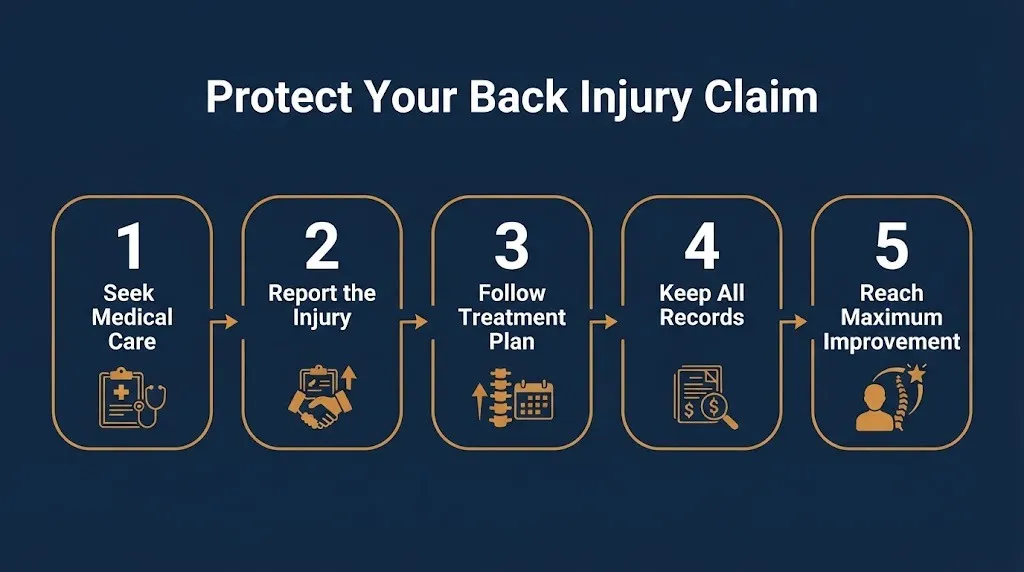
Here is a checklist:
- Seek medical attention immediately.
- Report the injury to the responsible party or your employer.
- Follow all treatment recommendations.
- Keep every medical record and bill.
- Take photos of the accident scene if applicable.
- Write down what happened while your memory is fresh.
- Avoid posting about the injury on social media.
- Contact a personal injury or workers comp attorney for a free consultation.
The documentation you create in the first days and weeks becomes the foundation of your settlement.
Key Takeaway: Immediate medical care, consistent treatment, and thorough documentation are the three pillars of a strong non-surgical back claim.
How Do Lawyers Get Paid in Back Injury Settlements?
Lawyers get paid in back injury settlements through contingency fees. The fee is a percentage of the settlement, not an upfront payment.
The typical contingency fee for a personal injury case is 30 to 40 percent of the settlement. For workers compensation, the fee is usually lower, often 15 to 25 percent depending on state law.
You pay nothing out of pocket. If the case settles for $50,000 and the fee is 33 percent, the lawyer receives $16,500 and you receive $33,500, minus any case expenses.
Case expenses are separate from attorney fees. They include medical record costs, filing fees, and expert witness fees. Those expenses are deducted from your share of the settlement.
What Happens Next
Here is the typical timeline for a back injury settlement without surgery:
- Weeks 1 to 4: Initial treatment and diagnostic imaging.
- Months 2 to 6: Conservative treatment: physical therapy, injections, chiropractic care.
- Months 4 to 12: Maximum medical improvement reached.
- After MMI: Final medical report issued with restrictions and impairment rating.
- Months 6 to 18: Settlement negotiations and demand package submission.
- After agreement: Settlement documents signed, payment issued within 30 to 60 days.
Frequently Asked Questions
Can I settle a back injury claim without an MRI?
Yes, but your settlement will likely be lower.
An MRI provides objective evidence of structural damage.
Without it, the insurance company may argue your injury is subjective.
How much is a herniated disc worth without surgery?
A herniated disc without surgery typically settles for $40,000 to $100,000.
The range depends on nerve involvement, work restrictions, and treatment history.
Multiple herniated discs can push the value higher.
Do I have to pay taxes on a back injury settlement?
No, personal injury settlements for physical injuries are generally not taxable.
Workers compensation settlements are also generally not taxable.
The IRS excludes compensation for physical injuries and sickness from gross income.
What if the insurance company says my injury is pre-existing?
You can challenge that claim with your medical history and treating doctor’s opinion.
The insurance company must show evidence that your current injury is not related to the accident.
An MRI showing a fresh injury can help prove causation.
Can I still work with a back injury and get a settlement?
Yes, working does not bar you from a settlement.
Your settlement may account for lost earning capacity if you cannot do your old job.
Document any work restrictions from your doctor.
How long do I have to file a back injury claim?
The statute of limitations for personal injury is 1 to 3 years in most states.
Workers compensation claims often have shorter notice requirements, sometimes as little as 30 days.
Check your state’s specific deadlines immediately.
What if my doctor says I need surgery after I settle?
You cannot ask for more money after the settlement is final.
The settlement must cover all future medical care, including surgery.
This is why settling before maximum medical improvement is risky.
Document Everything and Do Not Settle Too Early
The value of a back injury settlement without surgery depends almost entirely on your medical records. An MRI, consistent treatment, and clear work restrictions can produce a five-figure settlement even without an operation.
Do not rush the process. Wait until your doctor says you have reached maximum medical improvement. Settling too early leaves you responsible for future medical bills.
The single most important fact to remember: your statute of limitations is running, so gather your records and consult a lawyer while you still have time to file.