Dog Bite Compensation Claims and Settlement Amounts: 2026 Guide
Quick Answer
- Dog bite compensation is real and comes from homeowner or renter insurance policies, not a settlement fund.
- Average payouts range from $15,000 to $75,000 for moderate injuries, with severe cases higher.
- Statutes of limitations apply per state, most ranging from one to three years.
You or someone you know got bitten by a dog. Now you’re searching for what compensation is actually possible. The internet is full of settlement calculators, law firm ads, and forum posts quoting numbers that don’t match your situation.
Here’s what the data actually shows. Dog bite compensation in the United States comes almost entirely from insurance claims, not lawsuits that go to trial. Most cases settle through the dog owner’s homeowner or renter insurance policy. The average cost per dog bite claim has risen steadily over the past decade.
This article covers verified payout ranges, how settlements get calculated, what factors move the number up or down, and the steps to take after a bite. One surprising detail: most dog bite victims never file a claim, leaving compensation unclaimed simply because they didn’t know the owner’s insurance covered it.
The Facts
| Case | Individual personal injury claims, not a class action or MDL |
| Status | Ongoing claims filed daily through state courts and insurance negotiations |
| Fund Size | No national fund; payouts come from individual insurance policies |
| Est. Per Person | Varies by injury; commonly $15,000 to $75,000 for moderate cases |
| Claim Deadline | State statute of limitations, typically one to three years from bite date |
| Administrator | None; claims handled by insurance adjusters or personal injury attorneys |
| Proof Needed | Medical records, photographs, incident reports, witness statements |
Is Dog Bite Compensation Real?
Yes. Dog bite compensation is a real legal remedy available in every U.S. state, paid primarily through homeowner or renter insurance policies. It is not a government program, a class action settlement, or a lottery.
The mechanism is straightforward. When a dog bites someone, the dog owner’s liability insurance typically covers the injured person’s medical bills, lost wages, and pain and suffering. If the owner lacks insurance, compensation may come from the owner’s personal assets, though recovery is often harder.
The Insurance Information Institute reports that dog bite claims account for a significant share of homeowner liability payouts each year. Those payouts are real money sent to real victims. In 2025, the average cost per dog bite claim nationwide exceeded $60,000, though that figure includes severe injury cases that skew the average upward.
If you were bitten, the compensation path exists. But it requires action on your part. No one sends you a check automatically.
What Is the Average Dog Bite Settlement?
No single verified “average dog bite settlement” exists because settlements are confidential and vary by state, injury type, and insurance policy limits. However, insurance industry data provides useful reference points.
The average cost per dog bite claim, which includes settlements and judgments, was approximately $64,555 in 2023 according to the Insurance Information Institute and State Farm. That figure is not the same as what every victim receives. It includes catastrophic injury claims that push the average far above typical payouts.
For most moderate dog bite injuries, the actual settlement range is lower. Personal injury attorneys and insurance data suggest that claims involving puncture wounds, lacerations, and scarring without permanent disability often settle between $15,000 and $50,000. Cases with nerve damage, infection, or facial scarring in children can reach $75,000 to $150,000.
| Injury Severity | Typical Settlement Range |
|---|---|
| Minor bite, no scar | $5,000 to $15,000 |
| Puncture wounds, visible scar | $15,000 to $50,000 |
| Facial scarring, nerve damage | $50,000 to $150,000 |
| Permanent disability or disfigurement | $150,000 to $500,000+ |
These ranges reflect industry reporting, not guaranteed outcomes.
What Are Average Dog Bite Settlement Amounts by State?
Dog bite settlement amounts vary significantly by state because liability laws differ. Some states impose strict liability on dog owners. Others require proof of prior aggression, known as the “one-bite rule.”
Strict liability states, like California and Florida, generally make it easier to recover compensation. The dog owner is responsible for the bite regardless of whether the dog had bitten before. That legal foundation often leads to higher settlements.
One-bite rule states, like Texas and Virginia, require the victim to prove the owner knew the dog was dangerous. That’s a higher bar. Cases in those states can settle for less, or fail entirely, unless there’s clear evidence of prior aggression.
| State Liability Type | Examples | Claim Difficulty |
|---|---|---|
| Strict liability | California, Florida, New Jersey | Lower burden |
| One-bite rule | Texas, Virginia, Georgia | Higher burden |
| Mixed or modified | New York, Pennsylvania, Ohio | Depends on facts |
Your state’s law is one of the first things an attorney will check. It often determines whether you have a viable claim at all.
Key Takeaway: Your state’s liability law is the single biggest factor in whether you can recover and how much, so location matters as much as injury.
How Are Dog Bite Settlements Calculated?
Dog bite settlements are calculated by adding economic damages and non-economic damages, then adjusting for liability and insurance limits. There’s no fixed formula, but the components are consistent.
Economic damages include medical bills, lost wages, and future medical costs like scar revision surgery. Non-economic damages cover pain and suffering, emotional distress, and disfigurement. Insurance adjusters often multiply economic damages by a factor of 1.5 to 3 to estimate non-economic damages, depending on injury severity.
Here’s a simplified example. If your medical bills total $10,000 and you missed $2,000 in wages, your economic damages are $12,000. A moderate scar might support a multiplier of 2, producing a non-economic damages estimate of $24,000. The total demand would be $36,000.
But that’s a starting point. Insurance adjusters will argue for lower multipliers. Attorneys will argue for higher ones. The final number depends on negotiation, evidence quality, and the policy limit.
What Factors Increase a Dog Bite Settlement?
Several verified factors consistently push dog bite settlements higher. The most important is permanent scarring, especially on the face or neck of a child.
Insurance companies value cases differently based on these elements.
- Facial scarring or disfigurement, particularly in minors.
- Multiple bites or a prolonged attack.
- Nerve damage, infection, or permanent loss of function.
- The dog owner’s clear liability, such as a prior bite history.
- High insurance policy limits available to pay the claim.
- Strong photographic and medical evidence.
- The victim’s age, with children receiving higher valuations.
Each factor adds value because it increases what a jury might award if the case goes to trial. Insurance adjusters settle based on trial risk. The more a case looks like it could produce a large jury verdict, the more they’ll pay to avoid that risk.
What Reduces a Dog Bite Settlement?
Certain factors can reduce or even eliminate a dog bite settlement. The most common is provocation, where the victim is alleged to have provoked the dog.
If the dog owner can show that you were trespassing, teasing the dog, or otherwise caused the attack, your claim value drops. In some states, provocation is a complete defense. In others, it reduces your recovery proportionally under comparative negligence rules.
Other factors that reduce settlements include:
- Delays in seeking medical treatment, which suggest minor injury.
- Pre-existing scars or conditions that complicate causation.
- Unclear liability, such as a disputed account of the incident.
- Low insurance policy limits that cap the available recovery.
- Lack of photographs or witness statements to corroborate your account.
Insurance adjusters look for any reason to pay less. Your evidence and your consistency are your best protection.
Key Takeaway: Provocation, delayed treatment, and low policy limits are the three most common reasons dog bite settlements underperform expectations.
Dog Bite Settlement Examples From Real Cases
Real dog bite settlement examples are hard to verify because most settlements include confidentiality clauses. But some cases become public through jury verdicts or appellate court records.
Verified public examples include a California case where a postal carrier received over $500,000 after a dog attack caused permanent leg injuries. In another case, a child with facial scarring received a structured settlement valued at over $250,000. Smaller cases, such as adult puncture wounds without permanent disfigurement, routinely settle in the $20,000 to $40,000 range.
The key lesson from public examples is that catastrophic, permanent injuries produce the largest payouts. Cases with clean recoveries and minor scarring settle for far less.
Don’t compare your case to the biggest headline numbers. Those cases involve life-altering injuries. Your case value depends on your specific medical records, not on what someone else received.
Reality Check: No lawyer can guarantee a specific dog bite settlement amount. Run from anyone who promises a number before seeing your medical records and the dog owner’s insurance details.
How Do I File a Dog Bite Injury Claim?
Filing a dog bite injury claim follows a sequence that starts at the scene of the bite and ends with a settlement check or court judgment. Here are the steps.
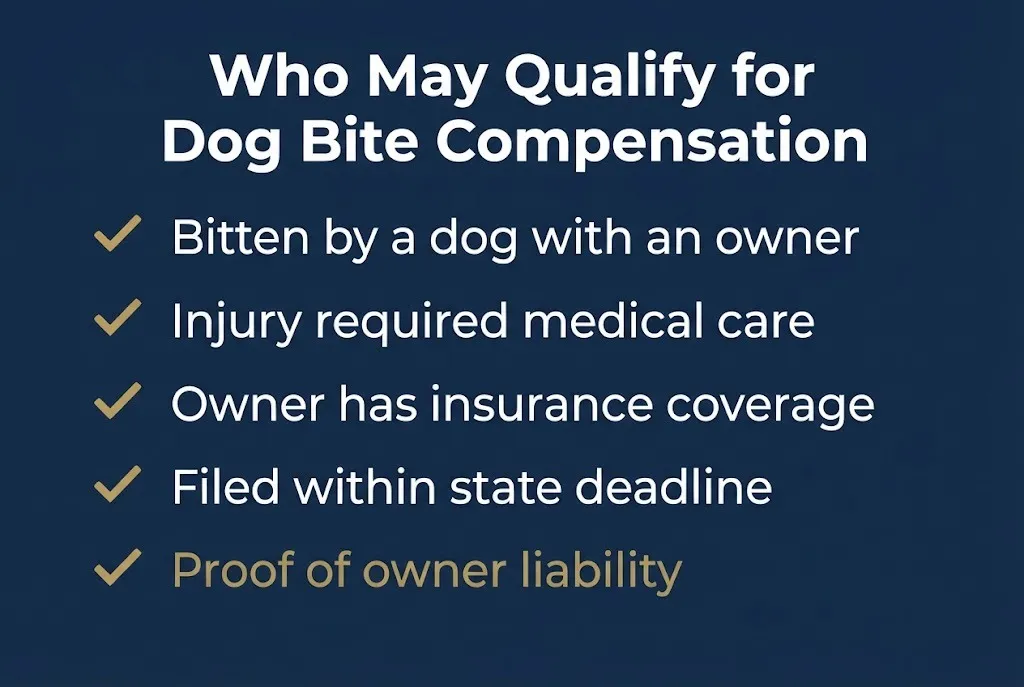
- Seek medical treatment immediately and keep all records.
- Identify the dog and its owner, if possible.
- Take photographs of the wound, the location, and the dog.
- File an animal control or police report.
- Obtain the dog owner’s homeowner or renter insurance information.
- Contact a personal injury attorney to evaluate your claim.
- Submit a demand letter or allow your attorney to negotiate.
- Accept a settlement or file a lawsuit before the deadline.
If the dog owner refuses to provide insurance information, animal control or an attorney can help identify the owner and any available coverage. Do not sign any release or accept any payment before understanding the full extent of your injuries.
What Is the Deadline to File a Dog Bite Lawsuit?
The deadline to file a dog bite lawsuit is set by your state’s statute of limitations, which typically ranges from one to three years from the date of the bite. Some states allow more time for minors.
Here are common deadlines by state pattern.
- California: two years.
- Florida: two years, but four years for negligence claims in some cases.
- New York: three years.
- Texas: two years.
- Pennsylvania: two years.
These are the general rules. Exceptions exist, and the clock sometimes starts when you discover the injury rather than when the bite occurred. That matters if an infection or complication appeared weeks later.
If you miss the deadline, your claim is barred. That’s why the single most important action after a bite, besides medical care, is noting your state’s deadline on a calendar.
What Compensation Can You Recover After a Dog Bite?
Dog bite compensation can include several categories of damages. The exact mix depends on your injuries and your state’s law.
- Medical expenses: emergency care, surgery, physical therapy, scar revision.
- Lost wages: time missed from work during recovery.
- Future medical costs: ongoing treatment or additional surgeries.
- Pain and suffering: physical pain and emotional distress.
- Disfigurement: compensation for permanent scarring or disability.
- Property damage: torn clothing, broken glasses, or damaged items.
Most dog bite claims are resolved through the dog owner’s insurance. The available policy limit often caps recovery, regardless of your damages. If the owner has a $100,000 liability limit and your case is worth $250,000, the insurance will typically pay only $100,000 unless the owner has personal assets to pursue.
Key Takeaway: Your total recoverable compensation is often capped by the dog owner’s insurance policy limit, not by the true value of your injuries.
Does Homeowners Insurance Cover Dog Bite Claims?
Yes. Homeowners insurance covers dog bite claims under the liability portion of the policy in most cases. Renters insurance provides the same protection for dog owners renting their home.
The standard homeowners policy includes personal liability coverage, often starting at $100,000. That means if a visitor is bitten by the policyholder’s dog, the insurance company will investigate, negotiate, and potentially pay the claim.
Some insurance companies exclude certain breeds from coverage. Others require dog owners to disclose the dog’s breed or bite history before issuing a policy. If the dog owner’s policy excludes the breed or the incident, recovery becomes harder.
Ask the dog owner for their insurance company name and policy number after a bite. If they refuse, animal control records or an attorney can help identify the insurer.
Is There a Dog Bite Class Action Settlement in 2026?
No. There is no dog bite class action settlement in 2026. Dog bite claims are individual personal injury claims, not class actions.
The confusion often comes from people searching for “settlement” after seeing law firm ads. Those ads describe individual case settlements, not a class action fund. There’s no single administrator, no claim form, and no national deadline.
Every dog bite claim is unique. Your recovery depends on your state’s law, your injuries, the dog owner’s insurance, and your attorney’s skill. That’s very different from a class action, where eligible members file a form and wait for a pro rata share.
If you see a website promising a “dog bite class action payout,” that’s misleading. Your claim is personal, not collective.
What Should You Do Immediately After a Dog Bite?
The first few hours after a dog bite shape the entire claim. Here’s what to do.
- Wash the wound with soap and water and seek medical care.
- Report the bite to animal control or local law enforcement.
- Document everything: photographs of the wound, the dog, the location.
- Get contact and insurance information from the dog owner.
- Gather witness names and phone numbers.
- Save all medical records and receipts.
- Contact a personal injury attorney before speaking to the owner’s insurer.
Insurance adjusters often call quickly, sometimes within days. They may ask for a recorded statement. You are not required to give one. Anything you say can be used to reduce your claim. Let your attorney handle those calls.
Think of the immediate steps like a store return without a receipt. You need proof of what happened. Without evidence, the store, or the insurer, won’t pay.
How Do Dog Bite Attorneys Get Paid?
Dog bite attorneys work on a contingency fee basis. That means they collect a percentage of your settlement or judgment, typically between 33 and 40 percent, and nothing if you recover nothing.
There are no upfront fees for most dog bite claims. The attorney covers case costs like medical record retrieval and expert witness fees. Those costs are then deducted from your recovery along with the attorney fee.
Here’s how a typical fee structure works on a $50,000 settlement.
| Item | Amount |
|---|---|
| Settlement | $50,000 |
| Attorney fee (33%) | $16,500 |
| Case costs | $1,200 |
| Client net recovery | $32,300 |
If the case goes to trial, the fee percentage often increases. That’s worth discussing before you sign a retainer.
Key Takeaway: Contingency fees mean you pay nothing upfront, but understand the percentage and cost structure before signing with any attorney.
What Is the One-Bite Rule in Dog Bite Cases?
The one-bite rule is a legal doctrine in some states that holds dog owners liable only if they knew or should have known their dog was dangerous. The name comes from the idea that the first bite is “free.”
In one-bite states, you must prove the dog had a history of aggression, such as a prior bite, a previous attack, or a pattern of lunging at people. Evidence might include animal control records, neighbor testimony, or social media posts showing the dog’s aggressive behavior.
Strict liability states don’t require this proof. The owner is liable for any bite, regardless of the dog’s history. California is the most prominent strict liability state.
If you’re bitten in a one-bite state, gather evidence of prior aggression immediately. Your claim may depend on it.
What If the Dog That Bit You Has No Insurance Coverage?
If the dog owner has no homeowners or renters insurance, your options narrow but don’t disappear. You may still file a lawsuit against the owner personally.
The problem is collection. A judgment against an uninsured owner is only worth what the owner can pay. If the owner has assets, your attorney can pursue them. If the owner has no assets, the judgment may be uncollectible.
Some states have victim compensation funds that cover dog bite injuries in limited circumstances. Those funds typically apply when the attack occurred on public property or involved a known dangerous dog. Check your state’s victim compensation program.
In most cases, insurance is the practical source of compensation. That’s why identifying the owner’s policy early is so important.
What Happens Next in a Dog Bite Claim?
Day 1 to 7: Seek medical care, report the bite, and document the injury.
Week 1 to 2: Contact an attorney, identify the insurance policy, and begin investigation.
Month 1 to 3: Medical treatment concludes, demand letter is submitted to the insurer.
Month 3 to 6: Negotiation between your attorney and the insurance adjuster.
Month 6 to 12: Settlement or lawsuit filing, depending on whether a fair offer is made.
Year 1 to 2: If a lawsuit is filed, discovery and possible trial preparation follow.
These timelines are typical but not guaranteed. Severity of injury and insurance cooperation are the biggest variables.
Frequently Asked Questions
Is dog bite compensation taxable?
No. Compensation for personal physical injuries, including dog bite settlements, is generally not taxable.
The IRS excludes damages received for physical injury or illness from gross income.
Can I file a dog bite claim without a lawyer?
Yes, but you’ll likely recover less than with an attorney.
Insurance adjusters negotiate against you professionally and know you’re not experienced.
What if the dog bit my child?
Children’s dog bite claims are often worth more because juries award more for children’s scarring.
A parent or guardian files the claim on the child’s behalf.
Does renters insurance cover dog bites?
Yes, if the policy includes personal liability coverage and doesn’t exclude the dog’s breed.
Renters insurance works like homeowners insurance for liability claims.
How long does a dog bite settlement take?
Most dog bite claims settle within six to twelve months after treatment concludes.
Severe injuries or disputed liability can push the timeline to two years or more.
What if I was bitten by a stray dog?
You can’t file an insurance claim without an owner, but a victim compensation fund may help.
Check your state’s crime victims compensation program for medical expense coverage.
Can I sue a landlord for a tenant’s dog bite?
Sometimes, if the landlord knew the dog was dangerous and failed to act.
Landlord liability is fact-specific and varies by state law.
What is the average dog bite settlement for a child?
Children’s claims often settle higher than adult claims with the same injury.
Facial scarring and permanent disfigurement are the main value drivers.
If you were bitten by a dog, the single most important number is your state’s statute of limitations. That deadline, not the severity of the bite, determines whether you still have a claim.
Get medical care, document everything, and talk to a personal injury attorney before you speak with the dog owner’s insurance company. The compensation path is real. But it only works if you take the first step.