Bard Hernia Mesh Settlement News and Payout Updates: 2026
Quick Answer
- The Bard hernia mesh litigation is real, with thousands of consolidated cases in federal court.
- Average payouts remain unconfirmed; individual settlements vary widely based on injury severity.
- No deadline applies to new claims yet, but statutes of limitations may bar older cases.
You’ve probably seen ads or received messages about Bard hernia mesh settlements in 2026. Some promise large payouts. Others warn about deadlines. Most of it is marketing from law firms, not verified news.
Here’s what the court records actually show. The Bard hernia mesh multidistrict litigation, known formally as the Bard MDL, continues in the Southern District of Ohio. No global settlement has been announced. Individual settlements do happen, but amounts are confidential and vary by case.
This article covers the confirmed status, what “average payout” actually means, how settlement amounts get determined, and what to do if you have a Bard mesh claim. One surprising detail: most people who qualify don’t realize their case value depends almost entirely on medical records, not on which law firm they hire.
The Facts
| Case | In re: Davol, Inc./C.R. Bard, Inc. Polypropylene Hernia Mesh Products Liability Litigation |
| Status | Active MDL; bellwether trials and individual settlements ongoing |
| Fund Size | Not applicable; no global settlement fund |
| Est. Per Person | Not yet determined; confidential individual settlements |
| Claim Deadline | None set; statutes of limitations apply per case |
| Administrator | No MDL-wide administrator; individual settlements use separate administrators |
| Proof Needed | Medical records, implant records, revision surgery documentation |
Is the Bard Hernia Mesh Lawsuit Legit?
Yes. The Bard hernia mesh litigation is a real, court-supervised multidistrict litigation involving thousands of plaintiffs who claim that Bard’s polypropylene hernia mesh products caused serious complications.
The cases are consolidated before a federal judge in the Southern District of Ohio. The MDL was created to handle common discovery and pretrial proceedings efficiently. It’s not a class action. Each plaintiff has their own case with their own facts.
Scammers do exploit this litigation. You may receive text messages, robocalls, or emails claiming you’ve been selected for a Bard mesh payout. Those are not legitimate. Real settlement communications come by mail from a court-appointed claims administrator or directly from your retained attorney.
If you have a Bard mesh claim, verify any unsolicited contact before sharing personal information. The litigation is real. Random messages about it usually are not.
What Is the Hernia Mesh Lawsuit Average Payout?
No verified average payout exists for Bard hernia mesh settlements in 2026. The court has not published any average figure, and individual settlements remain confidential.
Here’s the problem with “average payout” claims you see online. Law firm marketing sites often cite figures from unrelated mesh settlements or estimate potential trial verdicts. Those numbers don’t reflect what any specific Bard plaintiff actually received.
What is confirmed: some Bard cases have settled, others have gone to trial with mixed results, and many remain pending. Settlement values in mesh litigation generally depend on injury severity, number of revision surgeries, and whether the mesh caused permanent complications.
| Injury Factor | Relative Settlement Impact |
|---|---|
| Single revision surgery | Lower range |
| Multiple revisions | Higher range |
| Mesh erosion or organ damage | Higher range |
| Infection requiring mesh removal | Higher range |
| Chronic pain without removal | Moderate range |
These tiers reflect general patterns in mesh litigation, not verified Bard-specific amounts.
How Much Is the Bard Hernia Mesh Settlement Per Person?
Bard hernia mesh settlement amounts per person are not publicly disclosed. Individual settlements are confidential, and no MDL-wide settlement grid has been published.
That doesn’t mean you can’t estimate a potential range. Court documents and attorney reporting from similar mesh MDLs suggest that individual settlements often vary from the low tens of thousands to several hundred thousand dollars for the most severe injury cases. But those are patterns, not promises.
Your actual recovery depends on specific facts. How long the mesh was implanted. How many revision surgeries you needed. Whether you have ongoing complications. Whether your medical records clearly link the mesh to your injuries.
Any law firm advertising a specific “average payout” for Bard mesh claims is guessing. The court has not released an average. Treat any specific dollar figure with skepticism.
Key Takeaway: No verified average payout exists for Bard hernia mesh settlements in 2026, and any advertised figure is marketing, not court-confirmed data.
What Is the Latest Update on the Bard Hernia Mesh Lawsuit?
The latest confirmed update on the Bard hernia mesh litigation is that bellwether trial activity continues to shape settlement dynamics as of early 2026. No global resolution has been announced.
The MDL has completed multiple bellwether trials, which serve as test cases. Some have ended in plaintiff verdicts. Others have resulted in defense verdicts. These mixed outcomes influence how both sides value remaining cases.
In 2025, several additional bellwether trials were scheduled or completed, though specific verdict amounts from late 2025 are not all publicly confirmed. The court has encouraged continued settlement discussions, but no master settlement agreement has been filed.
For individual plaintiffs, this means the litigation is mature but not resolved. Cases that have strong medical documentation may be in active settlement negotiations. Cases with weaker records face a harder path.
Bard Mesh Lawsuit Update: Recent Court Activity
Recent court activity in the Bard MDL includes rulings on expert testimony, discovery disputes, and continued case management orders. The court has not scheduled a date for a global settlement announcement because none exists.
What we can confirm: the MDL docket remains active with new case filings and ongoing pretrial proceedings. The judge continues to issue orders governing bellwether selection and trial sequencing. Settlement conferences are occurring, but they are confidential.
The absence of a global settlement after several years of litigation is not unusual. Mesh MDLs often take a decade or more to resolve. The Bard litigation has been active since 2018, and resolution could still be years away.
For plaintiffs, this means your case timeline depends on factors that have nothing to do with the MDL’s overall pace. Your medical records, your state’s statute of limitations, and your attorney’s negotiation strategy matter more than the MDL’s next hearing date.
Who Qualifies for a Bard Hernia Mesh Claim?
You may qualify for a Bard hernia mesh claim if you meet several specific criteria. The most important is that you had a Bard-manufactured polypropylene hernia mesh implanted and experienced complications requiring medical treatment.
The qualifying Bard products include several models sold under the Bard, Davol, and Composix brand names. The most commonly cited products in litigation include the Ventralex, PerFix, and Kugel lines. But the specific product matters less than the complication history.
Qualification typically requires documented proof of all of the following.
- Implantation of a Bard hernia mesh product.
- A complication linked to the mesh in your medical records.
- Revision surgery, removal surgery, or ongoing treatment for the complication.
- Medical documentation connecting the mesh to your injury.
- Filing within your state’s statute of limitations.
If you don’t have your implant records, your attorney can help you obtain them from the hospital or surgeon.
Reality Check: No one at the court or a claims administrator will call you first about Bard mesh money. Legitimate claims start with you contacting an attorney, not with an unsolicited message offering a payout.
How Do I File a Bard Hernia Mesh Claim?
Filing a Bard hernia mesh claim is not like submitting a class action claim form. It requires hiring an attorney, gathering medical records, and potentially filing a lawsuit in federal or state court.
Here are the steps.
- Confirm the mesh product by obtaining your surgical implant records.
- Gather all medical records from the implant surgery and any follow-up care.
- Document every revision surgery, infection, or complication in a timeline.
- Contact an attorney who handles hernia mesh litigation and has MDL experience.
- Provide your records and let the attorney evaluate your case.
- Sign a retainer agreement if the attorney accepts your case.
- File your claim or lawsuit before your state’s deadline.
- Participate in settlement negotiations or trial preparation as directed.
There is no fee to file a claim with an attorney. Mesh attorneys work on contingency, meaning they’re paid only if you recover money.
Is There a Hernia Mesh Settlement Claim Form?
No universal Bard hernia mesh claim form exists because there’s no global settlement. Individual settlements are negotiated case by case, not processed through a single administrator.
This is different from class action settlements, where a single claim form covers everyone. The Bard MDL is not a class action. Each plaintiff files their own lawsuit and negotiates their own resolution.
When individual settlements occur, they’re typically confidential. You may never see a public claim form because your attorney handles the paperwork directly with the defendant’s counsel.
If you see a website offering a “Bard mesh settlement claim form” for a fee, that’s a red flag. Legitimate claims are handled by attorneys or court-appointed administrators, never by third-party websites charging upfront fees.
What Is the Deadline to File a Bard Hernia Mesh Lawsuit?
No MDL-wide deadline exists for Bard hernia mesh claims, but state statutes of limitations create hard deadlines for each individual case. Most states allow two to six years from the date of injury or discovery of the injury.
The clock usually starts when you knew or should have known that the mesh caused your complication. For many people, that’s the date of a revision surgery or a doctor’s diagnosis linking the mesh to their symptoms.
Here’s the practical problem. The Bard mesh products were implanted years ago for many patients. If your state has a two-year statute of limitations and your revision surgery was in 2021, your filing window may have already closed.
Don’t assume you’re too late. Some states apply a discovery rule that extends the deadline. But also don’t assume you have unlimited time. Check with an attorney immediately if you think you have a claim.
Key Takeaway: The biggest risk to your Bard mesh claim isn’t the MDL’s pace; it’s your state’s statute of limitations expiring while you wait.
What Is the Bard Mesh MDL and How Does It Work?
The Bard mesh MDL is a multidistrict litigation consolidating thousands of individual lawsuits against C.R. Bard and its Davol subsidiary over polypropylene hernia mesh products. It’s pending in the Southern District of Ohio.
An MDL is not a class action. Each plaintiff keeps their own case. The MDL streamlines discovery, expert testimony, and pretrial motions. Bellwether trials test how juries respond to representative cases.
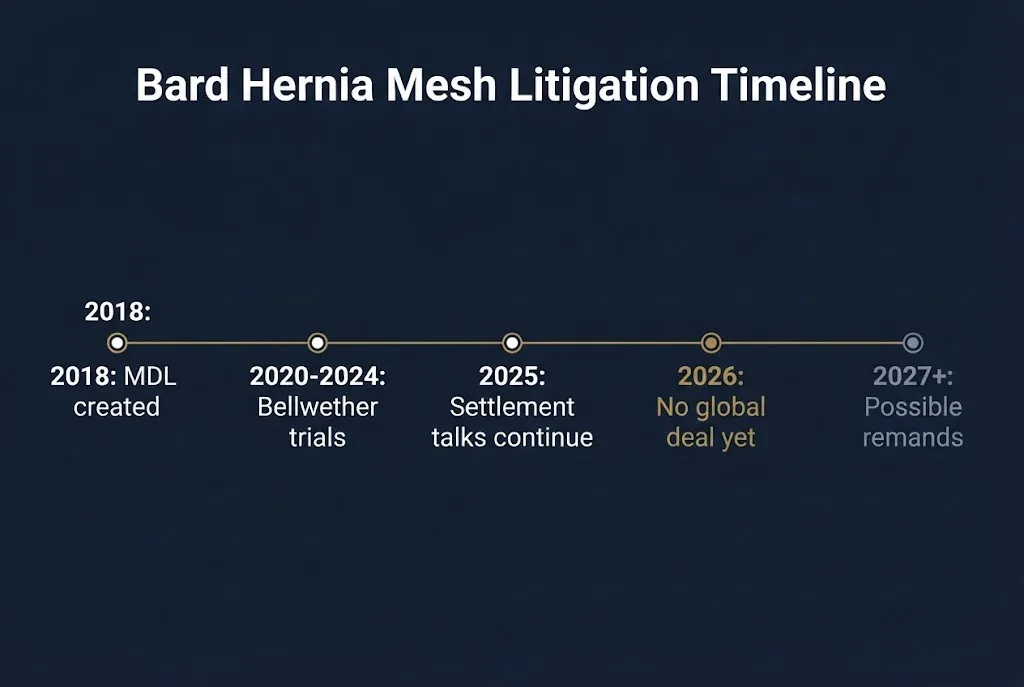
The Bard MDL was created in 2018. Since then, the court has overseen discovery involving millions of documents, multiple bellwether trials, and ongoing settlement negotiations. No global settlement has been reached.
For plaintiffs, the MDL structure means your case proceeds individually but benefits from shared evidence and legal rulings. If the bellwether trials produce favorable verdicts, settlement pressure increases on Bard.
What Complications Are Linked to Bard Hernia Mesh?
Bard hernia mesh complications cited in litigation include infection, mesh migration, mesh contraction, adhesion formation, bowel obstruction, chronic pain, and mesh erosion into surrounding tissue.
These complications often require revision surgery to remove or repair the mesh. In severe cases, the mesh cannot be fully removed because it has integrated into tissue, leaving patients with permanent pain or organ damage.
Your specific complication matters for settlement value. A single infection treated successfully with antibiotics is different from multiple revision surgeries for mesh erosion into the bowel. Medical records documenting the severity and duration of your complications are the strongest evidence you have.
The defendants dispute that their mesh products cause higher complication rates than other mesh. They argue that hernia repair itself carries inherent risks. This factual dispute is at the center of the litigation.
Does Bard Hernia Mesh Get Removed?
In many cases, yes. Bard hernia mesh removal or revision surgery is often necessary when complications occur. But full removal isn’t always possible.
Polypropylene mesh is designed to integrate with tissue over time. Once integrated, removal can damage surrounding organs, blood vessels, or nerves. Surgeons sometimes perform partial removal or revision rather than complete explant.
This creates a problem for litigation. The most severe cases often involve mesh that cannot be fully removed, leaving patients with permanent complications. Those cases generally have higher potential value than cases where the mesh was cleanly removed and the patient fully recovered.
Your medical records should state whether your mesh was partially or fully removed, how many revision surgeries you had, and whether any mesh remains implanted. That documentation directly affects your claim.
Key Takeaway: Cases involving mesh that cannot be fully removed or requiring multiple revisions generally carry higher potential settlement value than clean removal cases.
What Is the History of the Bard Hernia Mesh Litigation?
The Bard hernia mesh litigation began in earnest around 2018, when the Judicial Panel on Multidistrict Litigation consolidated federal cases into the Southern District of Ohio. Thousands of cases followed.
The litigation covers multiple Bard mesh products, including the Ventralex, Ventralight, PerFix, and Kugel lines. Some of these products were also the subject of earlier recalls or FDA actions, though the current litigation focuses on alleged design defects and failure to warn.
A separate earlier litigation over the Kugel mesh hernia patch resulted in settlements over a decade ago. That history sometimes confuses people searching for the current Bard mesh litigation. The current MDL is broader and involves different products.
The current litigation has produced mixed bellwether results. Some juries awarded substantial damages to plaintiffs. Other juries found for Bard. Those outcomes are typical in mass tort litigation and don’t predict individual case results.
Is There a Bard Hernia Mesh Class Action Settlement?
No. The Bard hernia mesh litigation is not a class action, and no class action settlement exists. The cases proceed as individual lawsuits consolidated in an MDL.
This distinction matters because it changes how you would receive money. In a class action, eligible class members automatically receive payment after submitting a claim form. In an MDL, your case resolves individually through settlement or trial.
Some people mistakenly search for a “Bard mesh class action settlement” because they’ve seen ads referencing a “settlement.” Those ads are often vague about whether a global settlement exists. It doesn’t.
If you have a Bard mesh case, your resolution depends on your own medical records, your attorney’s negotiation, and the broader litigation climate. There’s no single settlement fund waiting to pay you.
What Is the Bard Composix Kugel Mesh Recall Connection?
The Bard Composix Kugel mesh was subject to earlier recalls and litigation separate from the current MDL. Some people confuse the older Kugel litigation with the current Bard mesh MDL.
The Kugel mesh recall involved a memory recoil ring that could break, causing bowel perforation or other complications. That litigation resulted in settlements years ago. The current MDL covers a broader range of Bard mesh products, not just Kugel.
If you had a Bard Kugel mesh and received a settlement from the earlier litigation, that claim is closed. It does not automatically qualify you for the current MDL, which involves different product lines and different legal theories.
Check your implant records carefully. The exact product name matters. A Kugel mesh claim from 2010 is not the same as a Ventralex claim in the current litigation.
Should I Accept a Bard Hernia Mesh Settlement Offer?
That’s a decision only you and your attorney can make. But here’s what the court records and litigation patterns suggest.
Individual settlement offers in the Bard MDL are confidential. You won’t find a public list of what other plaintiffs received. Your attorney should explain how your offer compares to your specific injury profile.
Factors that influence whether an offer is reasonable include the strength of your medical causation evidence, how many revision surgeries you had, whether your state has favorable or unfavorable law, and how many similar cases have settled recently.
Be wary of attorneys who pressure you to accept quickly. Also be wary of attorneys who promise huge verdicts without explaining trial risks. A good attorney gives you a realistic range and explains the tradeoffs.
If you don’t have an attorney, you’re not receiving a settlement offer. Anyone offering you a payout without an attorney involved is running a scam.
What Happens Next in the Bard Hernia Mesh Litigation?
Expected spring 2026: Additional bellwether trial outcomes may be announced, influencing settlement pressure.
Expected mid-2026: The court may issue rulings on pending expert challenges or summary judgment motions.
Expected late 2026: Continued settlement conferences and possible additional trial scheduling.
Expected 2027: If no global settlement emerges, the court may begin remanding cases to their home districts for individual trials.
Expected beyond 2027: Resolution of remaining cases through individual settlements or trials.
These dates are estimates based on typical MDL progression. No specific court order has set these dates as of March 1, 2026.
Frequently Asked Questions
Is the Bard hernia mesh lawsuit real?
Yes. The Bard hernia mesh litigation is a real multidistrict litigation in federal court.
Thousands of individual cases are consolidated in the Southern District of Ohio.
What is the average payout for Bard hernia mesh?
No verified average payout exists.
Individual settlement amounts are confidential and vary by injury severity.
Is there a deadline to file a Bard mesh claim?
No MDL-wide deadline exists.
Your state’s statute of limitations controls how long you have to file.
Do I need a lawyer for a Bard mesh claim?
Yes. Individual lawsuits require an attorney to file and negotiate.
Mesh attorneys work on contingency, so there’s no upfront fee.
Can I file a Bard mesh claim if my surgery was years ago?
Maybe. It depends on when you discovered the complication and your state’s deadline.
Contact an attorney immediately to check whether you still have time.
Is the Bard mesh settlement a class action?
No. It’s an MDL, not a class action.
Each plaintiff’s case resolves individually through settlement or trial.
What Bard mesh products are in the lawsuit?
Multiple products are involved, including Ventralex, Ventralight, PerFix, and others.
Your implant records will confirm which product you had.
How do I know if my mesh is a Bard product?
Request your surgical implant records from the hospital or surgeon.
The records will list the manufacturer and product name.
If you have a Bard hernia mesh product and experienced complications, the most important step is to check your state’s filing deadline. That deadline, not the MDL’s timeline, determines whether you still have a claim.
Gather your implant records and your medical history. Then contact an attorney who handles mesh litigation. No legitimate settlement will find you on its own. You have to start the process.