How Long Does a Malpractice Settlement Take in 2026?
Quick Answer
- A medical malpractice settlement usually takes 18 months to 3 years from the date you file.
- Pre-suit investigation and expert review alone can take 6 to 12 months before filing.
- The most important deadline is your state’s statute of limitations, not the settlement timeline.
You believe a doctor, nurse, or hospital made a serious mistake. You want justice. You also want to know how long you will be waiting.
Here is the direct answer: medical malpractice settlements are slow. Most take 18 months to 3 years from filing. Some resolve in under a year. Some stretch past five years if they go to trial.
This article explains each stage of the malpractice timeline, what slows cases down, and what you can do to keep yours moving.
The Facts
| Topic | Malpractice Settlement Timeline |
| Status | No fixed legal deadline for settlement |
| Pre-Suit Investigation | 6 to 12 months |
| Filing to Discovery | 6 to 12 months |
| Discovery to Settlement | 12 to 24 months |
| Trial If No Settlement | 2 to 5 years total |
| Statute of Limitations | Varies by state, usually 1 to 3 years from injury or discovery |
Is a malpractice settlement faster than a trial?
Yes, a settlement is almost always faster than a trial. But faster does not mean fast.
A settled malpractice case typically resolves in 18 months to 3 years. A case that goes to trial can take four to six years or longer.

Settlement avoids the slowest parts of litigation: jury selection, a full trial, and appeals. But it still requires investigation, expert review, discovery, and negotiation. Each of those stages takes months.
What are the stages of a medical malpractice settlement?
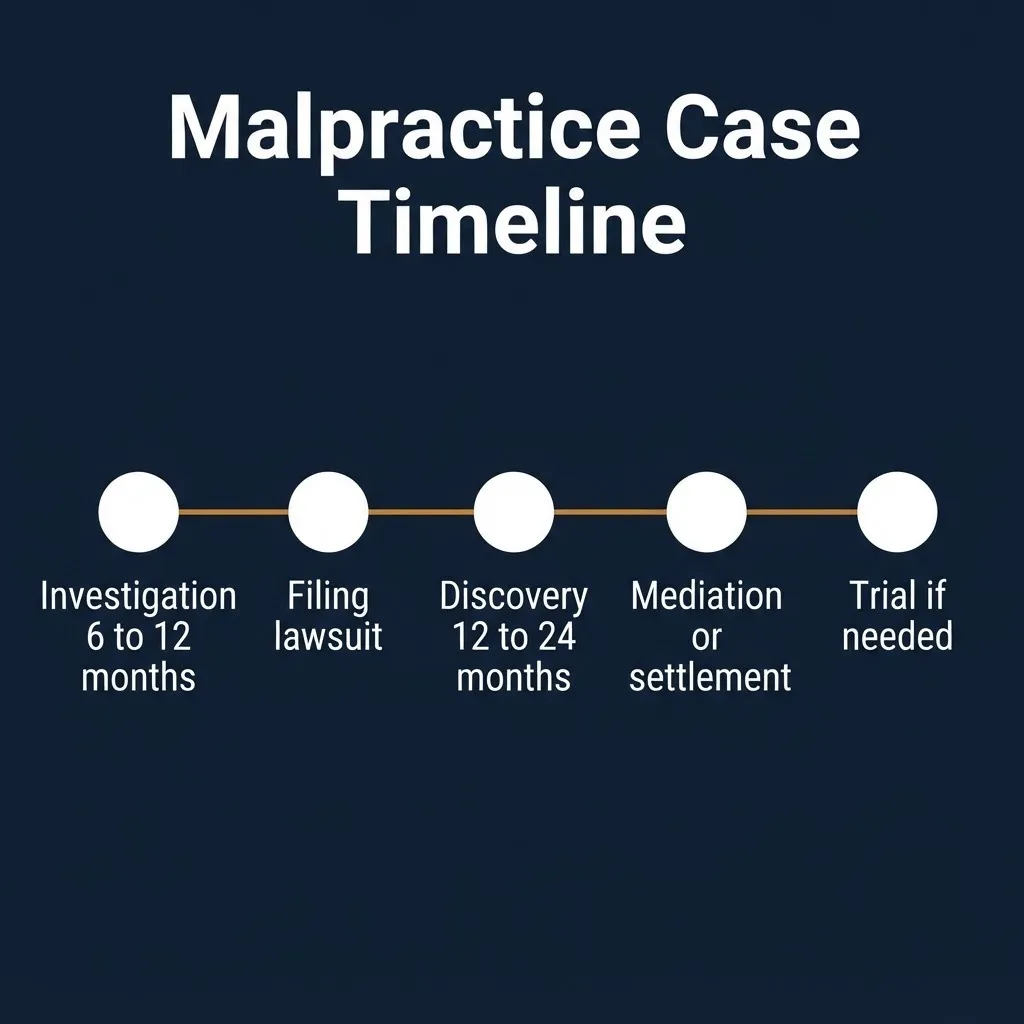
A malpractice case moves through distinct stages. Each one takes time.
Here is the typical sequence.
- Investigation and medical record review
- Expert consultation and certificate of merit
- Filing the lawsuit
- Discovery and depositions
- Settlement negotiation or mediation
- Trial if no settlement
Each stage can last months. The total is rarely under a year and often over two.
How long does the pre-suit investigation take?
The pre-suit investigation usually takes 6 to 12 months. This is the stage before a lawsuit is even filed.
Your attorney gathers medical records, reviews them, and consults with medical experts. In many states, you need a certificate of merit from a doctor saying the case has merit before you can file.
That expert review alone can take months. Experts are busy. They do not rush reviews for free.
Key Takeaway: You will spend at least six months, often a year, just getting the case ready to file. The settlement clock does not start when you call the lawyer. It starts after the investigation.
How long does a malpractice lawsuit take after filing?
After filing, most malpractice cases take another 18 to 24 months to resolve by settlement.
The first six months after filing involve the defendant answering the complaint and both sides exchanging initial documents. Then discovery begins. Depositions, expert reports, and medical record disputes take another year or more.
Settlement talks can start at any point. Many cases settle during discovery, once both sides see the strength of the evidence. Others settle at mediation, which usually happens 12 to 24 months after filing.
What factors slow down a malpractice settlement?
Several factors can add months or years to a malpractice case.
- Multiple defendants: hospitals, doctors, and nurses each need their own defense
- Complex medical issues: cancer, surgical error, and birth injury cases require more experts
- Disputed causation: the defense argues the bad outcome was not caused by negligence
- High-dollar demands: larger claims get more scrutiny and more negotiation rounds
- Court congestion: some jurisdictions simply move slower
Each factor adds time. The more complex your case, the longer the wait.
What can you do to speed up a malpractice settlement?
You cannot force a fast settlement, but you can avoid unnecessary delays.
Here are the steps.
- Gather all medical records yourself before hiring a lawyer.
- Respond to your attorney’s requests quickly.
- Show up for every appointment and deposition.
- Be realistic about the settlement value.
- Push your attorney to schedule mediation early.
A responsive client helps a case move faster. A client who disappears for weeks adds delay.
Reality Check: No lawyer can guarantee a settlement by a specific date. If an attorney promises your malpractice case will settle in six months, they are either inexperienced or lying. Good lawyers give ranges, not promises.
How long does a malpractice lawsuit take if it goes to trial?
If the case goes to trial, expect a total of three to six years from filing.
The trial itself may last one to three weeks. But getting to trial takes years. Jury selection, motions, and scheduling all add time.
After trial, either side can appeal. An appeal adds another one to two years. That is why most cases settle before trial. The risk and the delay of trial push both sides toward settlement.
What is the statute of limitations for a malpractice lawsuit?
The statute of limitations is the legal deadline for filing your malpractice lawsuit. It varies by state.
Most states allow one to three years from the date of the injury or the date you discovered it. Some states have a maximum cap of three to five years regardless of discovery.
If you miss the statute of limitations, your case is barred. That deadline matters more than any settlement timeline.
What is the difference between a malpractice settlement and a verdict?
A settlement is a voluntary agreement. You accept a payment and drop the case.
A verdict is a jury or judge decision after trial. The defendant may be ordered to pay damages, or the case may be dismissed.
Settlements are usually confidential. Verdicts are public record. Settlements are faster and less risky. Verdicts can be higher but take years longer.
Key Takeaway: A settlement trades speed and certainty for a potentially smaller amount than a verdict. A trial risks everything for a chance at more.
What happens next after a malpractice settlement is reached?
Once both sides agree to a settlement, the case enters the final paperwork stage.
| Timing | Expected Stage |
|---|---|
| Week 1 to 4 | Settlement agreement drafted and signed |
| Week 4 to 8 | Court approval if required |
| Week 8 to 12 | Payment processed and distributed |
| Week 12 and after | Case closed |
The payment usually arrives within a few months of signing. Then the case is over.
Frequently Asked Questions
How long does a malpractice settlement take on average?
Most malpractice settlements take 18 months to 3 years from filing.
The pre-suit investigation adds another 6 to 12 months before that.
Can a malpractice case settle before a lawsuit is filed?
Yes, some cases settle pre-suit.
But most defendants wait until after filing and discovery.
What is the fastest a malpractice case can settle?
A clear case with strong evidence can settle in 9 to 12 months.
That is rare and requires cooperative defendants and strong expert support.
What is the longest a malpractice case can take?
A case that goes through trial and appeals can take 5 to 7 years.
Some complex birth injury cases have lasted a decade.
Do most malpractice cases settle or go to trial?
Most settle.
Estimates suggest 90% or more of malpractice cases resolve before trial.
What is the deadline to file a malpractice lawsuit?
The deadline is your state’s statute of limitations.
Most states allow 1 to 3 years from injury or discovery.
Can I speed up my malpractice case?
You can be responsive and push for early mediation.
But you cannot control the court schedule or the defense timeline.
A malpractice settlement takes time. Expect 18 months to 3 years from filing, plus six to twelve months of investigation before that. Some cases settle faster. Some take far longer.
The deadline that matters is not the settlement date. It is the statute of limitations. If you think you have a malpractice claim, do not wait. The clock is already running.