How Long After a Demand Letter Can I Expect a Settlement in 2026?
Quick Answer
- A demand letter starts a negotiation, but no law requires a response by a specific date.
- Most settlements happen 30 to 90 days after a demand letter, though complex cases take longer.
- The real deadline is your state’s statute of limitations, not the demand letter timeline.
You sent the demand letter. Now you are staring at the calendar. Days pass. The phone does not ring.
Here is the direct answer: there is no legal deadline for responding to a demand letter. But in most personal injury and contract cases, you can expect a response within 30 to 90 days. Some cases settle faster. Some drag on for a year or more.
This article explains what a demand letter is, how long each stage of the process takes, what can slow things down, and when to file a lawsuit instead of waiting.
The Facts
| Topic | Settlement After Demand Letter |
| Status | No fixed legal deadline for response |
| Typical Response Time | 2 to 6 weeks |
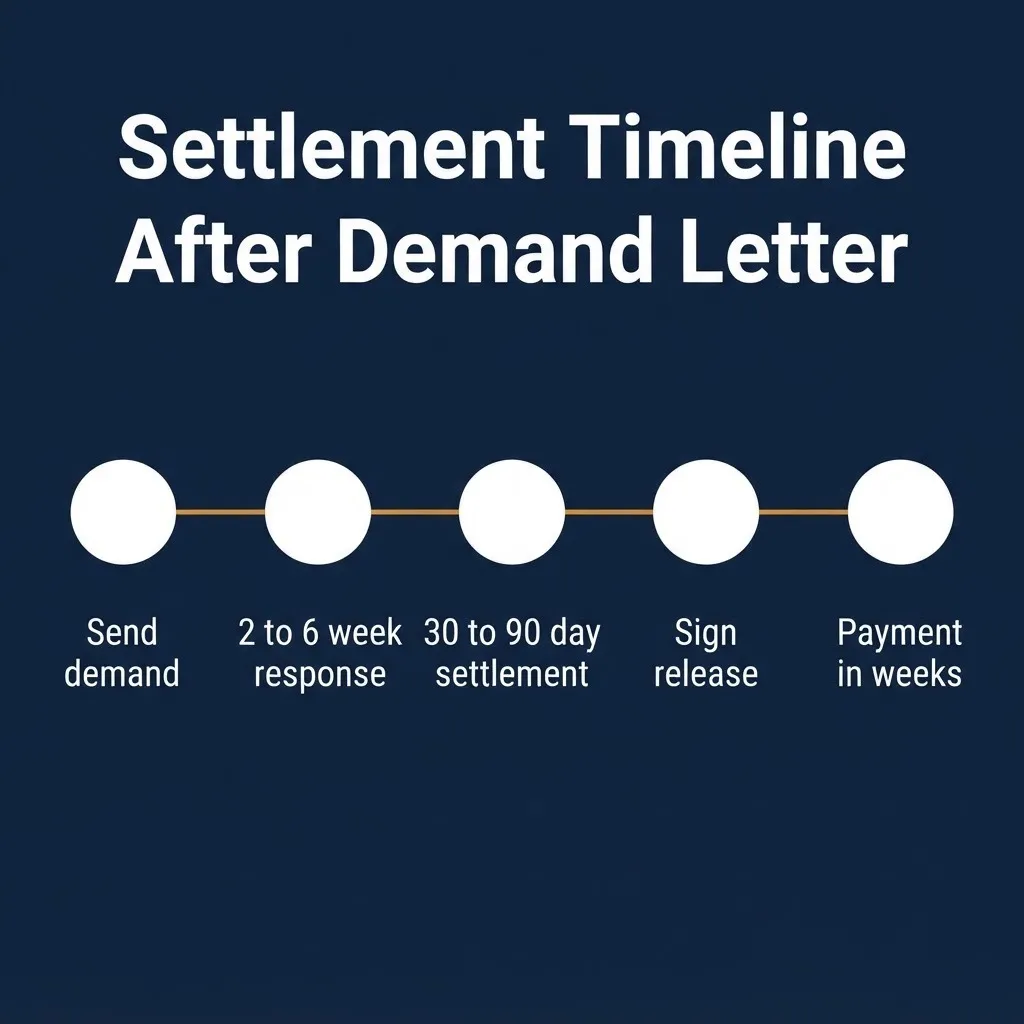
| Typical Settlement Window | 30 to 90 days after demand letter |
| Lawsuit Filing Deadline | Statute of limitations, varies by state and claim type |
| Insurance Company Duty | None to respond by a specific date |
| Best Move If No Response | Follow up at 30 days, consider filing suit at 60 to 90 days |
What is a demand letter?
A demand letter is a written request for payment. It states what happened, what you are owed, and how long the other side has to respond.
In personal injury cases, the demand letter goes to the at-fault party’s insurance company. It includes your medical records, proof of lost wages, and a specific dollar amount you will accept to settle.
In contract disputes, the demand letter goes to the person or business that owes you money. It lays out the breach and the amount due.
The letter is not a lawsuit. It is an attempt to resolve the case before going to court. But it does not legally require a response.
How long does it take to get a response to a demand letter?
Most insurance companies and opposing parties respond within two to six weeks. That is the practical norm, not a legal requirement.
An insurance adjuster may acknowledge the letter quickly and then take weeks to review the medical records, evaluate the claim, and get authority to make an offer. A busy adjuster handling hundreds of files will not drop everything for your letter.
Some demand letters get a fast lowball offer within days. Some get silence for months. The response time depends on the case, the company, and the amount at stake.
How long after a demand letter does settlement take?
Most settlements happen 30 to 90 days after the demand letter is received. That is the window where the adjuster reviews the file, makes an offer, and both sides negotiate.
Simple cases with clear liability and documented injuries can settle in as little as two weeks. Complex cases with disputed liability, multiple parties, or severe injuries can take six months or more.
The demand letter is the starting gun, not the finish line. Settlement is a negotiation, and negotiations take time.
Key Takeaway: Expect 30 to 90 days for a typical settlement after the demand letter. If the case is complex, add months to that estimate.
What happens during the settlement negotiation after a demand letter?
The negotiation follows a predictable back-and-forth pattern.
Here is the usual sequence.
- You send the demand letter with a specific amount.
- The adjuster reviews the file and responds with a counteroffer.
- You respond with a lower demand than your original.
- The adjuster counters again, moving closer to your number.
- Both sides agree on a final amount.
- You sign a release and receive payment.
Each round takes time. Expect days or weeks between offers, not minutes.
What if the insurance company does not respond to your demand letter?
If you hear nothing after 30 days, send a follow-up letter or email. Confirm the letter was received and ask for a status update.
If there is still no response after 60 days, consider filing a lawsuit. The demand letter has done its job. The case is not going to settle without pressure.
Filing a lawsuit changes the dynamic. The insurance company must respond to the court. The clock starts moving faster.
What is a reasonable settlement demand?
A reasonable demand is one that reflects your actual documented losses plus a fair amount for pain and suffering.
The demand should be higher than your bottom line. That leaves room to negotiate. If you want $50,000, do not demand $50,000. Demand $75,000 or more, then negotiate down.
But do not demand an absurd number. An unrealistic demand signals that you are not serious and may cause the adjuster to stop negotiating entirely.
Reality Check: No one can tell you the exact right demand amount without reviewing your medical records, your wage loss, and the insurance policy limits. Anyone promising a specific settlement number before seeing your file is guessing.
What factors slow down a settlement after a demand letter?
Several things can delay a settlement by weeks or months.
- Disputed liability: the insurance company says you were at fault
- Missing medical records: the adjuster cannot evaluate your injuries
- Pre-existing conditions: the insurer blames your pain on an old injury
- High-dollar claims: bigger demands need more approval layers
- Unresponsive adjusters: some files simply sit
- Policy limit disputes: the available coverage is unclear
Each factor adds time. The best way to speed things up is to send a complete demand package with every record and a clear dollar amount.
How can you speed up a settlement after sending a demand letter?
You cannot force a fast settlement, but you can remove obstacles.
Here are the steps.
- Send a complete demand package with all medical records and bills.
- Include a clear settlement amount and a response deadline.
- Follow up by phone or email after two weeks.
- Escalate to a supervisor if the adjuster is unresponsive.
- File a lawsuit at the 60 to 90 day mark if no fair offer arrives.
The threat of litigation is the best tool you have to move a stalled case.
Key Takeaway: A complete demand package and a firm follow-up schedule do more to speed up settlement than repeated phone calls or angry emails.
What is the difference between a demand letter and a lawsuit?
A demand letter is a request. A lawsuit is a court filing that forces a response.
A demand letter carries no legal deadline. The other side can ignore it without penalty. A lawsuit has hard deadlines. The defendant must answer or risk a default judgment.
The demand letter is cheaper and faster when it works. The lawsuit is the backup plan when negotiation fails.
What is the statute of limitations and how does it affect your settlement timeline?
The statute of limitations is the legal deadline for filing a lawsuit. It varies by state and by claim type.
For personal injury cases, most states allow two to three years from the injury date. For contract claims, the window is often three to six years.
The statute of limitations matters because you cannot negotiate forever. If the deadline passes, you lose your right to sue. That kills your leverage and your case.
What happens if you miss the statute of limitations while waiting for a settlement?
If you miss the deadline, your claim is barred. The insurance company will not pay because you cannot sue.
This is why you should never wait indefinitely for a settlement. If the negotiations stall and the deadline approaches, file the lawsuit. You can still settle after filing. Filing preserves your rights.
The demand letter is a step, not a strategy. The statute of limitations is the real clock.
What happens next after you accept a settlement offer?
Once you accept an offer, the case moves into the final paperwork stage.
| Timing | Expected Stage |
|---|---|
| Day 1 to 7 | You sign the release and return it |
| Week 2 to 4 | The insurance company processes the release |
| Week 4 to 6 | Check mailed or direct deposit sent |
| Week 6 to 8 | Funds clear and the case closes |
The payment usually arrives within a few weeks of signing the release. Then the case is over. You cannot reopen it later.
Frequently Asked Questions
How long after a demand letter will I get a settlement?
Most settlements happen 30 to 90 days after the letter.
Complex cases can take six months or longer.
Can an insurance company ignore a demand letter?
Yes, there is no legal requirement to respond.
If ignored, filing a lawsuit is the next step.
What should I do if I get no response after 30 days?
Send a follow-up letter or email.
Consider filing a lawsuit if there is still no response after 60 days.
How much should I demand in a settlement?
Demand more than your bottom line to leave room to negotiate.
Base the number on your documented medical bills, lost wages, and pain and suffering.
Does a demand letter have a deadline?
No law requires a response by a specific date.
You can set your own response deadline in the letter.
Can I settle after filing a lawsuit?
Yes, most cases settle after filing.
Filing preserves your rights and often speeds up negotiations.
What is the most important deadline in a settlement?
Your state’s statute of limitations for filing a lawsuit.
Missing that deadline bars your claim completely.
The demand letter starts the clock, but it does not control it. Most settlements happen within 30 to 90 days. Some take longer. Some never happen without a lawsuit.
The deadline that matters is not the demand letter response time. It is the statute of limitations. Know it. Watch it. File your lawsuit before it expires. That is how you protect your claim and force a real settlement.