Arbitration vs Litigation 2026: What the Difference Actually Means for Your Case
Quick Answer
- Arbitration is private, faster, and usually binding with almost no right to appeal.
- Litigation is public, slower, and includes the right to appeal and a jury trial.
- Your contract likely already decided which path you must take. Check it before you sue.
You signed something. A job offer. A credit card agreement. A nursing home admission. A phone plan. Buried in that stack of fine print was probably an arbitration clause. You did not read it. Most people do not.
That clause now controls what happens if you have a dispute. It may block you from court entirely. It may force you into a private process with different rules, different costs, and a different outcome than what you expected.
This article explains the difference between arbitration and litigation in plain terms. No law school jargon. Just the facts that matter when you are deciding whether to fight, settle, or walk away.
The Facts
| Fact | Verified Value |
|---|---|
| Process Types | Arbitration and litigation |
| Governing Law | Federal Arbitration Act for most arbitration clauses |
| Court Involvement | Public courts for litigation, private tribunals for arbitration |
| Appeal Rights | Broad in litigation, nearly nonexistent in arbitration |
| Average Timeline | Arbitration 6 to 12 months, litigation 18 to 36 months |
| Cost Structure | Arbitration filing fees often higher upfront, litigation total costs higher |
What is the difference between arbitration and litigation?
The core difference is simple. Litigation happens in a public court with a judge and possibly a jury. Arbitration happens in a private setting with a neutral third party called an arbitrator.
Litigation follows formal rules of evidence and procedure. The process is public. Anyone can sit in the courtroom and watch. The result becomes a public record. You can appeal a bad decision.
Arbitration is a creature of contract. The parties agree to resolve their dispute outside of court. The process is private. The rules are flexible. The arbitrator’s decision is usually final and binding.
Here is the comparison in simple terms:
- Litigation: public, slower, appealable, more expensive in total.
- Arbitration: private, faster, rarely appealable, lower total cost in many cases.
Key Takeaway: Litigation gives you more rights. Arbitration gives the company more control. That is why companies push arbitration clauses into every contract.
Is arbitration faster than litigation?
Yes, in most cases. Arbitration typically takes 6 to 12 months from filing to final award. Litigation often takes 18 to 36 months just to reach trial, and appeals can add years.
The speed difference comes from procedure. Arbitration has fewer discovery disputes, fewer motions, and no jury selection. The arbitrator controls the schedule tightly. Courts are crowded. Judges have hundreds of cases. An arbitrator has one case at a time.
But speed is not always a benefit. A fast arbitration can feel rushed. You may have less time to gather evidence or find witnesses. The pace is set by the arbitrator, not by your lawyer’s strategy.
Is litigation more expensive than arbitration?
The total cost of litigation is usually higher than arbitration. But the upfront cost of arbitration can be surprisingly high.
In litigation, you pay filing fees and your lawyer. The court system itself is subsidized by taxpayers. You do not pay the judge’s salary or the courthouse electricity bill. In arbitration, you pay the arbitrator’s fees, which can run hundreds of dollars per hour.
Here is a cost comparison:
| Cost Item | Litigation | Arbitration |
|---|---|---|
| Filing fee | $100 to $500 | $200 to $5,000+ depending on claims |
| Discovery | Expensive, extensive | Limited, less costly |
| Judge or arbitrator | Paid by taxpayers | Paid by the parties |
| Total cost | Usually higher | Usually lower overall |
| Upfront cost | Lower | Often higher |
For small claims, arbitration filing fees can exceed what you would pay to file in court. That is a real barrier for consumers and employees.
Can you appeal an arbitration decision?
Almost never. Arbitration awards are final and binding under the Federal Arbitration Act. A court can only vacate an award for extreme reasons: fraud, bias, or the arbitrator exceeding their authority.
You cannot appeal because you think the arbitrator got the facts wrong. You cannot appeal because you think the law was misapplied. The award stands even if a judge would have decided differently.
Litigation, by contrast, gives you a right to appeal. The appellate court reviews the trial record for legal errors. If the judge made a mistake, the higher court can reverse or modify the decision.
This is the biggest difference. You trade speed and cost for the loss of appeal rights. For many people, that trade is not worth it.
Key Takeaway: Arbitration is final. If you lose, you lose. There is no second chance in almost every case.
What is an arbitration clause?
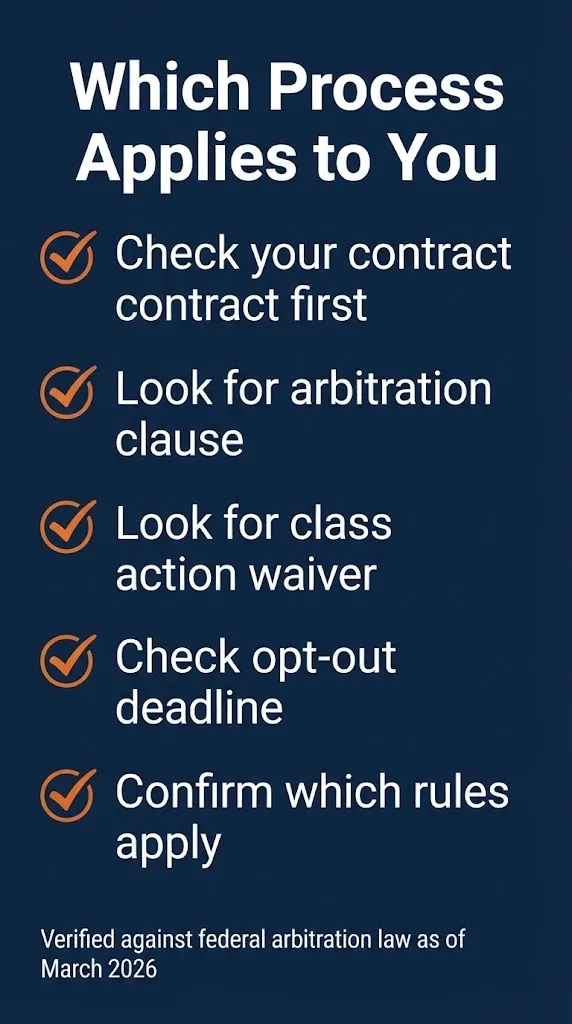
An arbitration clause is a contract provision that requires disputes to be resolved through arbitration instead of court. The clause usually appears in the fine print of consumer contracts, employment agreements, and service terms.
The clause may also include a class action waiver. That waiver prevents you from joining a class action lawsuit against the company. You must bring your claim individually in arbitration.
The U.S. Supreme Court has upheld these clauses repeatedly. The Federal Arbitration Act preempts state laws that try to limit arbitration. The practical result is that most consumers and employees are bound by arbitration clauses whether they know it or not.
You can sometimes opt out of an arbitration clause. Some employers and companies include an opt-out window, usually 30 days after signing. If you miss the window, you are bound.
What is the Federal Arbitration Act?
The Federal Arbitration Act, often called the FAA, is the federal law that makes arbitration agreements enforceable. Congress passed it in 1925. Courts have interpreted it broadly ever since.
The FAA says that arbitration agreements are valid, irrevocable, and enforceable like any other contract. State laws cannot single out arbitration for special restrictions. If you signed an arbitration clause, a court will almost certainly enforce it.
The Supreme Court has expanded the FAA’s reach over the years. The law applies to consumer contracts, employment contracts, and even some gig work agreements. The trend has been strongly in favor of arbitration.
What are the advantages of litigation over arbitration?
Litigation gives you more procedural protections. You have the right to a jury trial. You have broad discovery rights. You can subpoena witnesses and documents. You can appeal an adverse ruling.
The public nature of litigation also matters. Companies do not like bad publicity. A public lawsuit can pressure a defendant to settle. Arbitration is private. The company can resolve disputes quietly, without setting a precedent or attracting attention.
Here are the advantages of litigation:
- Right to a jury trial.
- Public record of the proceedings.
- Broad appeal rights.
- Formal discovery rules.
- Precedent-setting potential.
For a class action, litigation is often the only viable path. Arbitration clauses with class action waivers can kill a class case before it starts.
What are the advantages of arbitration over litigation?
Arbitration is faster, more flexible, and often less expensive overall. The rules can be tailored to the dispute. The arbitrator can be an expert in the relevant industry. The process is private.
For businesses, arbitration offers predictability. No runaway jury verdicts. No class actions if the clause includes a waiver. The company chooses the arbitration provider and the rules.
Here are the advantages of arbitration:
- Faster resolution.
- Lower total cost in many cases.
- Private and confidential.
- Flexible procedures.
- Expert decision-maker.
- No jury risk.
Key Takeaway: Arbitration benefits repeat players. Companies that arbitrate hundreds of cases know the process better than an individual bringing one claim.
When can you avoid an arbitration clause?
Avoiding an arbitration clause is difficult but not impossible. The most common paths are contract invalidation, opt-out provisions, and unconscionability challenges.
If the contract was formed through fraud, duress, or lack of capacity, a court may invalidate the entire agreement, including the arbitration clause. That is rare and fact-specific.
Some contracts include an opt-out window. You must act before the deadline, usually within 30 days. Follow the instructions exactly. Send the opt-out notice by the required method.
Unconscionability challenges argue that the arbitration clause is so one-sided it should not be enforced. Courts rarely accept this argument. But some state courts have invalidated clauses with excessive fees or biased arbitrator selection.
What is binding arbitration?
Binding arbitration means the arbitrator’s decision is final and legally enforceable. You cannot reject the award and ask for a trial. A court can enter the award as a judgment.
Non-binding arbitration is rare. In some court-ordered programs, the parties may arbitrate first and then request a trial if they reject the award. That is not the norm in consumer and employment contracts.
When you sign an arbitration clause, you are almost always agreeing to binding arbitration. The word “binding” may appear in the clause. Even if it does not, courts presume the parties intended a binding process.
What is a class action waiver?
A class action waiver is a contract provision that prevents you from participating in a class action lawsuit. It often accompanies an arbitration clause.
The waiver says you cannot join with other similarly situated people to bring a collective claim. You must pursue your claim individually. For companies, this is the most valuable part of the arbitration clause.
The Supreme Court has upheld class action waivers in arbitration agreements. In AT&T Mobility v. Concepcion and Epic Systems v. Lewis, the Court ruled that the FAA preempts state laws that would invalidate class waivers.
The practical result is that many consumer and employment disputes cannot proceed as class actions. Each individual must arbitrate separately, which is often not economically viable for small claims.
Key Takeaway: The class action waiver is the real prize for companies. It eliminates the threat of a large collective judgment.
How do you decide between arbitration and litigation?
You usually do not decide. Your contract decides. If you have an arbitration clause, you arbitrate. If you do not, you litigate.
The only time you have a real choice is when both parties prefer one process over the other and agree voluntarily. That happens after a dispute arises, in settlement negotiations, or in business-to-business relationships with equal bargaining power.
If you are drafting a contract, consider your goals. If you want speed and privacy, choose arbitration. If you want appeal rights and a public record, choose litigation. The choice depends on what you value.
What does the future of arbitration look like in 2026?
Arbitration is not going away. The Supreme Court has consistently upheld arbitration clauses. Congress has considered bills to limit forced arbitration, but none have passed.
The Ending Forced Arbitration of Sexual Assault and Sexual Harassment Claims Act became law in 2022. That law allows survivors of workplace sexual misconduct to avoid arbitration clauses. It is a narrow exception, not a broad reform.
Consumer advocates continue to push for broader limits. But as of March 2026, the legal landscape remains strongly pro-arbitration. Read every contract before you sign. The clause you skip today controls your rights tomorrow.
Reality Check
No one will call you to explain your arbitration rights. Your employer, your credit card company, and your cell provider will not highlight the clause that limits your options. The arbitration clause is buried in the fine print because most people never read it. If you are considering a dispute, pull out your contract and read the dispute resolution section first. What you find there determines everything else.
What Happens Next
| Timeline | Expected Stage |
|---|---|
| Now | Read your contract’s dispute resolution clause |
| Before filing | Determine if arbitration is mandatory |
| If arbitration | Select an arbitrator and pay filing fees |
| If litigation | File a complaint in the appropriate court |
| After decision | Arbitration ends, litigation may appeal |
These steps apply to most disputes. The specific path depends on your contract and your jurisdiction.
Frequently Asked Questions
What is the main difference between arbitration and litigation?
Arbitration is private and binding. Litigation is public and appealable.
Is arbitration cheaper than litigation?
Total costs are often lower, but upfront filing fees can be higher.
Can I appeal an arbitration award?
Almost never. Courts rarely overturn arbitration decisions.
What is a class action waiver?
A clause that prevents you from joining a class action lawsuit.
Can I opt out of an arbitration clause?
Sometimes, if the contract includes an opt-out window. Act quickly.
Is arbitration mandatory?
Yes, if you signed a contract with an arbitration clause.
How long does arbitration take?
Usually 6 to 12 months, compared to 18 to 36 months for litigation.
What is the Federal Arbitration Act?
The federal law that makes arbitration agreements enforceable.
The Clause You Ignored Is the Case You Cannot File
Arbitration versus litigation is not an academic debate. It is the difference between a public trial and a private hearing. It is the difference between an appeal and a final loss. It is the difference between a class action and a solo fight.
Read your contract. Find the clause. Know which path you are on before you take the first step.