Do You Actually Need a Lawyer for a Lawsuit?
Quick Answer
- Most personal injury lawyers work on contingency, charging 33.3% to 40% of your settlement, with nothing paid upfront.
- Lawyers billing by the hour average $349 nationally, though civil litigation rates vary widely by state and specialty.
- Free tools to verify a lawyer’s license exist through every state bar association, and using one takes just a few minutes.
If you’re searching “lawyers for lawsuits,” you’re likely trying to figure out where to start, not which specific case to join. This isn’t a settlement or a class action. It’s a decision about hiring the right attorney for a claim you’re considering or already facing.
The two numbers that matter most here are cost and credentials. Contingency fees for injury claims typically run 33.3% to 40% of your recovery, while hourly litigation rates average around $349 nationally, though that swings by state and practice area.
This article covers how lawsuit lawyers actually get paid, how to check if one is licensed and in good standing, and the questions worth asking before you sign anything. One detail people miss: your state bar’s lawyer referral service is usually free to use.
Fast Facts on Hiring a Lawsuit Lawyer
| Typical contingency fee (injury cases) | 33.3% to 40% of recovery |
| National average hourly rate (all practice areas) | Approximately $349 |
| Typical retainer fee (hourly arrangements) | $1,000 to $10,000 |
| Upfront cost with a contingency lawyer | $0, fee only comes from a win |
| Way to verify a license | Your state’s bar association attorney lookup tool |
| Some states cap contingency fees | Yes, for example Florida caps malpractice fees at 30% of the first $250,000 |
These are national benchmarks, not a quote for your specific case. Fees depend on your state, your case type, and the attorney you choose.
Do You Actually Need a Lawyer for a Lawsuit?
You don’t legally need a lawyer to file most civil lawsuits, but going without one puts you at a real disadvantage once the other side has legal representation.
Small claims court is built for self-representation and usually doesn’t allow lawyers at all. Anything beyond that, personal injury, employment disputes, contract claims, generally involves procedural rules, deadlines, and evidence standards that are easy to get wrong without training.

Situations where hiring a lawyer matters most:
- The other side already has an attorney or insurance company involved
- Your claim involves significant money or long-term damages
- You’re unsure which court has jurisdiction over your case
- Evidence, expert testimony, or complex liability questions are involved
A lawsuit without a lawyer is a bit like doing your own home wiring. Simple jobs are fine solo. Anything with real stakes usually calls for someone licensed.
How Much Does a Lawyer for a Lawsuit Cost?
Cost depends entirely on the fee structure and case type, ranging from $0 upfront on contingency to $150 to $700+ per hour for hourly billing.
There is no single “lawsuit lawyer” price. A personal injury attorney working on contingency doesn’t bill you hourly at all. A business litigation attorney almost always does.
| Fee Type | Typical Range | Common Case Types |
|---|---|---|
| Contingency (percentage of recovery) | 33.3% to 40% | Personal injury, some employment cases |
| Hourly rate | $150 to $700+ | Business, family, criminal defense |
| Flat fee | Varies by task | Simple, defined legal tasks |
| Retainer (upfront deposit) | $1,000 to $10,000 | Ongoing hourly representation |
Not yet determined for your case: the exact fee you’d pay, since it depends on your location, case complexity, and the specific attorney’s rate structure.
What Is a Contingency Fee and How Does It Work?
A contingency fee means your lawyer only gets paid if you win or settle, taking an agreed percentage of that recovery instead of hourly payment.
The industry standard for personal injury cases runs 33.3% for cases that settle before a lawsuit is filed, rising to around 40% if the case goes into full litigation. That’s a well-documented national norm, not a fixed legal requirement everywhere.
How the math works: on a $60,000 settlement at a 33% contingency fee, your attorney’s cut is roughly $19,800, before case costs like filing fees or expert witnesses, which usually come out separately.
Some states cap these percentages by law. Florida, for example, limits medical malpractice contingency fees to 30% of the first $250,000 recovered and 10% of anything above that.
Key Takeaway: contingency fees typically run 33.3% to 40% nationally, but always ask upfront whether case costs come out of your share before or after the percentage is calculated.
How Much Do Lawyers Charge Per Hour for a Lawsuit?
Hourly rates for litigation average around $349 nationally, though the range by state and practice area is wide.
| State (Example) | Avg. Lawyer Hourly Rate | Civil Litigation Rate |
|---|---|---|
| Connecticut | $406 | $435 |
| Virginia | $380 | Not separately reported |
| Texas | $366 | Not separately reported |
| Massachusetts | $335 | $347 |
| Arizona | $324 | $360 |
| Michigan | $297 | $298 |
Data reflects 2025 figures published in Clio’s Legal Trends Report, the most recent available comprehensive dataset as of this writing.
Hourly billing usually requires a retainer upfront, typically $1,000 to $10,000, which the attorney draws down as they bill hours worked. Ask for a written estimate of expected total hours before agreeing to hourly representation.
How Do You Find a Lawyer for a Lawsuit?
You can find a lawsuit lawyer through your state bar association’s referral service, personal recommendations, or legal directories that verify licensing.
Steps to find a legitimate attorney:
- Start with your state bar association’s official lawyer referral service, most offer this free or at low cost.
- Ask for recommendations from people who’ve had a similar type of case.
- Search legal directories that confirm bar admission and disciplinary history.
- Narrow to attorneys who specifically handle your case type, not general practice.
- Schedule free consultations, standard for contingency-based practice areas like injury law.
- Compare fee structures and communication style across at least two or three attorneys.
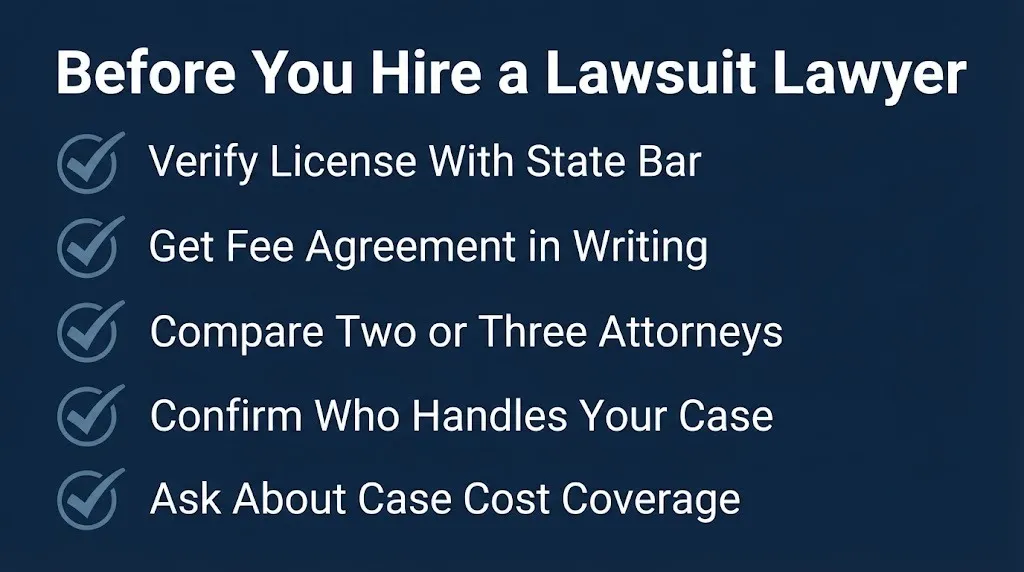
- Confirm licensing directly through your state bar’s lookup tool before signing anything.
Reality Check: No legitimate attorney contacts you first through an unsolicited text or cold call promising a guaranteed payout. Free consultations are standard for personal injury and contingency-based cases, and a real lawyer never asks for an upfront “processing fee” just to review your claim.
How Do You Choose the Right Type of Lawyer for Your Case?
Choosing the right lawyer means matching their specific practice area to your legal issue, not just hiring the first attorney available.
| Case Type | Lawyer Specialty to Search For |
|---|---|
| Car accident, slip and fall | Personal injury attorney |
| Workplace injury | Workers’ compensation attorney |
| Wrongful termination, discrimination | Employment lawyer |
| Contract dispute | Business or civil litigation attorney |
| Medical error | Medical malpractice attorney |
| Defective product | Product liability attorney |
A general practice attorney can sometimes help, but a specialist typically has deeper familiarity with the specific rules, deadlines, and common defenses in that exact area of law.
What Questions Should You Ask Before Hiring a Lawsuit Lawyer?
You should ask about fee structure, experience with your specific case type, and who will actually handle your file day to day.
Checklist of questions to ask in a consultation:
- What percentage or hourly rate do you charge, and what does it not cover?
- Have you handled cases like mine before, and what were typical outcomes?
- Will you personally handle my case, or will it go to another attorney or paralegal?
- What is your estimated timeline for a case like mine?
- Who covers costs like filing fees and expert witnesses if we don’t win?
- Can I get the fee agreement in writing before I sign?
Key Takeaway: getting the fee structure in writing before signing anything protects you more than any verbal promise a lawyer makes in a consultation.
How Do You Verify a Lawyer Is Licensed and in Good Standing?
You can verify a lawyer’s license directly through their state bar association’s public attorney lookup tool, free of charge.
Every state maintains this kind of database. It typically shows bar admission date, current standing, and any public disciplinary history.
Numbered verification steps:
- Search “[your state] bar association attorney search” to find the official tool.
- Enter the attorney’s name or bar number.
- Confirm their license status shows active and in good standing.
- Check for any public disciplinary actions or suspensions.
- Confirm they’re licensed in the state where your case will be filed.
This takes a few minutes and costs nothing, yet many people skip it entirely before signing a fee agreement.
What Red Flags Signal a Problem Lawyer?
Red flags include pressure to sign immediately, refusal to put fees in writing, and guarantees about how much you’ll recover.
Warning signs to watch for:
- Guarantees a specific dollar amount before reviewing your case
- Pressures you to sign the same day with no time to review terms
- Won’t provide a written fee agreement
- Has unresolved public disciplinary history with the state bar
- Asks for payment via gift cards, wire transfer, or unusual methods
- Is not actually licensed in the state where your case is filed
No legitimate attorney can promise a specific outcome before reviewing your evidence. Anyone who does is telling you what you want to hear, not what’s actually likely.
Can You File a Lawsuit Without a Lawyer?
Yes, you can represent yourself in most civil cases, a practice known as filing “pro se,” though it carries real risk in anything beyond small claims court.
Small claims court is specifically designed for self-representation, with simplified rules and dollar limits that vary by state. Anything above that threshold generally means facing procedural rules, filing deadlines, and evidentiary standards without training.
If you do go without a lawyer, most state courts publish self-help guides through their court clerk’s office, a legitimate free resource worth using before filing anything.
How Long Does It Take to Find and Hire a Lawyer?
Finding and hiring a lawyer typically takes anywhere from a few days to a few weeks, depending on how many consultations you schedule.
Free consultations, standard for contingency-based cases, usually take 30 to 60 minutes. Comparing two or three attorneys before deciding is common practice and shouldn’t feel rushed.
Time-sensitive cases matter here. If your state’s statute of limitations deadline is approaching, don’t delay comparison shopping so long that you risk missing your filing window entirely.
Frequently Asked Questions
How much does it cost to hire a lawyer for a lawsuit?
Cost depends on fee type: contingency fees run 33.3% to 40% of your recovery, with nothing upfront.
Hourly rates average around $349 nationally but vary widely by state and specialty.
Ask for a written fee agreement before signing with any attorney.
Do lawyers charge for a first consultation?
Many personal injury and contingency-based attorneys offer free initial consultations.
Attorneys billing hourly, such as for business or family law, may charge for consultations.
Always ask directly before scheduling.
What percentage do most lawsuit lawyers take?
Most personal injury attorneys take between 33.3% and 40% of your settlement or verdict.
The exact percentage often depends on whether your case settles early or requires full litigation.
Some states cap these percentages by law for specific case types like medical malpractice.
How do I know if a lawyer is legitimate?
Verify their license through your state bar association’s free attorney lookup tool.
Check for active standing and review any public disciplinary history.
A legitimate attorney will never object to you verifying their credentials.
Can I switch lawyers in the middle of a lawsuit?
Yes, you generally have the right to change attorneys during a case.
Your original attorney may be entitled to a portion of fees for work already completed.
Review your original fee agreement for any specific terms about termination.
What’s the difference between a contingency fee and an hourly rate?
A contingency fee means you pay nothing unless you win, with the lawyer taking a percentage of your recovery.
An hourly rate means you pay for time worked regardless of the outcome.
Contingency arrangements are common in personal injury; hourly billing is standard in business and family law.
Where can I find a free or low-cost lawyer referral?
Your state bar association operates an official lawyer referral service, typically free or low-cost to use.
Some nonprofit legal aid organizations also offer free consultations for qualifying income levels.
Search your state’s bar association website directly rather than relying on ads.
Before you sign any fee agreement, verify the attorney’s license through your state bar’s free lookup tool and get every fee term in writing. That single step protects you more than any promise made in a first meeting.