What Is the Average Payout for Roundup Lawsuit 2026: Verified Settlement Ranges and Claim Status
Quick Answer
- Is it legit? Yes. A real $7.25 billion settlement proposal filed in Missouri state court awaits final approval.
- How much? Average payouts range from $10,000 to $165,000 depending on exposure and diagnosis factors.
- Key deadline? The final approval hearing is September 14, 2026. Opt-out deadline was June 4, 2026.
The average payout for a Roundup lawsuit in 2026 falls between $10,000 and $165,000 per person, according to the proposed $7.25 billion class settlement filed in February 2026. Those figures are averages, not guarantees, and the exact amount depends on how you used Roundup, how old you were when diagnosed with non-Hodgkin lymphoma, and how aggressive your cancer is. A Missouri judge will decide on September 14, 2026, whether to grant final approval to this landmark deal.
If you are one of the roughly 200,000 people who filed a Roundup claim against Bayer and Monsanto, you are probably wondering what your case is worth. The short answer: it varies wildly. An agricultural worker diagnosed young with aggressive lymphoma could see around $165,000 on average. A retired homeowner diagnosed at 78 or older might average just $10,000. That gap reflects the settlement’s tiered structure, not arbitrary pricing.
This article breaks down the verified payout ranges, what factors move your number up or down, the critical September 14 hearing date, and what happens if you opted out. One fact that surprises most readers: the settlement fund pays out over up to 21 years, meaning even approved claimants will receive money in annual installments, not one lump sum.
The Facts
| Case | Monsanto Roundup Class Settlement (Missouri Circuit Court) |
|---|---|
| Status | Preliminary approval granted March 2026; final approval hearing September 14, 2026 |
| Fund Size | Up to $7.25 billion over 21 years |
| Est. Per Person | $10,000 to $165,000 average, depending on tier |
| Claim Deadline | Opt-out deadline was June 4, 2026; settlement now closed to new opt-outs |
| Administrator | Professional claims administrator appointed by court (not yet confirmed) |
| Proof Needed | Medical diagnosis of non-Hodgkin lymphoma plus proof of Roundup exposure |
Is the Roundup lawsuit settlement real or a scam?
The Roundup lawsuit settlement is real and verified. Bayer and Monsanto reached a proposed $7.25 billion nationwide class settlement in February 2026, filed in the 22nd Judicial Circuit Court of the City of St. Louis, Missouri . A Missouri judge granted preliminary approval in March 2026, allowing the settlement process to move forward .
This is not the first Roundup settlement. Bayer previously paid around $11 billion to resolve roughly 100,000 cases through a 2020 resolution program . That earlier deal did not end the litigation, which is why this new class settlement exists.
Scammers often impersonate settlement administrators. The actual court process is free to participate in. If someone contacts you demanding payment to “process your Roundup claim” or asks for your Social Security number upfront, that is fraud. Legitimate settlement notices come through court-approved channels, not cold calls or texts.
What is the average Roundup lawsuit payout per person?
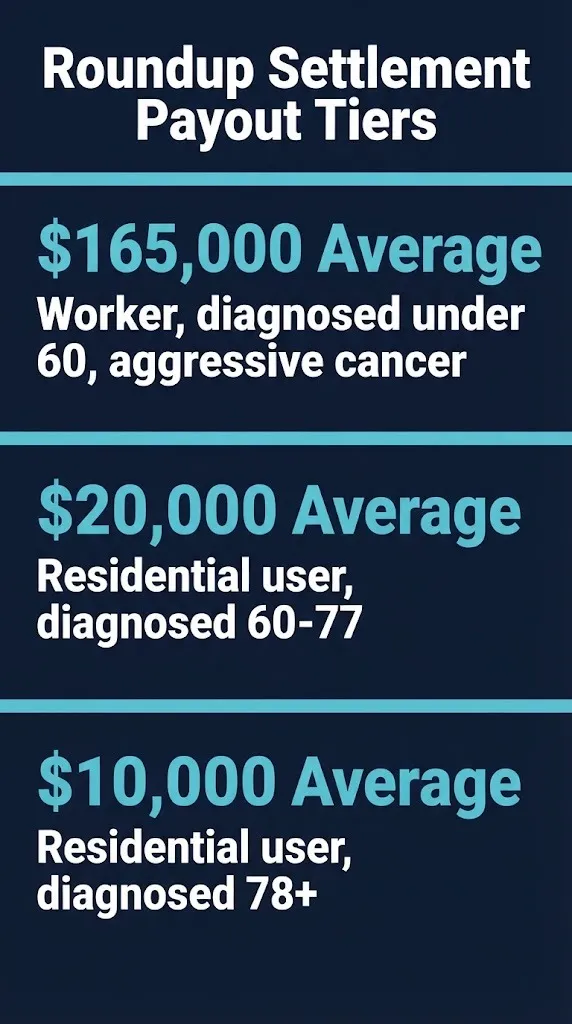
The average Roundup lawsuit payout per person ranges from $10,000 to $165,000 under the proposed settlement. These figures come directly from the settlement documents filed in February 2026 . The averages reflect four broad tiers based on who you are, how you used Roundup, and when you were diagnosed.
Here is the breakdown:
| Claimant Type | Diagnosis Age | Cancer Severity | Average Payout |
|---|---|---|---|
| Agricultural/industrial/turf worker | Under 60 | Aggressive | $165,000 |
| Residential user | 60-77 | Less aggressive | $20,000 |
| Residential user | 78 or older | Any | $10,000 |
The $165,000 figure applies to workers with long-term occupational exposure who were diagnosed young with an aggressive form of non-Hodgkin lymphoma . The $10,000 figure applies to the oldest claimants with the least aggressive diagnoses. Most claimants will fall somewhere between those extremes.
Some reports suggest payouts could reach as high as $198,000 or more per case in the highest tier, depending on individual factors . However, that figure has not been confirmed in the official settlement documents.
Key Takeaway: The Roundup settlement does not pay everyone the same amount. Workers diagnosed young with aggressive cancer receive the highest averages. Older residential users with milder diagnoses receive the lowest.
What factors determine your Roundup settlement amount?
Your Roundup settlement amount depends primarily on exposure type, diagnosis age, and cancer severity. The settlement uses these three factors to sort claimants into payment tiers .
Exposure type carries significant weight. Agricultural workers, landscapers, and turf managers who used Roundup professionally for years receive higher averages than homeowners who sprayed it occasionally. The settlement documents specifically distinguish “agricultural, industrial or turf worker exposed at length” from “residential Roundup user” .
Diagnosis age matters because younger claimants face more lost earning years and more future medical costs. The settlement creates a cutoff at age 60 for the highest tier and another at age 77 for the lowest tier.
Cancer severity affects both medical costs and pain and suffering. Aggressive forms of non-Hodgkin lymphoma require more intensive treatment and carry higher mortality risk.
Documentation strength also influences your claim. Medical records proving your diagnosis and evidence linking your cancer to Roundup exposure (purchase receipts, employment records, witness statements) strengthen your position. Without proof, your claim may face challenges.
How do you check your Roundup lawsuit claim status?
You can check your Roundup lawsuit claim status by contacting the settlement administrator appointed by the Missouri court. The administrator’s contact information will appear in official court notices mailed to class members. No administrator name has been publicly confirmed as of September 11, 2026.
If you filed a claim through the earlier 2020 settlement program, that process is separate from this new class settlement. The 2020 program resolved approximately 100,000 claims . This new settlement covers remaining claims and future diagnoses.
Steps to verify your claim status:
- Locate any settlement notice you received by mail or email.
- Find the administrator’s phone number or website on that notice.
- Have your claim number ready if you received one.
- Ask for written confirmation of your claim status.
- Do not pay anyone for “expedited processing.”
If you never received a notice and believe you should have, contact class counsel listed in the court docket. Do not rely on third-party websites that charge fees for status checks.
Reality Check: No legitimate settlement administrator asks you to pay a fee to file a claim or check your status. If someone demands payment upfront, it is a scam. The court-appointed process is always free for class members.
Did the Supreme Court ruling affect Roundup settlement payouts?
Yes, the Supreme Court’s June 2026 ruling in Monsanto v. Durnell significantly affects Roundup litigation, but it does not cancel the proposed settlement. The 7-2 decision held that federal pesticide law (FIFRA) preempts state-law failure-to-warn claims, meaning plaintiffs cannot sue Bayer for not adding a cancer warning that the EPA never required .
That ruling removed one major legal theory from Roundup lawsuits. It also reduced Bayer’s litigation risk, which could make the company less motivated to settle remaining claims on generous terms. However, the proposed $7.25 billion class settlement was filed before the Durnell decision and remains on track for final approval .
The Supreme Court ruling does not eliminate all Roundup claims. Lawsuits based on design defect and negligence theories survive, because those argue the product itself was dangerous regardless of warnings . How lower courts apply Durnell to those remaining theories is still being sorted out .
For settlement participants, the practical impact is limited. If you are part of the proposed class, the settlement terms were locked in before Durnell. The ruling affects future claims and cases that opted out of the settlement, not the payout structure for class members.
What happens at the September 14, 2026 final approval hearing?
The September 14, 2026 hearing is when a Missouri judge will decide whether to grant final approval to the $7.25 billion Roundup class settlement. The hearing was originally scheduled earlier but was rescheduled to give the administrator more time to process opt-out revocation requests following the Supreme Court’s Durnell decision .
At this hearing, the judge will consider:
- Whether the settlement terms are fair, reasonable, and adequate.
- Whether class counsel represented the class adequately.
- Whether the notice process complied with due process requirements.
- Any objections filed by class members.
If the judge grants final approval, the settlement becomes effective after all appeals are exhausted. Bayer has stated that the settlement “does not become final and effective until all appeal procedures have been concluded, which could take several years” . That means payments will not begin immediately after September 14, even if approval is granted.
If the judge denies approval, the parties return to negotiation or litigation. A $10 billion settlement proposal collapsed in 2020 after a judge objected to how future claims would be handled . That history shows approval is not guaranteed.
How long will it take to receive your Roundup settlement money?
You should not expect Roundup settlement money in 2026. The realistic timeline stretches into 2027 or later for initial payments, with the full payout schedule spanning up to 21 years .
Here is the expected sequence:
- September 14, 2026: Final approval hearing.
- Late 2026 to 2027: Appeals period and resolution.
- 2027 (expected): Claims processing begins if approval stands.
- 2027-2028 (expected): First payments distributed.
- Up to 21 years: Remaining annual payments.
The settlement fund is structured as “declining capped annual payments” over up to 21 years . That means Bayer pays into the fund gradually, not all at once. Claimants receive their share as the fund is funded, which spreads payments over decades.
This timeline resembles waiting for a delayed tax refund, except the delay is measured in years, not weeks. Patience and documentation are your main tools.
What are the key dates in the Roundup lawsuit settlement?
The Roundup lawsuit settlement has several verified dates that matter for claimants. The most critical upcoming date is the September 14, 2026 final approval hearing .
| Date | Event |
|---|---|
| February 17, 2026 | Proposed $7.25 billion settlement announced |
| March 2026 | Preliminary approval granted by Missouri court |
| June 4, 2026 | Opt-out and objection deadline |
| June 25, 2026 | Supreme Court Durnell decision |
| September 14, 2026 | Final approval hearing |
| TBD | Appeals resolution and payment start |
The opt-out deadline has passed. If you wanted to exclude yourself from the class settlement and pursue an individual lawsuit, that window closed on June 4, 2026 . If you did nothing, you are likely bound by the settlement terms if final approval is granted.
Key Takeaway: The single most important date for Roundup claimants is September 14, 2026. That is when the judge decides whether the $7.25 billion settlement moves forward or falls apart.
What happens next in the Roundup lawsuit settlement?
The next stage is the final approval hearing on September 14, 2026, followed by a lengthy appeals process. If approval is granted and appeals fail, claims processing and payments begin, but not before 2027 at the earliest.
Here is the expected timeline:
- September 14, 2026: Final approval hearing in Missouri court.
- Expected late 2026: Written approval order issued if granted.
- Expected 2027: Appeals filed and resolved.
- Expected 2027-2028: Claims administrator begins processing and payments.
- TBD: Full payout schedule over up to 21 years.
If the judge denies approval, Bayer and class counsel may renegotiate or return to trial. The 2020 collapse shows that settlement approval is never certain until the judge signs the order.
Frequently Asked Questions
What is the average payout for a Roundup lawsuit in 2026?
The average payout ranges from $10,000 to $165,000 depending on exposure type, diagnosis age, and cancer severity.
Is the Roundup lawsuit settlement approved yet?
No. The settlement received preliminary approval in March 2026. Final approval is pending at a September 14, 2026 hearing.
How much did Bayer agree to pay in the Roundup settlement?
Bayer agreed to fund up to $7.25 billion over 21 years to resolve current and future non-Hodgkin lymphoma claims.
Can I still file a Roundup lawsuit in 2026?
The class settlement covers people exposed before February 17, 2026. If you opted out by June 4, 2026, you can pursue an individual lawsuit. Otherwise, you are bound by the class terms.
When will Roundup settlement checks be mailed?
No checks will mail in 2026. Payments are expected in 2027 or later, after final approval and appeals are resolved.
Did the Supreme Court kill the Roundup settlement?
No. The June 2026 Durnell ruling weakened one legal theory but did not cancel the proposed settlement. The deal remains on track for final approval.
What proof do I need for a Roundup claim?
You need medical records confirming a non-Hodgkin lymphoma diagnosis and evidence of Roundup exposure (receipts, employment records, or witness statements).
What should you do right now?
If you are part of the Roundup class settlement, there is nothing to file right now. The opt-out deadline passed on June 4, 2026. Your job is to wait for the September 14 hearing and preserve your medical and exposure records.
Check the official court docket for the 22nd Judicial Circuit Court in St. Louis for updates. Ignore anyone who contacts you demanding payment to “expedite your claim.” The settlement process is free.
The single most important fact to remember: September 14, 2026 is the date that decides whether the $7.25 billion Roundup settlement moves forward or collapses. Mark it on your calendar.