Roundup Lawsuit Statute of Limitations 2026: State Deadlines, the 2026 Settlement Trap, and What Still Counts
Quick Answer
- Roundup has no single nationwide filing deadline. Your state’s statute of limitations controls, and it usually runs from your non-Hodgkin lymphoma diagnosis, not from when you used the weedkiller.
- A Missouri court granted final approval to a $7.25 billion class settlement on September 14, 2026, with payouts ranging from $10,000 to $165,000 for qualifying NHL claimants .
- The claim registration window opens after final approval and appeals resolve. Watch the official settlement website for the binding deadline, not a law firm ad.
You are probably here because a clock is already running and nobody will tell you exactly when it started. That is the honest problem with the Roundup statute of limitations in 2026: it is not one deadline, it is fifty state deadlines layered on top of a brand-new class settlement that captures some claims and excludes others.
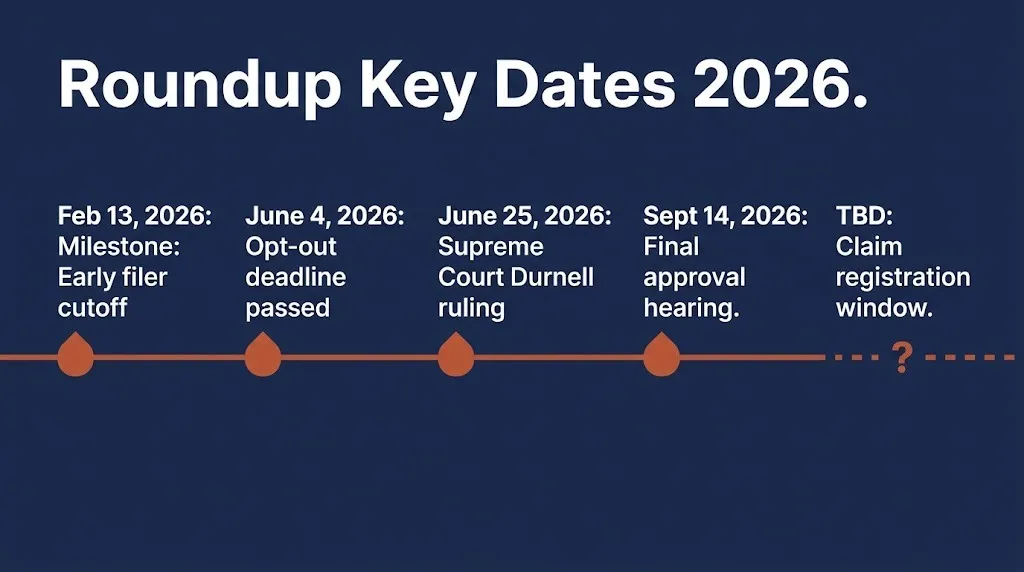
The one date that matters most right now is not a filing deadline at all. It is February 13, 2026, the cutoff for people who had already sued or signed a tolling agreement to qualify for expedited treatment under the settlement . If you missed it, your path runs through your state’s courthouse, not a claim form.
This article breaks down how the deadlines actually work, which states give you the shortest and longest windows, why the 2026 settlement changed the math for thousands of people, and what the Supreme Court did in June that makes early legal review more urgent, not less.
The Facts
| Item | Detail |
|---|---|
| Case Name | King v. Monsanto (St. Louis City Circuit Court) and In re: Roundup Products Liability Litigation (MDL 2741) |
| Status | Final approval granted September 14, 2026; subject to appeals |
| Fund Size | Up to $7.25 billion over 21 years |
| Est. Per Person | $10,000 to $165,000 for qualifying NHL claims; limited-proof awards around $150 |
| Claim Deadline | Registration window is 180 days after final approval or after appeals resolve; exact date not yet confirmed |
| Administrator | Not yet confirmed on a public claims portal |
| Proof Needed | Medical diagnosis of non-Hodgkin lymphoma and documented Roundup exposure; check the claim form |
Is the Roundup lawsuit statute of limitations the same in every state?
No. There is no federal Roundup filing deadline. Each state sets its own product liability and personal injury limitations period, and those windows range from one year to six years depending on where you live or were diagnosed .
The clock generally starts when you knew or should have known that your non-Hodgkin lymphoma might be connected to Roundup. That is called the discovery rule. In practice, most attorneys anchor the date to your NHL diagnosis, because that is the moment you had a reason to investigate the link .
A few states apply a statute of repose on top of the limitations period. That is an outer wall measured from the product’s sale or delivery, and it can bar an old exposure even if you were diagnosed yesterday. Wrongful death claims often run on a separate, shorter clock from the date of death.
Which states have the shortest Roundup filing deadlines?
Kentucky and Tennessee give you one year. Those are the tightest windows in the country for Roundup-related injury claims, and they leave almost no room to gather records before filing .
Louisiana is one year for injuries that occurred before July 1, 2024, though the rule shifted for later claims. Georgia, Virginia, and several other states sit in the two-year band, which is the most common product liability window nationally .
If you live in a one-year state and you were diagnosed more than twelve months ago, you need to understand something uncomfortable: you may already be outside the window for a standard lawsuit. That does not automatically mean you have no options under the class settlement, but the two tracks are separate.
Which states give you the longest window to file?
Arkansas, Connecticut, Maryland, and the District of Columbia generally allow three years for product liability claims . A handful of states stretch to four years or longer for certain injury theories.
Longer does not mean safer. The discovery rule can push the start date later, but defendants will argue you should have known sooner, especially after the 2015 World Health Organization classification and the wave of Roundup verdicts that followed. Waiting until the last six months of a four-year window gives the other side a ready-made argument that you sat on your rights.
How does the 2026 Roundup settlement change the statute of limitations?
It creates two tracks, and confusing them is the most common mistake people make right now. Track one is the class settlement in Missouri state court. Track two is a direct lawsuit against Monsanto in your state.
If you did not opt out by June 4, 2026, you are likely bound by the settlement’s terms for the claims it covers . That means you cannot file a separate Roundup lawsuit for the same injury, even if your state’s limitations period has not expired. The settlement becomes your remedy.
The settlement class covers people exposed to Roundup in the U.S. before February 17, 2026, who have an NHL diagnosis as of March 4, 2026, or receive one later within a defined period . If you fit that definition and did not opt out, your filing deadline question is now a claim registration deadline question.
What did the Supreme Court’s Durnell ruling do to Roundup claims?
Monsanto v. Durnell, decided June 25, 2026, held that federal pesticide law preempts state-law claims arguing Roundup’s warning label was inadequate . In plain terms, you cannot sue Monsanto for failing to warn about cancer risks that the EPA’s approved label did not require.
That does not kill every Roundup case. Plaintiffs’ attorneys argue that design defect and negligence claims survive the ruling, and the federal MDL judge in San Francisco has not dismissed the consolidated litigation . But the ruling narrows the legal theories available, which makes the statute of limitations question more urgent. If your only viable theory was failure to warn, the Durnell decision may have already closed a door that was open last year.
Key Takeaway: The Roundup deadline problem in 2026 is not just about time. It is about which claims still exist after the Supreme Court’s Durnell ruling and whether the class settlement already captured your case.
How much can you actually get from the Roundup settlement?
Payouts range from $10,000 to $165,000 for qualifying non-Hodgkin lymphoma claims under the settlement structure, according to court reporting on the proposed deal . Some limited-proof categories are far lower, around $150 for claimants who cannot document exposure or diagnosis at the higher tiers .
The exact award depends on several factors: the severity of your NHL, your age at diagnosis, whether exposure happened at home or at work, and whether you filed a lawsuit or signed a tolling agreement before February 13, 2026 . People in that early-filer group get access to expedited award categories that later claimants do not.
The $7.25 billion figure is the total fund, paid over up to 21 years, not a per-person number . Bayer structured the payments over two decades to protect its balance sheet. That means even a successful claimant will not see the full award in one check.
| Claim Category | Reported Range | Key Condition |
|---|---|---|
| Tier 1 (early filers, severe NHL) | Up to $165,000 average | Lawsuit or tolling agreement before Feb 13, 2026 |
| Standard class claimant | $10,000 to $165,000 | Qualifying NHL diagnosis and exposure |
| Limited proof | Around $150 | Minimal documentation |
Reality Check: No one will text you a settlement award and ask for a fee to release it. Claim registration through the official settlement program is free. Any “helper” charging you an upfront percentage to file a Roundup claim is selling you something you can do yourself or get through a licensed attorney’s contingency arrangement.
Who may qualify for the Roundup settlement?
You may qualify if you used or were exposed to Roundup in the United States before February 17, 2026, and have been diagnosed with non-Hodgkin lymphoma . The class definition includes people diagnosed as of March 4, 2026, and those who receive an NHL diagnosis later within the settlement’s future-claims window.
There is a residency requirement. You must be a U.S. citizen or have been living in the U.S. on March 4, 2026, according to the settlement terms reported by claims-tracking sources .
The hardest cut is the one for people diagnosed before 2020. If you did not file a lawsuit or sign a tolling agreement before February 13, 2026, you generally cannot receive settlement money unless you can show your state’s limitations period has not run . That is where the state-by-state deadline table becomes the whole ballgame.
How do you file a Roundup claim or lawsuit in 2026?
The steps differ depending on whether you are inside the settlement class or pursuing a direct lawsuit. If you did not opt out and you fit the class definition, your path is claim registration, not a courthouse filing.
- Confirm your opt-out status. If you did not submit an exclusion request by June 4, 2026, assume you are in the class and bound by its terms.
- Gather your medical records. You need pathology reports and treatment records confirming the non-Hodgkin lymphoma diagnosis.
- Document your Roundup exposure. Purchase receipts, work records, landscaping logs, or testimony about years of use all help.
- Watch for the official registration window. It opens after final approval and appeals resolve. Do not rely on a third-party site for the date.
- Register through the court-approved process. There is no legitimate upfront fee to register.
- If you opted out or missed the class, consult a licensed attorney in your state. Bring your diagnosis date and exposure history to the first call.
- Calendar your state’s limitations date. If you are pursuing a direct lawsuit, your attorney will calculate the filing deadline from your diagnosis and state law.
What happens next in the Roundup litigation?
The settlement is approved but not final in the practical sense. Appeals are expected, and no distribution happens until they resolve .
October to December 2026: Objectors’ appeals move through the Missouri appellate system. The Eighth Circuit already dismissed one objector attempt in August 2026, but that does not guarantee a quick end .
Expected first quarter 2027: If appeals are resolved or dismissed, the 180-day claim registration window opens. The exact date will be posted on the official settlement website, not in law firm advertising.
Expected 2027 to 2028: Claims processing and tier assignment begin. This is when limited-proof claimants and full-documentation claimants get separated.
Ongoing through 2047: Payments distribute over the 21-year funding schedule. The later tranches depend on Bayer’s annual payment obligations, not a single lump sum.
Parallel track: The federal MDL in San Francisco remains active with nearly 4,000 cases, and Judge Chhabria has not dismissed it post-Durnell . Direct lawsuits that opted out of the class continue there or in state courts.
Frequently Asked Questions
Is the Roundup lawsuit statute of limitations the same for everyone?
No. Your state’s law controls, and the window ranges from one year to six years or longer depending on where you live and when you were diagnosed .
Does the statute of limitations start when I used Roundup or when I was diagnosed?
In most states, the discovery rule starts the clock when you were diagnosed with non-Hodgkin lymphoma or knew it might be linked to Roundup, not when you last sprayed the weedkiller .
Can I still file a Roundup lawsuit if I missed the June 4, 2026 opt-out deadline?
Probably not for claims covered by the settlement. If you did not opt out, you are likely bound by the class settlement and must pursue a claim through that process instead of a separate lawsuit .
Does the 2026 Supreme Court ruling end all Roundup lawsuits?
No. The Durnell decision blocks failure-to-warn claims based on the label, but design defect and negligence theories may survive, and the federal MDL remains open .
How much is the Roundup settlement worth per person?
Qualifying non-Hodgkin lymphoma claims range from $10,000 to $165,000 depending on severity, age, exposure type, and whether you filed before February 13, 2026 .
When will Roundup settlement checks be mailed?
Not yet. Appeals must resolve first, then the registration window opens, then claims are processed. No payment date is confirmed as of October 29, 2026.
What if I was diagnosed with non-Hodgkin lymphoma after February 17, 2026?
The settlement includes future claimants within a defined window, but the exact diagnosis cutoff and registration process for later diagnoses need to be confirmed on the official settlement site.
Do I need a lawyer to file a Roundup claim?
No for the class settlement claim form. Yes, strongly recommended if you are considering a direct lawsuit or if your diagnosis predates 2020 and you did not sign a tolling agreement.
What You Should Do Before the Deadline Runs Out
The single most important number is not the settlement fund. It is your diagnosis date on your pathology report. Pull that document out today and write the date on a calendar.
Then check whether you filed a lawsuit or signed a tolling agreement before February 13, 2026. That fact determines which payout tier you fall into and whether the settlement is even your path.
If you did neither and your diagnosis was years ago, call a licensed Roundup attorney in your state this week. The Durnell ruling already narrowed the theories. The statute of limitations is the next wall, and it does not care that the settlement made headlines.