When Will I Get My Roundup Settlement Check? The 2026 Payout Timeline Nobody Can Promise You Yet
Quick Answer
- The Roundup settlement is real: a Missouri judge granted final approval on September 14, 2026.
- Per-person payouts range from about $150 for limited proof to $165,000 average for top-tier claims, but no official average exists.
- The claim registration deadline is January 5, 2027, or 180 days after final approval, whichever is later.
You want a date. A real one, circled on a calendar, the way you’d track a tax refund. The honest answer is that no date exists yet, and anyone who gives you one is guessing.
What is confirmed: the Roundup class settlement is legitimate, court-approved at the trial level, and structured to pay claims over up to 21 years. What is not confirmed: when the first dollar reaches your mailbox. Bayer’s own filing says the deal “does not become final and effective until all appeal procedures have been concluded, which could take several years.”
This article covers what the court record actually says about the payout timeline, who qualifies, how much the tiers pay, and the one deadline you can control right now. The surprising part: even claimants with cancer diagnoses may wait years for full payment, but a narrow group can get expedited checks before appeals end.
The Facts
| Item | Detail |
|---|---|
| Case | King v. Monsanto (Missouri state court class action) |
| Status | Final approval granted September 14, 2026; subject to appeals |
| Fund Size | Up to $7.25 billion over 21 years |
| Est. Per Person | $150 (limited proof) to $165,000 average (top tier); actual awards 80% to 120% of tier averages |
| Claim Deadline | Register by January 5, 2027, or 180 days after final approval, whichever is later |
| Administrator | BrownGreer PLC |
| Proof Needed | NHL diagnosis, exposure evidence, treatment records |
Is the Roundup Settlement Real or a Scam?
The Roundup settlement is real and court-supervised, not a scam. A judge in the Circuit Court of the City of St. Louis, Missouri granted preliminary approval on March 4, 2026, and final approval on September 14, 2026.
The confusion comes from the word “final.” In class action language, “final approval” from a trial judge does not mean the case is over. It means the judge signed off, and now the appeals clock starts. Bayer has been explicit about this in its own disclosures, stating the settlement “does not become final and effective until all appeal procedures have been concluded.”
If you search for this settlement and find a website demanding a fee to “release your funds,” close the tab. The official administrator is BrownGreer PLC, and filing a claim costs nothing.
How Much Is the Average Roundup Settlement Per Person?
There is no official average Roundup settlement per person. No court, agency, or administrator publishes one. Any website quoting a single “average” is showing you a marketing figure, not a measured number.
What exists instead is a tiered structure. The settlement creates categories based on diagnosis severity, age at diagnosis, exposure type (occupational versus residential), and proof strength. Reported ranges run from $10,000 to $165,000 for qualifying non-Hodgkin lymphoma claims, with some limited-proof categories paying around $150.
The table below reflects reported ranges from court reporting and legal notices, not a guarantee:
| Claim Category | Reported Range | Key Condition |
|---|---|---|
| Tier 1 (highest) | Average around $165,000 | Younger age, occupational exposure, aggressive NHL |
| Mid-tier claims | Varies widely | Mixed proof and exposure factors |
| Limited proof | Around $150 | Minimal documentation of exposure |
| Quick-Pay (Tiers 5-9) | $6,000 to $14,500 | Residential claimants or age 78+, filed before Feb. 13, 2026 |
Actual awards may range from 80% to 120% of the tier average, depending on your individual claim score. The $7.25 billion figure is the total funding ceiling paid over up to 21 years, not a per-person number.
Key Takeaway: The $7.25 billion is a fund cap stretched over two decades, so even a successful claimant will not see the full award in one check.
Who Qualifies for a Roundup Settlement Payment?
You may qualify if you were exposed to Roundup in the U.S. before February 17, 2026, and have been diagnosed with non-Hodgkin lymphoma. The settlement class includes people diagnosed as of the preliminary approval date, plus future claimants who develop NHL later within a defined period.
The eligibility rules have a sharp edge. If you filed a lawsuit or signed a tolling agreement before February 13, 2026, you have access to expedited award categories that later claimants do not. If you did not take legal action before that date and your state’s statute of limitations has already expired, you may remain in the settlement class but receive no money.
A legal notice filed in Kentucky summarized the class this way: farmers, landscapers, groundskeepers, gardeners, and others exposed to weed killers who have or may develop NHL. Family members and representatives of deceased, minor, or incapacitated class members may also be included.
Reality Check: No one texts you settlement money first. The administrator will not ask for your bank password, your Social Security number over the phone, or a gift card. Filing a claim is free. Third-party “claim helpers” charging upfront fees are unnecessary.
How Do You File a Roundup Settlement Claim?
You file by registering with the settlement administrator before the deadline. The process is free, and the court-appointed administrator is BrownGreer PLC.
Here are the steps:
- Go to the official settlement website (WeedKillerClass.com, per court documents) and locate the registration portal.
- Create an account with your basic contact information.
- Gather your medical records showing the NHL diagnosis, including date and subtype.
- Collect any proof of Roundup exposure: receipts, photos, employment records, or product purchase history.
- Submit the registration form before January 5, 2027, or 180 days after final approval, whichever is later.
- File the full claim package within 180 days after any appeals are resolved, if you have a current diagnosis.
- If you develop NHL later, you file within six years of diagnosis, with no need to register now.
The registration deadline is not the claim deadline. Registering preserves your place; the full claim comes later. Missing the registration cutoff is the mistake that cannot be fixed.
When Will Roundup Settlement Checks Actually Mail?
Checks will not mail until all appeals are resolved, and no one can give you a date for that. The final approval hearing was held September 14, 2026. The judge had not issued a final ruling by early October 2026, and appeals are expected to follow whenever he does.
Bayer’s official language is the clearest signal: the settlement “does not become final and effective until all appeal procedures have been concluded, which could take several years.” That is the company’s own description, not a plaintiff lawyer’s warning.
The payment structure adds another layer of delay. The $7.25 billion is paid in declining capped annual installments over up to 21 years. Even after appeals end, money flows in stages, not in one lump sum.
For comparison, think of it like a home insurance payout after a disaster: the adjuster approves the claim, but the check clears in stages as the work gets done. Approval is not payment.
What Is the Roundup Settlement Claim Deadline?
The claim registration deadline is January 5, 2027, or 180 days after the court approves the settlement, whichever is later. This comes from a court-authorized legal notice published in Kentucky.
The exclusion and objection deadline was June 4, 2026, and it has passed. If you did not opt out by that date, you are likely bound by the settlement’s terms for the claims it covers. That means you cannot file a separate Roundup lawsuit for the same injury, even if your state’s statute of limitations has not expired.
The final approval hearing was originally scheduled for July 9, 2026, then moved to September 14 after the parties asked for more time to process opt-out revocation requests following the Supreme Court’s Durnell decision.
What Happens Next in the Roundup Settlement?
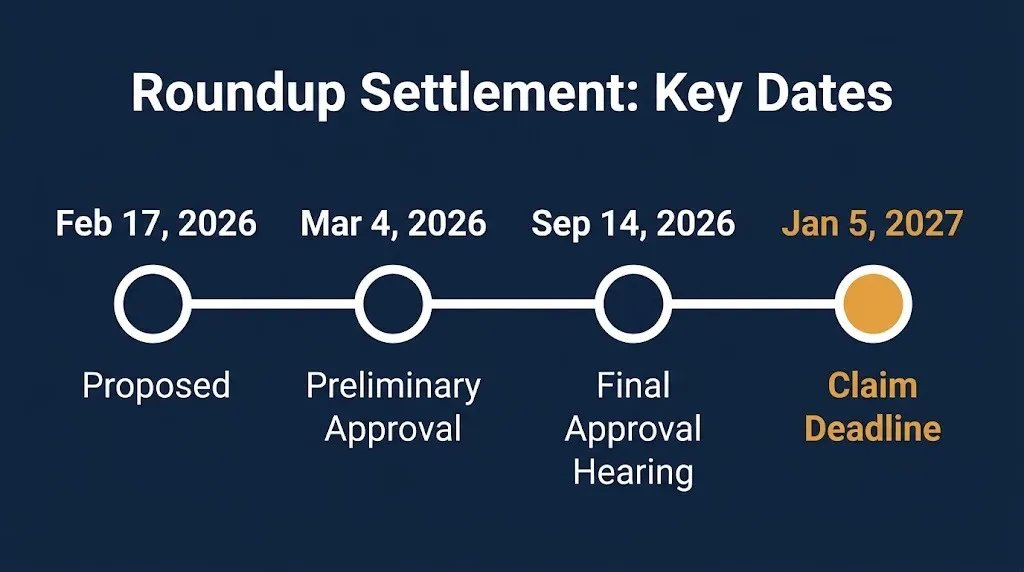
Here is the expected sequence, with confirmed dates where they exist:
September 14, 2026: Final approval hearing held. Judge did not rule immediately.
Expected late 2026: Judge issues final approval ruling.
Expected 2027: Appeals filed and processed. This is the main bottleneck.
January 5, 2027: Claim registration deadline, or 180 days after approval, whichever is later.
After appeals resolve: Claim packages filed and processed, then first payments begin.
Ongoing for up to 21 years: Annual payments distributed.
The appeals process is the wild card. Objectors already tried to move the decision to federal court and failed, but that does not mean appeals disappear. Bayer’s own statement about the Durnell decision suggests the company expects legal challenges to continue shaping the settlement’s scope.
What Does the Durnell Supreme Court Ruling Mean for Your Claim?
The Supreme Court’s June 25, 2026 ruling in Monsanto v. Durnell held that federal pesticide law preempts state-law claims arguing Roundup’s warning label was inadequate. In plain terms, you cannot sue Monsanto for failing to warn about cancer risks that the EPA-approved label did not require.
That ruling narrowed the path for future lawsuits, but it did not kill the settlement. The class settlement was structured to resolve claims regardless of the Durnell outcome, and the settlement itself remains under Missouri state court review.
For you, the practical effect is this: if you are in the settlement class, your remedy is the settlement, not a separate lawsuit. The Durnell decision makes that clearer, not murkier. Plaintiffs’ attorneys argue that design defect and negligence claims survive, and a St. Louis jury recently ruled for Bayer in the first post-Durnell trial, which suggests those arguments face a hard road.
Frequently Asked Questions
When will I get my Roundup settlement check?
No date is confirmed. Checks cannot mail until all appeals are resolved, which Bayer says could take several years.
Is the Roundup settlement real?
Yes. A Missouri judge granted final approval on September 14, 2026, and the administrator is BrownGreer PLC.
How much is the average Roundup settlement per person?
No official average exists. Reported ranges run from $150 for limited proof to $165,000 average for top-tier claims.
Do I need to file by January 5, 2027?
Yes, if you have a current NHL diagnosis. That is the registration deadline, or 180 days after approval, whichever is later.
What if I develop NHL after the deadline?
You can file within six years of diagnosis. You do not need to register now.
Can I still sue Monsanto separately?
Only if you opted out by June 4, 2026. If you stayed in, the settlement is your remedy.
Who is the settlement administrator?
BrownGreer PLC, named in court documents and legal notices.
What happens if I miss the registration deadline?
You may lose your right to payment under the settlement. Register even if you are unsure about documentation.
The Bottom Line
The Roundup settlement is real, the money is committed, and the timeline is controlled by appeals nobody can predict. The one date you control is January 5, 2027. Register before then if you have a diagnosis. Gather your medical records and any proof of exposure now, while you wait.
Key Takeaway: Final approval is not a check. The settlement is approved, but payment waits on appeals, and the registration deadline is the only deadline you can still meet.