Pressure Ulcer Litigation 2026: Stage-by-Stage Settlement Values and the Evidence That Decides Nursing Home Cases
Quick Answer
- Is it legit: Yes. Pressure ulcer lawsuits are individual negligence claims against nursing homes, not a group settlement with a claim form.
- How much: Stage 1-2 cases often settle for $50,000 to $250,000. Stage 4 cases reach $500,000 to $3 million or more. Wrongful death verdicts have exceeded $15 million .
- Deadline: No single deadline exists. State medical malpractice statutes of limitations control, and some states require pre-suit notice within 90 days for public hospitals .
If you searched for “pressure ulcer litigation,” you are likely watching someone you love suffer from a wound that should never have formed. Bedsores are largely preventable with basic turning, repositioning, and skin checks. When a facility fails at that, the legal question is not whether the sore happened. It is whether the staff ignored the signs.
The numbers reflect that outrage. A 2026 California jury awarded $15.75 million in a case involving a 96-year-old who developed a Stage 3 ulcer during short-term rehab . A Virginia case settled for $425,000 in January 2026 after an 87-year-old’s sacral wound was documented as “no wound present” while it deteriorated to Stage IV .
This article covers the verified settlement ranges by stage, the evidence that moves a case from low to high value, the deadlines that end claims, and the documentation families should preserve before anything else.
The Facts
| Item | Verified Detail |
|---|---|
| Claim Type | Individual nursing home negligence or medical malpractice lawsuit |
| Settlement Fund | None. No class action, no administrator. |
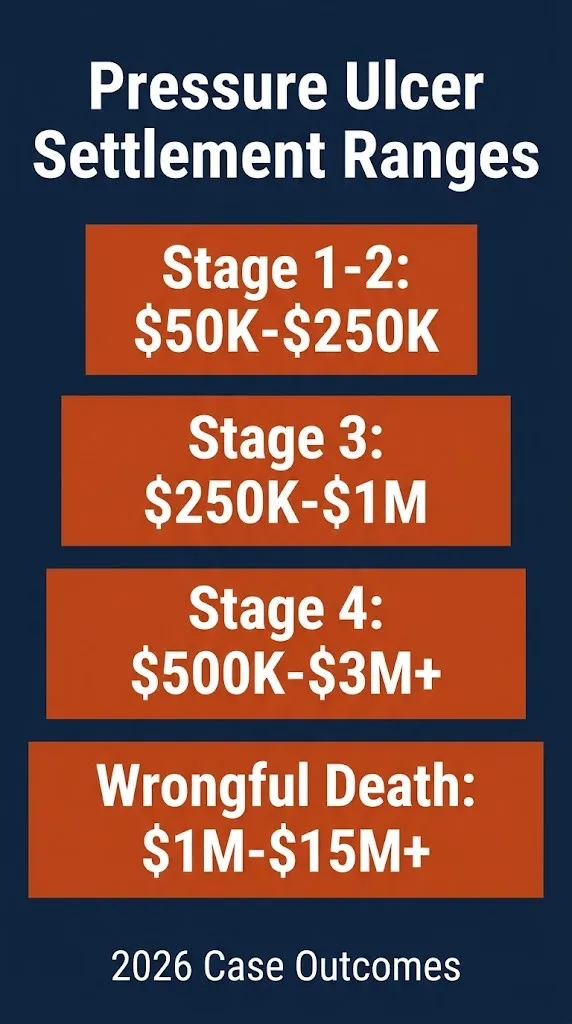
| Stage 1-2 Range | $50,000 to $250,000 |
| Stage 3 Range | $250,000 to $1,000,000 |
| Stage 4 Range | $500,000 to $3,000,000+ |
| Wrongful Death Range | $1,000,000 to $15,000,000+ |
| Key Evidence | Medical records, photos, staffing logs, regulatory citations |
| Deadline | State-specific medical malpractice statute of limitations |
Is Pressure Ulcer Litigation Real or a Scam?
Pressure ulcer litigation is real, but it is not a settlement program. It is a personal injury or medical malpractice lawsuit filed by a resident or their family against a nursing home, assisted living facility, or hospital.
There is no “pressure ulcer settlement fund” and no claim form to submit. Each case rises or falls on the specific facility’s conduct, the resident’s condition, and the documentation. A facility that turned and repositioned a resident every two hours has a defense. A facility that charted “no wound present” while a Stage IV ulcer developed does not .
The scam risk is in the marketing, not the litigation. Services that promise a specific payout before reviewing medical records are guessing. Legitimate nursing home attorneys review the chart, the staffing records, and the state inspection history before giving any range.
Key Takeaway: Pressure ulcer litigation is an individual negligence claim, not a class action payout. No fund exists, and no claim form will open.
How Much Is a Pressure Ulcer Lawsuit Worth?
A pressure ulcer lawsuit is worth $50,000 to $250,000 for Stage 1-2 injuries, $250,000 to $1,000,000 for Stage 3, and $500,000 to $3,000,000 or more for Stage 4, according to 2026 case data . Wrongful death cases have produced verdicts exceeding $15 million.
The stage of the wound is the starting point, not the final number. A Stage IV ulcer that heals with treatment is different from a Stage IV ulcer that leads to sepsis, amputation, or death. The table below reflects the verified ranges from recent case outcomes.
| Injury Level | Typical Range | Verified Example |
|---|---|---|
| Stage 1-2 | $50,000 to $250,000 | Early-stage sacral sore with complications settled for $500,000 |
| Stage 3 | $250,000 to $1,000,000 | 96-year-old Stage 3 case produced $15.75M verdict with punitive damages |
| Stage 4 | $500,000 to $3,000,000+ | Multiple Stage 4 ulcers with sepsis led to $7.75M verdict |
| Wrongful death | $1,000,000 to $15,000,000+ | $13.5M settlement for infected pressure injuries and death |
Reality Check: No one texts you settlement money first. A legitimate pressure ulcer claim starts with medical records, photographs, and a facility’s inspection history. Any message promising a payout before reviewing that evidence is a scam.
How Do You File a Pressure Ulcer Lawsuit?
Filing a pressure ulcer lawsuit means documenting the wound, obtaining the facility’s records, and filing a medical malpractice or negligence claim in the correct court. The steps below are the general sequence, not legal advice for your specific case.
- Photograph the wound immediately. Date-stamped photos are the most powerful evidence of severity.
- Request the complete medical chart. You are entitled to the records as the resident or legal representative.
- Preserve staffing and care records. Turn schedules, repositioning logs, and skin assessments show whether the facility followed its own care plan.
- Check the facility’s inspection history. Prior citations for wound care or understaffing strengthen the case .
- Consult a nursing home attorney about the deadline. Medical malpractice statutes of limitations vary by state and can be as short as one year.
- Send any required pre-suit notice. Some states require notice before filing, especially against public hospitals .
- File the complaint in the correct court. The facility’s location and the resident’s residence usually determine venue.
What Evidence Increases a Pressure Ulcer Settlement?
The evidence that increases a pressure ulcer settlement is proof that the facility knew the risk and ignored it. Documented understaffing, falsified records, and prior regulatory citations move cases from average ranges into seven figures .
The strongest evidence falls into four categories. Medical records show the wound’s progression and whether staff documented it accurately. Staffing logs reveal whether the facility had enough aides to turn and reposition residents. Regulatory inspection reports show whether the facility had prior deficiencies. Photographs and family observations fill gaps the chart omits.
The Virginia case settled in January 2026 is a clear example. The chart said “no wound present” while the sacral ulcer deteriorated to Stage IV. A nurse practitioner had urged staff to reposition the resident. The family discovered the wound by its foul odor . That gap between what the chart said and what the family saw is what drives value.
| Evidence Type | Why It Matters |
|---|---|
| Admission skin assessment | Shows whether the wound was present on arrival |
| Turn and reposition logs | Proves whether care plan was followed |
| Staffing records | Supports understaffing claims |
| Prior inspection citations | Shows facility knew the risk |
| Family photographs | Corroborates severity and timeline |
What Is the Deadline to File a Pressure Ulcer Lawsuit?
The deadline to file a pressure ulcer lawsuit is the state’s medical malpractice statute of limitations, which is often one to two years from the date the injury was discovered or should have been discovered. Some states shorten the window further for public facilities.
New York illustrates the complexity. A pressure sore claim against a public hospital may require a notice of claim within 90 days of the injury, with a possible extension for disability . A 2025 New York case involved a family seeking leave to file a late notice because the resident was incapacitated and the family could not retain counsel within the 90-day window .
Nevada applies a one-year statute of limitations to medical malpractice claims, including those against nursing facilities, with specific affidavit-of-merit requirements . Tennessee uses a one-year period with a 120-day extension if pre-suit notice is sent .
The practical rule is to consult an attorney immediately. The deadline may run from the date the wound was discovered, not the date it formed, and that distinction can save or end a claim.
What Happens Next After a Pressure Ulcer Diagnosis?
The next steps after a pressure ulcer diagnosis are medical first, legal second. The resident needs wound care, possibly surgical debridement, and a care plan that prevents further breakdown.
Immediately: Request a wound care consultation. Photograph the wound. Ask the facility for the care plan and the turn schedule.
Days 1 to 7: The facility should document the wound and update the care plan. If it does not, that failure becomes part of the case.
Weeks 1 to 4: Obtain the medical records. Consult a nursing home attorney about the deadline and the evidence.
Months 1 to 6: The attorney reviews records, obtains expert opinions, and sends a demand or files suit.
Months 6 to 18: Negotiation or litigation. Most cases settle, but severe injuries and wrongful death cases can take longer .
Frequently Asked Questions
How much is a pressure ulcer lawsuit worth?
Stage 1-2 cases settle for $50,000 to $250,000. Stage 4 cases reach $500,000 to $3 million or more. Wrongful death verdicts have exceeded $15 million .
Can you sue a nursing home for bedsores?
Yes, if negligence caused the injury. Failing to turn, reposition, or treat a wound is the basis for a nursing home negligence claim .
How long do you have to file a pressure ulcer lawsuit?
It depends on the state. Many states use a one-year to two-year medical malpractice statute of limitations. Some public facilities require notice within 90 days .
What stage bedsore is worth the most?
Stage 4 ulcers that lead to sepsis, amputation, or death produce the highest values. Stage 4 ranges start at $500,000 and can exceed $3 million before wrongful death is added .
What evidence do I need for a bedsore lawsuit?
Medical records, photographs, staffing logs, and the facility’s prior inspection citations. The gap between what the chart says and what the wound shows is often the strongest evidence .
Can a pressure ulcer lead to a wrongful death claim?
Yes. Untreated pressure ulcers can cause sepsis, osteomyelitis, or fatal infection. Wrongful death claims add damages for the loss of the resident’s life .
Do most pressure ulcer cases settle or go to trial?
Most settle. A 2026 Virginia case settled for $425,000 before trial . But cases with clear liability and severe injury can produce large verdicts if the facility refuses to pay a fair amount .
Pressure ulcer litigation is not a payout program. It is an individual negligence claim, and the value depends on the stage of the wound, the facility’s records, and the evidence of neglect.
Photograph the wound. Get the chart. Check the inspection history. The one-year to two-year deadline is the backstop, but the evidence that decides the case is in the facility’s records right now.