Texas Workers’ Compensation Rules 2026: The Opt-Out System, Benefit Caps, and Deadlines That Decide Claims
Quick Answer
- Is it legit: Yes. Texas workers’ comp is a real no-fault benefit system, but coverage is optional for most private employers.
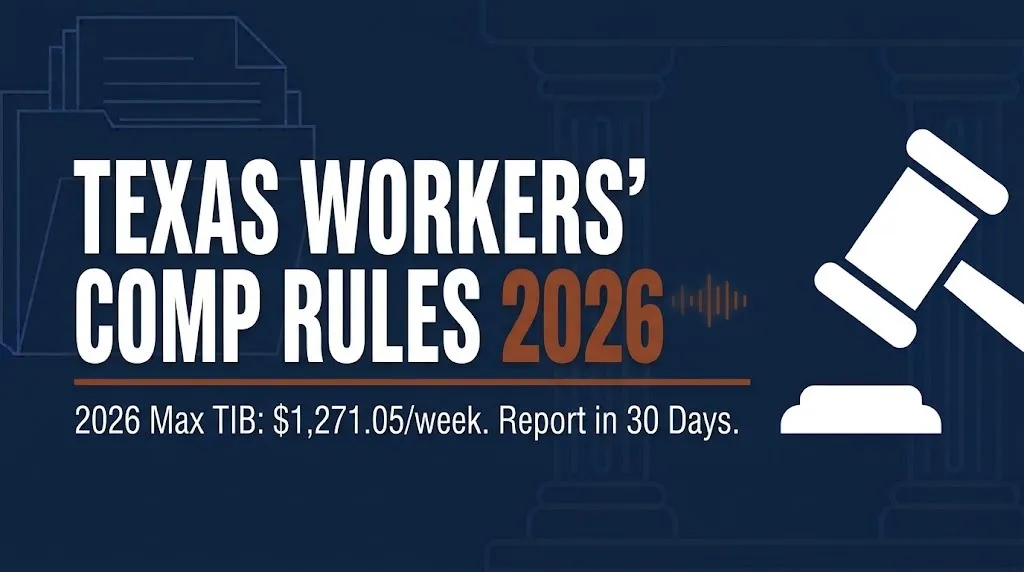
- How much: Temporary Income Benefits pay 70% of your average weekly wage, capped at $1,271.05 per week in 2026.
- Deadline: Report the injury to your employer within 30 days. File the DWC Form-041 with the state within one year.
If you searched for “Texas workers’ compensation rules,” you probably just got hurt on the job or you’re an employer trying to understand what the law actually requires. You may have heard that Texas is different from every other state. That’s true, and it changes everything about how a claim works.
Texas does not mandate workers’ compensation insurance for most private employers . An employer that carries coverage is called a “subscriber.” One that doesn’t is a “non-subscriber.” Subscribers get protection from most injury lawsuits. Non-subscribers don’t, and they lose key legal defenses if an injured worker sues .
This article covers the benefit math, the reporting deadlines, the catastrophic injury rules, and the filing duties that trip up employers who opt out.
The Facts
| Item | Verified Detail |
|---|---|
| Coverage Mandate | Optional for most private employers; required for government contractors and certain motor carriers |
| 2026 Max Weekly TIB | $1,271.05 |
| 2026 Max Weekly IIB | $890.00 |
| TIB Duration | 104 weeks maximum, unless spinal surgery extension applies |
| Employee Report Deadline | 30 days to employer |
| State Claim Deadline | 1 year to file DWC Form-041 |
| Death Benefit | 75% of average weekly wage; burial up to $10,000 |
Is Texas Workers’ Compensation Real or a Scam?
Texas workers’ compensation is a real state-regulated benefit system. The Division of Workers’ Compensation (DWC) within the Texas Department of Insurance administers it. Employers that subscribe pay premiums to licensed carriers, and those carriers pay medical and income benefits to injured workers.
The scam risk sits with anyone promising a specific settlement before reviewing your medical records. Texas eliminated traditional lump-sum settlements in 1989. Most “settlements” today are either disputed-benefit agreements or lump-sum payouts of Impairment Income Benefits in narrow circumstances .
What you should know: the system is no-fault for subscribers. You don’t have to prove your employer did anything wrong to get benefits. But you do have to prove the injury happened at work and meet the reporting deadlines.
Key Takeaway: Texas workers’ comp is real, but it’s not automatic. Your employer may not even have coverage, and the deadlines start the day you’re hurt.
How Much Does Texas Workers’ Comp Pay in 2026?
Texas workers’ comp pays 70% of your average weekly wage for Temporary Income Benefits, capped at $1,271.05 per week in 2026 . After you reach Maximum Medical Improvement, Impairment Income Benefits pay 70% of your wage for 3 weeks per percentage point of impairment, capped at $890 per week .
The benefit types stack in sequence, not all at once. Here is how the math works for a worker earning $1,000 per week:
| Benefit Type | Rate | Duration | 2026 Cap |
|---|---|---|---|
| Temporary Income (TIBs) | 70% of AWW (75% after 26 weeks) | Up to 104 weeks | $1,271.05/week |
| Impairment Income (IIBs) | 70% of AWW | 3 weeks per impairment point | $890.00/week |
| Supplemental Income (SIBs) | 80% of wage gap | Quarterly, up to 401 weeks total | 70% of SAWW |
| Lifetime Income (LIBs) | 75% of AWW + 3% annual COLA | For life | First-year cap only |
A worker with a 10% impairment rating and a $1,000 AWW gets $700 per week for 30 weeks, or $21,000 in IIBs . If the same worker earned $1,500 per week, the cap kicks in at $890 per week, and the total is $26,700 .
Reality Check: No one calls you offering workers’ comp money. Benefits start when your employer’s carrier accepts the claim. If someone asks for a fee to “release” your benefits, it’s a scam.
What Is the Deadline to Report a Texas Work Injury?
You must report a work injury to your employer within 30 days of the injury or the date you knew it was work-related . You must file the state claim form, DWC Form-041, with the Division of Workers’ Compensation within one year of the injury .
The 30-day clock is the one that kills claims. If you tell your supervisor the same day, you’re fine. If you wait two months because you thought it would heal, you may lose the right to benefits.
The one-year state filing deadline applies even if your employer never reports the injury. You don’t have to wait for the carrier. You can file the form yourself .
Key Takeaway: The 30-day report to your employer and the one-year state filing are separate deadlines. Missing the first one can end the claim before the second one matters.
How Do You File a Texas Workers’ Comp Claim?
Filing a Texas workers’ comp claim means notifying your employer, getting medical treatment from an approved provider, and filing the state form if the carrier doesn’t handle it. The steps below are the general sequence for a subscriber employer.
- Tell your employer within 30 days. Report the injury and how it happened. Get it in writing if you can.
- Get medical care. For subscribers, the carrier may direct you to a network provider. Emergency care is always covered.
- Confirm your employer has coverage. Ask for the carrier name and policy number. If they don’t have coverage, the rules change.
- File DWC Form-041 within one year. This is the state claim form. File it even if your employer is cooperating.
- Attend the designated doctor exam if scheduled. The impairment rating comes from this exam.
- Track your TIB payments. They should start within weeks of the carrier accepting the claim.
- Dispute a denial through a Benefit Review Conference. You have the right to challenge a carrier’s decision .
What Are Lifetime Income Benefits in Texas?
Lifetime Income Benefits (LIBs) are paid for life to workers with specific catastrophic injuries. The qualifying injuries are total and permanent loss of sight in both eyes, loss of both feet or hands, loss of one foot and one hand, spinal injury causing permanent paralysis, traumatic brain injury causing incurable insanity, or third-degree burns covering at least 40% of the body .
LIBs pay 75% of your average weekly wage with a 3% annual cost-of-living increase . The statutory maximum applies only to the first year of benefits. After that, the 3% increases apply without a cap .
There are roughly 100 LIBs claims per year in Texas . That’s how narrow the eligibility is. Most injured workers never qualify.
The process to get LIBs starts with a written request to the insurance carrier. The carrier must respond within 60 days. If denied, you can request a Benefit Review Conference .
Key Takeaway: LIBs are for catastrophic injuries only. The 3% annual increase is the most valuable part, and it applies after the first-year cap.
What Rules Apply to Non-Subscriber Employers in Texas?
Non-subscriber employers in Texas must file annual notices, post non-coverage signs, and report injuries to the state. They also lose three key legal defenses if an injured worker sues.
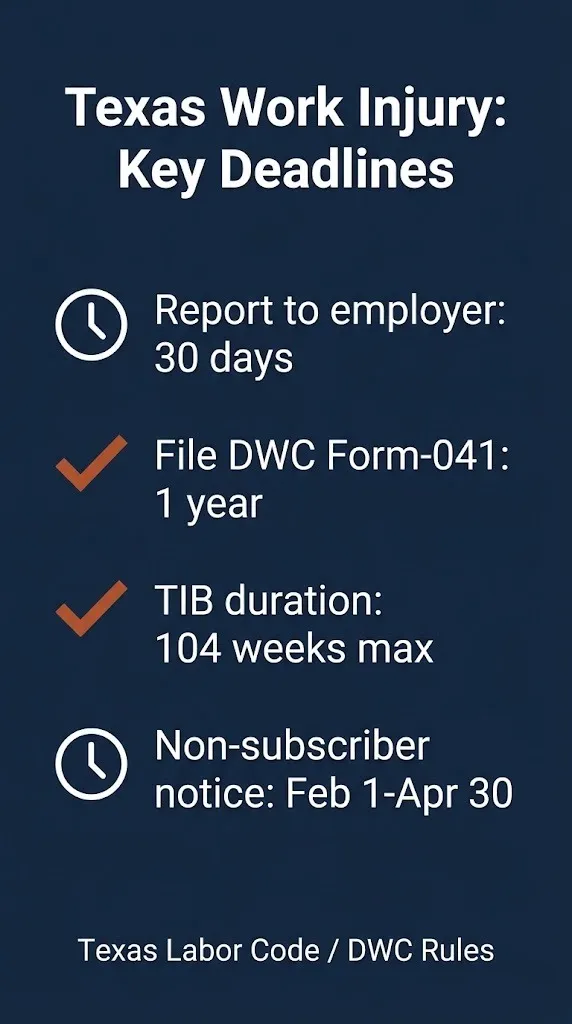
The filing duties are specific. Non-subscribers file DWC Form-005 between February 1 and April 30 each year. They post the DWC Notice 5 where employees can see it. They give written notice of non-coverage to every new hire. Employers with more than four employees file DWC Form-007 monthly for injuries causing more than one day of lost time .
The legal exposure is the bigger risk. Under Texas Labor Code § 406.033, a non-subscriber cannot argue that the employee was contributorily negligent, that the employee assumed the risk, or that a coworker caused the injury . The employee still has to prove negligence, but those defenses are gone.
A non-subscriber who wants to provide benefits typically buys an occupational accident policy and a separate employer liability policy. Those together are not always cheaper than workers’ comp, and they come with caps and exclusions .
What Happens Next After a Texas Work Injury?
The next stages depend on whether your employer is a subscriber and whether the carrier accepts the claim. For subscribers, the carrier investigates within 7 days of receiving first written notice .
Days 1 to 7: Report the injury. The carrier receives notice. Medical treatment begins.
Days 7 to 14: The carrier accepts or disputes the claim. TIB payments should start by the 7th day after the 8th day of disability .
Weeks 2 to 8: Medical treatment continues. The carrier may schedule a designated doctor exam.
Weeks 8 to 104: TIBs continue if you can’t work. At Maximum Medical Improvement, the doctor assigns an impairment rating.
After MMI: IIBs begin based on the rating. If the rating is 15% or higher and you haven’t returned to equivalent work, SIBs may apply.
If denied: Request a Benefit Review Conference. The dispute process can take months.
Frequently Asked Questions
Is workers’ compensation required in Texas?
No, not for most private employers. State and government contractors and certain motor carriers must carry it .
How much does Texas workers’ comp pay per week?
Temporary Income Benefits pay 70% of your average weekly wage, capped at $1,271.05 per week in 2026 .
What happens if my employer doesn’t have workers’ comp?
You can sue them. Non-subscribers lose the contributory negligence, assumption of risk, and fellow-servant defenses under Texas Labor Code § 406.033 .
How long do I have to report a work injury in Texas?
30 days to your employer and one year to file DWC Form-041 with the state .
What is Maximum Medical Improvement?
It’s the point when no further recovery is expected, or 104 weeks after income benefits begin, whichever comes first .
What are Lifetime Income Benefits?
Benefits paid for life for catastrophic injuries like blindness, amputation, paralysis, or severe burns. They pay 75% of your wage with a 3% annual increase .
Can I get a lump sum settlement in Texas workers’ comp?
Traditional lump sums were eliminated in 1989. IIBs can be paid in a lump sum in narrow circumstances .
Texas workers’ comp is not one system. It’s two: a no-fault benefit system for subscribers, and a lawsuit exposure system for non-subscribers. The benefit math is capped at $1,271.05 per week in 2026, and the reporting deadline is 30 days.
Find out whether your employer has coverage. Report the injury in writing. File DWC Form-041 within one year. The 30-day clock is the one that ends claims before they start.