Workers Comp Meniscus Tear Settlement 2026: Why the Number Is Smaller Than You Think, and Where the Real Money Hides
Quick Answer
- Is it legit: Yes. Meniscus tear settlements are real workers’ comp payouts, but they are individual negotiations, not a class action fund.
- How much: Non-surgical tears settle for $7,500 to $10,000. Arthroscopic surgery cases run $25,000 to $55,000. Severe cases with permanent restrictions can exceed $100,000 .
- Deadline: Report the injury to your employer immediately. Settlement talks typically begin only after you reach Maximum Medical Improvement (MMI).
If you searched for “workers comp meniscus tear settlement,” you probably just had an MRI, a surgeon recommended a scope, and the adjuster is already hinting at a number that feels too low. You want to know if the offer is normal or if you are being played.
Here is the uncomfortable truth about meniscus claims. The surgery itself does not rate very high on most state schedules. A partial meniscectomy in California, for example, converts to roughly 1% whole-person impairment in a clean knee . That translates to a permanent disability check in the low four figures, not the tens of thousands people expect.
The bigger settlements come from what rides on top: arthritis that develops later, instability, loss of motion, or the inability to return to your old job. This article breaks down the verified ranges, the impairment math that actually drives the number, and the one mistake that closes the door on future care forever.
The Facts
| Item | Verified Detail |
|---|---|
| Settlement Type | Individual workers’ comp claim, not a class action |
| Non-Surgical Range | $7,500 to $10,000 |
| Arthroscopic Surgery Range | $25,000 to $55,000 |
| Severe Cases with Restrictions | $100,000+ |
| Key Driver | Permanent Impairment (PPD) rating at MMI |
| Settlement Structure | Compromise & Release (C&R) or Stipulation with open medical |
| Critical Timing | Settlement value becomes clear only after MMI |
Is a Workers Comp Meniscus Tear Settlement Real or a Scam?
A workers comp meniscus tear settlement is real, but it is not a public fund or a claim form you fill out online. It is a negotiated agreement between you and the workers’ compensation insurance carrier.
The scam risk sits with anyone promising a specific payout before reviewing your operative report, your wage records, and your state’s rating schedule. No legitimate adjuster or attorney can tell you what your knee is worth from a web form.
What you should know: workers’ comp does not pay pain and suffering. That is a personal injury concept. The settlement covers lost wages, medical costs, and permanent impairment. If someone promises you a pain and suffering multiplier in a workers’ comp claim, they are confusing the systems.
Key Takeaway: A meniscus settlement is a private insurance negotiation, not a public payout. The number is built from your records and your state’s schedule, not from a calculator.
How Much Is a Torn Meniscus Workers Comp Settlement?
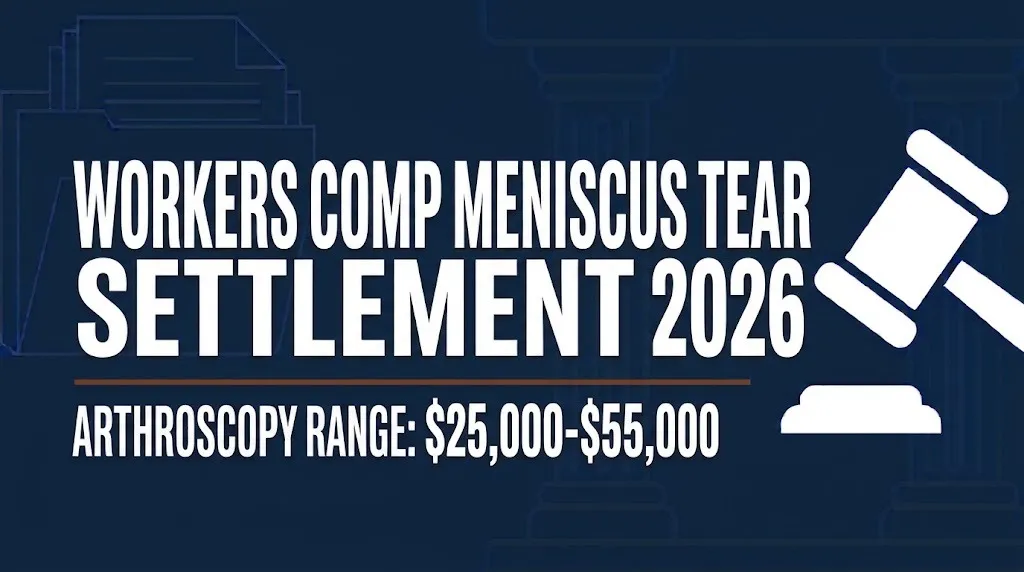
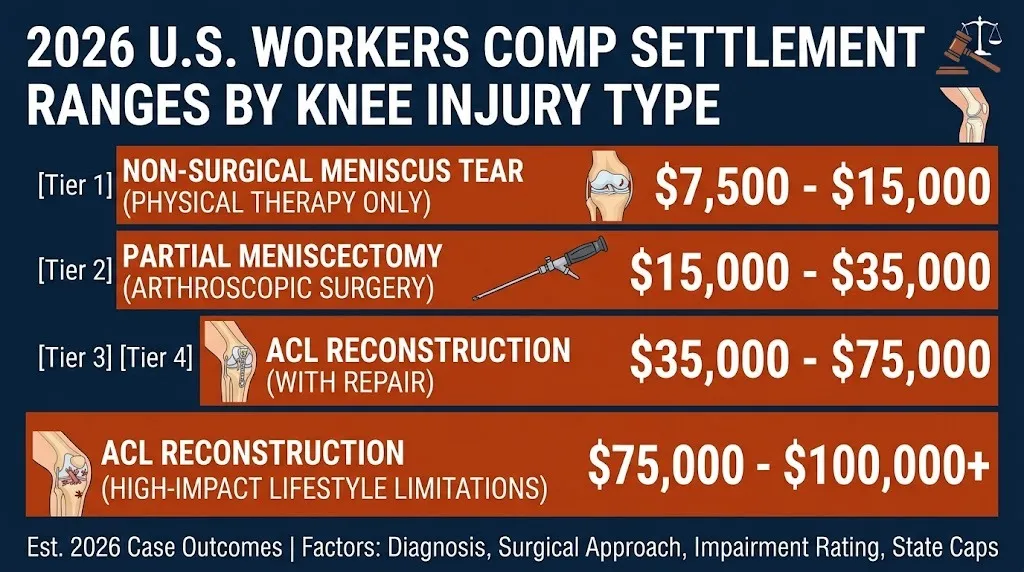
A torn meniscus workers comp settlement is typically $25,000 to $55,000 for arthroscopic repair, with severe cases involving permanent restrictions exceeding $100,000 . Non-surgical tears settle much lower, often $7,500 to $10,000 .
The range reflects real differences in outcomes. A partial meniscectomy that trims the torn tissue heals faster but raises the risk of arthritis later. A meniscus repair that stitches the cartilage back together preserves the joint but requires a longer recovery. The settlement should account for which procedure you had and what it means for your knee in ten years.
| Injury / Procedure | Typical Settlement Range (2026) |
|---|---|
| Meniscus tear, no surgery | $7,500 to $10,000 |
| Arthroscopic trim or repair | $25,000 to $55,000 |
| Severe tear with permanent restrictions | $100,000+ |
| ACL plus meniscus (combined) | $92,000+ in severe cases |
Reality Check: No one calls you offering settlement money first. The carrier will not volunteer a number until you reach MMI and the impairment rating is assigned. If someone asks for a fee to “release” your knee settlement, it is a scam.
How Do You Calculate a Meniscus Tear Settlement?
You calculate a meniscus tear settlement by adding your lost wages, your permanent impairment rating converted to a dollar figure under your state’s schedule, and any future medical costs you are buying out. There is no single national formula.
The permanent impairment rating is the biggest piece. After surgery, once you reach MMI, a doctor assigns a rating, usually a percentage of whole-person impairment or a scheduled loss of use for the leg . That percentage is multiplied by a statutory number of weeks and your weekly benefit rate. A higher rating means more weeks of payment.
The second piece is future medical care. If you settle by Compromise and Release (C&R), you are closing your right to future treatment. That means the settlement should include the estimated cost of future care, like arthritis management, injections, or even a future knee replacement if the arthritis risk is significant . If you leave medical open through a Stipulation, you get less money upfront but keep the right to treatment.
Key Takeaway: The impairment rating and the future medical buyout drive the number. Settling before MMI or closing medical too early are the two ways workers undervalue their knee.
What Is the Deadline to Settle a Meniscus Tear Claim?
There is no single settlement deadline. The timeline is driven by your medical recovery, not a filing window. The claim itself must be reported promptly, and the settlement usually happens after you reach Maximum Medical Improvement (MMI).
MMI is the point when your condition has stabilized and further treatment will not produce significant improvement . For meniscus surgery, that can be months after the scope, once physical therapy plateaus and the surgeon confirms you are as good as you are going to get. Settling before MMI is risky because you do not yet know your permanent restrictions or your final impairment rating.
The reporting deadline for the injury itself is a separate matter. Most states require prompt notice to your employer, often within 30 days. Missing that can jeopardize the whole claim. But the settlement itself has no fixed calendar date. It happens when the medical picture is clear and both sides agree on value.
| Stage | What It Means for Settlement |
|---|---|
| Injury reported | Claim opens. Medical treatment authorized. |
| Surgery and recovery | Temporary disability paid. No settlement yet. |
| MMI reached | Impairment rating assigned. Settlement value becomes calculable. |
| Negotiation or hearing | C&R or Stipulation finalized. |
What Evidence Increases a Meniscus Tear Settlement?
The evidence that increases a meniscus tear settlement is proof of permanent limitations and future medical needs. A clean operative report showing a significant tear, consistent physical therapy, and a functional capacity evaluation documenting restrictions are the core evidence.
The strongest evidence is the impairment rating itself, but the inputs matter. Documented range-of-motion loss, muscle atrophy, and instability all feed into a higher rating. If you returned to work with permanent restrictions against kneeling, squatting, or climbing, that loss of earning capacity should be reflected in the settlement.
Future medical risk is the other lever. Meniscectomy raises the risk of arthritis later. A meniscus repair can fail and require a second surgery. If the settlement closes future medical, those risks should be priced into the buyout. Settling without accounting for them leaves you paying out of pocket later.
| Evidence Type | Why It Matters |
|---|---|
| Operative report | Shows what was actually repaired or removed |
| Physical therapy records | Documents recovery plateau and residual limits |
| Functional Capacity Evaluation | Proves permanent work restrictions |
| Surgeon’s future medical opinion | Supports the buyout value for future care |
What Happens Next After a Meniscus Tear Settlement?
The next steps depend on whether you settle by Compromise and Release or by Stipulation. A C&R closes the claim and your future medical rights. A Stipulation leaves medical open but pays less upfront.
Before settlement: You reach MMI, the doctor assigns an impairment rating, and the carrier makes an offer. The offer is usually based on the rating and the estimated future medical cost.
Negotiation: Your attorney (if you have one) challenges the rating and the future medical estimate. This is where most of the value is won or lost.
Settlement: You sign the agreement. If it is a C&R, the claim closes. If it is a Stipulation, the carrier keeps paying for authorized future treatment.
After settlement: For a C&R, any new knee problem related to the injury is your financial responsibility. That is why the future medical buyout matters so much.
Frequently Asked Questions
How much is a workers comp settlement for a torn meniscus?
Typically $25,000 to $55,000 for arthroscopic surgery cases. Non-surgical tears settle for $7,500 to $10,000. Severe cases with permanent restrictions can exceed $100,000 .
Does surgery increase a meniscus tear settlement?
Yes, but not as much as people expect. The surgery itself often rates low on impairment schedules. The bigger money comes from arthritis, instability, or permanent work restrictions that develop afterward .
Can I settle before I reach Maximum Medical Improvement?
You can, but it is risky. Before MMI, you do not know your permanent restrictions or final impairment rating. Settling early often undervalues the claim.
Should I close future medical care in a settlement?
It depends on your arthritis risk and whether you might need a future knee replacement. Closing medical gets you more money now but shifts future costs to you .
Why is my meniscus settlement so low?
Because the schedule prices the residual impairment, not the surgery or the pain of recovery. A cleanly trimmed meniscus in a stable knee leaves little measurable impairment. The bigger numbers come from what rides on top .
Do I need a lawyer for a meniscus tear settlement?
Not legally required, but the impairment rating and future medical buyout are technical. An attorney can challenge a low rating and document future care costs that the carrier would otherwise ignore.
A meniscus tear settlement is built from your impairment rating and your future medical risk, not from a calculator. The range is $25,000 to $55,000 for arthroscopic cases, with severe cases going higher .
Get the operative report. Complete physical therapy. Do not settle before MMI. The number that matters comes from the rating, and the rating comes from the records you build now.