Workers’ Compensation NJ Rules 2026: Rates, Deadlines and New Laws Explained
Quick Answer
- New Jersey requires nearly all employers to carry workers’ comp insurance and pay 70% of lost wages.
- The 2026 maximum weekly benefit is $1,199; the minimum is $320, both set by the NJ Department of Labor.
- You generally have two years from your injury or last benefit payment to file a formal claim petition.
If you got hurt on the job in New Jersey this year, the state’s maximum workers’ comp benefit is $1,199 a week. That number went up from $1,159 in 2025, and it changes every January based on the statewide average wage. It is the single most important figure in the whole system, because it caps what almost every injured worker in the state can collect.
This affects anyone employed in New Jersey, since coverage is mandatory for nearly every business with workers on payroll. The deadline that trips people up most is the two-year statute of limitations for filing a formal claim petition, a clock that keeps running even if your employer is paying your medical bills right now.
This guide covers the 2026 rates, the filing deadlines, and two brand-new laws Governor Murphy signed in January. One surprising detail: New Jersey just rewrote a decades-old rule that valued employer-provided housing at a flat $25 a week no matter what it was actually worth.
The Rules at a Glance
| Category | Detail |
|---|---|
| Governing Law | New Jersey Workers’ Compensation Act, N.J.S.A. 34:15-1 et seq. |
| Coverage Requirement | Mandatory for nearly all NJ employers, including corporate officers |
| 2026 Max Weekly Benefit | $1,199 (up from $1,159 in 2025) |
| 2026 Min Weekly Benefit | $320 |
| Wage Replacement Formula | 70% of average weekly wage, within the min/max |
| Filing Deadline | 2 years from injury or last payment of compensation |
| 2026 Law Changes | Board and lodging valuation reform (S3772), First Responders PTSD Protection Act (S2373/A2145) |
| Uninsured Employer Penalty | Up to $5,000 per 10-day period of noncompliance |
Not every cell here is fixed forever. The maximum rate resets every January 1, and Trenton has several bills pending that could change parts of this table before the year is out.
Is Workers’ Comp Mandatory for New Jersey Employers?
Yes. Coverage is mandatory for nearly every business operating in New Jersey, including corporations, partnerships, and sole proprietors with employees.
Corporate officers are counted as employees too, which means small, closely held companies do not get an exemption just because the owner is also on the payroll. An employer can satisfy the requirement one of two ways: buying a policy from an insurer licensed in New Jersey, or getting state approval to self-insure.
Self-insurance approval depends on the employer’s financial ability to pay claims, and the state can require a security deposit before granting it. There is no gray area here under the statute.
Key Takeaway: New Jersey treats workers’ comp coverage as close to universal, and skipping it is treated as a criminal matter, not just a paperwork lapse.
What Happens If Your Employer Has No Workers’ Comp Insurance?
Going without coverage is a disorderly persons offense in New Jersey, and a willful violation escalates to a fourth-degree crime.
The financial penalties stack fast. The Division of Workers’ Compensation can impose up to $5,000 for the first 10 days an employer goes without coverage, then another $5,000 for every additional 10-day period after that.
These fines cannot be wiped out in bankruptcy. If the state issues a stop-work order and the employer ignores it, that adds a separate penalty of $1,000 to $5,000 for every day the business keeps operating in violation.
- Uninsured employers can also be held personally liable for an injured worker’s full medical and disability costs.
- The state’s Uninsured Employer’s Fund can step in to pay a worker, then pursue the employer for reimbursement.
- Misclassifying an employee as an independent contractor to dodge premiums can bring a separate fourth-degree felony charge.
How Much Does Workers’ Comp Pay in New Jersey in 2026?
Most injured workers in New Jersey receive 70% of their average weekly wage, up to the state maximum.
For accidents and occupational exposures in 2026, that maximum is $1,199 per week, and the floor is $320 per week, per N.J.S.A. 34:15-12(a) and (b). The New Jersey Department of Labor and Workforce Development confirmed these figures in a December 29, 2025 press release announcing rate changes for the new year.
Your actual weekly check depends entirely on what you earned before the injury. A worker earning $1,000 a week before getting hurt would receive about $700 weekly (70%), well under the cap. A worker earning $2,500 a week would still be capped at $1,199, since that is the legal ceiling regardless of income.
| Weekly Wage Before Injury | 70% Calculation | Actual Weekly Benefit (2026) |
|---|---|---|
| $400/week | $280 | $320 (raised to state minimum) |
| $1,000/week | $700 | $700 |
| $1,714/week or more | $1,200+ | $1,199 (capped at maximum) |
What Is the Maximum and Minimum Workers’ Comp Rate for 2026?
The 2026 maximum weekly workers’ comp rate in New Jersey is $1,199, and the minimum is $320.
These rates apply to temporary total disability, permanent total disability, permanent partial disability, and dependency benefits alike, since all four categories share the same statutory cap. The rate is tied to the state’s average weekly wage from two years earlier; the 2026 figures reflect a $1,598.66 statewide average wage recorded for 2024, itself a 3.4% jump from 2023.
Permanent partial disability benefits carry their own, lower minimum: $35 per week under N.J.S.A. 34:15-12(c), separate from the temporary disability floor. Rates are locked in on the date of the accident or, for occupational illness, the date of manifestation, so a claim tied to a 2025 injury still uses the 2025 numbers even if it settles years later.
Key Takeaway: The rate that governs your claim is frozen on the date you got hurt, not the date your case eventually resolves.
How Is Your Average Weekly Wage Calculated?
Your average weekly wage (AWW) is based on your actual earnings before the injury, and it drives every dollar figure in your claim.
The Division of Workers’ Compensation typically looks at gross wages over a set period before the accident to smooth out overtime spikes or slow weeks. As of January 2026, a new law (S3772) changes one piece of that math for workers who also receive employer-provided housing or meals.
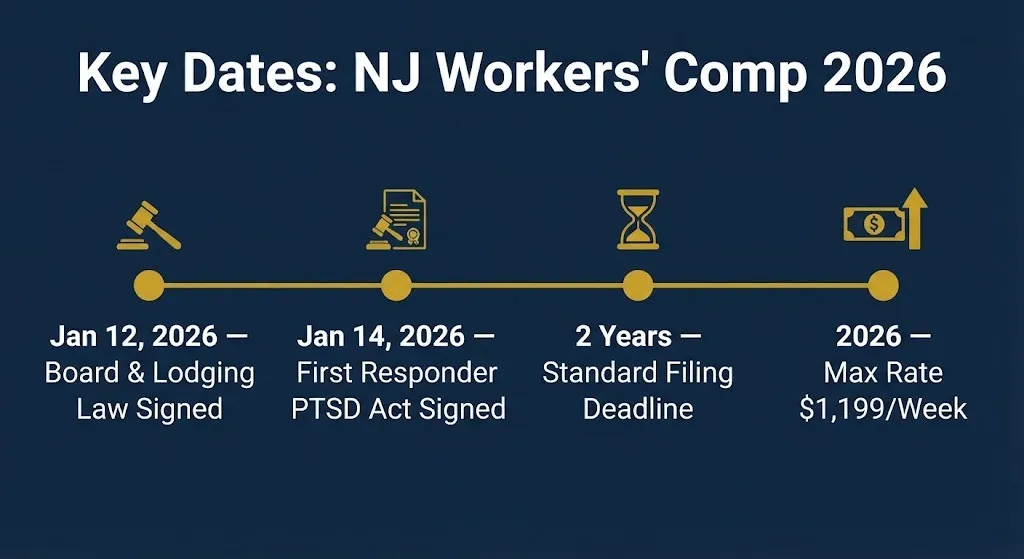
Previously, board and lodging furnished by an employer was valued at a flat $25 a week for AWW purposes, no matter what it actually cost. Governor Murphy signed S3772 on January 12, 2026, replacing that fixed figure with the item’s actual market value, unless a different amount was agreed to at hiring. That change will not apply while a worker is on temporary total disability and still receiving the housing or meals in kind.
What Are Permanent Disability Benefits in New Jersey?
Permanent disability benefits pay a set number of weeks of compensation based on the body part and severity involved, not a straight wage replacement.
New Jersey splits permanent injuries into two tracks. Permanent partial disability (PPD) uses a statutory schedule that assigns a fixed number of weeks to specific losses, such as a finger, an eye, or a percentage of “the whole body,” and pays out at a rate tied to the same 2026 max and min. Permanent total disability (PTD) applies when a worker cannot earn wages at all because of the injury, sometimes combined with a prior condition through the Second Injury Fund.
PTD payments run for a base period of 450 weeks. After that, checks continue only if the worker completed any court-ordered physical or educational rehabilitation and can still show it is impossible to earn wages comparable to their pre-injury pay.
- Reach maximum medical improvement (MMI), meaning further treatment will not meaningfully help.
- Get evaluated by a doctor to rate the permanent impairment.
- Receive a scheduled-loss or whole-body percentage determination.
- Collect weekly payments at the statutory rate for the assigned number of weeks.
- If found permanently and totally disabled, continue receiving payments past week 450 only with proof of ongoing inability to work.
How Do You File a Workers’ Comp Claim in New Jersey?
You file by first reporting the injury to your employer, then either requesting an informal hearing or filing a formal claim petition with the Division of Workers’ Compensation.
Filing itself is free. There is no cost to submit a claim petition, and you do not need an attorney to start the process, though complex permanent-injury cases often benefit from one.
- Notify your supervisor or employer as soon as possible after the injury; this does not have to be in writing.
- See a physician approved or designated by your employer or its insurer.
- Wait for a determination on your temporary disability and medical benefits.
- If you disagree with the outcome, request an informal hearing or file a formal claim petition with the Division.
- Understand that an informal hearing does NOT pause your two-year filing deadline.
- If unresolved, proceed to a formal claim petition, which starts the litigation track.
- Attend a first hearing, typically scheduled within about six months of filing.
- Most claims settle by agreement before trial; a smaller share proceed to a full hearing and judge’s decision.
Can You Choose Your Own Doctor for a Work Injury?
No, in most cases the employer or its insurance carrier picks the treating physician, not the injured worker.
This is one of the most misunderstood rules in the entire system. Under N.J.S.A. 34:15-15, the employer designates the authorized doctor for a work injury, and going outside that network can put payment for your treatment at risk. The only real exceptions are a genuine emergency or a situation where the employer unreasonably refuses to provide any treatment at all.
Even in those exception cases, you are expected to notify your employer as soon as possible about the treatment you received on your own. Think of it like a store return policy: skip the approved channel and you may still get help, but you will have to fight harder to get it paid for.
Reality Check: No legitimate settlement notice, text message, or employer email will ever ask you to pay a fee upfront to “process” your workers’ comp claim. Filing with the Division of Workers’ Compensation costs nothing, and companies charging money to “help file your paperwork” are not required and are not affiliated with the state.
How Long Do You Have to File a Claim in New Jersey?
You generally have two years from the date of injury, or from the date of your last compensation payment, whichever comes later.
Medical treatment authorized and paid for by your employer counts as a “payment of compensation” for purposes of that two-year clock. That means if your employer covered treatment for 18 months and then stopped, you still have two full years from that last payment date, not from the original injury date, to file a formal claim petition.
Occupational illness cases run differently. The two years starts from the date you discovered the condition and understood it was connected to your job, which can be years after you actually left that employer, as with hearing loss, asbestosis, or lead exposure.
Key Takeaway: Requesting an informal hearing feels like “doing something,” but it does not stop the two-year clock; only a formal claim petition preserves your rights.
What’s New in NJ Workers’ Comp Law for 2026?
Two new laws already took effect in January 2026, changing wage calculations for some workers and adding job protections for first responders with PTSD.
Governor Murphy signed S3772 on January 12, 2026, replacing the old $25-a-week fiction for employer-provided housing and meals with real market value. Two days later, on January 14, 2026, he signed S2373/A2145, the New Jersey First Responders Post-Traumatic Stress Disorder Protection Act, which took effect immediately.
| Law | Signed | What It Does |
|---|---|---|
| S3772 | January 12, 2026 | Values employer-furnished board/lodging at market rate, not a flat $25/week |
| S2373/A2145 | January 14, 2026 | Bars retaliation against first responders taking PTSD-related leave |
How Does the First Responders PTSD Protection Act Work?
The law bars employers from firing, harassing, or otherwise retaliating against a paid first responder who requests or takes leave tied to a qualifying PTSD diagnosis.
Coverage reaches law enforcement officers, paid firefighters, paid EMTs and paramedics, paid members of first aid and rescue squad associations, and paid 911 dispatchers. A qualifying diagnosis must either come through an order from a Division of Workers’ Compensation judge, or from a mental health professional who links the condition to a traumatic event or vicarious trauma experienced on the job.
Employers must reinstate the worker to their prior position once a mental health professional clears them to return. A violation can be brought as an action in the Division of Workers’ Compensation, where a judge can order reinstatement, restored benefits and seniority, back pay, and other relief.
What Bills Are Still Pending in the New Jersey Legislature?
Several workers’ comp bills remain stuck in committee as of mid-2026, and none of them are law yet.
Nearly all were introduced on January 13, 2026, at the start of the new legislative session. Committee referral is not the same as passage, and most of these have not moved since spring.
- Medical marijuana coverage requirement for workers’ comp, PIP, and health insurance (A1023/S3984), introduced January 13, 2026, still in committee.
- Personal liability for owners and executives who fail to secure coverage, introduced January 13, 2026, reported to the Assembly Judiciary Committee on May 7, 2026.
- Benefits for certain workers tied to the September 11, 2001 terrorist attacks (S1379), the only bill to clear its first committee, advancing to Senate Budget and Appropriations on February 5, 2026.
- A cost-of-living adjustment for permanently and totally disabled workers, introduced March 10, 2026.
- Cutting the statute of limitations for medical fee disputes from 6 years to 2 years, introduced January 13, 2026.
Key Takeaway: Watch the September 11 responder bill and the medical fee dispute bill; they are the furthest along, but “furthest along” in Trenton still means no guaranteed passage this session.
What Injuries and Illnesses Are Covered?
New Jersey covers injuries and occupational illnesses that arise out of and in the course of employment, whether from a single accident or gradual exposure.
That includes traumatic injuries like falls, cuts, and repetitive strain, plus occupational diseases such as hearing loss, asbestosis, and chemical exposure conditions that develop over years. Coverage is denied for injuries caused by intentional self-harm, intoxication, or fighting that the worker started.
You must be unable to work for seven days, including weekends and holidays, before you become eligible for temporary disability payments. Even after eligibility kicks in, workers typically wait about two weeks before the first check actually arrives, since claims still need to be processed.
What Are Death Benefits for Dependents?
When a work injury or illness causes an employee’s death, New Jersey pays wage-based dependency benefits to surviving family members.
A surviving spouse and dependent children generally qualify. Children remain dependents until age 18, or until 23 if they are enrolled full-time in school, and a disabled dependent child may qualify for extended benefits beyond that.
A surviving spouse who remarries typically loses eligibility for ongoing benefits, unless the deceased worker also left behind dependent children who still need support. The claims process for death benefits runs through the same Division of Workers’ Compensation system as any other claim.
What Is the Second Injury Fund?
The Second Injury Fund covers cases where a new work injury combines with a pre-existing condition to leave a worker permanently and totally disabled.
Without the fund, an employer could face the full cost of a “second” injury that, on its own, might only be a partial disability, simply because the worker already had a prior impairment. The fund shifts part of that financial burden away from the employer in qualifying cases, while still ensuring the worker receives full permanent total disability benefits.
Can Your Employer Fire You for Filing a Claim?
No. New Jersey law specifically prohibits firing or retaliating against an employee for filing a workers’ comp claim or testifying at a related hearing.
N.J.S.A. 34:15-39.1 covers this exact scenario. If you believe you were terminated for filing a claim or testifying, one option is filing a discrimination complaint directly with the Division of Workers’ Compensation, separate from the underlying injury claim.
Separately, employers who fail to report an injury as required under N.J.S.A. 34:15-101 face a penalty between $10 and $50, a smaller, older statutory fine most workers never hear about.
What Happens Next
- January 12 to 14, 2026: Two new laws signed, covering board/lodging valuation and first responder PTSD protections.
- February 5, 2026: September 11 responder benefits bill advances out of its first Senate committee.
- May 7, 2026: Personal liability bill for uninsured employer owners reported to Assembly Judiciary Committee.
- Now through end of 2026: Remaining bills, including medical marijuana coverage and the COLA measure, stay in committee with no confirmed floor vote scheduled.
- January 1, 2027 (expected): New maximum and minimum weekly rates take effect, recalculated from the statewide average wage.
Frequently Asked Questions
Is workers’ comp mandatory for all New Jersey employers?
Yes, coverage is mandatory for nearly every employer with employees, including corporations and their officers.
Employers can satisfy this by buying insurance or getting state approval to self-insure.
How much money will I get from workers’ comp in New Jersey?
Most workers receive 70% of their average weekly wage, subject to a 2026 maximum of $1,199 and a minimum of $320.
Permanent disability payouts use a separate weeks-based schedule instead of a straight wage percentage.
Can I choose my own doctor for a work injury?
No, your employer or its insurance carrier generally selects the treating physician.
You may pick your own doctor only in a true emergency or if your employer unreasonably refuses treatment.
How long do I have to file a workers’ comp claim in NJ?
You generally have two years from the injury date or your last compensation payment, whichever is later.
For occupational illness, the clock starts when you discover the condition and its link to your job.
What if my employer doesn’t have workers’ comp insurance?
Your employer faces fines up to $5,000 per 10-day period of noncompliance, plus possible criminal charges.
You may still recover benefits through the state’s Uninsured Employer’s Fund.
Can my employer fire me for filing a workers’ comp claim?
No, New Jersey law specifically bars retaliation for filing a claim or testifying at a hearing.
You can file a separate discrimination complaint with the Division of Workers’ Compensation if this happens.
Is workers’ compensation taxable in New Jersey?
No, workers’ comp benefits are generally not taxable under federal or New Jersey state law.
This applies to wage-replacement and permanent disability payments alike.
What’s the difference between an informal hearing and a formal claim petition?
An informal hearing is a non-binding attempt to resolve a dispute quickly, while a formal claim petition starts formal litigation.
Only a formal claim petition stops the two-year statute of limitations from expiring.
Check your pay stub against the 2026 rate table if you are currently on workers’ comp, since the wrong AWW calculation can quietly shortchange your weekly check. Mark your injury date and calendar the two-year filing deadline now, before an informal hearing lulls you into thinking the clock has stopped.