Workers Compensation Attorney in Los Angeles 2026: Fees, Settlement Values, and How to Choose
Quick Answer
- Workers’ comp in California is a no-fault system, not a class action settlement with one claim deadline.
- Your payout depends on your medical rating, wages, and case specifics. A 70% permanent disability rating can trigger a life pension worth hundreds weekly.
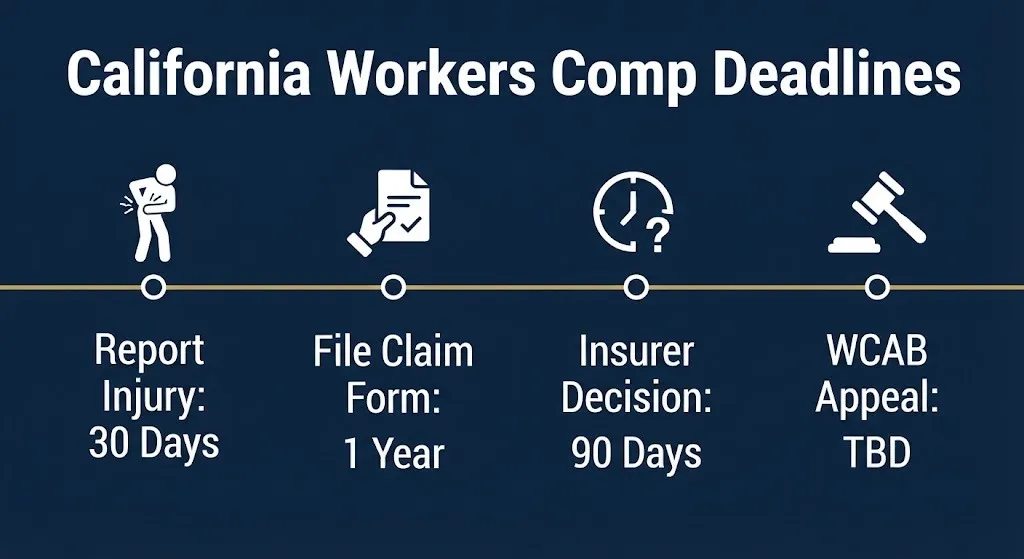
- The biggest deadline is reporting your injury to your employer within 30 days, with a claim form typically due within one year.
If you got hurt on the job in Los Angeles, you don’t file a claim in a single national settlement. You file a workers’ compensation case under California law, and the system works differently from the class action headlines you might see elsewhere.
Every claim is its own case. That means no single fund, no single administrator, and no single deadline that covers everyone.
This article explains how the system actually works in 2026. You’ll see real payout figures, fee rules, deadlines, and the specific things to check before you hire anyone.
The Facts
| Case | Individual workers’ compensation claim (no class action) |
|---|---|
| Status | Ongoing system; new claims filed daily |
| Fund Size | No single fund. Benefits paid by employer’s insurer |
| Est. Per Person | Varies by disability rating. 2026 max TTD: $1,764.11/week |
| Claim Deadline | Report injury within 30 days; file claim form within 1 year |
| Administrator | California Division of Workers’ Compensation (DWC) |
| Proof Needed | Medical records, wage statements, injury report |
Is a workers compensation attorney in Los Angeles legit or a scam?
A workers’ compensation attorney in Los Angeles is legitimate and regulated by the State Bar of California. The scam risk comes from non-attorney “claim helpers” who charge fees for services you can do yourself.
California has 826 workers’ compensation attorneys listed in Los Angeles alone . The system is real, the courts are real, and the appeals board is real.
The scam version looks different. Someone calls you after an injury and offers to “process your claim” for an upfront fee. That is not how it works.
Real attorneys work on contingency. In California workers’ comp, the attorney fee is typically paid from your settlement or award, and a judge must approve it . You pay nothing upfront.
How much can you get from a workers compensation claim in Los Angeles?
There is no fixed payout. Your amount depends on your average weekly wage, your permanent disability rating, and whether you qualify for a life pension.
California uses a formula, not a flat number. The 2026 rates give you a starting point.
For a 2026 injury, temporary total disability (TTD) ranges from $264.61 to $1,764.11 per week . That is the money you get while you cannot work and are recovering.
Permanent disability is different. It pays based on a rating from a doctor.
| Rating | What It Means | 2026 Payout Range |
|---|---|---|
| Under 70% | Scheduled permanent partial disability | $160 to $290 per week for a set number of weeks |
| 70% to 99% | Life pension eligibility | Scheduled PPD plus a weekly pension for life |
| 100% | Permanent total disability | Paid for life at total disability rate |
The weekly life pension amounts for 2026 start at $77.31 per week at a 70% rating and rise to $301.50 per week at 99% . Those payments continue for life after your scheduled weeks run out.
That difference between 99% and 100% is enormous. At 99%, you get scheduled weeks plus a pension. At 100%, you get lifetime total disability payments. A single percentage point can change your financial future.
Key Takeaway: Workers’ comp payouts in Los Angeles are not random. They follow a rating schedule, and a 70% rating is the line where lifetime pension benefits begin.
Are workers compensation lawyers in Los Angeles free to hire?
Most workers’ compensation lawyers in Los Angeles charge no upfront fees. They work on contingency, and the fee comes out of your settlement or award.
You will see “No fee unless we win” on almost every firm’s website. That is true, but it is not the whole story.
In California, the workers’ compensation judge must approve attorney fees . The fee is usually 12% to 15% of your settlement, taken from the total. You do not write a check.
What you might pay for: medical record copying fees, filing fees, or deposition costs in complex cases. Those are case expenses, and they are separate from attorney fees.
Ask any lawyer you interview: “What expenses will I be responsible for?” A straight answer is a good sign.
What are the deadlines to file a workers compensation claim in Los Angeles?
You must report your injury to your employer within 30 days. You generally have one year from the injury or last date of exposure to file a formal claim form.
The 30-day rule is strict. If you miss it, your employer can deny the claim for late reporting. There are exceptions, but they are narrow.
The one-year deadline runs from the date of injury or the date you knew or should have known the injury was work-related. For repetitive stress injuries, the clock starts later, which is why those cases are complicated.
Your deadline checklist:
- Report the injury to your supervisor in writing.
- Get medical treatment and tell the doctor it is a work injury.
- Fill out the DWC-1 claim form your employer must provide.
- Keep copies of everything.
- If denied, file for a hearing at the Workers’ Compensation Appeals Board.
Missing the reporting deadline is like waiting too long to return a defective product. The store says no, and you lose your leverage.
What should you look for when hiring a workers compensation lawyer in Los Angeles?
You want a lawyer whose practice is focused on workers’ compensation, not someone who handles it as a sideline. Experience with the Los Angeles WCAB matters.
Here is what separates a good hire from a bad one.
Questions to ask:
- How much of your practice is workers’ comp?
- Have you handled my specific type of injury?
- Who will actually handle my case day to day?
- What is the biggest challenge in my claim?
- How do you handle QME and medical-legal issues?
A lawyer who cannot answer the QME question is not a workers’ comp specialist. QME stands for Qualified Medical Evaluator, and those medical reports often decide the value of your case .
The best Los Angeles workers’ comp lawyers know the local WCAB judges, the local defense firms, and the adjusters who handle claims for major employers.
Reality Check: No one can guarantee a settlement amount, and no legitimate lawyer will promise a specific dollar figure before seeing your medical records. If someone guarantees you $50,000 on the first phone call, walk away.
What happens after you file a workers compensation claim in Los Angeles?
After you file, the insurance company has 90 days to accept or deny your claim. If they do nothing, the claim is presumed accepted.
The process has stages. You will not get a check immediately.
Typical timeline:
- Day 0: You report the injury and file the DWC-1 form.
- Days 1 to 30: Employer submits claim to insurer. You may start medical treatment.
- Days 30 to 90: Insurer investigates and either accepts or denies.
- Months 3 to 12: You receive temporary disability if unable to work. Medical treatment continues.
- Month 12+: If permanent disability remains, you get a QME or AME evaluation and a rating.
- Settlement or hearing: The case resolves by settlement or WCAB decision.
You might get a lump sum offer. You might get a structured settlement with payments over time. A “Compromise and Release” closes out future medical care in exchange for money now. A “Stipulated Award” keeps future medical open .
Each choice has trade-offs. That is where the lawyer earns their fee.
What if your workers compensation claim is denied in Los Angeles?
A denial is not the end. You have the right to appeal, and roughly half of properly challenged medical denials are overturned.
If the insurer denies your claim, you can file for a hearing at the Workers’ Compensation Appeals Board. You will get a trial-like proceeding before a judge.
Common denial reasons include late reporting, disputes about whether the injury happened at work, or claims that your injury was pre-existing.
Apportionment is a major issue. Under Labor Code section 4663, a doctor can attribute part of your disability to non-work factors . If 25% of your back problem is from aging, the insurer pays only 75%.
Your attorney challenges apportionment opinions that are conclusory or not supported by evidence.
How do workers compensation settlements work in Los Angeles?
A settlement can be a lump sum, a structured payout, or a mix. The two main types are Compromise and Release and Stipulated Award.
Compromise and Release (C&R): You take a lump sum and close out the case, including future medical care. The insurer loves this because it ends their exposure.
Stipulated Award: You keep future medical benefits open. You get permanent disability payments, and the insurer pays for reasonable future care.
The right choice depends on your medical needs. If you need future surgery, keeping medical open may be worth more than a slightly larger lump sum.
Future medical care is often the biggest hidden value in a C&R settlement . A case with credible future surgery needs is worth far more than one with the same rating and no future care.
Key Takeaway: A workers’ comp settlement in Los Angeles is not just a number. It is a package of benefits, and closing future medical care is a decision you should not make alone.
What are the 2026 workers compensation rates in California?
The 2026 rates are set by the Division of Workers’ Compensation. The maximum temporary disability rate is $1,764.11 per week, and the minimum is $264.61 per week.
For permanent disability, the weekly rate for a rating under 70% is between $160 and $290 per week . For ratings of 70% or higher, the rate is $240 to $435 per week plus a life pension .
The number of weeks you get paid depends on your rating. The weeks per point increase as the rating goes up, so a 30% disability is worth more than three times a 10% disability.
What this means for you: The weekly rate matters, but the number of weeks and whether you qualify for a life pension matter more.
What happens next in your Los Angeles workers compensation case?
The next steps depend on where you are in the process. Here is what to expect.
If you have not filed: Report your injury today. The 30-day clock is running.
If you filed and were denied: You have the right to appeal. The WCAB hearing is the next step.
If you have a rating: You and the insurer will negotiate. A settlement offer may come.
If you settle: Review the terms carefully. Understand what you are giving up, especially future medical care.
Expected timeline:
- Immediate: Report injury, file claim form
- Within 90 days: Insurer accepts or denies
- Within 12 months: Medical evaluation and rating if disability remains
- 12 to 24 months: Settlement negotiations or WCAB hearing
- After settlement: Payment issued according to terms
Every case is different. Some resolve in months. Others take years.
Frequently Asked Questions
Do I need a lawyer for a workers compensation claim in Los Angeles?
Not always, but claims with denied benefits, disputed injuries, or permanent disability often benefit from representation. Studies show unrepresented workers receive lower settlements.
How much does a workers compensation lawyer cost in Los Angeles?
Most work on contingency with no upfront fee. The attorney fee is typically 12% to 15% of your settlement and must be approved by a judge .
What is the deadline to file a workers compensation claim in California?
Report your injury within 30 days. File the formal claim form within one year of the injury or last exposure.
Can I get fired for filing a workers compensation claim in California?
No. Retaliation for filing a workers’ comp claim is illegal. If you are fired after reporting an injury, you may have a separate wrongful termination claim.
How long does a workers compensation case take in Los Angeles?
Simple claims can resolve in a few months. Disputed cases with permanent disability often take 12 to 24 months or longer.
What is a life pension in California workers compensation?
A life pension is a weekly payment for life when your permanent disability rating is 70% or higher. The 2026 base amounts range from $77.31 to $301.50 per week .
Can I sue my employer for a work injury in California?
Generally, no. Workers’ compensation is the exclusive remedy against your employer. You can sue third parties, like equipment manufacturers or property owners.
What is apportionment in a California workers comp case?
Apportionment reduces your permanent disability award by the percentage a doctor attributes to non-work factors. An attorney can challenge apportionment opinions that lack solid medical support.