Workers Compensation for Small Business 2026: Requirements, Costs, and Claim Process
Quick Answer
- Workers compensation for small business is mandatory in most states once you hire even one employee.
- Costs vary by state, industry, and payroll, often ranging from a few hundred to several thousand dollars annually.
- The critical deadline is securing coverage before your first employee starts work, not after an injury.
Workers compensation for small business is not optional in most states. It is a legal requirement that kicks in the moment you hire your first employee, and in some states even a single part-time worker triggers the obligation. The system pays medical bills and partial lost wages if a worker gets hurt on the job. If you are searching this term, you are probably a small business owner trying to figure out whether you need coverage, what it costs, and what happens if you do not have it.
The people most affected are owners with fewer than 10 employees, contractors, and home-based businesses. The number that matters most is your state’s threshold for mandatory coverage. In most states, that threshold is one employee. In a handful, it is higher. Getting this wrong is not a paperwork error. It is a legal exposure that can bankrupt a small company.
This article explains who must carry workers compensation, what it costs, how claims work, what happens if you skip it, and how to choose the right insurance. One surprising verified fact: many owners do not realize that workers compensation premiums are based on payroll and job classification, not on company revenue or profit.
| The Facts | |
|---|---|
| Case | No single case; applies to state workers compensation laws |
| Status | State-mandated coverage in most jurisdictions |
| Fund Size | No fund; premiums paid to private insurers or state funds |
| Est. Per Person | Varies by state, payroll, and industry class code |
| Claim Deadline | State-specific, usually within days of injury |
| Administrator | State workers compensation board or commission |
| Proof Needed | Injury report, medical records, wage documentation |
Is Workers Compensation Required for Small Business?
Yes, workers compensation is required for most small businesses in the United States. The rule is set by each state, not by the federal government. In the majority of states, the requirement starts when you hire your first employee, even if that employee is part time. Texas is the notable exception, where workers compensation is optional for most private employers, though clients and contracts often require it anyway.
The obligation is not based on how much money your business makes. It is based on having employees. A one-person landscaping company with no employees usually does not need coverage. The same company with a single helper does. That threshold surprises many owners who assume small means exempt.
Some states exempt certain categories of workers, such as sole proprietors, partners, and sometimes family members. But those exemptions are narrow and state-specific. You cannot assume your spouse or child working in the business is automatically excluded. Checking your state’s workers compensation board rules is the only way to know.
Key Takeaway: Most states require workers compensation as soon as you have one employee, and exemptions are narrow and vary by state.
How Much Does Workers Compensation Cost for a Small Business?
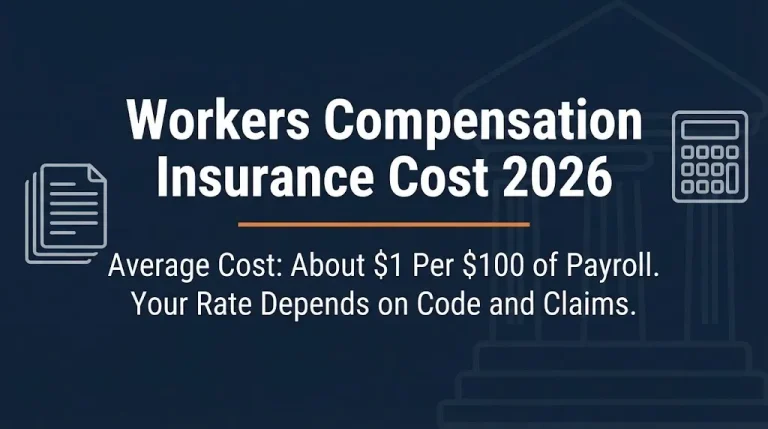
Workers compensation costs for a small business depend on three things: your state, your payroll, and your industry classification. The premium is calculated per $100 of payroll, and the rate is set by the risk of the job. A clerical worker costs less to insure than a roofer. A business with $50,000 in payroll and a low-risk classification might pay a few hundred dollars a year. A roofing company with the same payroll might pay several thousand.
The classification system is called the class code system. Each industry has a code, and each code has a rate. The rate reflects the likelihood and severity of injuries in that line of work. Premium auditors can adjust your premium after the policy year if your actual payroll was different from your estimate.
| Business Type | Typical Risk Level | Relative Premium |
|---|---|---|
| Office or clerical | Low | Lowest |
| Retail or restaurant | Medium | Moderate |
| Construction or roofing | High | Highest |
| Manufacturing | Medium to high | High |
The exact dollar amount is set by the insurer or state fund, not by the government. Comparing quotes from multiple carriers is the best way to find the actual cost for your specific situation.
Key Takeaway: Premiums are based on payroll and job risk class, and the same payroll can cost very different amounts across industries.
What Is Workers Compensation Insurance for Small Business?
Workers compensation insurance for small business is a policy that pays for medical treatment, rehabilitation, and a portion of lost wages when an employee is injured or becomes ill because of work. It also provides death benefits to dependents if a worker dies from a job-related injury. The employer pays the premium. The employee pays nothing.
The system is a no-fault system. The injured worker does not need to prove the employer was negligent. The tradeoff is that workers compensation is usually the exclusive remedy, meaning the employee cannot sue the employer for the same injury. That protection from lawsuits is one reason the coverage is mandatory.
The policy covers injuries that happen suddenly, like a fall, and conditions that develop over time, like carpal tunnel syndrome. It does not cover injuries from intoxication, self-harm, or conduct outside the scope of employment. Each state has its own rules for what qualifies.
Key Takeaway: Workers compensation is a no-fault system that covers work injuries and protects employers from most injury lawsuits.
What Happens If a Small Business Has No Workers Compensation?
If a small business has no workers compensation and an employee gets hurt, the financial and legal consequences can be severe. The injured worker can sue the employer directly in most states, and the employer cannot use the usual workers compensation defenses. The business may also face fines from the state workers compensation board. Those fines can be per day of noncompliance.
The direct lawsuit is the biggest risk. Without workers compensation, the exclusive remedy protection disappears. The employee can sue for medical bills, lost wages, pain and suffering, and sometimes punitive damages. A single serious injury can produce a judgment that forces the business to close.
Some states also impose criminal penalties for willful failure to carry coverage. Even if no one gets hurt, an audit or a disgruntled employee report can trigger an investigation. The state can shut down the business until coverage is obtained. The risk is not theoretical. It is a compliance issue with real teeth.
Reality Check: No one plans to have an employee get hurt, but that is exactly when the absence of workers compensation turns a bad week into a business-ending event. Coverage is cheaper than one uninsured injury.
How Do I Get Workers Compensation for My Small Business?
Getting workers compensation for your small business starts with determining whether your state uses a private insurance market, a state fund, or a combination of both. In most states, you can buy a policy from a private insurer or through an agent. In monopolistic states like Ohio, North Dakota, Washington, and Wyoming, you must buy from the state fund.
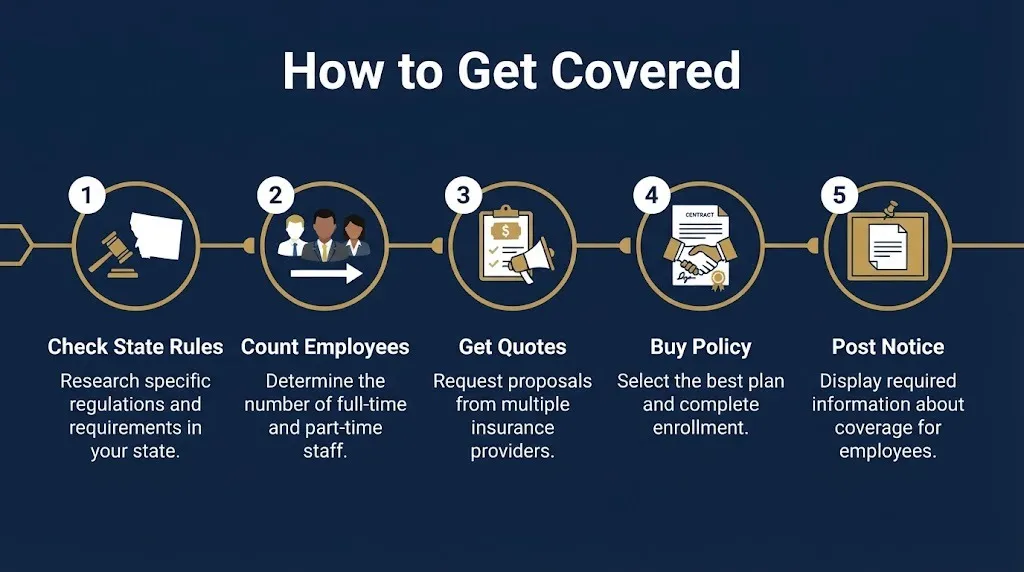
The process is straightforward if you have your basic business information ready. Here is the sequence:
- Confirm your state’s coverage threshold by checking the state workers compensation board.
- Determine your employee count and payroll for the coming year.
- Identify your industry class codes based on the work your employees perform.
- Request quotes from private insurers or your state fund.
- Compare coverage terms and premium rates, not just price.
- Purchase the policy before your first employee starts work.
- Post the required notice in your workplace and keep the certificate of insurance.
The policy is renewed annually and adjusted based on actual payroll. Failing to update payroll can lead to an audit and an additional premium bill.
Key Takeaway: Getting coverage means knowing your state’s system, your payroll, and your class codes, then buying before the first employee starts.
What Are the Best Workers Compensation Insurance Companies for Small Business?
The best workers compensation insurance company for a small business depends on your state, your industry, and your need for service versus price. Large national carriers like The Hartford, Travelers, and biBERK write workers compensation policies in many states. State funds are often competitive, especially for small businesses that private carriers may not want to insure.
There is no single best carrier for every business. A restaurant in California has different options than a contractor in Florida. The right carrier is one that is licensed in your state, understands your industry class codes, and offers a premium that fits your payroll.
| Carrier Type | Strengths | Weaknesses |
|---|---|---|
| Large national carriers | Broad coverage, strong service | May be pricey for small payrolls |
| State funds | Often competitive, stable | Limited to certain states |
| Regional carriers | Local knowledge, flexible | Smaller footprint |
| Pay-as-you-go providers | Predictable cash flow | May cost more over time |
The best move is to get quotes from at least three sources and compare the coverage terms, not just the annual premium. An agent who specializes in your industry can help with class codes and risk management.
Key Takeaway: The best carrier varies by state and industry, and the right choice balances price, service, and industry expertise.
How Do Workers Compensation Claims Work for Small Businesses?
Workers compensation claims start when an employee reports a work-related injury. The employer must provide the claim form, report the injury to the insurer and the state board within the state’s deadline, and direct the employee to authorized medical care. The insurer then investigates and either approves or denies the claim.
The employee’s medical treatment for the accepted injury is covered. If the injury causes missed work beyond a waiting period, the employee receives a portion of lost wages, usually about two-thirds of the average weekly wage, up to a state maximum. The exact percentage and cap vary by state.
The employer’s role is procedural but important. Late reporting can delay benefits and trigger fines. Misclassifying an employee as an independent contractor does not remove the obligation. If the injury happened in the scope of employment, the claim moves forward regardless of the employer’s opinion.
Key Takeaway: Claims follow a state-regulated process: report promptly, provide the form, and direct the employee to authorized care.
What Is a Workers Compensation Audit?
A workers compensation audit is a review at the end of the policy period to compare estimated payroll with actual payroll. The insurer checks payroll records, employee classifications, and sometimes subcontractor payments. If actual payroll was higher than estimated, the employer owes additional premium. If lower, the employer may receive a credit.
The audit is not optional. The policy requires the employer to cooperate. Failure to respond to an audit can result in an estimated premium increase and possible policy cancellation. The audit is also where classification mistakes surface. An employee doing roofing work cannot be classified as a clerk to save premium.
Small businesses often fear audits, but the process is routine. Keeping accurate payroll records and separating employee wages from subcontractor payments makes the audit simple. Subcontractors without their own workers compensation coverage may be counted as employees, which can increase the premium.
Key Takeaway: The audit reconciles estimated and actual payroll, and clean records prevent surprise premium bills.
Can a Small Business Owner Be Exempt From Workers Compensation?
A small business owner can sometimes be exempt from workers compensation coverage for themselves, but the rules vary by state. Sole proprietors and partners are often excluded from mandatory coverage. Corporate officers may be included or excluded depending on the state and the percentage of ownership. But exempting yourself does not remove the obligation to cover your employees.
The exemption applies to the owner, not the business. If you have employees, they must be covered even if you are not. Some states allow owners to opt into coverage if they want protection for their own injuries. That is a personal decision based on your health insurance and risk tolerance.
Confusion arises when owners assume that exempting themselves means the business is exempt. That is wrong. The business is required to cover employees. The owner’s status is separate from the employer’s obligation.
Key Takeaway: Owner exemptions are personal and do not change the requirement to cover employees.
What Happens Next
- Before hiring: Confirm your state’s coverage threshold and get quotes.
- When you hire: Purchase the policy before the first day of work.
- During the year: Track payroll accurately for the audit.
- If an injury occurs: Report promptly and file the claim with the insurer.
- At renewal: Update payroll and review class codes for accuracy.
Frequently Asked Questions
Is workers compensation required for one employee?
Yes, in most states, workers compensation is required as soon as you have one employee.
Texas is the main exception, where coverage is optional for most private employers.
How much does workers compensation cost?
Costs vary by state, payroll, and industry class code.
A low-risk business might pay a few hundred dollars a year.
What happens if I do not have workers compensation?
You may face fines, and an injured employee can sue you directly.
The business could be shut down until coverage is obtained.
Can I buy workers compensation online?
Yes, many insurers and state funds allow online quotes and purchases.
Pay-as-you-go options are common for small businesses.
Does workers compensation cover part-time employees?
Yes, part-time employees are covered in most states.
The coverage requirement is not limited to full-time workers.
What is the deadline to report a work injury?
Reporting deadlines vary by state but are often within a few days.
Late reporting can delay benefits and trigger penalties.
Can I be exempt as a sole proprietor?
Yes, sole proprietors are often exempt from covering themselves.
But the exemption does not apply to any employees you hire.
How do I choose a workers compensation company?
Compare quotes from national carriers, state funds, and pay-as-you-go providers.
Look for industry expertise and good claims service, not just the lowest price.
Workers compensation for small business is a legal requirement in most states, and the time to get it is before the first employee clocks in. The cost is manageable for most businesses. The cost of not having it is not.