Massachusetts Workers Compensation 2026: Benefits, Rates, and Claim Deadlines
Quick Answer
- Massachusetts workers compensation is real and mandatory for nearly all employers in the state.
- Weekly benefits equal 60 percent of your average weekly wage, subject to state minimum and maximum caps.
- You must report your injury to your employer as soon as possible. Waiting can hurt your claim.
You got hurt at work in Massachusetts. Or you’re an employer trying to understand what coverage costs and what happens when someone files a claim. Either way, the Massachusetts workers compensation system has specific rules. The numbers are set by statute. The deadlines matter. And the process is not as simple as the state’s brochures suggest.
This article gives you the verified 2026 rates, the claim steps, and the traps that delay or deny benefits. One fact matters most: Massachusetts pays injured workers 60 percent of their average weekly wage. That is lower than most people expect. And the maximum weekly benefit is capped by state law.
What Is Massachusetts Workers Compensation?
Massachusetts workers compensation is a state-mandated insurance system that pays medical bills and lost wages when an employee is injured on the job. It is a no-fault system. You do not have to prove your employer was negligent. You only have to prove the injury happened at work.
The Massachusetts Department of Industrial Accidents, usually called the DIA, oversees the system. The DIA sets rates, approves insurers, and runs the dispute resolution process for contested claims.

Nearly every employer in Massachusetts must carry workers compensation insurance. The law applies to full-time, part-time, and seasonal workers. Independent contractors are generally excluded, but misclassification is a constant issue.
Workers compensation covers medical treatment, temporary disability benefits, permanent disability benefits, vocational rehabilitation, and death benefits. It does not cover pain and suffering. That is the tradeoff. You get benefits without proving fault, but you give up the right to sue your employer for most work injuries.
Key Takeaway: Massachusetts workers comp is no-fault and mandatory. You get benefits for work injuries, but not for pain and suffering.
How Much Does Massachusetts Workers Compensation Pay Per Week?
Massachusetts pays injured workers 60 percent of their average weekly wage. That is the base formula set by Massachusetts General Laws chapter 152.
The average weekly wage is calculated from your earnings over the 52 weeks before your injury. If you worked less than 52 weeks, the DIA uses the weeks you did work. Overtime and bonuses are included in most cases.
Here is how the weekly benefit works with different wage levels:
| Average Weekly Wage | 60% Benefit | 2026 State Cap Applied |
|---|---|---|
| $600 | $360 | $360 |
| $1,000 | $600 | $600 |
| $1,500 | $900 | $900 |
| $2,500 | $1,500 | Capped at state maximum |
The 2026 maximum weekly benefit in Massachusetts is adjusted annually. The exact cap is published by the DIA each October. As of February 2026, the maximum is approximately $1,700 per week, but check the DIA website for the current exact figure.
The minimum weekly benefit is also set by law. If your average weekly wage is low, you may receive a minimum benefit that is higher than 60 percent of your wage.
Key Takeaway: The 60 percent formula sounds simple. The cap and the minimum change the real number for many workers.
What Are the Massachusetts Workers Compensation Benefit Types?
Massachusetts workers compensation pays several types of benefits. Each has its own rules, duration, and calculation method.
Temporary total disability. You cannot work at all while recovering. You receive 60 percent of your average weekly wage, capped by law.
Temporary partial disability. You can work but earn less because of your injury. You receive 60 percent of the difference between your pre-injury and post-injury wages, with a higher maximum.
Permanent total disability. You can never return to any job. You receive 60 percent of your average weekly wage, plus annual cost-of-living adjustments.
Permanent partial disability. You can work but have a lasting impairment. Benefits depend on the body part and the impairment rating.
Medical benefits. Your employer’s insurer pays all reasonable and necessary medical treatment related to the work injury. There is no copay or deductible.
Vocational rehabilitation. If you cannot return to your old job, the insurer may pay for job training or placement services.
Here is a quick comparison table:
| Benefit Type | Duration | Weekly Amount |
|---|---|---|
| Temporary total | Up to 156 weeks | 60% of average weekly wage |
| Temporary partial | Up to 260 weeks | 60% of wage difference |
| Permanent total | Lifetime | 66.67% of average weekly wage with COLA |
| Permanent partial | Varies by impairment | Based on state schedule |
Key Takeaway: The benefit type matters. Temporary total, temporary partial, and permanent benefits use different formulas and different durations.
How Do I File a Massachusetts Workers Compensation Claim?
Filing a Massachusetts workers compensation claim involves specific steps and strict deadlines. Missing a step can delay or deny your benefits.
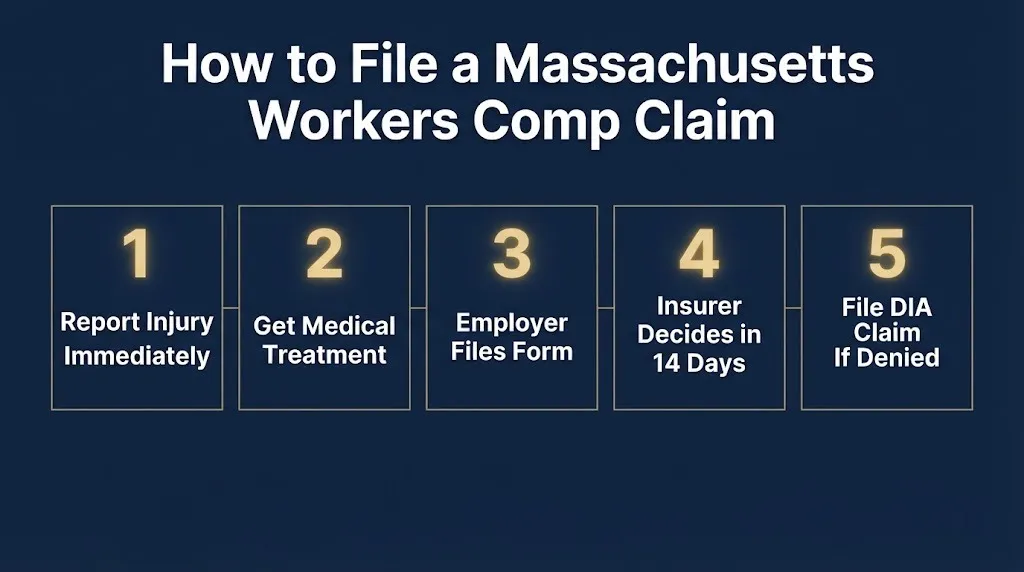
Here are the steps in order:
- Report your injury to your employer immediately, verbally and in writing.
- Seek medical treatment and tell the doctor the injury happened at work.
- Your employer must file a First Report of Injury with the DIA and the insurer within 7 days.
- The insurer has 14 days to accept or deny your claim.
- If accepted, you begin receiving weekly benefits.
- If denied, you file a claim with the DIA to challenge the denial.
- Attend any scheduled hearings or medical examinations.
The most important step is the first one. Report the injury immediately. If you wait, the insurer will ask why. The gap between the injury and the report is the most common reason claims get investigated or denied.
What Is the Deadline to Report a Work Injury in Massachusetts?
Massachusetts law requires you to report a work injury to your employer as soon as possible. There is no grace period written in the statute, but practical guidance says do it within days, not weeks.
The formal claim deadline is different. You have four years from the date you learned your injury was work-related to file a claim with the DIA. That is the statute of limitations in Massachusetts workers compensation.
Do not confuse the two deadlines. The reporting deadline is immediate. The filing deadline is four years. Waiting to report may not bar your claim, but it gives the insurer a reason to question whether the injury actually happened at work.
A delayed report is like a delayed tax refund claim. You may still get it, but the longer you wait, the harder it is to prove.
Reality Check: No one from the DIA or your employer’s insurer will text you asking for money to process your workers comp claim. Filing is free. The system does not charge injured workers a fee to apply for benefits.
What Is the Massachusetts Workers Compensation Maximum Weekly Benefit in 2026?
The maximum weekly benefit for temporary total disability in Massachusetts changes every October. The DIA calculates it based on the state average weekly wage.
For injuries occurring in 2026, the maximum is approximately $1,700 per week. The exact figure is published by the DIA and applies to injuries on or after the effective date.
The minimum weekly benefit is also set by law. It is typically 20 percent of the state average weekly wage. If your average weekly wage produces a 60 percent benefit below that minimum, you receive the minimum instead.
Here is how the caps work in practice:
| Your Average Weekly Wage | 60% Calculation | Benefit Paid |
|---|---|---|
| $500 | $300 | $300 |
| $1,000 | $600 | $600 |
| $3,000 | $1,800 | Capped at approximately $1,700 |
| $5,000 | $3,000 | Capped at approximately $1,700 |
The cap matters most for higher-wage workers. If you earn $150,000 per year, your workers comp benefit is not 60 percent of your full wage. It is 60 percent up to the state maximum.
How Long Do Massachusetts Workers Compensation Benefits Last?
The duration of Massachusetts workers compensation benefits depends on the benefit type and your medical condition.
Temporary total disability lasts until you can return to work or until you reach the 156-week maximum. Most temporary total claims last a few weeks to several months.
Temporary partial disability lasts up to 260 weeks. You receive benefits while you work at reduced capacity.
Permanent total disability lasts for life. You must prove you cannot perform any meaningful work.
Permanent partial disability lasts for a set number of weeks based on the body part and impairment rating. The schedule is in Massachusetts law.
Here is a sample of the permanent partial disability schedule for common injuries:
| Body Part | Maximum Weeks |
|---|---|
| Arm | 216 weeks |
| Leg | 216 weeks |
| Hand | 162 weeks |
| Foot | 144 weeks |
| Eye | 144 weeks |
The weeks listed are maximums. Your actual award depends on your impairment rating.
How Much Does Massachusetts Workers Compensation Insurance Cost Employers?
Massachusetts workers compensation insurance costs employers between $0.75 and $2.00 per $100 of payroll on average. The exact rate depends on your industry class code and claims history.
The Workers Compensation Rating and Inspection Bureau of Massachusetts, known as the WCRIBMA, sets the class codes and rates. Insurers then apply their own pricing factors.
Here are approximate 2026 rates per $100 of payroll for common Massachusetts class codes:
| Class Code | Industry | Approx. Rate per $100 Payroll |
|---|---|---|
| 8810 | Clerical office | $0.25 to $0.50 |
| 8742 | Outside sales | $0.50 to $0.80 |
| 9082 | Restaurant | $1.50 to $2.50 |
| 5645 | Carpentry | $8.00 to $12.00 |
| 5551 | Roofing | $14.00 to $20.00 |
Roofing is among the most expensive class codes in Massachusetts. Clerical work is among the cheapest. Your actual premium comes from the formula: payroll divided by 100, times class rate, times your experience modification factor.
Key Takeaway: Massachusetts workers comp rates vary dramatically by industry. A roofing company pays 30 to 50 times more per payroll dollar than an office.
What Is the Massachusetts Workers Compensation Assigned Risk Pool?
The Massachusetts assigned risk pool, called the Workers Compensation Assigned Risk Pool, is the market of last resort for employers who cannot buy coverage from a private insurer.
Employers end up in the pool because their claims history is too poor, their industry is too risky, or they are new and unproven. The pool charges higher rates than the voluntary market.
The pool is administered by the WCRIBMA. Every insurer licensed to write workers comp in Massachusetts must participate. If an employer is rejected by three insurers, they can apply to the pool.
Being in the pool is not a penalty. It is a safety net. But it costs more. Employers should work with an agent to improve their safety record and re-enter the voluntary market as soon as possible.
What Happens If a Massachusetts Employer Does Not Have Workers Compensation Insurance?
Operating without workers compensation insurance in Massachusetts is illegal. The penalties are serious.
The DIA can issue a stop-work order. That order shuts down your business until you obtain coverage. The fine is $100 per day for each day you were uninsured, starting from the date the coverage was required.
The employer is personally liable for all medical bills and lost wages of any injured worker. There is no insurance to cover the claim. A single serious injury can bankrupt a small business.
Criminal penalties are possible for willful violations. Business owners can face misdemeanor charges and, in extreme cases, imprisonment.
Can a Massachusetts Worker Sue Their Employer Instead of Filing Workers Comp?
Most Massachusetts workers cannot sue their employer for a work injury. Workers compensation is the exclusive remedy. That means the workers comp system replaces the right to sue.
There are narrow exceptions. You may sue if your employer intentionally injured you. You may sue if your employer did not carry workers compensation insurance. You may sue a third party, like a manufacturer of defective equipment or a negligent driver from another company.
Third-party lawsuits are common in Massachusetts. If you are injured in a work-related car accident caused by another driver, you can file a workers comp claim for your medical bills and lost wages. You can also file a personal injury lawsuit against the other driver for pain and suffering.
Key Takeaway: Workers comp is usually your only remedy against your employer. But third-party claims can provide additional recovery.
What Is a Massachusetts Workers Compensation Lump Sum Settlement?
A lump sum settlement closes your workers compensation claim in exchange for a one-time payment. It is final. You cannot reopen the claim later.
Most Massachusetts workers comp cases settle after the injured worker reaches maximum medical improvement. That is the point where your condition is stable and further improvement is unlikely.
The settlement amount depends on several factors:
- Your average weekly wage
- The severity of your permanent impairment
- Future medical costs
- Whether the insurer disputes liability
- Your age and work capacity
Lump sum settlements must be approved by an administrative judge at the DIA. The judge reviews the settlement to ensure it is not clearly inadequate.
A typical settlement for a moderate permanent injury might range from $20,000 to $100,000. Severe injuries with lifetime medical needs can settle for far more. No public database reports average settlement amounts, so these ranges are estimates from practitioner reports, not official state data.
How Does a Massachusetts Workers Comp Hearing Work?
If your claim is denied or disputed, you can request a hearing before an administrative judge at the DIA. The hearing is less formal than a court trial but still follows legal rules.
The hearing is called a conference. Both sides present evidence and arguments. The judge issues a written decision, usually within a few weeks.
If either side disagrees with the conference order, they can appeal to a full evidentiary hearing. That is a more formal proceeding with witness testimony and medical evidence.
The entire process, from conference to final decision, can take 6 to 18 months depending on the complexity and the DIA’s caseload.
What Are the Most Common Reasons Massachusetts Workers Comp Claims Are Denied?
Massachusetts workers comp claims are denied for predictable reasons. Knowing them helps you avoid them.
Late reporting. The insurer argues the injury was not reported promptly, so it may not have happened at work.
No witness. No one saw the injury happen. The insurer questions whether it occurred on the job.
Pre-existing condition. The insurer argues your pain comes from an old injury, not a new work event.
Inconsistent statements. What you told the doctor differs from what you told your employer.
Drug or alcohol involvement. A positive drug test after the injury can bar benefits.
Failure to attend medical appointments. Missing scheduled exams suggests you are not injured.
Avoid these problems by reporting immediately, telling a consistent story, attending every appointment, and documenting everything.
Key Takeaway: Most denials come from delays, inconsistencies, or missed appointments. Control what you can control.
What Should a Massachusetts Worker Do If Their Claim Is Denied?
A denial is not the end of your case. You have the right to challenge it.
Here are the steps after a denial:
- Read the denial letter carefully. It states the reason.
- Gather evidence that responds to that reason.
- File a claim with the DIA using the Employee Claim form.
- Request a conference before an administrative judge.
- Present your medical records, witness statements, and wage documentation.
- Await the judge’s written order.
- Appeal to an evidentiary hearing if you disagree.
Many denied claims are approved at the conference stage. The insurer may deny hoping you will give up. Do not give up.
What Is the Role of the DIA in Massachusetts Workers Compensation?
The Massachusetts Department of Industrial Accidents is the state agency that runs the workers compensation system. It has several functions.
The DIA approves insurance policies, monitors compliance, and issues stop-work orders for uninsured employers. It also provides the dispute resolution process through administrative judges.
The DIA does not represent workers or employers. It is a neutral agency. Its job is to apply the law and resolve disputes.
Workers can contact the DIA directly for information about their claim. The DIA website provides claim forms, benefit rate charts, and hearing schedules.
What Happens Next in a Massachusetts Workers Comp Claim?
Here is the typical timeline from injury to resolution. Dates are estimates unless tied to a specific legal deadline.
Day 1: Injury occurs. Report it to your employer immediately.
Within 7 days: Employer files the First Report of Injury with the DIA and insurer.
Within 14 days: Insurer accepts or denies the claim.
If accepted: Weekly benefits begin immediately.
If denied: You file a claim with the DIA and request a conference.
30 to 90 days later: Conference held before an administrative judge.
6 to 18 months later: Full evidentiary hearing if either side appeals.
Settlement: Most cases resolve after maximum medical improvement through a lump sum approved by the DIA.
Frequently Asked Questions
How much does Massachusetts workers compensation pay?
Massachusetts pays 60 percent of your average weekly wage for temporary total disability.
The 2026 maximum is approximately $1,700 per week, set by the DIA.
How long do Massachusetts workers comp benefits last?
Temporary total benefits last up to 156 weeks.
Permanent partial benefits last based on a statutory schedule of weeks.
Is workers compensation required in Massachusetts?
Yes, nearly every employer must carry workers compensation insurance.
Failure to comply brings fines and personal liability for injuries.
Can I sue my employer instead of taking workers comp?
Usually no. Workers comp is the exclusive remedy for work injuries.
You may sue third parties whose negligence caused your injury.
What is the deadline to file a Massachusetts workers comp claim?
You have four years from the date you knew your injury was work-related to file with the DIA.
But you must report the injury to your employer immediately.
How do I settle my Massachusetts workers comp case?
Most cases settle after maximum medical improvement through a lump sum agreement.
The settlement must be approved by an administrative judge at the DIA.
What is the Massachusetts workers comp assigned risk pool?
It is the insurance market for employers who cannot buy coverage voluntarily.
The pool charges higher rates but guarantees coverage.
How much does Massachusetts workers comp insurance cost?
Most employers pay $0.75 to $2.00 per $100 of payroll on average.
High-risk industries like roofing pay far more.
The single most important number in Massachusetts workers compensation is 60 percent. That is your weekly benefit rate. Everything else follows from your average weekly wage and the state cap.
Report your injury immediately. File your claim if denied. The system works for workers who follow the rules and document everything.