Is Texas workers’ compensation insurance mandatory?
Quick Answer
- Texas workers’ compensation is real, state-regulated insurance, but it’s optional for most private employers, unlike every other state.
- Weekly income benefits for fiscal year 2026 range from $191.00 to $1,271.00, based on your wages and the type of benefit.
- You must report an injury within 30 days and file a claim with the state within one year, or you risk losing your right to benefits.
If you searched “Texas workers compensation,” here’s the direct answer: it’s a state-regulated insurance system that pays medical care and partial wage replacement to workers hurt on the job, but Texas is the only state that lets most private employers opt out of it entirely. That single fact changes everything about how a Texas injury claim works compared to any other state.
This matters most if you got hurt at work recently, or if you just found out your employer doesn’t carry coverage. The deadline that matters most: you have one year from your injury date to file a claim with the Texas Division of Workers’ Compensation (DWC), and only 30 days to report the injury to your employer in the first place.
This article covers what Texas workers’ comp actually pays in 2026, how to file, what happens if your employer opted out, and how to appeal a denial. One detail that surprises a lot of workers: Texas doesn’t have a single state fund. Every subscribing employer buys its own policy or self-insures.
The Facts
| Case | Texas workers’ compensation system, governed by Texas Labor Code Title 5 |
| Status | Active, state-regulated program overseen by the Texas Department of Insurance |
| Fund Size | Not applicable. Benefits come from individual employer policies or self-insurance, not one state fund |
| Est. Per Person | $191.00 to $1,271.00 per week for income benefits (fiscal year 2026), depending on wages and benefit type |
| Claim Deadline | 1 year from date of injury to file DWC Form-041; report to employer within 30 days |
| Administrator | Texas Department of Insurance, Division of Workers’ Compensation (DWC) |
| Proof Needed | DWC Form-041, medical records, and your employer’s First Report of Injury |
Is Texas workers’ compensation insurance mandatory?
No. Texas is the only state that does not require most private employers to carry workers’ compensation insurance.
Employers choose one of two paths. They can “subscribe” and buy a policy, or they can become a “non-subscriber” and opt out completely.
Government entities and most contractors on public projects are the exception. They generally must carry coverage regardless of size.
Non-subscribers still have obligations. They must file DWC Form-005 with the state between February 1 and April 30 each year, and post a notice in the workplace telling employees they have no coverage.
Is Texas really the only state where workers’ comp is optional?
Yes, as of 2026 Texas is the sole state where private employers can fully opt out of the workers’ compensation system.
Oklahoma tried something similar between 2013 and 2016. Its Supreme Court struck the opt-out law down as unconstitutional.
That leaves Texas alone with this structure, built on Texas Labor Code Section 406.002. Every other state either requires coverage outright or requires it once a company hits a certain employee count.
Key Takeaway: Texas is the only state where an employer can walk away from workers’ comp entirely, and that choice, not the injury itself, often decides how much an injured worker can recover.
How much does Texas workers’ compensation pay in 2026?
Income benefits in Texas are calculated as a percentage of your average weekly wage (AWW), capped by state maximums that reset every October 1.
For the period October 1, 2025 through September 30, 2026, the state average weekly wage is $1,271.05. That number sets the ceiling for most benefit types.
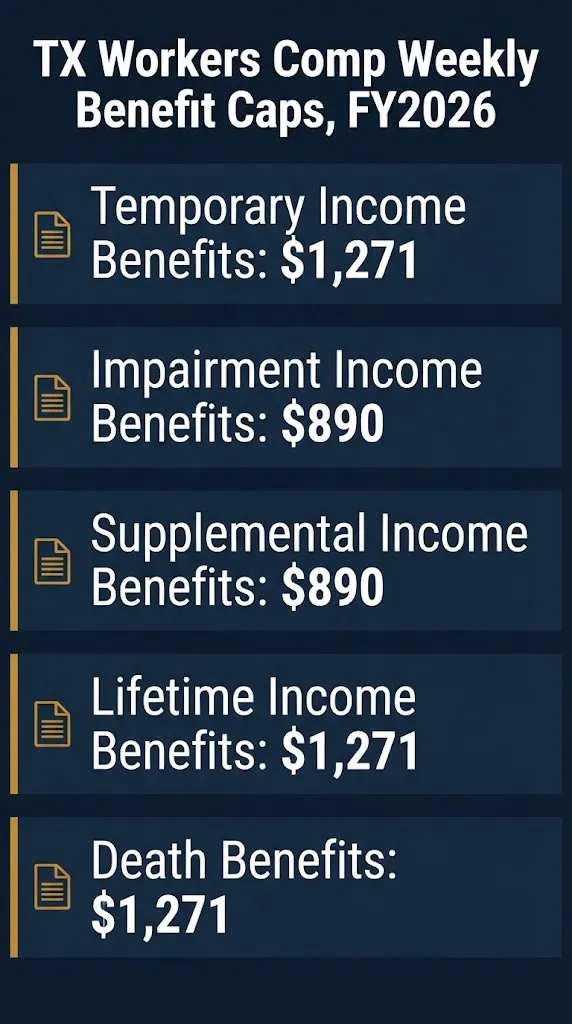
Here’s how the caps break down by benefit type for fiscal year 2026:
| Benefit Type | Weekly Maximum | Weekly Minimum |
|---|---|---|
| Temporary Income Benefits (TIBs) | $1,271.00 | $191.00 |
| Impairment Income Benefits (IIBs) | $890.00 | $191.00 |
| Supplemental Income Benefits (SIBs) | $890.00 | Not set |
| Lifetime Income Benefits (LIBs) | $1,271.00 | $191.00 |
| Death Benefits | $1,271.00 | Not set |
Source: Texas Department of Insurance, Division of Workers’ Compensation official benefit tables.
TIBs pay 70% of the gap between your pre-injury and post-injury wages for the first 26 weeks, generally rising to 75% after that, up to 104 weeks total or until you reach maximum medical improvement (MMI), whichever comes first.
How is my weekly workers’ comp check calculated in Texas?
Your weekly check is based on your average weekly wage during the 13 weeks before your injury, multiplied by a fixed percentage tied to the benefit type you’re receiving.
Most wage-replacement benefits use 70% of AWW as the base formula, then apply the yearly maximum and minimum caps shown above.
There’s also a short waiting period. The first week of lost wages usually isn’t paid unless your disability lasts two weeks or longer, in which case that first week gets paid retroactively.
Quick math example: if your AWW is $1,000, your weekly TIB check runs $700, well under the $1,271.00 cap for 2026.
What is a Texas workers’ comp settlement or lump sum worth?
Not yet determined for any individual case until an impairment rating is assigned and a settlement is negotiated. There’s no fixed statewide payout table.
Texas does allow one narrow lump-sum option: commuting Impairment Income Benefits. You can request this only after returning to work for at least three straight months and earning at least 80% of your pre-injury wage.
Once you commute IIBs into a lump sum, you permanently give up further income benefits tied to that injury. It’s a one-way decision under state administrative rules.
Separately, disputed claims can sometimes resolve through a negotiated settlement on DWC Form-025, but that only applies to genuinely contested liability, not to benefits nobody is disputing.
Lifetime Income Benefits, reserved for catastrophic injuries like total blindness or paralysis, can never be commuted into a lump sum under any circumstance.
Reality Check
No government agency or insurance carrier will text or email you out of nowhere offering a Texas workers’ comp payout. Filing a claim with the DWC is always free.
Be wary of third-party “claim helpers” who charge upfront fees to file a form you can submit yourself at no cost through the DWC website or by mail.
How do I file a Texas workers’ compensation claim?
You file by reporting the injury to your employer first, then submitting DWC Form-041 to the Division of Workers’ Compensation within one year.
Follow these steps in order:
- Report the injury to your employer within 30 days of when it happened or when you learned it was work-related.
- Get medical treatment, using a network provider if your employer’s policy requires one.
- Your employer must file a First Report of Injury with the DWC within 8 days of learning about it.
- File DWC Form-041 (Employee’s Claim for Compensation) with the DWC within 1 year of the injury date.
- The insurance carrier reviews the claim and either accepts or disputes it.
- Benefits begin if the claim is accepted, after any applicable waiting period.
- If denied, you can request a Benefit Review Conference through the DWC.
What is the deadline to file a workers’ comp claim in Texas?
You have one year from the date of injury, or from the date you knew or should have known an illness was work-related, to file DWC Form-041.
Missing this deadline usually means losing the right to income and medical benefits permanently. There are limited exceptions, but they’re narrow and fact-specific.
Separately, you only have 30 days to notify your employer of the injury in the first place. Skipping that step can jeopardize your claim even if you later file on time with the state.
What happens if my Texas employer doesn’t have workers’ comp?
If your employer is a non-subscriber, you generally cannot file a traditional workers’ comp claim, and instead may pursue a personal injury lawsuit against them.
This cuts both ways. Non-subscribing employers lose key legal defenses they’d otherwise have, including the contributory negligence defense, the assumption of risk defense, and the fellow employee defense.
That means a negligence lawsuit against a non-subscriber can sometimes pay more than a standard workers’ comp claim would, but it also requires proving the employer was at fault, something workers’ comp claims don’t require.
Key Takeaway: Whether your employer subscribes to workers’ comp determines your entire legal path after an injury, from a no-fault insurance claim to a negligence lawsuit you have to prove.
Who is exempt from Texas workers’ compensation coverage?
Certain domestic workers and certain farm and ranch workers are generally exempt from mandatory coverage requirements, even under subscribing employers.
Independent contractors, properly classified, also typically fall outside the system. Misclassification disputes are common and can affect whether a worker is covered at all.
Government entities and companies with public construction contracts are treated differently. They’re generally required to carry coverage even though the general private-employer rule is optional.
Can I opt out of my employer’s workers’ comp coverage as an employee?
Yes. Under Texas Labor Code Section 406.034, an employee can elect in writing to opt out of an employer’s workers’ comp coverage and preserve the right to sue instead.
That written election must happen before an injury occurs, and generally within five days of starting the job or of the employer beginning coverage.
The tradeoff: opting out as an employee doesn’t come with job protection. Texas remains an at-will state, and an employer can still terminate you without cause.
What are the current 2026 Texas workers’ comp benefit rates?
The rates shown earlier in this article apply to injuries occurring between October 1, 2025 and September 30, 2026, based on a state average weekly wage of $1,271.05.
These figures reset every October 1. A worker injured in October 2026 will fall under a new fiscal year table, likely with slightly higher caps.
Impairment Income Benefits pay 3 weeks per percentage point of whole-body impairment rating, assigned by a doctor once you reach maximum medical improvement, up to a maximum duration set under state rules.
Supplemental Income Benefits can extend beyond that for workers with an impairment rating of 15% or higher who are earning less than 80% of their pre-injury wage.
How does workers compensation insurance work for Texas employers?
Subscribing employers buy a policy from a private insurer, a group like Texas Mutual, or become certified to self-insure through the DWC.
In exchange for paying premiums, subscribers get protection from most workplace injury lawsuits, since workers’ comp becomes the employee’s exclusive remedy except in cases of gross negligence resulting in death.
Non-subscribers skip the premium cost but take on open-ended lawsuit exposure instead. Some choose to offer their own occupational injury benefit plans as a middle-ground option, without becoming DWC subscribers.
What if my Texas workers’ comp claim gets denied?
A denial isn’t the end of the process. Texas gives injured workers a structured appeals path through the DWC.
The typical sequence looks like this:
- Benefit Review Conference (BRC): an informal mediation session to try to resolve the dispute.
- Contested Case Hearing (CCH): a formal hearing before a DWC hearing officer if the BRC doesn’t resolve it.
- Appeals Panel review: either side can appeal the CCH decision to the DWC Appeals Panel.
- Judicial review: as a last step, either party can take the dispute to state district court.
Key Takeaway: A denied Texas workers’ comp claim can still move through four separate levels of review, so a first denial is rarely the final word.
Can I be fired for filing a workers’ comp claim in Texas?
Retaliation for filing, or attempting to file, a workers’ comp claim in good faith is illegal in Texas under Labor Code Section 451.001.
Prohibited employer actions include firing, demoting, or otherwise punishing an employee specifically because they filed a claim, testified in a proceeding, or hired a lawyer for a claim.
Workers who believe they were retaliated against can file a separate complaint, and remedies can include reinstatement, back pay, or damages, depending on the outcome.
What Happens Next
Within 30 days of an injury: the worker reports it to the employer in writing or verbally, starting the clock on the claim.
Within 8 days of employer notice: the employer must submit a First Report of Injury to the DWC if the employer subscribes.
Within 1 year of the injury date: the worker must file DWC Form-041 to preserve the right to benefits.
At Maximum Medical Improvement: a doctor assigns an impairment rating, which then determines Impairment Income Benefits.
If disputed: the claim proceeds through the Benefit Review Conference and, if needed, a Contested Case Hearing.
Frequently Asked Questions
Is Texas workers’ compensation insurance required by law?
No, it’s optional for most private employers in Texas.
Government entities and most public-project contractors are the main exceptions.
Employers who opt out are called non-subscribers and must file an annual notice with the state.
Can I sue my employer instead of filing a workers’ comp claim in Texas?
Only if your employer is a non-subscriber, meaning they don’t carry workers’ comp coverage.
Subscribing employers are generally protected from lawsuits except in cases involving gross negligence that causes death.
Non-subscriber lawsuits require proving fault, which workers’ comp claims do not.
How much is the average workers’ comp settlement in Texas?
Not yet determined as a single statewide figure, since Texas doesn’t publish an average settlement amount.
Payouts depend on your impairment rating, average weekly wage, and whether liability is disputed.
The main lump-sum option is commuting Impairment Income Benefits after meeting a return-to-work threshold.
How long do I have to report a workplace injury in Texas?
You have 30 days to notify your employer of the injury.
You then have one year to file DWC Form-041 with the state.
Missing either deadline can jeopardize your right to benefits.
What happens if my employer doesn’t have workers’ comp insurance?
You generally cannot file a standard workers’ comp claim against a non-subscriber.
You may instead pursue a personal injury lawsuit, and the employer loses several common legal defenses.
Non-subscribers must still report injuries to the DWC using Form-007.
Can I be fired for filing a workers’ comp claim in Texas?
No, retaliation for a good-faith claim is illegal under Texas Labor Code Section 451.001.
This includes firing, demotion, or other punishment tied to the claim.
Workers who face retaliation can file a separate complaint and pursue remedies like back pay.
How is my weekly workers’ comp check calculated in Texas?
Most income benefits pay 70% of your average weekly wage, based on the 13 weeks before your injury.
That amount is then capped by the yearly maximum, which is $1,271.00 per week for fiscal year 2026.
A short waiting period applies before the first payment unless your disability lasts two weeks or more.
What if my claim is denied?
You can request a Benefit Review Conference through the DWC, the first step in a four-level appeals process.
If that doesn’t resolve it, the case can move to a Contested Case Hearing, then the Appeals Panel, then state court.
A denial is not automatically final.
If you got hurt on the job in Texas, start by finding out whether your employer subscribes to workers’ comp, since that single fact shapes your entire legal path. Calendar the one-year filing deadline now, and keep copies of every medical record and report you file.