Chime Class Action Lawsuit 2026: Settlement Status, Claim Deadlines, and Payout Estimates
Quick Answer
- The Chime lawsuits are real proposed class actions, not a scam, but no final settlement has been approved yet.
- Payout amounts are not yet determined because claims have not been opened for filing.
- No claim deadline exists yet. Watch the official settlement website once a class action is certified or settled.
If you searched for “Chime lawsuit” because you saw an ad, a social post, or a text mentioning money from Chime, you are not alone. Chime is not a bank. It is a financial technology company that partners with actual banks, and that distinction sits at the center of several legal fights. The main proposed class action accuses Chime of freezing accounts and holding customer funds without timely access or clear explanation.
You may have gotten an email with phrases like “Chime settlement” or “claim your payment.” As of August 20, 2026, no court has approved a Chime class action settlement that requires you to file a claim. That does not mean the lawsuits are fake. It means the cases are still moving. The most important thing you can do right now is know the difference between a filed case, a certified class, and an approved settlement, and watch the official court docket rather than social media.
This article maps every verified detail in the Chime litigation, what each lawsuit actually claims, who may qualify if a settlement is reached, and what to watch for in 2026.
| The Facts | |
|---|---|
| Case | Proposed class actions against Chime Financial, Inc. and partner banks |
| Status | Active litigation; no certified class or approved settlement as of August 20, 2026 |
| Fund Size | Not yet confirmed |
| Est. Per Person | Not yet determined |
| Claim Deadline | No deadline yet; no claim form available |
| Administrator | Not yet appointed |
| Proof Needed | Unknown until a settlement is reached |
Is the Chime class action lawsuit real?
Yes, the Chime class action lawsuits are real court cases, not a rumor. Multiple plaintiffs have filed proposed class actions against Chime Financial, Inc. in different federal and state courts. A real lawsuit appears on a court docket with a case number, named plaintiffs, and a filed complaint. Several Chime cases meet that standard.
The most commonly cited case is Richards v. Chime Financial, Inc., filed in the United States District Court for the Northern District of California. Plaintiffs in that case say Chime froze accounts, sometimes for weeks or months, and did not return money quickly after account closures. Similar claims appear in arbitration demands and other court filings.
But a filed lawsuit is not the same as a settled lawsuit. No court has certified a class. No settlement fund exists. No claim form is available. If a website or text tells you to file a Chime claim right now for guaranteed money, it is misrepresenting the stage of the case.
The Federal Trade Commission has not announced a Chime settlement either. Chime did pay civil penalties to regulators before, but that was not a consumer class action payout. In 2023, the Consumer Financial Protection Bureau and state regulators examined Chime’s practices, but no resulting fund has been established for customer claims in this litigation.
- A real case exists: Richards v. Chime Financial, Inc.
- The case is in active litigation, not settlement
- No official claim portal is open
- Be cautious with any source saying “claim your Chime money now”
What is the Chime class action lawsuit about?
The core claim in the Chime class action litigation is that Chime freezes or closes accounts and then holds customer money without giving a clear timeline or an easy way to get it back. Chime is a financial technology platform, not a chartered bank. It provides spending accounts and debit cards through partner banks, including The Bancorp Bank and Stride Bank.
Plaintiffs say that when Chime flags an account for suspected fraud or a terms-of-service issue, it can freeze the entire balance. Customers then wait. Some report waiting weeks. Some say they lost access to direct deposit paychecks, tax refunds, or emergency funds. The lawsuit claims Chime does not provide a fast, fair process to challenge the freeze or recover funds.
Chime has denied the allegations in court filings. The company says it freezes accounts only to comply with anti-fraud and anti-money-laundering rules. Chime also points to its account agreement, which includes dispute resolution and arbitration clauses.
But the plaintiffs argue that the account agreement terms do not give Chime unlimited time to hold funds. That legal fight is unresolved. A court has not ruled that Chime broke the law. A court has not ruled that Chime followed the law. The case is pending.
Key Takeaway: The lawsuits are real, but real does not mean settled. No one can honestly promise you a Chime payout today.
How much money could I get from the Chime lawsuit?
You cannot get a Chime lawsuit payout yet because no settlement has been approved. Any number you see online is an estimate or a guess. The court has not set a fund size. No per-person amount has been calculated.
If the case reaches a settlement, the amount per person will depend on several factors. How many people file valid claims. How long their accounts were frozen. How much money was held. Whether the court approves a tiered distribution or a flat payment.
Here is how settlement math typically works in consumer class actions. A defendant agrees to a total fund, say a hypothetical $20 million. The lawyers take a percentage, typically 20 to 30 percent. The settlement administrator takes a fee. Named plaintiffs get service awards, often a few thousand dollars each. What remains gets divided among everyone who files a valid claim.
If 200,000 people file claims, the per-person payout is small. If 20,000 people file, the payout is larger. Neither number is confirmed for Chime.
| Potential Factor | Impact on Payout |
|---|---|
| Length of account freeze | Longer freezes may support larger awards |
| Amount of funds held | Higher held amounts may support larger awards |
| Number of claimants | More claimants means smaller individual share |
| Court-approved tiers | Tiered awards may pay some groups more than others |
Do not budget for a Chime payout. If a settlement comes, the amount will likely be modest, not life-changing. Treat any promised dollar figure as unverified.
How do I file a Chime lawsuit claim?
You cannot file a Chime lawsuit claim right now. No claim form exists. No settlement administrator has been appointed. No court has opened a claims period.
When and if a settlement is approved, here is the process you can expect, based on how consumer class action settlements typically work.
- The court holds a preliminary approval hearing.
- If granted, the settlement website goes live.
- The administrator posts the claim form online.
- You enter your name, contact information, and proof if required.
- You submit the claim before the court-set deadline.
- The court holds a final approval hearing.
- If approved and after any appeals, payments go out.
That is the standard sequence. None of those steps have happened for the Chime litigation as of August 20, 2026.
One caution. Filing a claim in a class action is free. You never pay to file. You never pay to “unlock” a payment. Anyone asking for a fee to file a Chime claim is operating outside the legitimate process.
What is the Chime lawsuit deadline?
There is no Chime lawsuit deadline because there is no approved settlement. Deadlines only exist after a court approves a settlement and sets a claims period. That has not occurred.
You may see dates online. Some sites list deadlines for other Chime matters, like regulatory deadlines or unrelated arbitration deadlines. Do not confuse those with a class action claim deadline. A real claim deadline will appear on the official settlement website, not on a random blog or social post.
If a settlement is reached in 2026, the claim deadline will likely be set 60 to 120 days after the settlement website launches. That is a pattern, not a promise. The court controls the calendar.
For now, the only deadline you should track is the next court status conference or hearing date in the Richards case. Check the official docket for the Northern District of California for updated dates.
Who is eligible for the Chime class action settlement?
Eligibility has not been determined because no class has been certified. No judge has defined the class. No settlement has been approved.
If the case follows the typical pattern, the proposed class would likely include people who had a Chime account frozen or closed, and who lost access to funds for a period of time, during the covered period. The covered period would be set by the court based on the statute of limitations and the claims in the complaint.
But “likely” is not “confirmed.” You may or may not be included. The only way to know is to wait for a certified class or an approved settlement and then read the official class definition.
Factors that may matter if a class is certified:
- Whether you had a Chime spending account
- Whether your account was frozen or closed
- When the freeze or closure happened
- How long you lost access to funds
- Whether you tried to recover the funds and were delayed
None of these factors are official yet. They are inferred from the complaint’s allegations.
Key Takeaway: Anyone quoting a Chime eligibility cutoff or a per-person check amount is inventing details. Watch the docket, not the ads.
Reality Check: No legitimate class action settlement ever asks you to pay a filing fee. No one sends you a text saying you won money from a case you never heard of. Third-party “claim helpers” that charge fees are unnecessary. Filing is always free when a real settlement opens.
What is the status of the Chime lawsuit in 2026?
As of August 20, 2026, the Chime litigation remains in the pre-certification stage. That means motions are being filed, discovery may be underway, and the court has not yet decided whether the case can proceed as a class action.
The Richards v. Chime Financial, Inc. case in the Northern District of California is the most visible. Other cases may have been filed in other districts or sent to arbitration. Chime’s account agreement includes an arbitration clause, which means some customers may have to pursue individual arbitration rather than join a class action. Courts sometimes enforce those clauses, and sometimes they do not. The outcome here is unresolved.
The status is best described as active but uncertain. No trial date is set. No settlement conference has been publicly announced. No claims window is open.
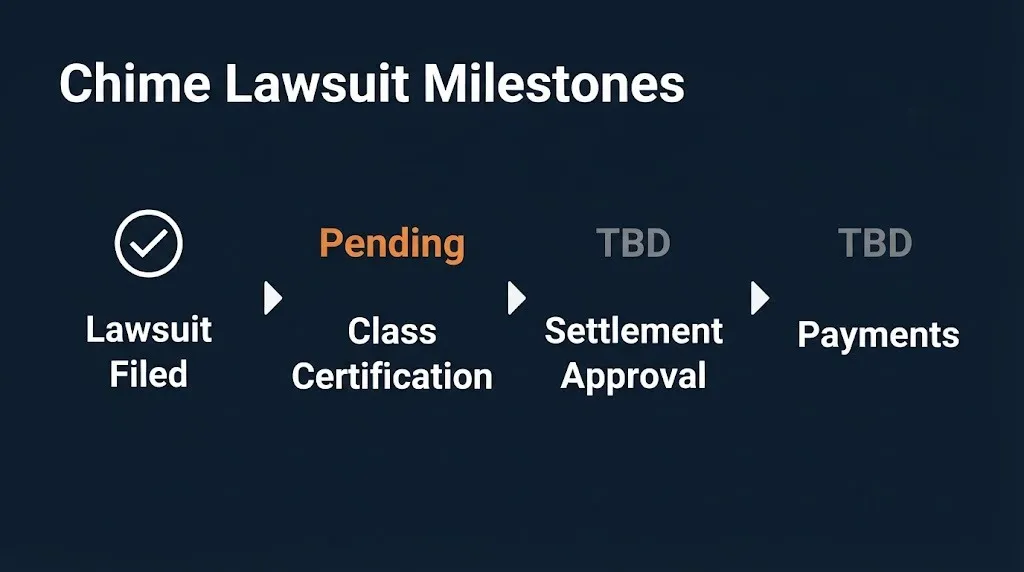
If you are watching this case, the milestones to track are:
- Class certification motion filed
- Court ruling on class certification
- Any settlement announcement
- Preliminary approval hearing
- Claims period opens
- Final approval hearing
- Payment distribution
We are not at step one yet.
Why is Chime being sued?
Chime is being sued because customers say the company froze their accounts and held their money without a fair or timely process. The plaintiffs argue that Chime markets itself like a bank, with phrases like “banking that has your back,” but does not provide the same access to funds that a regulated bank would have to provide in similar situations.
The legal claims in the complaints typically include breach of contract, breach of the implied covenant of good faith and fair dealing, unjust enrichment, and violations of state consumer protection laws. Some plaintiffs also mention conversion, the legal term for wrongfully taking or holding someone else’s property.
Chime’s defense is that it must freeze accounts to comply with anti-money-laundering rules and fraud detection systems. The company says it follows its account agreement and eventually releases funds when possible.
The deeper consumer issue is this. A traditional bank faces specific regulatory scrutiny when it freezes an account. Chime operates as a technology layer between you and a partner bank. When something goes wrong, it can be hard to tell who is responsible, Chime or the bank. That confusion is part of what the litigation is trying to untangle.
What happened with Chime and the CFPB?
The Consumer Financial Protection Bureau has looked at Chime’s practices before. In 2023, regulators and state attorneys general examined issues around Chime’s outage response and account access. The CFPB has not announced a Chime settlement in 2026 that creates a consumer payout fund.
Regulatory actions are different from class actions. A regulatory penalty goes to the government, not to individual customers. A class action settlement goes to the people who file claims. Confusing the two is common in ads and social posts that promise “Chime lawsuit payouts.”
Chime has said it cooperates with regulators. The company has also pointed to improvements in customer service and account review processes. But those statements have not resolved the pending litigation.
Where can I check my Chime settlement claim status?
You cannot check a Chime settlement claim status because no claims have been filed. There is no portal. There is no administrator. There is no status to check.
When a settlement is approved, the settlement administrator will set up a website where you can enter your claim number and check your status. That website will be named in the settlement notice. Until then, any site claiming to let you check a Chime claim status is not legitimate.
Do not enter your personal information on a website that promises to check your Chime claim for you. Scam sites collect that information for identity theft. Legitimate settlement administrators never charge to check claim status.
Is Chime a bank?
No, Chime is not a bank. Chime Financial, Inc. is a financial technology company. The accounts are provided by partner banks, typically The Bancorp Bank, N.A. and Stride Bank, N.A. Your deposits are held by those banks, not by Chime itself.
This matters for the lawsuit. The plaintiffs say Chime acts like a bank but does not face the same regulatory requirements when it freezes an account. Chime says it follows the rules that apply to its role as a service provider to banks.
The distinction also matters for deposit insurance. Chime accounts are FDIC insured through the partner banks, but only if the partner bank fails. FDIC insurance does not protect you if Chime freezes your account. That gap is one reason customers feel stuck when a freeze happens.
If your Chime account is frozen, you are dealing with a technology company’s fraud and risk system, not a bank teller. The path to getting your money back may be slower than you expect. That is precisely what the litigation claims.
Key Takeaway: Chime is not a bank, and that distinction is at the heart of every major legal claim against the company.
What is the Chime class action lawsuit sign up process?
There is no sign-up process for the Chime class action because no class has been certified and no settlement has been approved. You do not “sign up” to join a class action. If a class is certified, you are either included automatically if you meet the definition or you may need to file a claim to receive payment, depending on how the settlement is structured.
Some sites offer to “sign you up” for the Chime lawsuit. Do not use them. They are not official. They may charge a fee. They may harvest your data. The only sign-up that matters is a court-approved claim form, and none exists.
If you want to stay informed without falling for a scam, here is what to do.
- Search the official court docket for Richards v. Chime Financial, Inc.
- Check the Northern District of California court website for case updates.
- Watch for a settlement notice from a legitimate administrator, usually mailed or emailed with a court-approved notice.
- Bookmark the official settlement website once one is announced.
- Ignore social posts that say “claim your Chime money now.”
How long will the Chime lawsuit take?
Class actions take years, not months. The Chime litigation is no exception. If the case survives Chime’s motion to dismiss and the arbitration issues, the next phase is class certification. That could take most of 2026. If a class is certified, the parties may then negotiate a settlement or proceed toward trial.
A settlement in 2026 is possible but not guaranteed. A payout in 2026 is unlikely. The realistic timeline for any payment, if a settlement happens, would be 2027 or later.
Here is a rough sequence, based on typical federal class action timelines.
| Stage | Expected Timing |
|---|---|
| Motion to dismiss ruling | 2026 |
| Class certification briefing | 2026 to 2027 |
| Possible settlement talks | 2027 |
| Preliminary approval | TBD |
| Claims period | TBD |
| Final approval | TBD |
| Payments | TBD |
Every stage is an estimate. The court controls the calendar. Do not plan your finances around this case.
What documents do I need for a Chime settlement claim?
You do not need documents yet because no claim form exists. If a settlement is approved, the documents you need will depend on the claim form instructions.
Based on the allegations, the likely proof would include anything that shows you had a Chime account and lost access to funds. That could include:
- Chime account statements
- Emails from Chime about a freeze or account closure
- Transaction history showing your balance before the freeze
- Screenshots of error messages or in-app notifications
- Correspondence with Chime support
- Bank statements showing direct deposits from an employer or benefits agency
Keep any of these records now, even if you do not need them yet. It is easier to save a statement today than to reconstruct it two years from now.
You also want to keep proof of identity, like a driver’s license or passport, and proof of your current address. Settlement administrators routinely ask for that to prevent fraud.
What does the Chime lawsuit settlement notice look like?
No settlement notice has been issued because no settlement exists. When a real notice goes out, it will follow a court-approved format. It will name the case, the court, the settlement administrator, the claim deadline, and the official website.
A real notice will never ask for your bank password. It will never ask you to pay a fee. It will never threaten you with losing your claim if you do not act within hours.
Scam notices often look urgent. They use phrases like “final payment,” “unclaimed funds,” or “verify your account now.” Do not click links in texts or emails that use that language.
The official notice will likely arrive by email if you had a Chime account, or by mail if the administrator can locate your address. It will also appear on the official settlement website, which will be listed in court documents.
What is the Chime lawsuit payout date?
There is no payout date because there is no settlement. Any site listing a Chime payout date in 2026 is not citing a court record.
If a settlement is approved, payments typically go out 60 to 120 days after final approval, assuming no appeals. That timeline starts only after the final approval hearing. As of now, no final approval hearing has been scheduled.
The fastest realistic path to a payout, if everything goes perfectly, would be late 2027. That assumes a settlement in early 2027, a claims period in mid-2027, and approval by late 2027. A slower path could push payments into 2028.
Do not rely on a Chime payout to cover a bill. Treat it as a possibility, not a plan.
Key Takeaway: No payout date exists. Anyone naming a specific day or month is making it up.
Is the Chime lawsuit legit or a scam?
The lawsuit is legit. The ads about it are often not.
You can verify the lawsuit yourself. Search the federal court PACER system for Richards v. Chime Financial, Inc. The case number and docket are public. You will see real filings from real lawyers.
But the social media ads and texts that say “Chime owes you money” or “claim your Chime settlement today” are often lead-generation bait. They collect your contact information and sell it to marketing companies. Some push “claim filing services” that charge money for something you could do yourself for free, once a real claim form exists.
Here is a quick test. If a post names a dollar amount and a deadline that you cannot find on a court docket or official settlement website, it is not reliable. If it asks for your Social Security number before a claim form exists, it is dangerous.
The real case is moving slowly through court. That is not exciting. But it is true.
What are the Chime lawsuit updates for 2026?
The Chime litigation updates for 2026 are mostly procedural. Motions have been filed. The court has issued scheduling orders. Discovery disputes may be underway. No class has been certified. No settlement has been announced.
The best source for updates is the official docket for the Northern District of California. You can search by case name or number. The second-best source is a reputable legal news outlet that covers financial technology litigation.
Do not rely on YouTube summaries or TikTok videos. They often conflate separate cases, miscite dollar amounts, and overstate the stage of litigation. If you hear “Chime is paying out” from a creator, ask for the court case number and the settlement administrator name. If they cannot provide both, move on.
Here are the updates that would actually matter for you:
- A motion for class certification is filed.
- The court grants class certification.
- A settlement is announced with a fund amount.
- The court grants preliminary approval.
- A claim form becomes available.
- The court grants final approval.
- Payments are distributed.
As of August 20, 2026, none of those have occurred.
What are people asking about the Chime lawsuit?
Real people asking about the Chime lawsuit online tend to ask the same questions. The answers are simpler than the ads suggest.
Did Chime freeze accounts without warning?
Some customers say yes. The litigation alleges freezes happened with little explanation and slow resolution. Chime says it follows fraud and compliance rules. The court has not decided who is right.
Can I sue Chime on my own?
Maybe. Chime’s account agreement includes an arbitration clause. That may limit your ability to join a class action or file in court. Whether the clause is enforceable in your situation depends on facts and state law. This is legal information, not legal advice.
Will I automatically get a Chime settlement check?
No. If a settlement is approved, you will likely need to file a claim. Even then, payment is not automatic or guaranteed.
How do I know if I am part of the class?
You will only know once a class is certified and the class definition is published. Until then, no one can tell you for sure.
What if I already closed my Chime account?
If a settlement is approved and covers closed accounts, you may still be included. The class definition will say so. Keep old statements if you have them.
Can I get my frozen Chime money back now?
The lawsuit does not create a faster path to unfreezing your account. If your account is currently frozen, contact Chime support in writing. You can also file a complaint with the Consumer Financial Protection Bureau.
Is there a Chime class action settlement 2026 payout?
No. There is no approved settlement and no payout.
Frequently Asked Questions
Is the Chime class action lawsuit real?
Yes, the Chime class action lawsuits are real court cases, including Richards v. Chime Financial, Inc. in the Northern District of California.
No settlement has been approved and no claim form exists yet.
How much will I get from the Chime lawsuit?
No payout amount has been determined because no settlement has been reached.
Any dollar figure you see online is an estimate or a fabrication.
How do I file a Chime claim?
You cannot file a claim right now because no claims period has opened.
When a settlement is approved, a court-appointed administrator will post a free claim form on an official website.
What is the Chime lawsuit deadline?
There is no deadline because there is no approved settlement.
A real deadline will be set by the court and published on the official settlement website.
Is Chime a bank?
No, Chime is a financial technology company, not a bank.
Its accounts are provided through partner banks including The Bancorp Bank and Stride Bank.
Where can I check my Chime claim status?
There is no claim status to check because no claims have been filed.
Ignore any site that asks for personal information to check a Chime claim.
Will I get a Chime settlement check automatically?
No, if a settlement is approved you will likely need to file a claim.
Payments are never automatic in consumer class actions.
What should I do right now?
Keep your Chime statements and any emails about account freezes.
Check the official court docket and wait for a real settlement notice.
What Happens Next
Late 2026: The court may rule on Chime’s motion to dismiss or class certification briefs.
2027: If the case survives, settlement talks or class certification hearings may occur.
2027 to 2028: If a settlement is reached, a preliminary approval hearing and claims period would follow.
2028 or later: If approved, payments would be distributed after final approval and any appeals.
The single most important date right now is August 20, 2026, the day you confirmed there is no deadline, no claim form, and no settlement yet. Check the docket again next month.