Affirm Class Action Lawsuit 2026: Status, Allegations, and Consumer Rights
Quick Answer:
- The Affirm class action lawsuit is real, with multiple cases alleging deceptive lending and consumer harm.
- No unified settlement exists, so payout amounts are not determined and no claim form is available.
- The litigation is active, with procedural rulings ongoing and no consumer deadline set.
If you used Affirm for buy now, pay later financing and are wondering whether you are owed money, the answer in 2026 is complicated. Affirm is not facing one lawsuit. It is facing several, across different courts, over different allegations. Some are consumer class actions. Some involve regulatory enforcement. None has produced a consumer settlement yet.
The people searching this term include shoppers who used Affirm at checkout and later faced surprise fees, damaged credit, or collection actions. The single most important fact is that no unified Affirm settlement exists, no claim form is available, and no payout date has been set.
This article covers the major active lawsuits, what they allege, which ones may eventually pay consumers, and how to protect yourself from the fake settlement scams already circulating. One surprising detail: the Consumer Financial Protection Bureau has taken regulatory action against Affirm, which often accelerates private litigation.
| The Facts | |
|---|---|
| Company | Affirm Holdings, Inc. |
| Cases | Multiple consumer class actions and regulatory actions |
| Status | Active, no global settlement |
| Fund Size | None established |
| Est. Per Person | Not determined |
| Claim Deadline | None set |
| Administrator | None appointed |
| Proof Needed | Loan records, transaction history |
Is the Affirm Class Action Lawsuit Real?
Yes, the Affirm class action lawsuit is real. Multiple cases are active in U.S. federal and state courts. The company is defending a portfolio of litigation covering lending practices, disclosure failures, and consumer protection violations.
The most prominent consumer class actions allege that Affirm misrepresented the terms of its buy now, pay later loans. Plaintiffs claim the company failed to clearly disclose interest rates, late fees, and the credit reporting consequences of missed payments.
Separate litigation involves regulatory actions. The Consumer Financial Protection Bureau has investigated Affirm’s lending practices. Regulatory actions often run parallel to private class actions and can strengthen the plaintiffs’ positions.
| Litigation Type | What It Alleges |
|---|---|
| Consumer class action | Deceptive lending and fee disclosures |
| Credit reporting claims | Unfair reporting of missed payments |
| Regulatory action | CFPB enforcement over lending practices |
| State AG actions | State-level consumer protection claims |
The lawsuits are legitimate. They appear in court dockets with named plaintiffs and established law firms. But the existence of a lawsuit does not mean a settlement is coming, and it does not mean every Affirm user will receive money.
What Is the Affirm Lawsuit About?
The Affirm lawsuits focus on the company’s buy now, pay later model. Affirm offers point-of-sale loans that let shoppers split purchases into installments. The lawsuits allege that the terms of these loans were not always clear.
The consumer class actions claim that Affirm marketed its loans as interest-free or low-cost without adequately disclosing that some loans carried high interest rates. Plaintiffs say the checkout process buried the true cost of financing.
| Claim Type | What Plaintiffs Allege |
|---|---|
| Deceptive disclosures | Hidden interest rates and fees |
| Misleading marketing | “Interest-free” claims were misleading |
| Unfair credit reporting | Missed payments harmed credit scores |
| Collection practices | Aggressive or unlawful collections |
| Fee structures | Late fees not clearly disclosed |
The credit reporting claims are significant. Some Affirm loans are reported to credit bureaus, while others are not. Plaintiffs allege that Affirm failed to explain which loans would affect credit scores, leading to surprise negative marks.
How Much Could the Affirm Lawsuit Pay?
No payout amount has been determined. There is no settlement fund, no settlement agreement, and no court-approved compensation schedule. Any number you see online is fabricated.
If the consumer class actions eventually settle, the per-person payout would likely be modest. Consumer finance class actions often produce refunds or small payments. The amount depends on the settlement fund size and the number of class members.
| Potential Factor | Effect on Payout |
|---|---|
| Documented Affirm loans | Required for most claims |
| Late fees paid | Higher individual claim value |
| Credit score damage | Potential additional damages |
| Number of class members | More members means smaller shares |
| Settlement fund size | Determines total available |
The regulatory action by the CFPB could produce consumer redress separately from any private settlement. But that process is also unresolved, and any payments would require a finalized order.
Do not expect a windfall. The value, if any, will come from refunds or small compensation for documented harm.
Who May Qualify for the Affirm Class Action?
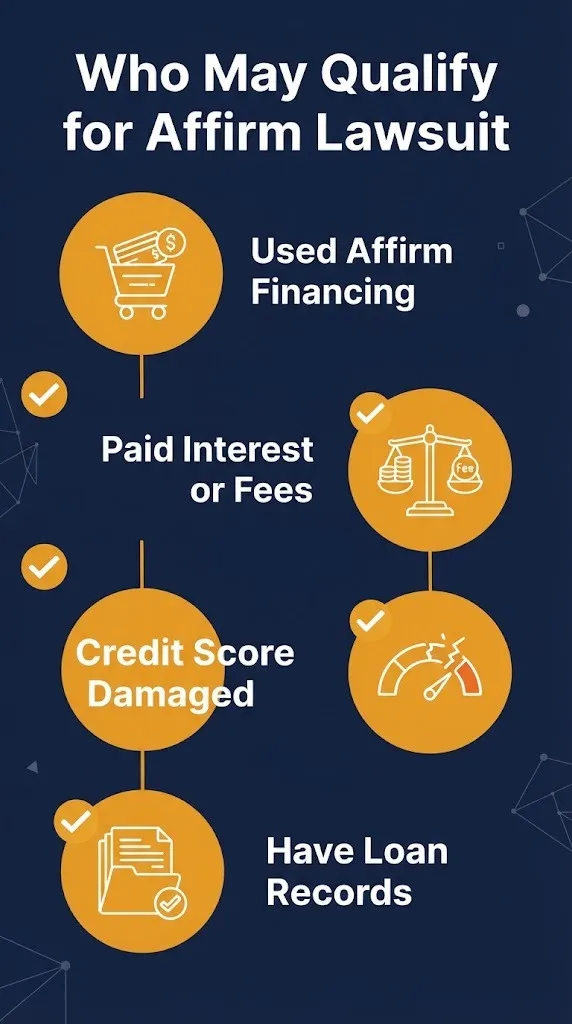
You may qualify for an Affirm class action if you took out an Affirm loan during the class period and were subject to the alleged practices. The exact class definitions have not been finalized.
For the disclosure claims, the class likely includes consumers who financed purchases through Affirm and paid interest or fees they did not understand. Loan records from the Affirm app or email confirmations will be essential.
For the credit reporting claims, the class likely includes consumers whose credit scores were damaged by Affirm loans they believed were not reported to credit bureaus.
| Potential Class Member | Likely Covered |
|---|---|
| Used Affirm financing | Yes, if within class period |
| Paid interest or late fees | Yes, documented |
| Credit score damaged | Yes, for credit reporting claims |
| No adverse experience | May still qualify if class is broad |
| No loan records | Harder to prove claim |
The class definitions will be set by the court if the cases are certified. Until then, no one can say with certainty who qualifies.
Key Takeaway: Affirm faces multiple active lawsuits and regulatory scrutiny, but no settlement, no claim form, and no payout date exist for consumers as of August 2026.
What Should You Do If You Used Affirm?
If you used Affirm and believe you were harmed by the alleged practices, you should preserve your records now. The litigation may take years, and your loan history will be your proof.
Here are the verified steps to take:
- Download your Affirm loan history from the app or website.
- Save email confirmations and statements for your Affirm loans.
- Take screenshots of any misleading disclosures or fee structures you encountered.
- Check your credit report for negative marks from Affirm loans.
- Save records of any late fees or interest charges you paid.
- Keep correspondence with Affirm customer service.
- Watch for official court notices about class certification.
The screenshots matter for the disclosure claims. If you can document unclear fee structures or misleading “interest-free” marketing, that evidence supports the plaintiffs’ allegations.
Do not fall for fake settlement websites. No claims are being accepted. Any site asking for your personal information to “join” the Affirm settlement is a scam.
What Is the CFPB Action Against Affirm?
The Consumer Financial Protection Bureau has taken regulatory action against Affirm. The exact nature and status of the action vary, but the general allegation is that Affirm engaged in practices that harmed consumers.
CFPB enforcement actions often lead to consent orders requiring the company to pay consumer redress and change its practices. Those orders can produce payments to affected consumers even without a private class action settlement.
| Regulatory Element | What It Means |
|---|---|
| CFPB investigation | Agency reviewed Affirm’s practices |
| Consent order | Company agrees to changes and payments |
| Consumer redress | Payments to affected borrowers |
| Compliance monitoring | Agency oversees changes |
The CFPB action is separate from the private class actions. It could resolve faster or slower depending on the agency’s priorities. Any consumer redress from the CFPB would follow its own process.
What Is the Status of the Affirm Lawsuit Update 2026?
The status of the Affirm lawsuits in 2026 is active litigation. No global settlement exists. The consumer class actions are in pre-certification or early discovery. The regulatory action is in progress.
The procedural status varies by case. Some lawsuits have survived motions to dismiss. Others have been dismissed or consolidated. The landscape is fluid.
| Case Type | 2026 Status |
|---|---|
| Consumer class action | Active, pre-certification |
| Credit reporting claims | Active, early discovery |
| CFPB action | Ongoing enforcement |
| State AG actions | Varies by state |
The next significant milestones will be class certification rulings in the consumer cases. If a court certifies a class, the case becomes more valuable and more likely to settle.
Reality Check: No One Is Sending You an Affirm Settlement Check
Reality Check: If you see a text, email, or social media post saying you qualified for an Affirm settlement, it is a scam. No settlement exists. No claims are being accepted. No one is mailing checks. Legitimate class actions send official notice only after a court approves the process. Any unsolicited message asking for your bank account or personal information is fraud.
How Does the Affirm Lawsuit Compare to Other BNPL Litigation?
Affirm is not the only buy now, pay later company facing litigation. Competitors like Klarna, Afterpay, and PayPal have faced similar claims. The BNPL industry has drawn regulatory scrutiny over disclosure practices, credit reporting, and debt collection.
The Affirm litigation is part of a broader trend. Regulators and class action lawyers have targeted BNPL providers because the products are popular but the terms are often confusing. The outcome of the Affirm cases could shape the entire industry.
| BNPL Provider | Litigation Status |
|---|---|
| Affirm | Active class actions, CFPB action |
| Klarna | Regulatory scrutiny, some litigation |
| Afterpay | Similar disclosure claims |
| PayPal | Consumer protection inquiries |
The comparison matters because the legal theories are similar. A ruling in one case can influence settlements in others. But each company’s practices differ, and each case stands on its own facts.
What Are the Risks of Using Affirm in 2026?
The Affirm litigation highlights the risks of buy now, pay later financing. The primary risk is that the terms are not always clear. Consumers may not understand which loans carry interest, which are reported to credit bureaus, and what happens if they miss a payment.
The second risk is credit damage. Some Affirm loans are reported to credit bureaus, while others are not. A missed payment on a reported loan can lower your credit score. A missed payment on an unreported loan may still trigger collections.
| Risk Factor | What It Means |
|---|---|
| Hidden interest | Some loans carry high rates |
| Credit reporting | Some loans affect credit scores |
| Late fees | Missed payments trigger fees |
| Collections | Unpaid loans go to collections |
| Debt accumulation | Easy credit leads to overextension |
The litigation does not make Affirm illegal. It challenges whether the company adequately disclosed these risks. Until the cases resolve, consumers should read the terms carefully before using any BNPL service.
Key Takeaway: Multiple Affirm lawsuits and regulatory actions are active, including consumer class actions and CFPB enforcement, but no settlement or payout exists for consumers.
How Do You Avoid Fake Affirm Settlement Scams?
Fake Affirm settlement scams are already circulating. They take the form of phishing emails, text messages, and social media ads claiming you qualified for a payout. The goal is to harvest your personal information or steal your money.
Here is how to protect yourself:
- Never click links in unsolicited settlement messages.
- Check the official court docket or a trusted legal news source.
- Remember that legitimate settlements send notice by mail after court approval.
- Never pay a fee to file a class action claim.
- Never provide your bank account number to an unknown claims service.
- Verify any settlement website through the court’s official records.
- Report scam messages to the Federal Trade Commission.
The rule is simple. If you did not receive an official court-approved notice by mail, no settlement exists for you to join. Everything else is noise.
What Happens Next in the Affirm Litigation
| Expected Timing | Milestone |
|---|---|
| Late 2026 | Class certification rulings in consumer cases |
| 2027 | Possible settlement negotiations |
| If settled | Claim filing period opens |
| After claims | Final approval hearing |
| Unknown | Payout distribution, if any |
These dates are estimates based on the pace of similar consumer finance class actions. The court has not published a schedule for the Affirm cases.
The most important thing you can do is preserve your loan records and wait for official notice. If a settlement happens, the notice will explain the claim process. Until then, ignore the social media hype.
Frequently Asked Questions
Is there an Affirm settlement in 2026?
No settlement exists in 2026.
Multiple lawsuits are active but unresolved.
No claim form or payout date has been set.
How do I join the Affirm class action lawsuit?
You cannot join by filling out an online form.
If a class is certified, you will receive official notice.
Until then, there is no action for you to take.
How much money can I get from the Affirm lawsuit?
No payout amount has been determined.
There is no settlement fund in 2026.
Any specific dollar figure is speculation.
What is the CFPB action against Affirm?
The CFPB has taken regulatory action over lending practices.
The action is separate from private class actions.
Consumer redress may result from the CFPB process.
Can I sue Affirm for misleading disclosures?
Individual lawsuits over misleading disclosures are possible.
Class actions are already pending.
A lawyer can evaluate your specific situation.
What should I do if I received an Affirm settlement email?
Treat it as a scam unless verified through court records.
Do not click links or provide personal information.
Legitimate settlements send notice by mail.
Is the Affirm lawsuit a class action?
Yes, some of the Affirm lawsuits are proposed class actions.
The classes have not been certified yet.
Other cases are regulatory actions, not class actions.
How long will the Affirm lawsuit take?
Class actions typically take two to five years.
The Affirm cases are still in early stages.
A settlement, if any, is likely years away.
The Affirm lawsuits are real, but they are not a settlement. No money is waiting for you. No claim form exists. No deadline has been set. If you used Affirm and want to protect your rights, preserve your loan records and ignore the scams. August 25, 2026 is the date this information was verified. The date that matters most to you is the future claim deadline, and that date has not been set by any court.