Attorney Workers Compensation 2026: What a Lawyer Actually Does for Your Claim
Quick Answer
- A workers compensation attorney handles your claim, appeals denials, and negotiates settlements.
- Attorney fees are capped by state law, typically 15 to 20 percent of your recovery.
- Most workers comp lawyers offer free consultations and charge nothing upfront.
You got hurt at work. You filed a workers compensation claim. Then the insurance company denied it, delayed it, or offered you a settlement that does not cover your lost wages. Now you are asking one question: do I need an attorney?
The answer in 2026 is the same as it has been for years. You can file a workers comp claim without a lawyer. But the data and the lived experience of injured workers say the same thing: claims with attorneys get approved more often and settle for more money.
This article explains exactly what a workers compensation attorney does, when you need one, what it costs, and how the rules work in Michigan and other key states.
| The Facts | |
|---|---|
| Legal Field | Workers compensation law |
| Attorney Fee Cap | 15% to 20%, varies by state |
| Contingency Basis | Yes, almost always |
| Free Consultation | Standard practice |
| Claim Deadlines | Vary by state, often 1 to 3 years |
| Michigan Wage Loss Cap | 80% of after-tax average weekly wage |
| No Win No Fee | Yes, for most cases |
Is Hiring a Workers Comp Attorney Worth It?
Yes, hiring a workers compensation attorney is usually worth it if your claim involves lost time, permanent restrictions, or a denial.
The workers comp system looks simple on paper. You report an injury, see a doctor, and the insurer pays your medical bills and part of your wages. In practice, insurers dispute causation, fight treatment requests, and push low settlements.

An attorney knows the system’s pressure points. They can force the insurer to authorize surgery, challenge an independent medical exam that says you are fine, and negotiate a settlement that reflects future medical costs and wage loss.
The people who benefit most from representation are those with denied claims, serious injuries, preexisting conditions, or employers who retaliate after an injury report.
How Much Does a Workers Comp Attorney Cost?
A workers comp attorney costs nothing upfront and takes a percentage of your recovery only if you win.
The fee is set by state law, not by the lawyer. Most states cap attorney fees at 15 to 20 percent of your settlement or award. Some states use a sliding scale tied to the recovery amount.
| State | Typical Fee Cap |
|---|---|
| Michigan | 15% of settlement, up to 30% for trial |
| California | 15% of award |
| Texas | 20% of recovery |
| Florida | 20% of first $5,000, 15% after |
You do not pay filing fees or expert costs out of pocket in most cases. The attorney advances those costs and deducts them from the final recovery.
Key Takeaway: Workers comp attorneys work on contingency, meaning you pay nothing unless you recover money, and the fee is capped by law.
When Should You Hire a Workers Compensation Lawyer?
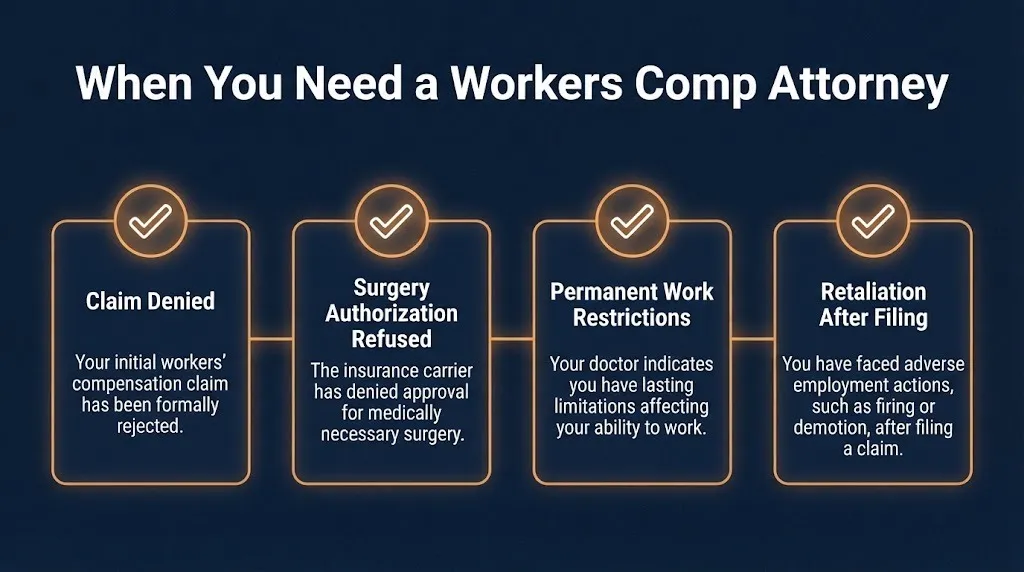
You should hire a workers compensation lawyer the moment your claim hits friction: a denial, a delay, a low offer, or a serious injury.
Some situations scream for representation. A denied claim means you fight an insurance company’s legal team alone if you do not hire counsel. A permanent injury means the settlement must cover decades of lost earning capacity.
Other trigger points include:
- Your employer disputes that the injury happened at work
- The insurer stops paying benefits without explanation
- You need surgery and the insurer refuses to authorize it
- You cannot return to your old job
- Your employer retaliates after you file
Waiting costs you time and money. Evidence gets harder to gather, and deadlines keep running.
What Does a Workers Comp Attorney Actually Do?
A workers comp attorney investigates your case, gathers medical evidence, negotiates with the insurer, and represents you at hearings.
The work starts with a file review. The lawyer looks at your medical records, accident report, wage statements, and any correspondence from the insurer.
Then comes strategy. The attorney identifies what the insurer is doing wrong: a missed deadline, an improper denial, an inadequate vocational assessment. They use those errors to push for benefits or a better settlement.
| Task | What It Means for You |
|---|---|
| Evidence gathering | Medical records, witness statements, expert reports |
| Negotiation | Higher settlement, faster approval |
| Hearing representation | The lawyer argues before a workers comp judge |
| Appeal filing | Deadline-driven paperwork to keep your claim alive |
You do not hand over control of your life. You get an advocate who knows the rules better than the adjuster on the other side.
What Is the Difference Between Workers Comp and a Personal Injury Lawsuit?
Workers comp is a no-fault system. You do not have to prove your employer did anything wrong. A personal injury lawsuit requires proof of negligence.
That difference shapes everything. Workers comp pays medical bills and a portion of lost wages, but it does not pay for pain and suffering in most states.
A personal injury claim, if you can file one against a third party, may pay for pain, emotional distress, and full lost wages. Some injured workers have both claims at once: workers comp against the employer and a liability claim against a negligent third party.
| Factor | Workers Comp | Personal Injury |
|---|---|---|
| Fault required | No | Yes |
| Pain and suffering | Usually no | Yes |
| Wage replacement | Partial | Full |
| Attorney fee | Capped by state | Often 33% to 40% |
An attorney can tell you whether a third-party claim exists alongside your workers comp case.
Key Takeaway: Workers comp is no-fault and limited in what it pays, while personal injury requires fault but offers broader damages.
What Is a Workmen’s Compensation Lawyer?
A workmen’s compensation lawyer is the same as a workers compensation attorney. The term “workmen’s compensation” is older language for the same legal practice.
You may see both phrases on law firm websites and in state statutes. They refer to the same body of law: benefits for workers injured on the job.
The language has shifted over time as states modernized their statutes. Michigan, for example, now uses “worker’s disability compensation” in some official documents. But courts, insurers, and lawyers use the terms interchangeably.
Do not let the wording confuse you. Any attorney who handles work injury claims under your state’s comp system is a workers comp lawyer, whatever the sign on the door says.
What Are the Michigan Workers Compensation Rules in 2026?
Michigan workers compensation rules cap wage loss benefits at 80 percent of your after-tax average weekly wage.
The state sets a maximum weekly benefit amount that adjusts each year. For 2026, the state maximum is not yet confirmed in all published sources, but it has historically tracked around 90 percent of the state average weekly wage.
Michigan requires employers to carry workers comp insurance if they have one or more employees. That broad mandate means most Michigan workers are covered.
| Michigan Benefit | 2026 Rule |
|---|---|
| Wage loss | 80% of after-tax average weekly wage |
| Medical coverage | Full, no copay, employer-selected provider |
| Waiting period | 7 days before wage benefits start |
| Retroactive pay | Yes, if disabled beyond 14 days |
| Filing deadline | 2 years from injury date |
Michigan also allows settlements that close out future medical benefits. Those settlements require a magistrate’s approval and are final.
How Does a Michigan Workers Compensation Attorney Help?
A Michigan workers compensation attorney helps by navigating the state’s specific benefit caps, deadlines, and dispute process.
Michigan has its own workers comp agency, the Workers’ Disability Compensation Agency. The process involves mediation, hearings before a magistrate, and appeals to the Workers’ Compensation Appellate Commission.
An attorney who practices in Michigan knows the magistrates, the insurers, and the medical examiners the insurers use. That local knowledge shortens the learning curve and often leads to better outcomes.
- File the claim correctly the first time
- Respond to insurer medical exams
- Negotiate wage loss benefits
- Represent you at mediation and hearing
- Structure settlements to protect future medical rights
The Michigan process is not something you want to learn while injured and broke.
What Does a Michigan Workers Compensation Lawyer Cost?
A Michigan workers compensation lawyer costs 15 percent of your settlement or award in most cases.
The fee is set by the Michigan Workers’ Disability Compensation Act and must be approved by a magistrate. If the case goes to trial, the fee may rise, but only with approval.
You pay nothing upfront. The lawyer covers filing fees, medical record costs, and expert witness fees. Those expenses come out of your settlement, not your pocket.
| Fee Type | Michigan Rule |
|---|---|
| Settlement fee | 15% of recovery |
| Trial fee | Up to 30%, magistrate approved |
| Upfront fee | None |
| Free consultation | Standard |
The contingency model means the attorney has every incentive to maximize your recovery.
Key Takeaway: Michigan caps workers comp attorney fees at 15 percent for settlements, and you pay nothing unless you win.
What Should You Look for in a Workers Comp Attorney?
Look for a workers comp attorney who practices in your state, has trial experience, and communicates clearly.
Workers comp is state-specific. A lawyer who practices in Michigan but not California will not know California’s rules. Start with a local search.
Experience matters more than advertising. Ask how many comp cases the attorney has taken to hearing in the last two years. Ask about outcomes in cases like yours.
| Quality | Why It Matters |
|---|---|
| State-specific experience | Rules vary by state |
| Hearing and trial experience | Insurers settle differently when a lawyer tries cases |
| Clear communication | You need to understand your own case |
| No upfront fees | Standard for workers comp |
Avoid lawyers who promise a specific dollar outcome. No ethical attorney guarantees a settlement amount before reviewing the evidence.
What Are the Most Common Workers Comp Claim Mistakes?
The most common workers comp mistakes are late reporting, gaps in medical treatment, and signing settlements without understanding them.
Late reporting lets the insurer argue the injury did not happen at work. Most states require you to report an injury within 30 days or less. Michigan requires notice within 90 days, but sooner is always better.
Gaps in treatment create room for the insurer to claim you recovered or your injury is not serious. Follow your doctor’s instructions and keep every appointment.
| Mistake | Consequence |
|---|---|
| Late injury report | Claim denial for lack of notice |
| Missed doctor visits | Benefit suspension |
| Signing a low settlement | You waive future benefits |
| Not documenting restrictions | Insurer says you can work |
An attorney can fix some of these mistakes. Others are permanent.
Reality Check: The workers comp insurer is not on your side. Its adjusters are measured on how little they pay out. Every conversation you have with them is on the record.
How Long Does a Workers Comp Claim Take?
A workers comp claim can take months for a simple case and years for a contested one.
The timeline depends on injury severity, insurer cooperation, and whether the case goes to hearing. A straightforward injury with clear medical evidence might settle in 6 to 12 months.
A disputed claim can stretch 2 to 3 years through mediation, hearing, and appeal. Michigan cases involving permanent disability often take the longest.
| Stage | Typical Timeframe |
|---|---|
| Initial filing to decision | 30 to 90 days |
| Mediation | 3 to 6 months |
| Hearing | 6 to 18 months |
| Appeal | 12 to 24 more months |
| Settlement | Varies widely |
An attorney cannot always speed up the process, but they can prevent the insurer from running out the clock.
What Happens If You Are Fired After Filing Workers Comp?
If you are fired after filing workers comp, you may have a retaliation claim under state law.
Workers comp statutes protect employees from retaliation for exercising their comp rights. If your employer fires you for filing a claim, you may sue for back pay and reinstatement.
The timing matters. A firing that comes weeks after your injury report looks retaliatory. A firing that comes months later with documented performance issues may not.
| Retaliation Factor | What It Shows |
|---|---|
| Close timing to claim | Retaliatory intent |
| Pretextual reason given | Employer is covering retaliation |
| Inconsistent discipline | You were treated differently |
An attorney can evaluate whether your firing crossed the line into illegal retaliation.
Key Takeaway: Retaliation for filing a workers comp claim is illegal, but proving it requires careful documentation and legal help.
What Does the Future of Workers Comp Look Like in 2026?
Workers comp in 2026 is drifting toward more telehealth medicine, more surveillance of claimants, and more pressure on settlements.
Insurers use technology to watch claimants. Social media posts, GPS data, and video surveillance all get used to dispute claims. Assume you are being watched after a serious injury claim.
The rise of remote work creates new legal questions. Is an injury at your home office compensable? Courts are still sorting through those cases.
- More telehealth medical exams
- Increased surveillance of claimants
- Remote work injury disputes
- Faster settlement pressure from insurers
None of these trends favor injured workers. They favor insurers with data and lawyers.
What Happens Next With Your Workers Comp Claim
Your workers comp claim moves through a defined process, whether you hire an attorney or not.
- Week 1: Report the injury to your employer in writing
- Weeks 1 to 6: See the employer’s authorized doctor and follow restrictions
- Month 1 to 3: Insurer accepts or denies the claim
- Month 3 to 12: Mediation or settlement negotiations
- Year 1 to 3: Hearing and appeal if unresolved
These timeframes are estimates based on typical state processes. Your case may move faster or slower.
Frequently Asked Questions
Do I really need a workers comp attorney?
You need one if your claim is denied, delayed, or involves permanent injury.
Simple accepted claims may not require representation.
How much does a workers comp lawyer cost in Michigan?
Michigan caps fees at 15 percent of your settlement.
You pay nothing upfront and nothing if you lose.
What is the deadline to file a workers comp claim in Michigan?
You have 2 years from the injury date to file in Michigan.
The employer notice deadline is 90 days, but sooner is safer.
Can I sue my employer for a work injury?
Usually no, because workers comp is the exclusive remedy.
You may sue a third party if their negligence caused your injury.
What if my workers comp claim is denied?
You can appeal the denial through the state workers comp agency.
An attorney can handle the appeal and represent you at hearing.
Does workers comp pay for pain and suffering?
No, workers comp does not pay for pain and suffering in most states.
It pays medical bills and a portion of lost wages only.
The Bottom Line
A workers compensation attorney is not a luxury for injured workers in 2026. It is the difference between accepting whatever the insurer offers and getting what the law actually allows.
If your claim is denied, stalled, or involves a permanent injury, call a local workers comp lawyer this week. The consultation is free, the fee is capped, and the clock is already running on your claim.
The single most important deadline is your state’s filing window. In Michigan, that is 2 years from the injury date. Miss it and your claim is dead no matter how strong the facts.