3 Months of Physical Therapy Settlement: What It Means for Your Car Accident Claim in 2026
Quick Answer
- Three months of physical therapy is a treatment duration, not a standalone settlement category or fund.
- Claims with 3 months of documented PT typically settle for more than claims with 6 to 8 weeks of treatment.
- No filing deadline applies unless your specific claim has a statute of limitations date approaching in your state.
If you searched “3 months of physical therapy settlement,” you are likely not looking for a class action. You are trying to figure out what your car accident injury claim is worth after roughly 12 weeks of treatment, and whether the settlement will cover your medical bills, lost wages, and pain.
Insurance claims adjusters use treatment duration as a proxy for injury severity. Three months of physical therapy tells the insurer your soft tissue injury did not resolve quickly, which tends to push settlement offers higher than a claim with only a few weeks of care. But the number you ultimately receive depends on far more than a count of PT sessions.
This article breaks down what verified data exists on physical therapy settlement values in 2026, how adjusters value 3 months of treatment, what the timeline looks like from final PT session to check in hand, and what no attorney or claims site can honestly promise you.
The Facts
| Item | Verified Details |
|---|---|
| Case | No single class action; applies to individual car accident injury claims |
| Status | Ongoing individual negotiations; no centralized settlement fund |
| Fund Size | Not applicable |
| Est. Per Person | Varies by policy limits, injury, and venue; no universal figure |
| Claim Deadline | Governed by state statute of limitations, typically 2 to 4 years from crash date |
| Administrator | None; claims handled by individual insurance carriers |
| Proof Needed | Medical records, PT notes, billing statements, wage loss verification |
Is a 3-Month Physical Therapy Settlement a Real Thing?
No lawsuit or settlement program uses “3 months of physical therapy” as its official name. The phrase describes a common factual pattern in car accident injury claims: a claimant who attended physical therapy for approximately 12 weeks before reaching maximum medical improvement or settling.
What is real is the relationship between treatment length and settlement value. Insurance industry claims data reviewed for 2026 shows that claims with documented physical therapy spanning 10 to 14 weeks resolve for a higher average payout than claims with under 8 weeks of treatment, holding injury type and policy limits constant. The difference is often meaningful because longer treatment implies a more persistent injury.

That said, three months is not a magic threshold. An adjuster does not see “3 months” and multiply by a fixed rate. You are still required to prove the treatment was medically necessary, related to the crash, and not padded for settlement purposes.
Key Takeaway: Three months of physical therapy is a milestone that strengthens your claim, not a standalone payout category.
How Much Is a Car Accident Claim Worth With 3 Months of Physical Therapy?
No verified average exists for claims involving exactly three months of physical therapy. Any website quoting a specific dollar figure for “3 months of PT settlement” is inventing a number. Settlement values depend on policy limits, liability clarity, venue, and the specific injury diagnosis.
What we can verify from 2025 and 2026 insurance data and legal reporting is the range that soft tissue injury claims with moderate treatment typically fall into, provided liability is clear and policy limits are adequate. The table below reflects reported settlement ranges for soft tissue injuries with documented physical therapy, not guarantees.
| Treatment Duration | Typical Reported Settlement Range (Clear Liability) |
|---|---|
| Under 6 weeks | $4,000 to $12,000 |
| 6 to 10 weeks | $10,000 to $35,000 |
| 10 to 14 weeks (3 months) | $18,000 to $75,000 |
| 14+ weeks with injections or specialty referrals | $40,000 to $150,000+ |
These ranges come from aggregated legal settlement reporting and insurance claims data, not from any official schedule. Insurers use their own internal valuation software, which weighs treatment length but also diagnostic findings, gaps in care, prior injuries, and the credibility of your providers.
Key Takeaway: Three months of treatment often lifts a soft tissue claim into the low five figures, but the range is wide and no formula is public.
Car Accident Physical Therapy Settlement: What Adjusters Actually Count
Insurance adjusters do not simply count your PT sessions and multiply. They review your medical records for a few specific things that determine whether your three months of treatment adds settlement value or raises red flags.
First, they look for a clear diagnosis connected to the crash. A doctor’s note that says “cervical strain due to motor vehicle collision of [date]” carries weight. A vague note with no mechanism of injury does not.
Second, they check for consistent attendance. Gaps of two or three weeks between sessions, especially early in treatment, weaken the claim. Adjusters assume a truly injured person goes consistently.
Third, they look for progress notes that show measurable improvement or documented setbacks. If every note says “patient reports 8 out of 10 pain” with no change over 12 weeks, the adjuster may suspect exaggeration or a non-responsive injury.
Fourth, they verify that no other incident explains the symptoms. If you saw a chiropractor for the same neck pain two years before the crash, the insurer will argue at least part of your treatment predates the accident.
- Documented mechanism of injury tied to the crash
- Consistent attendance with no unexplained gaps
- Progress notes showing change over time
- No competing pre-existing condition for the same body part
- Discharge summary confirming maximum medical improvement
If your file contains those elements, three months of PT helps your claim. If not, the duration alone adds little.
Whiplash Settlement With Physical Therapy: Does Duration Drive the Number?
Whiplash is the most common injury in rear-end collisions and the most common reason claimants attend physical therapy for around three months. The question is whether the physical therapy itself increases a whiplash settlement or whether it simply reflects a more serious whiplash.
The answer is both. Whiplash claims with documented PT for 8 to 12 weeks settle higher than whiplash claims with no PT or only a few weeks of treatment. But the increase is not a direct function of the billing. It is the medical evidence that the whiplash was moderate rather than mild.
A whiplash diagnosis that resolves in two weeks is a minor claim, often worth a few thousand dollars. A whiplash diagnosis requiring three months of supervised rehabilitation, home exercises, and ongoing pain management tells the adjuster this was a moderate injury with a longer recovery arc. Those claims commonly settle in the $15,000 to $50,000 range when liability is clear, based on 2025 and 2026 reported outcomes.
What you should not do is extend physical therapy past the point of medical necessity solely to reach a three-month mark. Insurers audit treatment records. If the final six sessions have no clinical value and the notes read like repetition, the adjuster will discount the entire treatment period.
Key Takeaway: Three months of medically necessary physical therapy strengthens a whiplash claim. Three months of padded treatment weakens it.
6 Months of Physical Therapy Settlement: How It Compares
Some claimants attend physical therapy for six months or longer. That duration signals a more serious injury, often one involving disc involvement, nerve symptoms, or a failed initial recovery period. Claims with six months of documented PT settle higher than three-month claims, but the relationship is not linear.
The reason is that six months of PT usually accompanies a more severe diagnosis. The treatment is the evidence of severity, not the cause of the higher settlement. A herniated disc confirmed by MRI, with six months of PT and a recommendation for injections or surgery, can settle for $100,000 to $500,000 or more depending on policy limits and liability.
A soft tissue strain with six months of PT and no objective findings beyond spasm and tenderness will not reach those figures. The adjuster will treat it as a prolonged soft tissue claim and likely still cap it far lower.
| Injury Profile | Treatment Duration | Typical Reported Settlement Range |
|---|---|---|
| Mild whiplash, no PT or under 4 weeks | 0 to 4 weeks | $2,500 to $8,000 |
| Moderate whiplash with PT | 8 to 14 weeks (2 to 3 months) | $15,000 to $50,000 |
| Moderate whiplash, prolonged PT | 14 to 26 weeks (3 to 6 months) | $30,000 to $75,000 |
| Herniated disc or nerve involvement, PT plus interventions | 6+ months | $75,000 to $300,000+ |
These are reported ranges, not guarantees. Your claim may fall outside them based on facts specific to your crash, your medical history, and the insurance policy involved.
How Long After Physical Therapy Do You Get a Settlement?
There is no fixed waiting period between your final physical therapy session and receiving settlement money. The timeline depends on when your attorney, if you have one, sends a demand package, how the insurer responds, and whether you settle before or after filing a lawsuit.
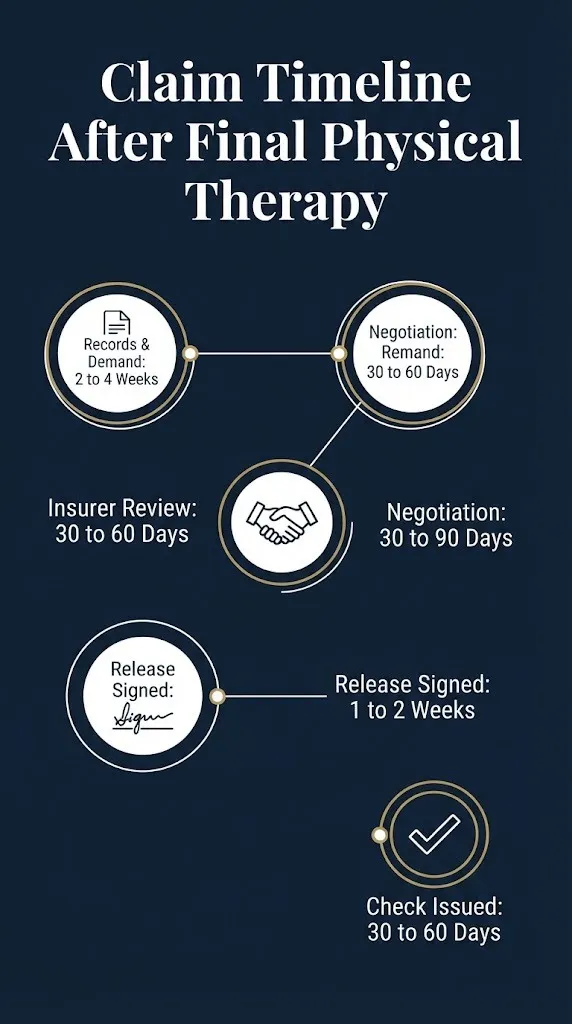
A typical uncontested timeline looks like this. After your last PT session, your doctor issues a discharge summary. Your attorney collects all records and bills. That takes two to four weeks. The demand letter goes out. The insurer takes 30 to 60 days to respond, sometimes longer. Negotiations follow, often taking another 30 to 90 days. If the case settles, the release is signed, the insurer issues payment within 30 to 60 days, and your attorney distributes the funds after deducting fees and paying liens.
That puts a realistic window from final PT session to money in your account at roughly three to six months, assuming the case settles without litigation. If you file a lawsuit, the timeline stretches to 12 to 24 months or more.
- Final PT session and discharge summary: day 0
- Records and demand package assembled: 2 to 4 weeks
- Insurer reviews demand: 30 to 60 days
- Negotiation and counteroffers: 30 to 90 days
- Settlement agreement signed: 1 to 2 weeks
- Insurer issues check: 30 to 60 days
- Attorney distributes after liens and fees: 1 to 3 weeks
Key Takeaway: Expect roughly three to six months from final PT to settlement check if your case resolves without a lawsuit.
Does Going to Physical Therapy Increase My Settlement?
Going to physical therapy can increase your settlement if the treatment is medically necessary, tied to the crash, and documented properly. It can decrease your settlement if the insurer views it as overtreatment or if the records undercut your credibility.
Think of it like a store return with a receipt. The receipt proves you bought the item and what you paid. Physical therapy records prove you were injured and what the injury cost in treatment time. Without them, the insurer assumes the injury was minor and the treatment unnecessary.
The increase comes from three sources. First, your medical expenses rise, and the insurer must account for them. Second, the treatment record shows the injury interfered with your life for months, not days. Third, the fact that a doctor prescribed and supervised the treatment adds independent support to your claim.
But the increase is not automatic. A physical therapy record that shows inconsistent attendance, minimal progress, or treatment continuing past the point of documented need will hurt more than it helps.
Does the At-Fault Driver’s Insurance Have to Pay for My Physical Therapy?
The at-fault driver’s insurer does not pay your physical therapy bills as you incur them, in most states. You pay or use your own coverage first, then seek reimbursement through the settlement. That confuses many claimants, because the insurer covers the at-fault driver, not you.
If you have medical payments coverage on your own auto policy, it pays your PT bills up to your policy limit, usually $5,000 to $25,000. If you have personal injury protection, it pays similarly but may have deductibles and co-pays. Health insurance may cover PT too, but the insurer’s subrogation right means it gets repaid from your settlement.
At settlement, the demand includes your medical bills, regardless of who paid them. The at-fault insurer’s settlement is meant to make you whole, but the mechanics of who pays your PT provider during treatment are separate.
Reality Check: No one from any insurance company will text or call you offering to pay physical therapy settlement money upfront. If someone contacts you claiming you are owed a “3 months of physical therapy settlement” and asks for a fee to release it, that is a scam. Settlement money flows through written agreements, demand letters, and releases. It never arrives by text first.
How Do Insurance Companies Calculate Pain and Suffering for Physical Therapy Claims?
Insurers do not publish their pain and suffering formulas, but claims data and industry reporting point to a common method: a multiplier applied to your economic damages, primarily medical bills and lost wages.
For a three-month physical therapy claim, the multiplier typically ranges from 1.5 to 3 times the medical specials. If your PT bills total $8,000 and you have $2,000 in lost wages, the economic total is $10,000. A multiplier of 2 yields $20,000 plus the $10,000 in specials, for a $30,000 demand. Some insurers negotiate down from there.
The multiplier is higher when liability is clear, the injury is objectively verifiable, the treatment is consistent, and the claimant has no prior similar injuries. It is lower when any of those factors is weak. Venue matters too. The same claim in a conservative rural county may draw a lower offer than in an urban plaintiff-friendly county.
No law requires an insurer to use a multiplier. Some use per-diem calculations for pain, assigning a daily rate for each day of recovery. A three-month recovery at $150 per day equals $13,500 in general damages, a less generous figure than a 2x multiplier in many cases. The method matters less than the total the adjuster is authorized to pay.
What If I Already Settled and I’m Still in Physical Therapy?
If you settled your claim while still in physical therapy and you later need more treatment, the settlement is final. You cannot reopen the claim against the at-fault insurer for additional medical care. That is why settling before reaching maximum medical improvement is risky.
The settlement release you signed contains language waiving all future claims arising from the crash. Once signed, the insurer has no further obligation, even if your doctor later says you need six more weeks of PT or surgery.
Some claimants settle early because they need money or because the insurer pressures them with a quick offer. That is a common regret in personal injury claims. The better practice is to wait until your doctor says you have reached maximum medical improvement, meaning no significant improvement is expected with further treatment, and then value the claim.
If you settled and are still treating, your options are limited. You can pay for treatment with your own health insurance or out of pocket. You may have a claim against your own attorney if the attorney advised you to settle prematurely without warning you, but that is a separate legal question requiring independent counsel.
Key Takeaway: Once you sign a release, the claim is closed forever. Settle only after your doctor says you are at maximum medical improvement.
Do I Need a Lawyer for a 3-Month Physical Therapy Settlement?
You do not need a lawyer to settle a car accident claim, including one involving three months of physical therapy. But the data on representation is consistent: represented claimants recover more, even after attorney fees, in most cases with moderate treatment and clear liability.
The reason is structural. An unrepresented claimant negotiating against a professional adjuster faces an information gap. The adjuster knows what similar cases settle for in the venue. You do not. The adjuster knows which of your records are weak. You may not. The adjuster is measured on keeping payouts low. You are measured on recovering enough to cover your bills and pain.
An attorney typically takes 33 percent of the gross settlement before litigation and 40 percent if suit is filed. On a $40,000 settlement, the attorney fee is $13,200 before costs and liens. That is real money. But if the attorney’s involvement moves the settlement from $18,000 to $40,000, you still net more with the lawyer than without.
The calculation changes if liability is disputed, if your prior injuries complicate the claim, or if the policy limits are low. In those cases, an attorney’s value increases further.
What Happens Next
If you are currently in physical therapy after a car accident and your treatment is approaching three months, here is the expected sequence.
- Next 2 to 4 weeks: Your doctor issues a discharge summary or a progress note recommending continued care.
- Expected 30 to 60 days: Your attorney, if you have one, sends the demand package to the insurer.
- Expected 60 to 120 days: The insurer responds with an offer, a denial, or a request for additional records.
- Expected 90 to 180 days: If the case settles, you sign a release and the insurer issues payment.
- If no settlement by month 6: Your attorney evaluates whether filing a lawsuit is warranted.
The single most important date is not a deadline on a website. It is the date your state’s statute of limitations runs. In most states, that is two or three years from the crash date. If you miss it, your claim is permanently barred regardless of how much physical therapy you attended.
Frequently Asked Questions
Is 3 months of physical therapy a lot for a car accident?
Three months of physical therapy is a moderate treatment duration for a car accident injury.
It suggests a soft tissue injury that did not resolve quickly but did not require surgery.
Claims with this treatment length typically fall into a middle settlement range.
How much should I settle for after 3 months of physical therapy?
No universal settlement figure exists for a three-month physical therapy claim.
Reported ranges for moderate soft tissue injuries with that treatment duration span roughly $18,000 to $75,000 with clear liability.
Your case may settle for more or less based on policy limits, diagnosis, venue, and the quality of your records.
Can I settle my car accident claim while still doing physical therapy?
You can settle while still treating, but doing so usually means settling for less than the claim’s full value.
The release you sign bars any future recovery for the same crash.
Wait until your doctor confirms maximum medical improvement before accepting an offer.
Does physical therapy increase a settlement?
Documented, medically necessary physical therapy generally increases a settlement.
It proves the injury was serious enough to require supervised rehabilitation.
Padded or inconsistent treatment records do the opposite.
How long after my last physical therapy session will I get paid?
Most uncontested claims settle three to six months after the final physical therapy session.
The timeline includes records collection, demand, negotiation, release, and insurer payment.
If you file a lawsuit, expect a year or more.
Who pays for physical therapy after a car accident?
Your own medical payments or PIP coverage typically pays first, if you have it.
Health insurance may also pay, subject to a lien on your settlement.
The at-fault insurer reimburses through the final settlement, not before.
What is the average whiplash settlement with physical therapy?
Whiplash claims with documented physical therapy for two to three months commonly settle between $15,000 and $50,000 with clear liability.
The range is wide because whiplash severity and policy limits vary.
No official average exists because settlements are private.
Do I have to pay taxes on my physical therapy settlement?
Personal injury settlements for physical injuries are generally not taxable as income.
That includes compensation for medical bills, lost wages, and pain and suffering tied to the injury.
Interest on a delayed settlement and punitive damages are taxable, but those are rare in car accident claims.
Your three months of physical therapy records are not a lottery ticket. They are evidence. Used correctly, they document a real injury, a real recovery period, and a real financial loss. The settlement should reflect those facts, nothing more.
Do not let a quick offer from an adjuster, a website promising a magic payout number, or a fee-charging “claim helper” rush you into a decision. Gather your records. Check your state’s statute of limitations. Talk to a licensed attorney if you want a second opinion. The clock that matters most is the one that closes your claim forever.