Tesla Class Action Lawsuit 2026: FSD Ruling, Payouts and What Owners Can Do
Quick Answer
- A Ninth Circuit panel ended class status for California Tesla Full Self-Driving buyers on October 16, 2026.
- No FSD payout exists. A separate idle fee settlement pays $50 or $350 for disabled vehicles.
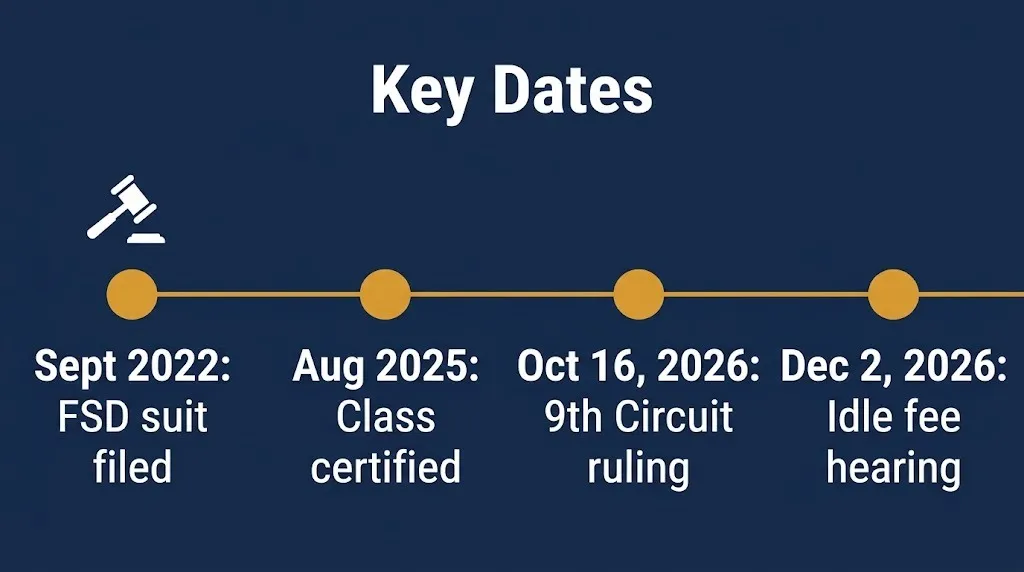
- The idle fee claim deadline was September 25, 2026. Its final approval hearing is December 2.
The Tesla class action lawsuit most readers mean, over Full Self-Driving marketing, lost its class status on October 16, 2026. A federal appeals court said too many individual questions about what buyers saw made a class unworkable.
It affected California buyers who paid for Full Self-Driving, and no payout is available in that case. The date to know is December 2, 2026, the final approval hearing in a separate Tesla settlement.
This guide covers the ruling, the money, your options, and Tesla’s other 2026 cases. One surprise: most of the original plaintiffs were sent to individual arbitration back in September 2023.
The Facts
| Case | In re Tesla Advanced Driver Assistance Systems Litigation, U.S. District Court, Northern District of California (case number not yet confirmed) |
| Status | Ninth Circuit threw out class certification October 16, 2026. The merits remain unresolved |
| Fund Size | None. No settlement fund exists |
| Est. Per Person | Not yet determined. No payout is available in this case |
| Claim Deadline | None. No claim process exists for the FSD class |
| Administrator | None for the FSD case |
| Proof Needed | Not applicable. The related idle fee claim window closed September 25, 2026 |
Is there a Tesla class action lawsuit right now?
Yes, several Tesla class actions are active in 2026, but they cover different issues and only one pays money today. The one most people search for, over Full Self-Driving, just lost its class status.
| Case | Issue | Status |
|---|---|---|
| FSD marketing (Northern District of California) | Alleged misleading self-driving claims | Class certification thrown out October 16, 2026 |
| Supercharger idle fees (Alameda County Superior Court) | Fees and disabled vehicles | Claim window closed. Final hearing December 2, 2026 |
| Securities suit (Western District of Texas) | Statements on Autopilot, FSD, and Robotaxi | Motion to dismiss filed April 20, 2026 |
| Race discrimination (Alameda County) | Workplace harassment | Class decertified November 17, 2025 |
Each case has its own court, class definition, and deadlines. Mixing them up is the most common reader mistake.
Check which one fits your situation before you act.
What happened to the Tesla Full Self-Driving class action on October 16, 2026?
The Ninth Circuit threw out the order that let California Tesla buyers sue together over Full Self-Driving, ruling the case can’t proceed as a class action. The October 16 decision came from a three-judge panel in San Francisco.
The panel said the trial court wrongly assumed every buyer saw the same allegedly misleading website statement. Too many individualized questions about what each buyer saw made a class improper.
The ruling covers only class status. It doesn’t decide whether Tesla’s marketing was truthful.
Tesla denies the claims. Plaintiffs’ lawyers said the panel didn’t fully appreciate the unique circumstances or the weight of Tesla’s hardware statement.
The panel included Judges Ronald Gould, Jay Bybee, and Daniel Bress. The U.S. Chamber of Commerce had urged the court to strike the class orders.
Is the Tesla Supercharger idle fee settlement real?
Yes, the Tesla Supercharger idle fee settlement is real, and it has an official settlement website and a court case number. The case is Shenkman v. Tesla, Inc., Case No. RG21102833, in Alameda County Superior Court.
Tesla denies wrongdoing but agreed to settle. The class is limited to a defined group of California owners.
You may qualify if all of these apply:
- You received an eligible Tesla before December 16, 2016.
- You kept the vehicle after that date.
- You were a California citizen as of June 21, 2021.
- Your purchase agreement used one of three Supercharger descriptions, such as “Supercharger Enabled.”
Class members who did nothing don’t receive cash payments. The only path to cash was a valid, timely claim form.
The settlement administrator’s mailing address is in Santa Ana, California. The administrator’s name was not stated in the sources we checked.
Key Takeaway: The FSD class action lost class status on October 16, 2026, while the idle fee settlement is real but its claim window has closed.
How much could you get from a Tesla class action lawsuit?
Per-person amounts are not yet determined in the FSD case and the securities case, and the only confirmed payments come from the idle fee settlement. Amounts depend on the case.
| Case | Verified payout |
|---|---|
| FSD marketing class action | None. Class certification was thrown out |
| Idle fee settlement | Refund of idle fees paid through settlement date. $50 if disabled under 30 days. $350 if disabled 30 or more consecutive days |
| Securities class action | Not yet determined. No settlement reported |
| Race discrimination class | Not yet determined. Class was decertified |
The idle fee settlement is a benefit program, not a fixed fund, according to one tracker. Your amount depends on Tesla’s records of your vehicle.
If you have multiple eligible vehicles, you needed a separate claim for each.
Be skeptical of sites projecting big Tesla payouts. One page projects a settlement range for a mileage case, but it says settlement talks hadn’t begun. That’s speculation, not a verified figure.
Can you still claim money in the Tesla idle fee settlement?
No, the claim deadline for the Tesla idle fee settlement was September 25, 2026, and it has passed. Online claims and postmarked mailed claims both had to meet that date.
The same date applied to exclusion and objection requests. Class members who did nothing don’t get cash.
It’s like returning a store item after the return window closes. The item is fine, but the offer is gone.
The next date is December 2, 2026. That’s the final approval hearing, set for Oakland.
Payments won’t be issued until the judge grants final approval and any appeals or objections are resolved. Check the official settlement website for any late-claim rules, which are not yet confirmed.
If your Tesla is still eligible and you still own it, Tesla also agreed to restore Supercharger access, per local news coverage.
Reality Check: No one legitimate texts you first offering a Tesla payout. Filing a claim in an approved settlement is free, so ignore anyone charging a fee to “register” you. Use only the official settlement website.
What can Tesla FSD buyers do now after the class was decertified?
Tesla FSD buyers can pursue individual claims, check arbitration terms, and keep records while the case’s next steps play out. The class route is closed for now.
- Find your Tesla purchase agreement and read any arbitration clause.
- Save your order confirmation and screenshots of what you saw.
- Note the date you bought and what you paid for Full Self-Driving.
- Check whether you opted out of arbitration at purchase.
- Talk to a licensed attorney about individual or small-claims options.
- Watch for news on any rehearing or further review, not yet confirmed.
- Never assume the ruling ended all claims.
The ruling addressed class status only. The question of whether the marketing was misleading remains unresolved.
Individual cases can proceed in court or in arbitration, depending on your agreement.
How do you check if you’re in a Tesla class action?
You check by matching your purchase, state, and dates to the class definition in each case. The class definition is the single most important detail.
- Write down when and where you bought or leased your Tesla.
- Note your state of residence at that time.
- Find your purchase agreement and its exact contract wording.
- Compare your facts with the class definition on the official settlement website.
- Check whether you signed an arbitration agreement.
- Look for any notice sent by the settlement administrator.
- Confirm deadlines before you act.
Notices usually come by email or mail. Don’t click links in unexpected texts.
If you don’t fit the class, you may still have an individual claim. A licensed attorney can review your options.
What documents should Tesla owners keep for a lawsuit?
Tesla owners should keep their purchase agreement, order confirmation, payment records, and screenshots of marketing claims. Documents decide who qualifies and what proof they have.
Think of it like a warranty claim. Without the receipt and the original terms, you’re arguing from memory.
Build your file with this checklist:
- The signed purchase or lease agreement, with any arbitration clause.
- Your order confirmation and the date you bought.
- Proof you paid for Full Self-Driving or other add-ons.
- Screenshots or copies of Tesla website statements you relied on.
- Supercharger statements showing idle fees, if relevant.
- Any notices from Tesla or a settlement administrator.
In the FSD ruling, the court focused on what buyers actually saw. That makes your own screenshots and notes more important.
Save everything now. Websites change, and old pages disappear.
Key Takeaway: You can’t join a decertified FSD class, but you can protect individual claims by keeping your purchase agreement and proof of what you saw.
What is the latest on the Tesla securities class action?
The latest verified step is Tesla’s April 20, 2026 motion to dismiss, and a ruling is not yet confirmed in the sources we checked. The proposed class action was filed August 4, 2025.
It sits in the U.S. District Court for the Western District of Texas. It names Tesla, Elon Musk, and certain current and former executives.
The complaint alleges misleading statements in public filings about Autopilot, Full Self-Driving (Supervised), and Robotaxi. It seeks money for people who bought Tesla stock between April 19, 2023, and June 22, 2025.
The plaintiffs filed an amended complaint on February 17, 2026. Tesla says it will defend itself vigorously and can’t estimate any loss.
If you bought stock in that window, you may be in the proposed class. No claim process exists unless a settlement is reached and approved.
What is happening with other Tesla lawsuits in 2026?
Tesla faces individual injury verdicts, a California regulatory dispute, and a federal safety probe alongside its class actions. Each runs on a separate track.
| Matter | Verified detail |
|---|---|
| Benavides v. Tesla | Jury verdict August 1, 2025, in Southern District of Florida. A judge sustained a $243 million award in February 2026, with jurors assigning about one-third of fault to Tesla |
| California DMV | December 2025 decision found Tesla’s Autopilot and Full Self-Driving Capability terms violated false-advertising law. Tesla sued the DMV in February 2026 |
| NHTSA | October 2024 probe into Full Self-Driving covering 2.4 million vehicles |
| Race discrimination class | Certified on limited issues May 17, 2024. Decertified November 17, 2025 |
The Benavides case is not a class action. It’s an individual wrongful-death case, and it shows how single plaintiffs can win large awards even when class actions fail.
Tesla says it can’t predict outcomes in these matters.
Is there a Tesla odometer or mileage class action?
We could not verify a certified Tesla odometer or mileage class action with a settlement. One tracker describes a mileage case as pre-certification and projects a large payout, but it admits no settlement talks have started.
Treat projected numbers as guesses. A projected range isn’t a court-approved fund.
A separate page reports attorneys investigating a Hardware 3 case, including a June 2026 suit titled Waller. Details of that case are not yet confirmed.
Lawyer-investigation pages often collect leads. They don’t mean a class exists.
Here’s how to check any Tesla class action claim:
- Look for a case name and number.
- Look for a court.
- Look for an official settlement website.
- Look for a named settlement administrator.
If any of those are missing, wait.
What is a class action, and why do arbitration clauses matter in Tesla cases?
A class action lets many people with similar claims sue together, and an arbitration clause can push your claim out of court. In the Tesla FSD case, arbitration shrank the group before the appeal.
In September 2023, federal judge Haywood Gilliam sent most of the original named plaintiffs to individual arbitration. They had signed Tesla’s standard purchase agreement.
That left buyers who explicitly opted out of arbitration as the eligible group. In August 2025, Judge Rita Lin certified a limited class of California consumers not subject to arbitration.
It works like fine print in a warranty. The clause you skim at purchase can decide where you can sue.
The Ninth Circuit later threw out those class orders. The result is that arbitration and class limits both narrowed this case.
What did the Tesla FSD lawsuit claim about full self-driving hardware?
The plaintiffs claim Tesla told buyers that vehicles sold from October 2016 onward had the hardware needed for full self-driving. They say customers paid extra for software that doesn’t work as promised.
Tesla has denied these claims. The Ninth Circuit did not rule on whether the statement was misleading.
Judge Lin had found that thousands of prospective buyers were likely exposed to the website claim. The appeals panel disagreed that this applied to all buyers.
The classes Judge Lin certified covered California drivers who bought or leased a Tesla and paid separately for Full Self-Driving. One class ran from October 20, 2016, through May 19, 2017, and another from May 19, 2017, through July 31, 2024, limited to arbitration opt-outs.
The original case dates to September 2022, with Thomas LoSavio as lead plaintiff.
How do regulators view Tesla’s Autopilot and Full Self-Driving names?
California’s DMV found Tesla violated state false-advertising law by using the terms Autopilot and Full Self-Driving Capability. That December 2025 decision gave Tesla 60 days to fix the problem or risk a dealer license suspension.
Tesla made temporary marketing changes to protect its California dealer license. It then sued the DMV in February 2026 to overturn the decision.
Regulators abroad pushed back too. After German transport authorities objected to the name, Tesla agreed to use “Tesla Assisted Driving” on its European websites.
The federal safety probe is separate from the marketing fights. NHTSA’s October 2024 investigation followed four reported crashes in reduced-visibility conditions, including a fatal pedestrian collision.
None of these actions pays consumers. They do shape how courts and juries view the marketing.
What Happens Next
Expected, date not confirmed: Plaintiffs decide whether to seek further review of the Ninth Circuit ruling.
December 2, 2026: Final approval hearing in the Tesla idle fee settlement, in Oakland.
Expected after final approval: Idle fee payments issue once any appeals or objections are resolved.
Not yet confirmed: A ruling on Tesla’s motion to dismiss the securities class action.
Expected: Individual FSD claims continue in court or arbitration, depending on each buyer’s agreement.
Frequently Asked Questions
Is there a Tesla class action lawsuit I can join?
Not right now for Full Self-Driving, because the class was thrown out October 16, 2026.
The idle fee settlement claim window closed September 25, 2026.
Check each case’s official website.
What happened to the Tesla FSD class action?
The Ninth Circuit ruled it cannot proceed as a class action.
Judges said too many individual questions about what buyers saw.
The merits remain unresolved.
How much is the Tesla idle fee settlement?
Eligible members could get a refund of idle fees plus $50 or $350 for disabled vehicles.
The $350 applies to 30 or more consecutive days.
Amounts depend on Tesla’s records.
What is the Tesla idle fee settlement deadline?
The claim deadline was September 25, 2026.
The final approval hearing is December 2, 2026.
Payments wait for final approval.
Can I sue Tesla over Full Self-Driving on my own?
You may have individual options, but your purchase agreement may require arbitration.
A licensed attorney can review your agreement.
Keep your records.
Is there a Tesla securities class action?
Yes, a proposed class action was filed August 4, 2025, in the Western District of Texas.
It covers stock bought between April 19, 2023, and June 22, 2025.
Tesla moved to dismiss in April 2026.
Is the Tesla odometer lawsuit real?
We couldn’t verify a certified odometer class action or a settlement.
Projected payout figures online are speculation.
Check for a case name, court, and settlement website.
Closing
Find your Tesla purchase agreement today and read the arbitration clause. Save your order confirmation and any screenshots of Tesla’s claims.
Then calendar December 2, 2026, the final approval hearing in the Tesla idle fee settlement. That’s the next confirmed date in any Tesla class case.