Auto Accident Compensation in 2026: What California Claims Actually Pay
Quick Answer
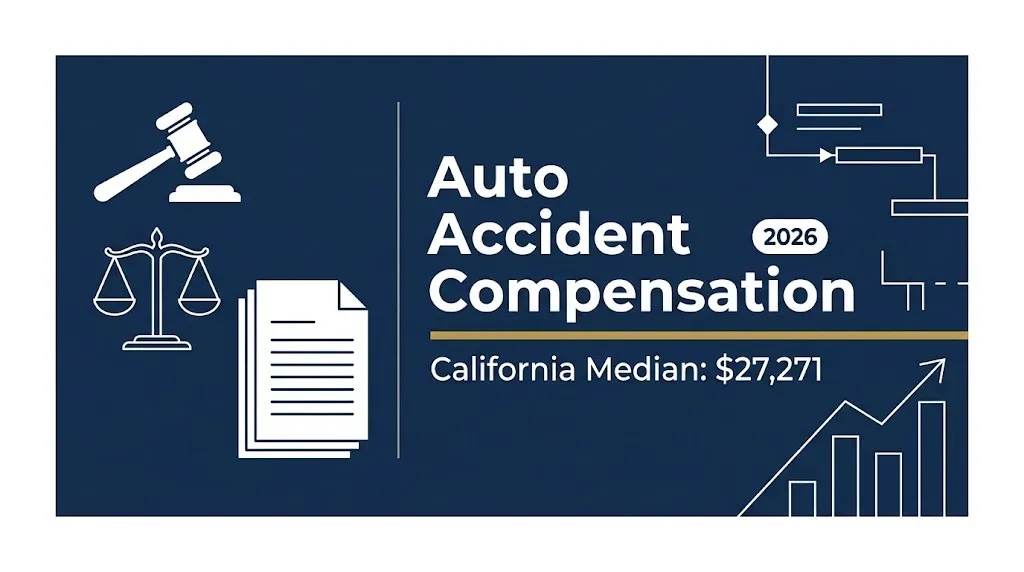
- Median settlement: Around $27,271 across 4,188 analyzed cases, with typical range of $9,327 to $133,125.
- Average with attorney: Cases with representation settle roughly 3.4 times higher than unrepresented claims.
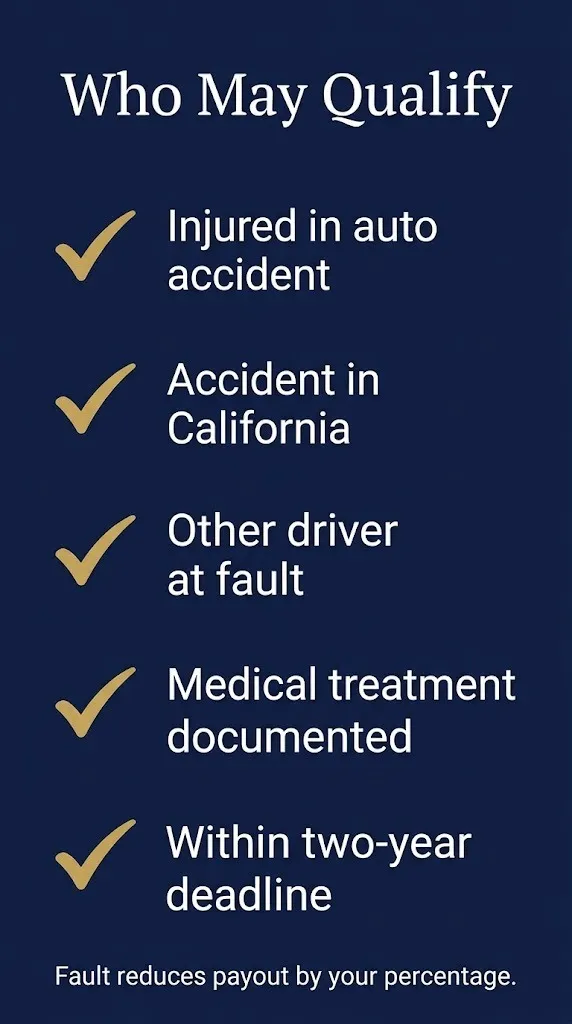
- Key deadline: California’s statute of limitations for personal injury is generally two years from the accident date.
Auto accident compensation in California is not a lottery ticket. It is a calculation built from medical bills, lost wages, pain and suffering, and one variable that trips up most people: your share of the fault.
The average car accident settlement in California sits between $15,000 and $80,000, with a median closer to $23,000 for cases that resolve without trial. But those numbers hide more than they reveal. A whiplash claim and a spinal cord injury claim are not the same case, even if they happen on the same freeway.
This article breaks down what actually drives settlement values in 2026, how California’s pure comparative fault system cuts your payout, what new laws change the game, and the exact steps to protect your claim starting today.
The Facts
| Item | Detail |
|---|---|
| Average Settlement (CA) | $15,000 to $80,000, median around $23,000 |
| Median (National) | $27,271 across 4,188 cases |
| Fault Rule | Pure comparative fault, recovery reduced by your % of blame |
| Statute of Limitations | Generally two years from accident date |
| Minimum Insurance (2025+) | $30,000 per person / $60,000 per accident |
| Rideshare Coverage | Up to $1 million when app shows ride accepted |
Is auto accident compensation in California legitimate or a scam?
Auto accident compensation is legitimate when it comes from an insurance company or court judgment, not from a text message promising free money. California has real laws, real courts, and real insurance requirements. The scam risk lives in the space between the legitimate claim and the person who contacts you first.
California’s Department of Insurance and consumer protection agencies have flagged common schemes. Some involve fake “claim processors” who demand upfront fees. Others come from medical lien companies that inflate treatment costs and take a cut of your settlement.
Warning signs of a compensation scam:
- Someone contacts you first about a settlement you never filed.
- They ask for an upfront fee to “release” your money.
- They request your Social Security number or bank details before you verify anything.
- They pressure you to sign immediately without reviewing the paperwork.
- The caller ID shows a government agency, but the number does not match the official listing.
Real auto accident compensation follows a process. You file a claim. The insurer investigates. You negotiate or litigate. No legitimate party texts you a settlement offer before you have even reported the crash.
Key Takeaway: Real compensation comes through insurance claims or lawsuits, never through unsolicited messages demanding fees or personal data.
How much is auto accident compensation in California worth in 2026?
Auto accident compensation in California ranges from a few thousand dollars for minor soft tissue injuries to several million for catastrophic harm, with the median settlement around $23,000 to $27,000. The number that matters for your case depends on injury severity, medical documentation, and liability evidence.
Here is what different injuries actually pay based on 2026 data.
| Injury Type | Typical Settlement Range |
|---|---|
| Whiplash / soft tissue | $5,000 to $20,000 |
| Mild concussion | $20,000 to $30,000 |
| Broken bones | $30,000 to $100,000 |
| Herniated disc | $50,000 to $100,000+ |
| Spinal cord injury | $1 million+ |
These ranges assume strong liability evidence and consistent medical treatment. They do not include cases where fault is disputed or where you share blame.
The median settlement across 4,188 analyzed cases is $27,271, with the middle 50% falling between $9,327 and $133,125. That wide spread reflects one truth: injury severity drives value more than any other factor.
Average numbers mislead because a single $5 million verdict pulls the mean up for everyone. The median tells you what half of claimants actually receive.
Key Takeaway: Median settlement is roughly $27,000, but your injury type and documentation determine whether you land near the bottom or top of that range.
How does California’s pure comparative fault rule reduce your settlement?
California follows pure comparative fault, which means your compensation is reduced by your percentage of fault, no matter how high that percentage goes. If a jury finds you 20% responsible, you recover 80% of your damages. If you are 90% responsible, you still recover 10%.
This rule comes from California Civil Code § 1714. It replaced the old contributory negligence system in 1975 because the old rule barred recovery entirely if you shared any fault.
Insurance adjusters know this rule and use it aggressively. They assign fault percentages before you even realize it is negotiable. A rear-end collision that was clearly the other driver’s fault suddenly becomes “you should have braked sooner” and a 30% fault assignment.
Common tactics adjusters use to shift fault to you:
- Claiming you were distracted by the radio or a passenger.
- Arguing you failed to avoid a collision you saw coming.
- Suggesting your delayed medical treatment proves the injury was not serious.
- Pointing to pre-existing conditions as the real cause of your pain.
The fault percentage an adjuster assigns is not a legal determination. It is an opening offer. Police reports, witness statements, dashcam footage, and accident reconstruction can reduce or eliminate an unfair fault assignment.
Key Takeaway: Your settlement shrinks by whatever fault percentage gets assigned to you, and that percentage is negotiable evidence, not a fixed fact.
What damages can you recover in a California auto accident claim?
California auto accident compensation covers both economic and non-economic damages, meaning your measurable financial losses plus pain, suffering, and emotional harm. Economic damages get calculated from receipts and records. Non-economic damages get estimated using multipliers that insurers often fight over.
Economic damages include:
- Medical bills from emergency care, surgery, physical therapy, and future treatment.
- Lost wages for time missed from work, including future earning capacity if the injury limits your career.
- Property damage for vehicle repair or replacement.
- Out-of-pocket costs like transportation to appointments and prescription medications.
Non-economic damages include:
- Pain and suffering from the injury itself and the recovery process.
- Emotional distress including anxiety, depression, and PTSD.
- Loss of enjoyment for activities and hobbies you can no longer do.
Insurers typically apply a multiplier of 1.5 to 5 times your economic damages to estimate pain and suffering. Minor soft tissue injuries sit near the low end. Permanent, life-altering harm pushes toward the high end or beyond, using a per-diem method instead.
Multiple injuries can increase a settlement by 30 to 50 percent compared to a single injury claim. Commercial truck accidents carry multipliers roughly 3.4 times higher than standard car cases because of federal regulations and corporate liability exposure.
Key Takeaway: Economic damages pay your bills. Non-economic damages pay for what the crash took from your life, and both categories belong in your claim.
How do you file an auto accident compensation claim in California?
You file an auto accident compensation claim by reporting the crash, gathering evidence, notifying insurers, and either negotiating a settlement or filing a lawsuit before the deadline. The process starts the moment the accident happens, not when you decide to hire an attorney.
Numbered steps to file your claim:
- Report the accident to police and file an SR-1 with the DMV within 10 days if there was injury or death.
- Seek medical attention immediately, even if you feel fine, to document injuries and create a treatment record.
- Gather evidence including photos, witness contacts, police report, and the other driver’s insurance information.
- Notify your own insurer about the crash, but provide only basic facts and avoid recorded statements until you understand your rights.
- Collect medical records and bills as treatment continues, tracking every expense tied to the accident.
- Send a demand letter to the at-fault driver’s insurer outlining your damages and requested settlement amount.
- Negotiate or litigate if the insurer’s offer falls short, which may mean filing a lawsuit within the two-year deadline.
- Document everything including lost wages, out-of-pocket costs, and how the injury affects daily life.
Filing a claim costs nothing. Contingency fee attorneys charge nothing upfront and take a percentage only if you recover money.
Key Takeaway: Report, document, treat, notify, then negotiate. The steps you take in the first 48 hours shape what your claim is worth months later.
Reality Check
No one texts you auto accident compensation money. If you get a message saying you have a settlement waiting and need to pay a fee or provide bank details to release it, that is a scam. Real compensation comes through a claim process you initiate or an attorney you hire, never through an unsolicited text. California’s Victim Compensation Board exists for certain crime-related expenses, but it does not text you either.
How does insurance coverage limit your auto accident compensation?
Your auto accident compensation cannot exceed the at-fault driver’s available insurance coverage unless the driver has personal assets to pursue. California’s minimum liability coverage is now $30,000 per person and $60,000 per accident for bodily injury, raised from the old $15,000/$30,000 limits in January 2025.
That is still not much. A serious injury can blow past $30,000 in the first hospital visit. When the at-fault driver’s policy runs out, your options shrink.
What happens when insurance is not enough:
- Uninsured/underinsured motorist coverage (UM/UIM) from your own policy may cover the gap, if you purchased it. Insurers must offer it but you can decline.
- Rideshare coverage can reach $1 million when the app shows a ride accepted or in progress.
- Personal assets of the at-fault driver become the target only if they have real wealth and you win a judgment.
- Med Pay from your own policy covers medical bills regardless of fault, usually in smaller amounts.
A hit-and-run with no identified driver leaves you with your own UM/UIM coverage or the California Victim Compensation Board if the incident qualifies as a crime.
Key Takeaway: The at-fault driver’s policy limit caps most settlements, so UM/UIM coverage on your own policy is often the most important number you never check.
How do Uber and Lyft accidents change your compensation?
Uber and Lyft accidents in California can access up to $1 million in liability coverage when the driver’s app shows a ride accepted or in progress. The coverage available depends entirely on the app status at the moment of the crash, which the rideshare companies track with timestamped data.
California divides rideshare driving into periods with different insurance rules:
| Period | App Status | Coverage Available |
|---|---|---|
| Period 0 | App off | Driver’s personal insurance only |
| Period 1 | App on, no ride accepted | $50,000 per person / $100,000 per accident |
| Periods 2 & 3 | Ride accepted or passenger aboard | $1 million liability |
Disputes arise when drivers claim the app was off to keep their personal insurer on the hook, or when a crash happens at the transition point between periods. Subpoenas for app data often resolve the question, but that takes time and legal process.
If you were a passenger in an Uber or Lyft during a crash, you are covered under the same rules. The $1 million policy applies if the ride was active. If you were in your own car hit by a rideshare driver, your claim follows the same period-based structure.
Key Takeaway: App status at the moment of impact determines whether you chase a $30,000 personal policy or a $1 million rideshare policy.
What does California’s new SB 623 law change for accident claims?
SB 623, signed June 25, 2026, imposes new rules on medical liens, referral arrangements, and rideshare liability for California auto accident cases, effective for crashes occurring on or after January 1, 2027. It replaces a ballot fight between Uber and the Consumer Attorneys of California that would have imposed far stricter limits on contingency fees and medical expense recovery.
The law targets medical lien practices that critics call abusive. Lien-based providers treat accident victims on credit, expecting payment from the settlement. Some sell those liens to third parties at a discount, and the new law makes those transfers discoverable and restricts undisclosed liens from being recovered against settlement proceeds.
What SB 623 changes:
- Medical lien transfers must be disclosed to all parties within 30 days.
- Undisclosed liens cannot be asserted against settlement money or defendants.
- Attorney referral arrangements with lien-based providers face new restrictions.
- Rideshare accident claims get benchmark limits on recoverable lien-based medical expenses.
- Background check requirements on transportation network companies expand.
The practical effect for accident victims depends on whether your treatment involved a medical lien, and whether that lien gets sold or transferred before your case resolves.
Key Takeaway: SB 623 tightens rules on medical liens in accident cases starting in 2027, but the core claim process and fault rules stay the same.
What happens next in your auto accident compensation timeline?
Your auto accident compensation timeline depends on whether the case settles or goes to trial, with most cases resolving within months but litigation stretching past a year. The statute of limitations gives you two years to file a lawsuit, but evidence weakens and memories fade long before that deadline.
Expected stages:
- Immediately after crash: Medical treatment, evidence gathering, police report, DMV filing if required.
- Weeks 1 to 4: Insurance notification, initial medical records collection, demand letter preparation.
- Months 1 to 6: Settlement negotiation with adjusters, possible mediation, treatment continuing.
- Months 6 to 12: If no settlement, lawsuit filing and discovery begin.
- Year 1 to 2: Litigation, depositions, expert witnesses, trial date if needed.
- Trial or settlement: Roughly 95% of cases settle before trial.
The two-year deadline is not a target. It is a wall. Filing on day 729 gives the defense almost two years of faded evidence to attack.
Key Takeaway: Most cases settle within six months, but the two-year filing deadline is a hard stop, not a suggestion.
Frequently Asked Questions
How much is the average auto accident settlement in California?
Average settlements run $15,000 to $80,000, with a median around $23,000. Serious injury cases with strong documentation can reach six figures or more.
How long do you have to file an auto accident claim in California?
You generally have two years from the accident date to file a personal injury lawsuit. Missing that deadline usually bars recovery entirely.
Does California use fault to reduce car accident settlements?
Yes. California follows pure comparative fault. Your compensation is reduced by your percentage of responsibility, even if you are mostly at fault.
What if the at-fault driver has no insurance?
You may recover through your own uninsured motorist coverage, or through the California Victim Compensation Board if the crash qualifies as a crime like hit-and-run.
How much can you get from an Uber accident in California?
Up to $1 million if the driver’s app showed a ride accepted or in progress at the time of the crash. Personal insurance applies if the app was off.
Can you still recover compensation if you were partially at fault?
Yes. California allows recovery regardless of your fault percentage, though your payout drops by that same percentage.
What damages are not available in a California car accident claim?
Property damage is recoverable, but California’s Victim Compensation Board does not pay property damage, court costs, or attorney fees for crime-related claims.
Do you need an attorney for an auto accident claim in California?
Not legally, but data shows represented claimants receive settlements roughly 3.4 times higher on average, even after fees.
Your Next Step
If you were in a crash, the clock started the moment it happened. Two years sounds long until you are 18 months out with incomplete medical records and an adjuster who stopped returning calls.
Call your insurance company if you have not already. Gather every medical bill and wage stub tied to the accident. Calendar the two-year deadline from your crash date. That date is the one that matters most.