Tesla Elon Musk Compensation Plan 2026: Court Rulings, Pay Package Status, and What Happens Next
Quick Answer
- The Tesla Elon Musk compensation plan is a real 2018 pay package, not a consumer settlement or class action.
- No payout, claim form, or settlement administrator exists because this is a corporate governance dispute, not a consumer case.
- The key unresolved issue is whether Tesla shareholders can ratify the voided package despite the court’s ruling.
The Tesla Elon Musk compensation plan is not a consumer lawsuit. It is a shareholder derivative action over corporate governance. You cannot file a claim, receive a payout, or join a settlement. That is the most important thing to understand before reading further.
The 2018 pay package, valued at roughly $56 billion at grant date, was the largest executive compensation plan in U.S. corporate history. A Delaware judge struck it down in January 2024. Tesla shareholders then voted to ratify it in June 2024. The legal fight over whether that ratification works is still playing out in 2026.
This article explains what the compensation plan is, why the court voided it, where the litigation stands now, and what it means for Tesla shareholders, corporate governance watchers, and anyone confused by headlines about Elon Musk’s pay.
The Facts
| Detail | Verified Information |
|---|---|
| Case | Tornetta v. Musk, et al. |
| Court | Delaware Court of Chancery |
| Case Number | C.A. No. 2018-0408-KSJM |
| Status | Rescission ordered, ratification disputed, appeals pending |
| Total Compensation Value | Approximately $56 billion at grant date |
| Per-Person Payout | Not applicable, no consumer settlement |
| Claim Deadline | None exists |
| Administrator | None, not a settlement |
| Proof Needed | Not applicable |
Is the Tesla Elon Musk Compensation Plan a Lawsuit or a Settlement?
The Tesla Elon Musk compensation plan is the subject of a shareholder lawsuit, not a settlement. The case is Tornetta v. Musk, filed in the Delaware Court of Chancery in 2018.
A shareholder named Richard Tornetta sued Tesla’s board and Musk. He alleged that the board breached its fiduciary duties by awarding Musk an outsized pay package without proper independence or negotiation.
Chancellor Kathaleen McCormick ruled on January 30, 2024 that the package must be rescinded. She found the board was not sufficiently independent from Musk and that shareholders were not fully informed when they approved the plan in 2018.
No settlement fund exists. No claims administrator has been appointed. No class member will receive a check. This is corporate litigation, not consumer litigation.
Key Takeaway: The Tesla Musk pay case is a shareholder derivative action over board conduct, not a consumer class action with payouts.
How Much Is the Elon Musk Compensation Package Worth?
The Elon Musk compensation package was valued at approximately $56 billion at the time it was granted in 2018. That figure comes from court filings and was the largest executive pay package ever awarded to a CEO of a publicly traded company.
The package was not a salary. It consisted of 12 tranches of stock options. Each tranche vested only if Tesla hit specific market capitalization and operational milestones.
By 2021, Tesla had hit all 12 milestones, and Musk received all 12 option tranches. At the time the Delaware court ruled, the package’s value had fluctuated significantly with Tesla’s stock price.
The compensation plan was structured as follows:
| Component | Detail |
|---|---|
| Form | 20.3 million stock options, split into 12 tranches |
| Exercise Price | $23.34 per share |
| Vesting Triggers | Market cap milestones starting at $100 billion, rising in $50 billion increments |
| Operational Triggers | Revenue and adjusted EBITDA targets |
| Board Oversight | Compensation committee chaired by Ira Ehrenpreis |
The court’s rescission ruling means Musk cannot exercise the remaining unexercised options. Tesla has since taken accounting charges related to the package.
What Did the Delaware Court Rule About Elon Musk’s Pay?
The Delaware Court of Chancery ruled on January 30, 2024 that the 2018 Elon Musk compensation package must be rescinded. Chancellor Kathaleen McCormick found the approval process was deeply flawed.
The court found that Musk controlled the negotiation process despite owning only about 22 percent of Tesla stock. The compensation committee was not independent. The shareholder vote in 2018 was based on a proxy statement that omitted key facts about Musk’s relationship with the directors who negotiated the deal.
The ruling was not about whether Musk deserved the money. It was about whether the process met Delaware fiduciary duty standards. The court found it did not.
Chancellor McCormick wrote that the package was “the largest potential compensation opportunity ever observed in public markets by multiple orders of magnitude.” She also found the board failed to prove the package was entirely fair to shareholders.
Key Takeaway: The Delaware court voided Musk’s pay package because the approval process failed fiduciary duty standards, not because of any consumer harm.
Has the Delaware Supreme Court Weighed In?
The Delaware Supreme Court had not issued a final ruling on the Elon Musk compensation package appeal as of September 2, 2026. The case remains in a procedural holding pattern.
Tesla appealed the Court of Chancery’s rescission ruling. The company argued that the June 2024 shareholder ratification vote cured the defects Chancellor McCormick identified.
The Delaware Supreme Court has not yet decided whether ratification can override a post-trial rescission order. That question is novel. Delaware law has no clear precedent for a situation where shareholders re-approve a package after a court has already voided it.
If the Supreme Court rules that ratification does not cure the original defect, the package remains void. If it rules that ratification can work, the case may return to the Chancery Court for further proceedings.
Can Tesla Shareholders Ratify the Voided Pay Package?
Tesla shareholders voted in June 2024 to ratify the Elon Musk compensation package. More than 70 percent of voting shares approved the ratification, excluding Musk’s own shares and those of his brother Kimbal Musk.
But the legal effect of that vote is unclear. Chancellor McCormick ruled in December 2024 that the ratification vote could not automatically overturn her January 2024 rescission ruling. She held that Delaware law does not allow a post-trial ratification to nullify a final judgment.
Tesla appealed that ruling. The company argues the shareholder vote demonstrates that investors want the package to stand. The plaintiff argues that a flawed process cannot be cured by another flawed process.
This is not like a store accepting a return without a receipt. It is more like a judge voiding a contract and then one party asking the same judge to ignore her own ruling because the other side held a new vote.
Key Takeaway: The June 2024 ratification vote happened, but the Delaware Chancery Court ruled it did not automatically restore the voided package.
What Is the Current Status of the Tesla Musk Pay Litigation in 2026?
The Tesla Musk pay litigation remains active in the Delaware courts as of September 2, 2026. The case is not settled and not dismissed.
The current posture involves multiple layers. The Delaware Supreme Court is considering Tesla’s appeal of both the rescission ruling and the ratification ruling. Simultaneously, Tesla has taken corporate actions to address the issue.
Tesla reincorporated from Delaware to Texas in 2024. The company then sought to reissue the compensation package under Texas law. A Texas court proceeding may address whether that reissuance is valid.
The Delaware plaintiff has continued to seek enforcement of the original rescission order. Legal fees for the plaintiff’s attorneys have become a separate dispute, with a request for fees tied to the value of the rescission.
The case is likely years from final resolution. Both sides have signaled intent to appeal any adverse ruling.
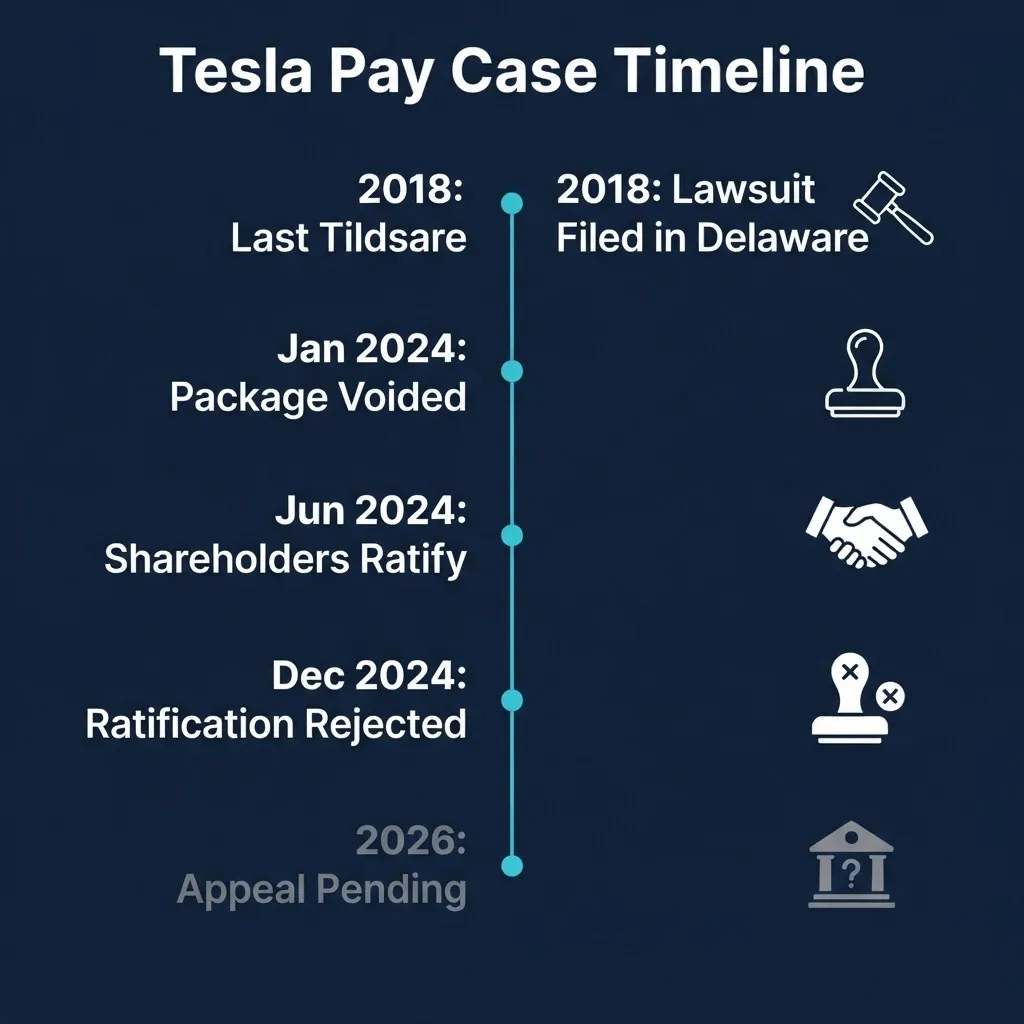
Litigation Timeline
| Date | Event |
|---|---|
| 2018 | Tornetta v. Musk filed in Delaware Chancery Court |
| January 2024 | Chancellor McCormick voids the package |
| June 2024 | Tesla shareholders vote to ratify the package |
| December 2024 | Chancery Court rules ratification cannot cure the rescission |
| 2025 to 2026 | Delaware Supreme Court considers appeals |
| 2026 | No final resolution as of September 2 |
Does the Tesla Musk Pay Case Affect Tesla Stockholders?
Tesla stockholders are the parties most directly affected by the Elon Musk compensation plan litigation. The case is about whether shareholders overpaid for Musk’s services.
If the package remains void, Tesla may avoid issuing billions of dollars in stock options. That could benefit existing shareholders by reducing dilution.
If the package is restored, Tesla must account for the expense. The company has already taken accounting charges related to the package. Those charges reduced reported earnings in multiple quarters.
Individual Tesla shareholders do not need to take any action. The case is not a class action with a claim form. Shareholders are represented by the derivative plaintiff, who acts on behalf of the corporation.
The court’s ruling also has broader implications for Delaware corporate law. It signals stricter scrutiny of executive pay packages approved by boards that are not truly independent.
Is There a Tesla Elon Musk Compensation Plan Class Action?
No Tesla Elon Musk compensation plan class action exists. The case is a shareholder derivative action, not a class action.
In a class action, a group of similarly situated people sue for damages and any recovery is divided among class members. In a derivative action, a shareholder sues on behalf of the corporation. Any recovery goes to the corporation, not to individual shareholders.
The Tornetta case is derivative. The remedy sought was rescission of the pay package, which returns value to Tesla itself. No individual shareholder receives a direct payment.
The only individual recovery in the case is attorney fees for the plaintiff’s lawyers. Chancellor McCormick awarded $345 million in fees in December 2024. That fee award is also on appeal.
Key Takeaway: This is a derivative action, not a class action, so no shareholder will receive a direct cash payout.
Reality Check: No One Is Sending You a Tesla Settlement Check
No Tesla shareholder settlement check is coming. This is not a consumer case with a settlement fund. Any message, email, or ad claiming you can claim a Tesla or Elon Musk pay settlement is a scam. Filing a claim is never required in shareholder derivative actions because the case is handled by the derivative plaintiff on behalf of the corporation. Third-party services offering to help you “claim” money from this case are fraudulent.
How Did the 2018 Elon Musk Pay Package Work?
The 2018 Elon Musk compensation package was a performance-based stock option plan. Musk received no salary or cash bonus. His entire pay depended on Tesla hitting aggressive targets.
The package had 12 tranches. Each tranche contained roughly 1.69 million stock options. Each tranche vested only when two conditions were met simultaneously.
First, Tesla’s market capitalization had to increase by $50 billion, starting at $100 billion and rising to $650 billion. Second, Tesla had to hit one of 16 operational milestones, split between revenue and adjusted EBITDA targets.
The exercise price was $23.34 per share. If Tesla’s stock price rose, the options became extremely valuable. If Tesla stagnated, the options would be worthless.
Tesla hit all 12 market cap milestones by late 2021. The company’s stock price rose from around $21 per share in early 2018 to over $400 at its peak in 2021, adjusted for splits. That made the package worth tens of billions.
Why Did the Court Find the Board Was Not Independent?
The Delaware court found Tesla’s board was not independent because of Musk’s extensive ties to the directors who approved the pay package.
The compensation committee included Ira Ehrenpreis, Antonio Gracias, and James Murdoch. The court found each had close personal or financial relationships with Musk.
Ehrenpreis had invested in Musk companies and served on SpaceX’s board. Gracias was a long-time Musk associate whose private equity firm held significant Tesla and SpaceX positions. Murdoch had personal ties through vacations and family connections.
The court also found that Musk controlled the process. He proposed the package’s terms. The board did not negotiate at arm’s length. No true independent analysis of whether the package was necessary to retain Musk occurred.
The proxy statement sent to shareholders did not disclose these conflicts. The court held that omission made the 2018 shareholder vote uninformed.
What Does the Tesla Pay Case Mean for Executive Compensation?
The Tesla pay case has already reshaped executive compensation practices. Boards across corporate America are paying closer attention to director independence and disclosure.
The ruling signals that Delaware courts will scrutinize mega-grants of equity to founder-CEOs. Boards must show genuine negotiation, not rubber-stamping.
Companies are now more careful about proxy disclosures regarding compensation committee members’ ties to executives. Failure to disclose material relationships can render shareholder votes invalid.
The case may also accelerate the trend of companies reincorporating outside Delaware. Tesla moved to Texas. Other companies have considered similar moves to avoid Delaware’s strict fiduciary oversight.
For ordinary investors, the case is a reminder that executive pay is a governance issue, not just a business decision. Courts can and will intervene when the process is corrupted.
Key Takeaway: The Tesla ruling is reshaping how boards approve executive pay and how much disclosure is required in proxy statements.
What Is Richard Tornetta’s Role in the Case?
Richard Tornetta is the shareholder who filed the derivative lawsuit against Tesla’s board and Elon Musk. He held nine shares of Tesla stock when he filed the case in 2018.
Tornetta is a former heavy metal drummer and a small-time shareholder. His small stake did not prevent him from challenging the largest executive pay package in history.
Delaware law allows any shareholder to bring a derivative action. The size of the shareholder’s stake does not limit the claim. The requirement is that the shareholder owned stock at the time of the challenged conduct and continues to hold it through the litigation.
Tornetta’s lawyer, Greg Varallo of Bernstein Litowitz Berger and Grossmann, argued the case through trial. The firm sought $5.6 billion in fees based on the value of the rescission. Chancellor McCormick awarded $345 million.
Will Elon Musk Get the Pay Package Back?
It is not yet confirmed whether Elon Musk will get the pay package back. The Delaware courts have not issued a final ruling on the ratification and appeal issues as of September 2, 2026.
Tesla has multiple paths to restore the package. The Delaware Supreme Court could reverse Chancellor McCormick’s rulings. Tesla’s Texas reincorporation and reissuance could be challenged but might survive. A new compensation package could be negotiated and approved with proper process.
Musk has not received the full value of the 2018 package. Some tranches were exercised before the rescission ruling. Others remain unexercised and in legal limbo.
Tesla has already expensed some of the package on its income statements. The accounting treatment depends on the final legal outcome.
Anyone claiming certainty about the outcome is speculating. The Delaware Supreme Court has not tipped its hand.
What Happens Next
The Tesla Musk pay litigation will likely unfold over several more years. Here are the expected next stages.
Expected late 2026: Delaware Supreme Court hears oral arguments on the ratification appeal.
Expected 2027: Delaware Supreme Court issues a ruling on whether the package can be restored.
If Tesla loses: The company may negotiate a new pay package under Texas law with proper board process.
If Tesla wins: The package may be restored, subject to further Chancery Court proceedings on remedy.
Long term: Any final ruling will face additional appeals to the U.S. Supreme Court if federal issues are raised.
These dates are projections based on typical Delaware Supreme Court timelines. No firm hearing dates have been publicly announced.
Frequently Asked Questions
Is the Tesla Elon Musk compensation plan a real lawsuit?
Yes. The case is Tornetta v. Musk, filed in Delaware Chancery Court in 2018. It is a shareholder derivative action challenging the 2018 pay package.
Do I qualify for any Tesla Musk pay settlement?
No. There is no settlement and no claim process. This is not a consumer class action.
How much was Elon Musk’s Tesla pay package worth?
The package was valued at approximately $56 billion at grant date in 2018. The value fluctuates with Tesla’s stock price.
Can I file a claim in the Tesla pay case?
No. There is no claim form, no settlement administrator, and no payout to individual shareholders. The case is handled by the derivative plaintiff.
What did the Delaware court decide?
Chancellor Kathaleen McCormick rescinded the package in January 2024. She found the board was not independent and shareholders were not fully informed.
Is Tesla still fighting the ruling?
Yes. Tesla appealed to the Delaware Supreme Court. The company also ratified the package through a shareholder vote in June 2024, but the Chancery Court ruled that ratification did not cure the defect.
What happens if Musk loses the appeal?
The package remains void. Tesla may negotiate a new pay package or seek to restore it through Texas corporate law after reincorporation.
Where does the case stand in 2026?
The case is pending before the Delaware Supreme Court. No final ruling had been issued as of September 2, 2026.
If you own Tesla stock, monitor the company’s SEC filings and the Delaware Supreme Court docket. Do not expect a check. Do not respond to any solicitation about a Tesla settlement. The only real question is whether Musk’s record pay package survives a Delaware judge’s ruling, and that answer is still pending.