I Eat Ass Lawsuit 2026: Webb v. English Ruling, Payout Facts and Status
Quick Answer
- The case is Webb v. English, a federal civil rights suit over a 2019 Florida arrest for a vehicle sticker.
- No payout is confirmed. A judge granted qualified immunity on the First Amendment claims in 2021.
- No claim form exists. Only the plaintiff’s own suit applies, and no final outcome is confirmed.
The “I eat ass” lawsuit is a federal civil rights case, Webb v. English, over a Florida man’s 2019 arrest for a rear-window sticker. It has not ended in a confirmed win or payout.
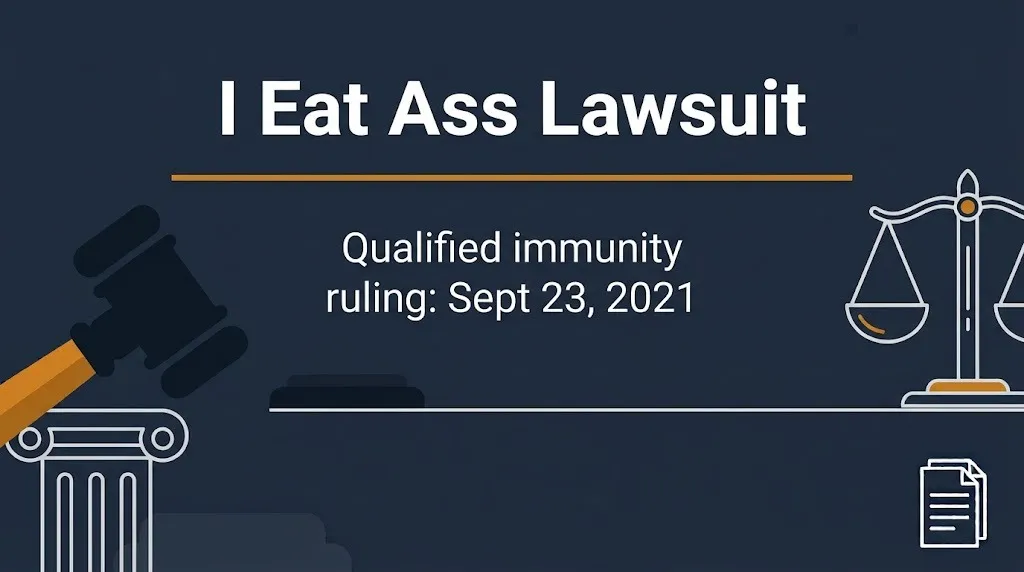
It affects one plaintiff, Dillon Shane Webb, and no one else can claim money from it. The key date is September 23, 2021, when a federal judge granted qualified immunity on the First Amendment claims.
This guide covers the ruling, the money question, and your options if police target your speech. One surprise: some pages say Webb “won,” but the court record says otherwise.
The Facts
| Case | Webb v. English, No. 3:19-cv-975-MMH-JBT, U.S. District Court, Middle District of Florida, Jacksonville Division |
| Status | Qualified immunity granted on First Amendment and arrest claims September 23, 2021. Fourth Amendment search and impoundment claim allowed to proceed. Final outcome not yet confirmed |
| Fund Size | Not applicable. No class fund exists |
| Est. Per Person | Not yet determined. No settlement amount is confirmed |
| Claim Deadline | None. No claim form exists |
| Administrator | None |
| Proof Needed | Not applicable to the public |
Is the I eat ass lawsuit real?
Yes, the “I eat ass” lawsuit is real. It’s a federal civil rights case, Webb v. English, filed in the U.S. District Court for the Middle District of Florida.
The plaintiff is Dillon Shane Webb of Lake City, Florida. The defendants include Columbia County Sheriff’s Deputy Travis English and Corporal Chad Kirby.
The complaint lists eight claims. They include First Amendment retaliation, unlawful stop, unlawful search, unlawful arrest, and county liability for failure to train.
It isn’t a class action. No settlement fund, claims administrator, or claim deadline exists for the public.
The case number is 3:19-cv-975-MMH-JBT. The “19” in that number points to a 2019 filing.
Did Dillon Webb win the I eat ass lawsuit?
No, Webb did not win on his First Amendment claim, and no final win or payout is confirmed. A federal judge granted the deputies qualified immunity on the First Amendment and arrest claims.
The criminal charges were dropped in May 2019. That’s separate from the civil suit.
Some online pages blur the two. One tracker says Webb “won” his civil suit and that a ruling confirmed vulgar stickers are protected. The court record doesn’t say that.
Here’s what the record shows:
| Question | Verified answer |
|---|---|
| Were the criminal charges dropped? | Yes, in May 2019 |
| Did the civil court rule the sticker protected? | No. The judge said it was arguably obscene |
| Did the deputies get qualified immunity? | Yes, on the First Amendment and arrest claims |
| Did any claim survive? | Yes, the Fourth Amendment search and impoundment claim |
A surviving claim isn’t a win. It means that part could go forward.
Is a vulgar bumper sticker protected by the First Amendment?
Vulgar speech is often protected, but obscene speech isn’t, and the line is the legal fight in this case. Courts treat the two differently.
Judge Marcia Morales Howard did not decide whether Webb’s sticker was actually obscene. She found it arguably obscene under Florida law, which was enough to protect the officers from liability.
Another court reached a different result in 1991. A federal court in Alabama protected a trucker’s profane “How’s My Driving?” sticker because it carried serious literary and political value.
One First Amendment resource says the constitutionality of criminalizing bumper stickers remains in serious doubt. It adds that it’s hard to imagine a bumper sticker meeting the legal definition of obscenity.
Webb said in interviews that the sticker had a sexual meaning. The judge noted that. She also said a joking intent doesn’t rule out obscenity.
Key Takeaway: The “I eat ass” lawsuit is real, but Webb did not win it, and the court only said the sticker was arguably obscene.
How much money did Dillon Webb get from the I eat ass lawsuit?
The amount Dillon Webb received is not yet confirmed, and we found no reported settlement or judgment figure. The case record available publicly stops short of a final payout.
What we can verify is what Webb spent. He paid about $225 to get his truck out of the tow lot. He paid about $250 to a bail bondsman.
He also set up a GoFundMe on May 10, 2019, with a $15,000 goal. It had raised $244 as of the Tuesday after he launched it.
| Item | Verified figure |
|---|---|
| Tow lot fee | About $225 |
| Bail bondsman | About $250 |
| GoFundMe goal | $15,000 |
| GoFundMe raised early on | $244 |
| Settlement or judgment | Not yet confirmed |
Be careful with pages that list a settlement amount. We found none in the court record or major reporting.
Money from a surviving claim, if any, would go to Webb, not the public.
Can you join or claim money from the I eat ass lawsuit?
No, you can’t join the “I eat ass” lawsuit or claim money from it. It’s an individual civil rights case with one plaintiff.
There’s no class, no claim form, and no deadline. No settlement administrator exists.
If a site or message says you can file a claim in this case, be suspicious. Treat it like a store giving a refund to a stranger who never bought the item.
Your own claim is possible only if the police violated your rights in a similar way. That’s a separate case with your own facts and deadlines.
We cover how those suits work later in this guide.
Reality Check: No one legitimate texts you first about a payout from this case. Nothing in the record suggests a fund exists, so anyone charging a fee to “register” you is not connected to it.
What damages can you seek if police arrest you over speech?
People who win civil rights suits against police can seek money for the harm they suffered, but qualified immunity can block a case before it reaches a jury. Winning isn’t automatic.
Reason’s coverage notes that people who overcome qualified immunity don’t win money at that stage. They only get the chance to present their claim to a jury.
Possible losses in a case like Webb’s include:
- Tow and impound fees
- Bail costs
- Time in jail
- Legal fees
- Emotional distress
Those categories are general. What a court allows depends on the claim and the evidence.
Webb’s out-of-pocket costs were small. His case shows that the legal fight can matter more than the dollar amounts at stake.
Key Takeaway: No payout to Webb is confirmed, nobody else can claim money, and qualified immunity can stop a speech-based police suit before trial.
What should you do if police tell you to remove a bumper sticker?
You can ask whether you’re free to go, state your objection calmly, and document everything, but the right choice depends on your facts. This is general information, not legal advice.
In Webb’s case, the deputy told him to remove one letter. Webb refused, citing the First Amendment. The deputy then arrested him.
Here are options people consider:
- Stay calm and keep your hands visible.
- Ask if you’re free to go.
- State clearly that you object, without arguing.
- Don’t physically resist.
- Record the stop if your state allows it.
- Write down names, badge numbers, and times afterward.
- Keep your citation or notice to appear.
- Talk to a licensed attorney before deciding what to do.
Each choice carries risk. Webb’s arrest shows that refusing an order can lead to a resisting charge, even when the underlying charge later fails.
How do you file a civil rights lawsuit against police?
You file a federal civil rights lawsuit by identifying the officers, listing the rights you say were violated, and filing a complaint in federal court. Most people hire a civil rights attorney first.
- Gather your arrest report, citation, and booking records.
- Save video, photos, and receipts for costs.
- Write a timeline of the stop and arrest.
- Identify each officer and agency involved.
- List each constitutional claim, such as First or Fourth Amendment.
- Consult a civil rights attorney about deadlines.
- File the complaint in the proper federal or state court.
- Expect a qualified immunity motion early on.
Webb’s complaint shows how detailed these filings get. It listed eight separate claims against the deputies and the county.
Deadlines vary by state and claim type. A Florida-specific deadline is not yet confirmed here, so ask an attorney.
What evidence helps in a civil rights lawsuit over an arrest?
Video, official reports, and receipts for costs help most in a civil rights suit over an arrest. They show what officers did and what it cost you.
Webb’s case had strong video. Dashcam footage captured the deputy’s exchange with Webb. That footage became part of the public story.
Think of it like a warranty claim with a receipt. Paper and footage carry more weight than memory.
Build your file with this checklist:
- Arrest report and notice to appear.
- Dashcam or body cam footage, if you can request it.
- Your own phone video, if you recorded.
- Tow, bail, and legal fee receipts.
- Names of officers and supervisors involved.
- Court records showing dismissed charges.
Request public records quickly. Agencies keep some footage for limited periods.
Key Takeaway: If police target your speech, document the stop, keep receipts, and talk to an attorney, since early evidence shapes any later case.
What is the latest in the Webb v. English case in 2026?
No 2026 ruling is confirmed in the sources we checked, and the last verified decision is the September 23, 2021 order. We found no reported appellate decision or final judgment.
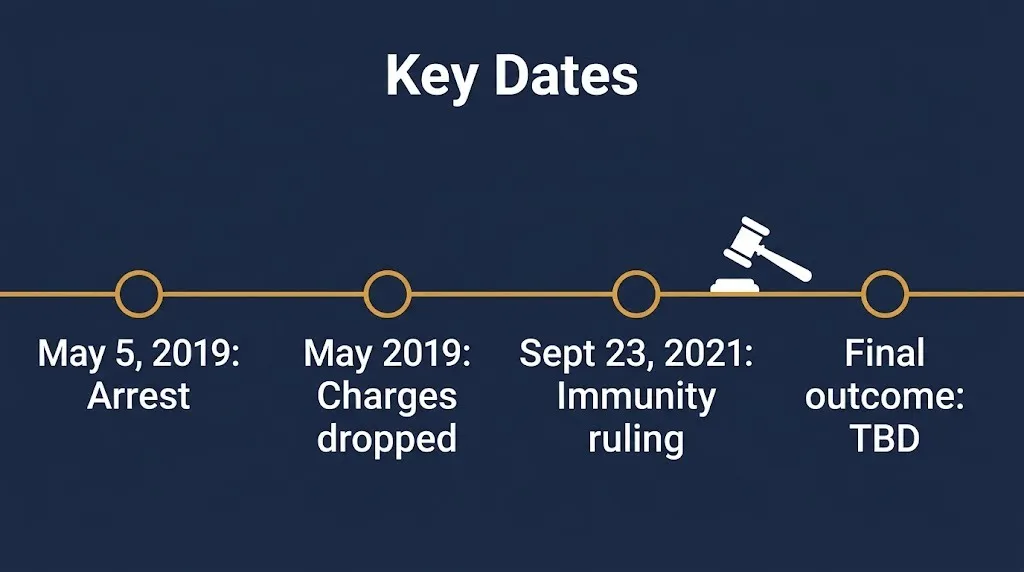
| Date | Verified event |
|---|---|
| May 5, 2019 | Webb is stopped and arrested in Lake City |
| May 2019 | State Attorney’s Office drops the criminal charges |
| September 23, 2021 | Judge Howard grants qualified immunity on First Amendment and arrest claims |
| After 2021 | Outcome of surviving Fourth Amendment claim not yet confirmed |
The surviving claim covers the search and impoundment of Webb’s vehicle after his arrest. Whether it settled, went to trial, or ended another way is not confirmed.
Check the federal docket for the Middle District of Florida for anything newer. Court records can change without news coverage.
Be wary of pages that claim a 2026 outcome without a case number or docket citation.
What did Judge Howard actually rule on September 23, 2021?
Judge Marcia Morales Howard ruled that the deputies had qualified immunity on Webb’s First Amendment and arrest claims, while his Fourth Amendment search and impoundment claim could proceed. She did not decide whether the sticker was obscene.
| Claim | Ruling |
|---|---|
| First Amendment retaliation | Qualified immunity granted |
| False arrest | Qualified immunity granted |
| Search and impoundment of vehicle | Allowed to proceed |
Her reasoning was narrow. At the time of the arrest, the right to be free from a retaliatory arrest that was otherwise supported by probable cause wasn’t clearly established.
She also found that the officers’ view that the sticker lacked serious value wasn’t inherently unreasonable. Both officers believed it depicted a sexual act and violated the obscenity law.
The Supreme Court decided a related case about three weeks after Webb’s arrest. The judge noted that timing.
Why do some websites say Webb won the I eat ass lawsuit?
Some websites say Webb won because they mix the dropped criminal charges with the civil case. The court record doesn’t support a civil win on his speech claims.
Those pages often cite the dismissal in May 2019. They then jump to a claim of vindication.
Here’s how to check any lawsuit claim online:
- Find the case name and number.
- Identify the court and the judge.
- Look for the ruling date.
- Read what the order actually says.
- Check whether the page cites a docket.
- Compare at least two independent news sources.
Another red flag is a wrong date. One tracker puts the arrest on May 6, 2019. The court record gives May 5, 2019.
If a page lists a settlement amount but no source, treat it as unverified.
Key Takeaway: The latest verified ruling is from 2021, so any page claiming a 2026 win or payout needs a docket citation.
What happened during the I eat ass sticker arrest?
A Columbia County deputy stopped Webb on U.S. Highway 90 in Lake City on May 5, 2019, because of the sticker on his truck’s rear window. He ended up arrested after refusing to alter it.
The deputy issued a notice to appear for a misdemeanor obscenity violation. He asked Webb to remove a letter from the sticker.
Webb refused, citing the First Amendment. Webb reportedly said they were “just words.”
The deputy consulted a supervisor, arrested Webb, searched the truck, and had it towed. The added charge was resisting an officer without violence.
Webb was released on $2,500 bond. The State Attorney’s Office dropped the charges within days, citing a valid First Amendment defense.
How long Webb sat in jail is disputed in the court record. One account says more than an hour, another says several hours.
What is qualified immunity and why did it matter in this case?
Qualified immunity is a legal rule that shields government officials from personal liability unless they violated a right that was clearly established. It decided this case’s most important claims.
Courts ask two questions. Did the officer violate a right, and was that right clearly established at the time?
In Webb’s case, the judge didn’t need to decide whether the arrest violated his rights. She found the law wasn’t clearly established in May 2019.
That’s why the deputies left the case on the First Amendment claims. It doesn’t mean the arrest was proper.
Critics say the doctrine lets officers avoid accountability for novel situations. Supporters say it protects officers who make reasonable judgment calls.
For you, it means a speech-based police suit can fail before a jury ever hears it.
Do other states criminalize bumper stickers?
Some states criminalize obscene bumper stickers, but the constitutionality of those laws is in serious doubt. Florida’s law covers stickers, decals, and other devices on a motor vehicle that contain obscene descriptions or depictions.
The First Amendment resource notes that few bumper stickers meet the legal definition of obscenity. That definition is narrow.
Courts have protected some crude stickers. The 1991 Alabama case is one example, where the court found serious literary and political value.
Webb’s case went the other way for the officers, but only because of qualified immunity. The judge did not rule the law valid.
If you’re unsure about your state, read its statute or ask an attorney. Don’t assume a sticker is safe or illegal based on a news headline.
What Happens Next
Not yet confirmed: The status of Webb’s surviving Fourth Amendment search and impoundment claim.
Expected, date not confirmed: Any final judgment, settlement, or appeal would appear on the Middle District of Florida docket.
Not yet confirmed: Any reported appellate ruling on qualified immunity in this case.
Ongoing: Courts continue to weigh bumper-sticker obscenity cases individually.
Anytime: Check the federal docket for case number 3:19-cv-975.
Frequently Asked Questions
What is the I eat ass lawsuit?
It’s Webb v. English, a federal civil rights suit over a 2019 Florida arrest for a vehicle sticker.
Dillon Shane Webb sued a deputy and others.
The case number is 3:19-cv-975.
Did Dillon Shane Webb win his lawsuit?
No final win is confirmed.
A judge granted qualified immunity on the First Amendment and arrest claims in 2021.
A Fourth Amendment claim was allowed to proceed.
How much did Dillon Webb settle for?
No settlement amount is confirmed.
We found no reported figure in court records or major news coverage.
Treat unsourced numbers as unverified.
Were the charges against Webb dropped?
Yes, the State Attorney’s Office dropped the charges in May 2019.
It cited a valid First Amendment defense.
That is separate from the civil suit.
Can I file a claim in the I eat ass lawsuit?
No, there’s no claim process.
It is an individual case with one plaintiff.
Anyone offering a claim form is not connected to it.
Is a vulgar sticker protected speech?
Often yes, but obscene speech isn’t protected.
The judge called Webb’s sticker arguably obscene without deciding the question.
Courts treat each case on its facts.
What is qualified immunity?
It shields officials from liability unless they violated a clearly established right.
It protected the deputies on the speech and arrest claims.
It doesn’t mean the arrest was proper.
Closing
If you saw a headline claiming a payout, check the court docket first. Search the federal docket for Webb v. English, case number 3:19-cv-975, and read the actual orders.
No claim exists for the public. The last verified ruling is September 23, 2021, and any newer outcome needs a docket citation.