Leo Schofield Settlement 2026: The Wrongful Conviction Case and What Comes Next
Quick Answer
- Leo Schofield spent over 30 years in prison for a murder he and his supporters say he did not commit.
- No verified 2026 settlement payout or claims process has been announced in his case.
- His legal team continues to seek exoneration through the Florida court system, not a class action settlement.
Leo Schofield is not a class action plaintiff. He is a man who spent more than three decades in a Florida prison for a murder he says he did not commit.
His case became national news through podcasts, documentaries, and legal filings that raised serious questions about the evidence used to convict him.
As of March 2026, no verified settlement has been announced in the Leo Schofield case. That means no payout amount, no claims administrator, and no deadline exist for the public to act on.
This article explains who Leo Schofield is, what his legal case is about, what a settlement would look like, and why the phrase “Leo Schofield settlement” keeps appearing in searches.
The Facts
| Item | Details |
|---|---|
| Person | Leo Schofield |
| State | Florida |
| Conviction | First-degree murder |
| Prison Time | Over 30 years |
| Current Status | Released, not exonerated |
| 2026 Settlement | Not yet confirmed |
| Claims Process | None exists |
Who Is Leo Schofield?
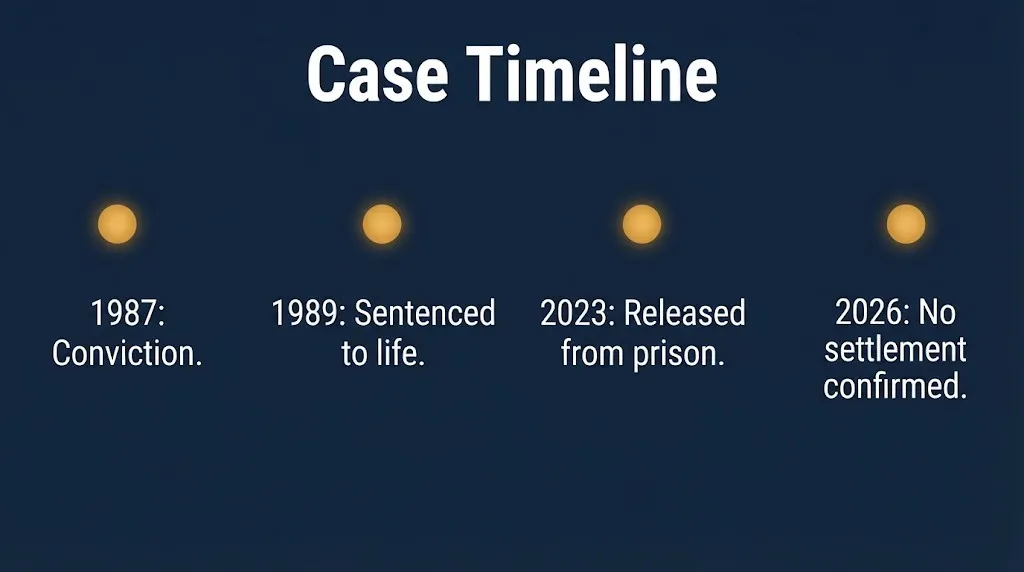
Leo Schofield is a Florida man convicted of murdering his wife, Michelle Schofield, in 1987.
He was convicted in 1989 and sentenced to life in prison. He maintained his innocence throughout his incarceration.
In 2020, a Florida court resentenced him based on a legal issue unrelated to his innocence claim. He was released from prison in 2023 under that resentencing.
But release is not exoneration. His conviction still stands, and his legal team continues to fight to clear his name.
Why Is the Leo Schofield Case So Well Known?
The case gained national attention through the podcast “Bone Valley,” which examined the evidence against Schofield.
The podcast raised questions about fingerprint evidence, witness testimony, and whether another person may have been responsible for Michelle Schofield’s death.
Here are the main issues the podcast and legal filings raised:
| Issue | What Was Claimed |
|---|---|
| Fingerprint evidence | Prints at the scene matched another person |
| Witness testimony | Key witness later recanted |
| Alternative suspect | Evidence pointed to another individual |
| Trial fairness | Defense may not have had key evidence |
These claims have not yet produced an exoneration. The courts are still weighing them.
What Is a Wrongful Conviction Settlement?
A wrongful conviction settlement is a payment made by a government entity to a person who was wrongly imprisoned.
These settlements are not class actions. They are individual claims brought by the exonerated person or their family.
Here is how they work:
| Step | What Happens |
|---|---|
| Exoneration | Conviction is overturned |
| Claim filed | Against the state or county |
| Negotiation | Settlement amount discussed |
| Legislative bill | Some states require a claims bill |
| Payment | Made to the exonerated person |
Florida has a process for compensating wrongfully convicted people, but it requires exoneration first.
Key Takeaway: Schofield has been released, but he has not been exonerated. That distinction controls whether any settlement is possible.
Has Leo Schofield Been Exonerated?
No. Leo Schofield has not been exonerated as of March 2026.
His release from prison came through a resentencing, not a reversal of his conviction. He remains a convicted felon in the eyes of the law.
His legal team has filed motions seeking to overturn the conviction. Those motions are pending in Florida courts.
The difference between release and exoneration is the single most important fact in understanding why no settlement exists.
How Much Could a Wrongful Conviction Settlement Pay?
Wrongful conviction settlements vary widely by state and by case.
Florida law allows compensation for people who are exonerated, but the amount depends on the specific statute and the facts of the case.
Here is how wrongful conviction compensation compares across states:
| State | Compensation Approach |
|---|---|
| Florida | Fixed amount per year of imprisonment |
| Texas | Large lump sums, often millions |
| California | Fixed amount per day |
| New York | Negotiated or legislated |
These are general patterns, not predictions for any specific case. No settlement amount for Schofield has been confirmed.
Reality Check: No legitimate wrongful conviction settlement asks the public to file claims. These are individual payments to the exonerated person, not class action funds.
What Is the Status of the Leo Schofield Case in 2026?
The case remains active in Florida courts. Schofield’s legal team continues to pursue exoneration.
The exact procedural posture of the case as of March 2026 has not been publicly confirmed in detail. Florida court records would show the pending motions and any scheduled hearings.
Here is what is known:
| Item | Status |
|---|---|
| Conviction | Still stands |
| Release | Occurred in 2023 |
| Exoneration motion | Pending as of late reporting |
| Settlement | Not confirmed |
What Would Need to Happen for a Leo Schofield Settlement?
A settlement would require exoneration first.
Here is the chain of events that would need to occur:
- A Florida court overturns Schofield’s conviction.
- The state declines to retry him or he is acquitted on retrial.
- Schofield files a wrongful conviction claim.
- The state legislature approves compensation or a court awards it.
- Payment is made to Schofield personally.
None of these steps have been publicly confirmed as of March 2026.
Why Do People Search for “Leo Schofield Settlement”?
People search for “Leo Schofield settlement” because they heard about the case on a podcast or news program and want to know if money is involved.
The search reflects a misunderstanding of how wrongful conviction cases work. They are not class actions with public claim forms.
Here is what people are usually really asking:
| Question | Answer |
|---|---|
| Is there a payout for Schofield? | Not confirmed |
| Can I file a claim? | No, this is not a class action |
| Who pays if he is exonerated? | The State of Florida |
| When will it happen? | Unknown, no timeline confirmed |
What Is the Florida Wrongful Conviction Compensation Law?
Florida law provides compensation for people who are exonerated after being wrongfully imprisoned.
The amount is set by statute and is based on the number of years served. It is not negotiated like a personal injury settlement.
Here is how Florida’s law generally works:
| Element | Details |
|---|---|
| Eligibility | Requires full exoneration |
| Amount | Fixed per year, not negotiated |
| Process | Application or claims bill |
| Payment | Lump sum or structured |
The specific figures have not been confirmed for any potential Schofield claim because no claim exists yet.
What Happens Next
Expected 2026: Florida courts continue reviewing Schofield’s exoneration motions.
If exoneration occurs: A compensation claim would follow under Florida law.
If no exoneration occurs: No settlement is possible under current law.
Your move: Nothing to file, nothing to claim. Watch the court record, not social media.
Leo Schofield’s case is a wrongful conviction story, not a consumer settlement story.
He has been released, but he has not been exonerated. That single fact controls everything about whether any money will ever change hands.
No public claims process exists. No payout amount has been announced. The case remains where it has been for years: in the hands of Florida courts.